
When a judge signs a custody decree, a parent often feels relief for about five minutes, then panic sets in. You're holding a document that can shape school drop-offs, weekend handoffs, holiday plans, and who makes the big decisions for your child, and the language doesn't always feel friendly or clear.
That confusion is normal. A final custody order is more than paperwork, it's the controlling order in your case once the judge signs it, and until that happens, even a ruling announced in court may not be the final word familylawselfhelpcenter.org. If you've ever read your decree and wondered, “What does this mean for my child's daily life?”, you're asking the right question.
When Your Child's Future Depends on Understanding this Document
The first time many parents read their decree, they look for the obvious parts, who has the child, when exchanges happen, and whether child support is included. Then they run into words like conservator, possession, access, and best interests, and the page starts to feel much heavier than it should. That reaction makes sense when you are trying to think about something ordinary, like tomorrow's school drop-off, while reading legal language that sounds far removed from daily parenting.
A final custody order becomes the roadmap for your family's day-to-day life. In Texas practice, the written decree is the document that controls, not just what the judge said from the bench, and if one parent refuses to sign after trial, the other side may need to file a Motion to Sign so the court can enter a final judgment after proper notice Texas Law Help. That is why the exact wording matters so much. The decree can set legal custody, physical custody, parenting time, and related family-law issues in one place, and the final-custody process is explained in the familylawselfhelpcenter.org guidance parents often use when they are trying to understand what the signed order means.
Practical rule: Read your decree like it is a schedule, a decision chart, and an enforcement manual all at once. It is not just a record of what happened in court.
For parents, that can feel overwhelming at first, but it also means the order gives structure. It tells you what is expected, what is protected, and what the court can enforce later. Once you know where to look, the document becomes less mysterious and much more useful.
The Anatomy of a Texas Custody Decree
Start with the caption and signature page
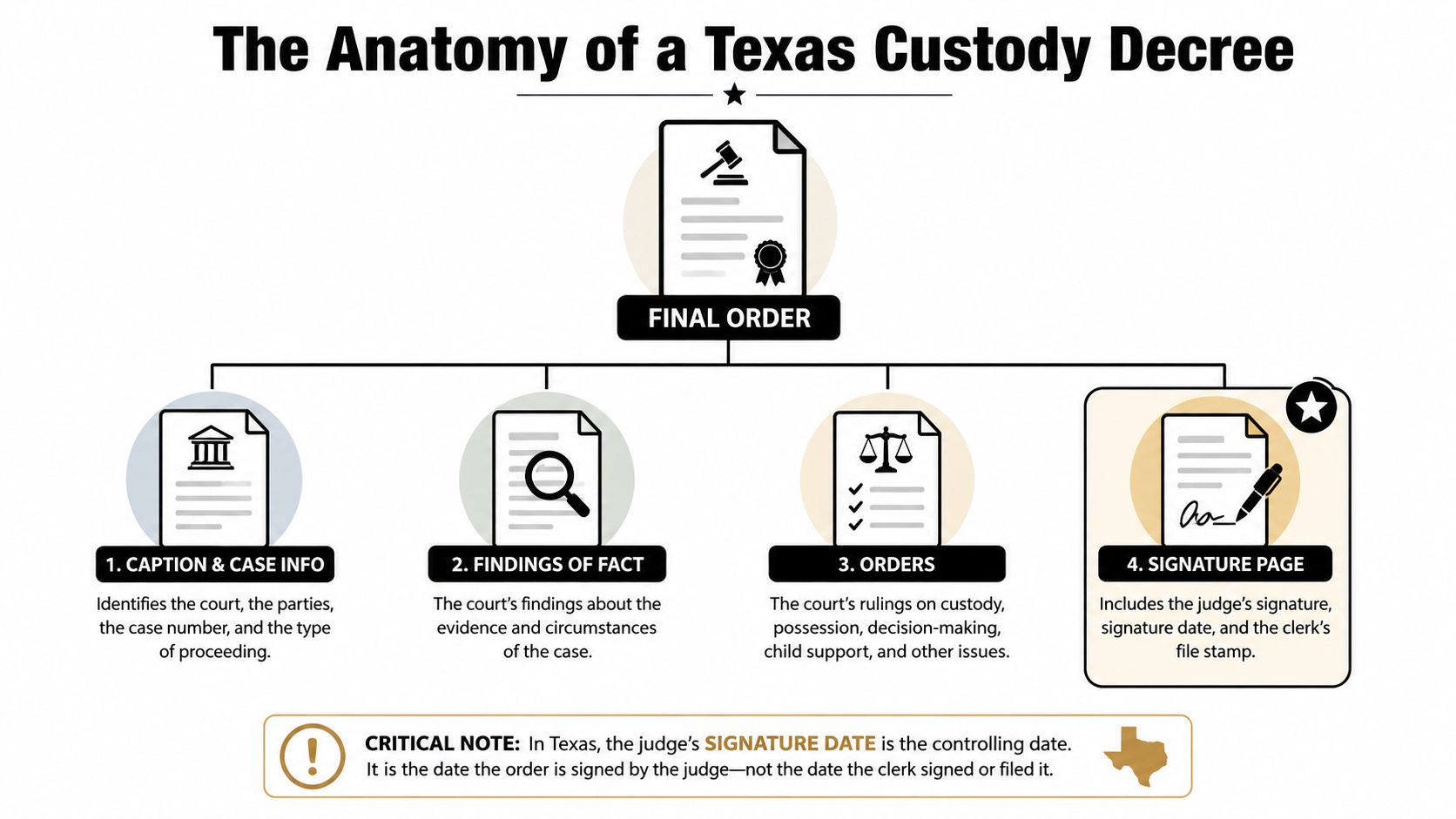
A parent can read the first page of a decree and still miss the detail that controls everything later. The top of the document usually shows the case caption, the parties, and the court information, but the signature page is what makes the order operative. In Texas, the judge's signature is the step that turns a ruling into the controlling judgment, and if that signature never happens, the oral ruling may never become the final order.
That timing detail causes real confusion. The hearing date is when the judge heard the case, while the signature date often determines finality and later enforcement questions barefootlawyer.com. Parents who are trying to tell whether they are reading a temporary order or a final decree should focus on the labels, the signatures, and the language that says the order is final.
Find the orders, not just the headings
The numbered “Orders” section usually carries the instructions. That is where the decree explains conservatorship labels, the possession schedule, decision-making rights, and enforcement language. Courts choose that wording carefully because the order has to tell each parent what they may do, when they may do it, and what happens if someone violates it.
Temporary orders and final decrees serve different jobs. Temporary orders hold things together while the case is pending, while a final decree usually stays in place until the child turns 18, becomes emancipated, or a judge later changes it for a legally sufficient reason custodyxchange.com. In Texas, that difference matters because finality can affect how hard the order is to modify later barefootlawyer.com.
Look for cross-references. If one paragraph says “as set out above” or “subject to Paragraph 12,” the document works as a connected whole, not as isolated pieces.
If you want a practical overview of what happens when someone ignores the decree, Enforcing a Texas Custody and Possession Order is a useful related resource. It focuses on what to do when the other parent violates the custody order, which is often the point where families end up after reading the fine print.
Conservatorship and Decision-Making Authority Explained
Joint managing conservatorship is about rights, not equal time
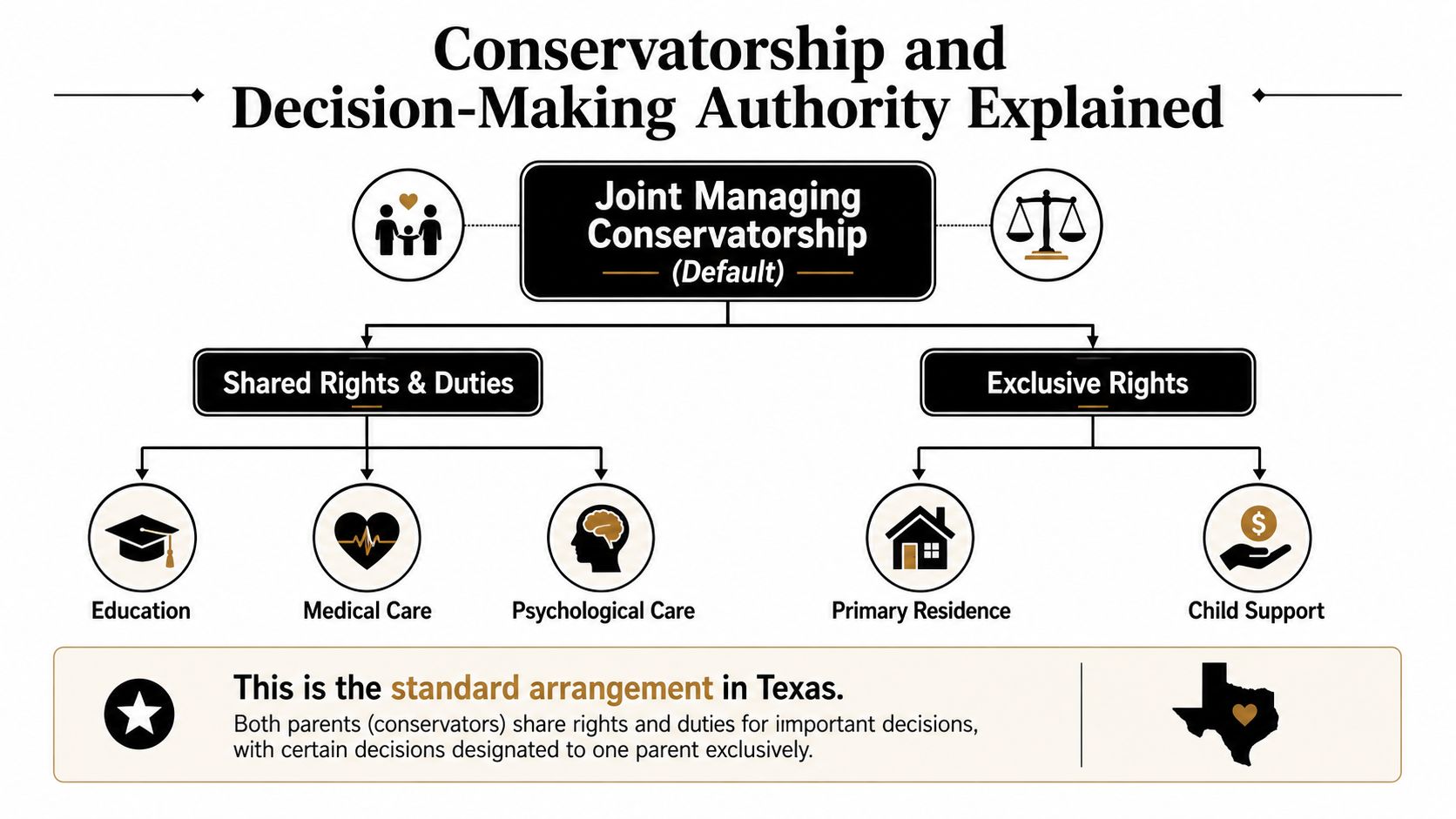
A Texas decree can use plain words that still leave parents confused. The term joint managing conservatorship sounds legalistic, but it answers one practical question, who decides what? In many cases, both parents keep some legal rights and duties even if the child spends more time with one parent than the other laws-lois.justice.gc.ca.
That is the part many parents miss. “Joint” does not mean a 50/50 schedule, and it does not automatically mean both parents share every decision. It usually means the decree divides authority, so one parent may control certain choices while both parents still have rights tied to the child's care and upbringing. For a broader explanation of how Texas orders separate legal authority from parenting time, conservatorship in Texas is a helpful reference.
What those rights can look like in real life
A decree should say who handles school choices, medical decisions, and other major issues. It may require both parents to agree before changing a school, consenting to non-emergency treatment, or making certain educational decisions. Depending on how the order is written, a parent may still be allowed to sign a permission slip, schedule routine care, or handle emergency treatment.
That is why the exact wording matters more than the label at the top of the page. A parent reading the decree should match the language to the situation in front of them. If a child gets sick, the order may allow immediate action without waiting for agreement. If a school transfer comes up, the decree may require joint input, or it may give one parent exclusive authority over the child's residence and related choices. The answer is in the decree itself, not in what feels fair in the moment.
The phrase Joint Managing Conservatorship in Texas can sound more complicated than it is. Read it as a division of decision-making power. Which parent can make a choice, and which choices require both parents to cooperate? Once you know that, the rest of the order is easier to read and apply.
Practical rule: If a decision affects the child's schooling, medical care, or long-term stability, read the decree first. Do not guess based on who has the child that day.
What Your Final Order Can and Cannot Require
A parent can read a custody decree and still miss the core purpose. The order may look broad on the page, yet it only controls certain parts of family life after the case ends. That gap between what people assume a decree covers and what it explicitly states is where a lot of confusion starts.
What the decree can require
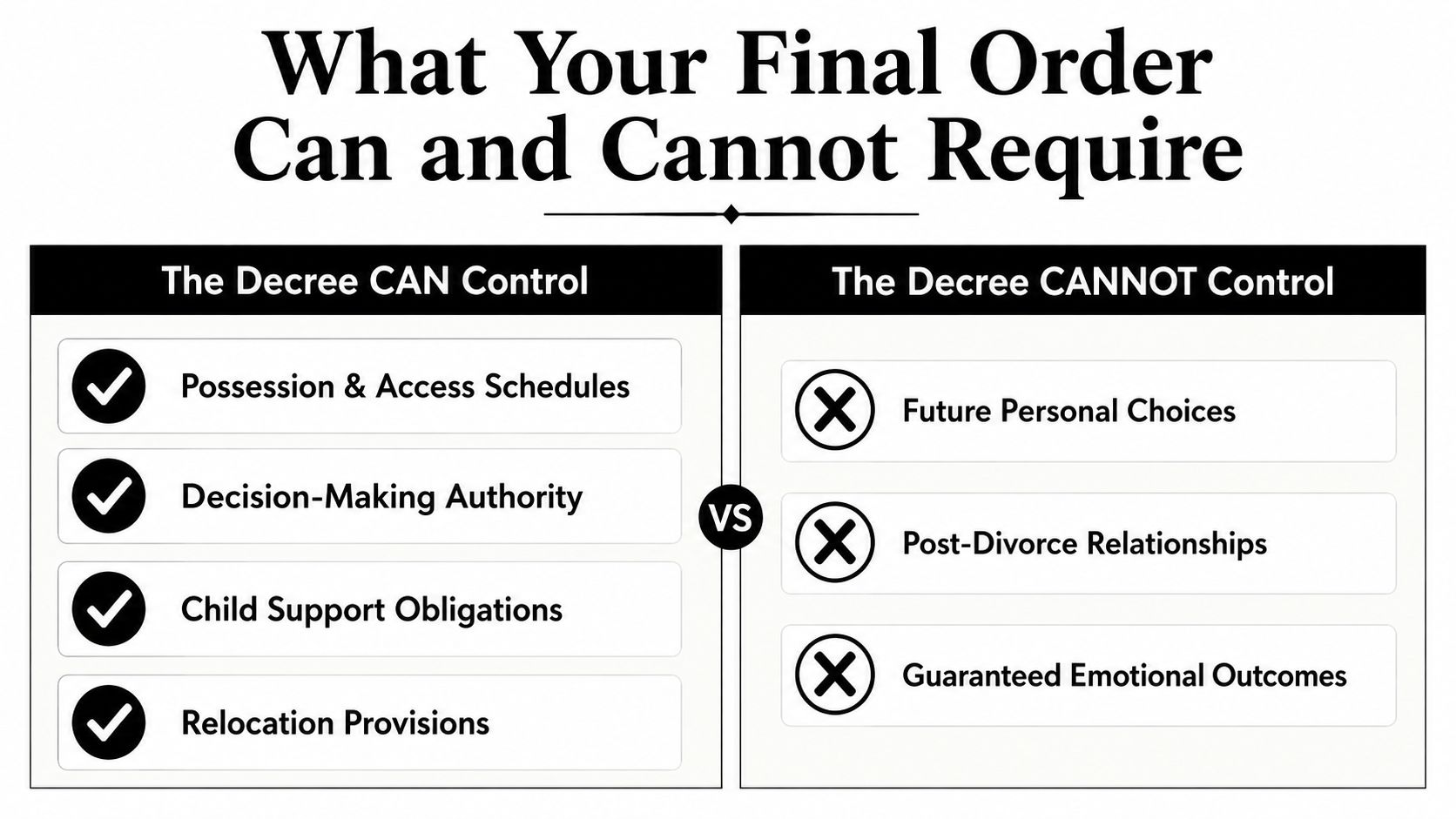
A final order can require a possession schedule, assign decision-making authority, set child support obligations, and include relocation terms or communication rules. It can spell out when exchanges happen, who decides where the child lives, and how holidays rotate. Texas enforcement guidance also explains that a SAPCR can be enforced through remedies such as contempt, wage garnishment, liens, or license suspension in the right situation Texas Law Help.
It can also gather several responsibilities into one document. That matters because the decree may connect custody, support, and visitation in the same instrument, so each paragraph has to be read on its own terms familylawselfhelpcenter.org. If one clause requires notice before a move, that clause controls. If another says communication must happen through a specific app or method, that direction also controls.
What the decree cannot do
A final order cannot make a parent feel a certain way. It cannot guarantee emotional healing, force attendance at every school event, or erase conflict by command. It also cannot micromanage every parenting choice during possession time unless the order gives the court a legal reason to limit those choices.
Many readers get tripped up here. A parent may assume the decree blocks every move, even a move within the same city, but the result depends on the exact relocation language in the order. Others may assume the decree can control dating, housemates, or every detail of the home, but those questions usually fall outside the order unless a safety issue or a specific court restriction is in place.
Texas family-law disputes get easier to read when parents separate legal control from personal choice. The court can set rules around the child. It cannot make two adults cooperate emotionally on command.
Reading Your Possession Schedule Line by Line
The possession schedule is the part most parents check first, and for good reason. It's the calendar that tells you who has the child on weekends, holidays, and school breaks. If you misread it, you can create a conflict without meaning to.
Start with the basic rhythm
Texas possession orders often use recurring patterns like alternating weekends, a weekday evening visit, or another custom arrangement. Whatever the pattern, the order should tell you the exchange time and the exchange location. If a holiday period conflicts with the regular weekend schedule, the holiday language usually controls because it is the more specific provision.
That is why parents should read the schedule with a calendar in hand. Mark the exchange days, then layer holidays on top, then check whether the decree has special language for summer, birthdays, or school breaks. If the order says a parent has possession from after school on Friday until Sunday evening, that exact timing matters, not a rough estimate.
Don't use child support as leverage
A frequent mistake is assuming missed child support means missed visitation. Texas enforcement materials separate custody enforcement from support enforcement, and the right response is to use the court process rather than self-help Texas Law Help. In other words, you generally can't withhold the child because the other parent hasn't paid support, and you can't refuse possession just because you're angry.
Practical rule: If the schedule says the other parent gets the child, follow the order unless there's a real safety issue or a separate court order says otherwise.
Watch for holiday conflicts
Holiday provisions often override the normal weekend pattern. If Christmas, Thanksgiving, or spring break falls during a regular possession period, the decree should tell you which schedule wins. That's why line-by-line reading matters. A parent may think the regular weekend still controls, but the holiday clause may say otherwise.
For a more detailed look at Texas's default framework, see The Texas Standard Possession Order. It's a useful reference when you're comparing your custom order to the standard language many Texas families see.
Enforcement and Modification Options
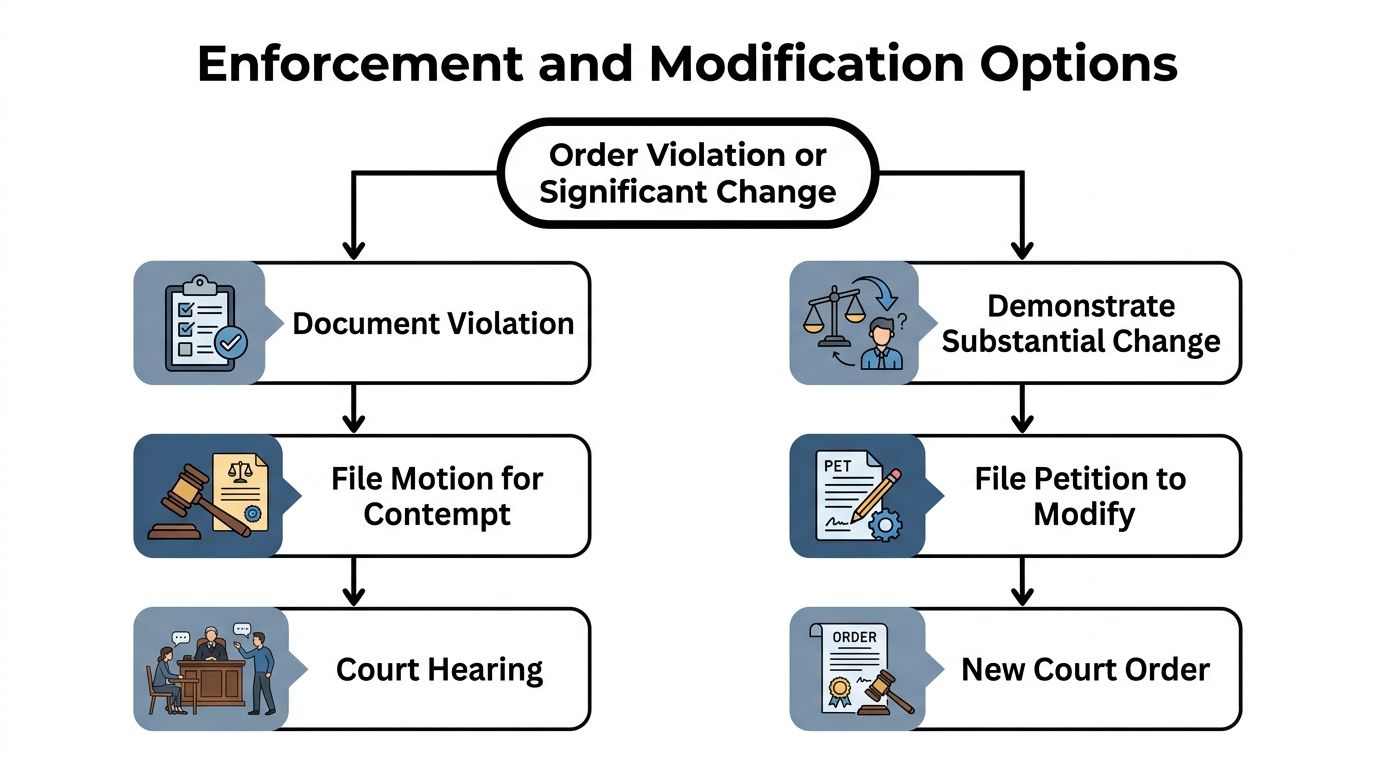
When one parent ignores the decree, Texas law gives the other parent a court process to ask for enforcement. When life changes enough that the order no longer fits the child's needs, the court may modify it if the legal standard is met. Those are separate tools, and using the wrong one usually slows the case down.
Enforcement starts with details
A final custody order can usually be enforced right away, but a judge still needs clear proof of what was violated. In Texas, an enforcement motion must identify the exact provision that was not followed, explain what happened, and state the relief requested. For visitation enforcement, the motion must also list the date, place, and time of each missed exchange, and those details can decide whether the court can hear the request Texas Law Help.
That level of detail matters because general complaints are hard to act on. If you are documenting violations, save texts, emails, and a simple log of missed or changed exchanges. Parents who want a fuller roadmap can review How to Enforce a Custody Order in Texas, Step by Step to see how enforcement usually works in practice. If the problem is repeated or serious, a lawyer can help decide whether contempt, make-up time, or another request fits the situation.
Modification is for real change, not frustration
A final order can be changed later, but not just because one parent is unhappy with it. Courts look for a real change in circumstances and then ask whether the requested change serves the child's best interests before they alter parenting time in a meaningful way. That keeps a decree from being rewritten every time a disagreement comes up. womenslaw.org explains how post-order change standards work in custody cases, and the same basic idea helps parents understand why a judge does not revisit a final order casually.
Examples of changes that may matter include job loss, relocation, substance abuse, or a child whose needs have changed with age. Even then, the current order stays in place until a judge signs a new one. A parent cannot ignore the decree and hope the court sorts it out later. In Texas, finality also depends on the language of the order itself, which is why the court's wording and signature matter so much ajbapc.com.
Your Next Steps and Available Resources
Start by reading the entire decree, not just the first few pages. Mark every exchange time, holiday, and deadline on a calendar, then flag any clause that feels unclear or inconsistent. If your order uses terms you don't understand, write those down before you assume what they mean.
Keep records of communication, missed exchanges, and any messages about schedule changes. If the issue is enforcement, modification, relocation, or safety, talk with an attorney before you make a move that could hurt your case. A parent who follows the order carefully while seeking help usually has a stronger position than one who tries to fix things alone by breaking the same order.
You're not failing your child by asking for legal guidance. You're trying to protect stability, and that matters. If the decree is confusing, the right next step is to get it translated into plain English so you can make decisions with confidence.
If you need help with a child custody or visitation case in Texas, our experienced attorneys can guide you every step of the way. Contact The Law Office of Bryan Fagan, PLLC today for a free consultation. Visit Law Office of Bryan Fagan, PLLC to get help reading your decree, understanding your rights, and taking the next step for your family.