 Skip to content
When your child's future is on the line, understanding your rights matters most. If a co-parent has threatened to leave the country, asked about new passports, or made sudden travel plans, fear can take over quickly. You may be wondering whether the court can act before your child disappears.
Texas law gives concerned parents a preventive path. Texas Family Code § 153.503 allows a court to order safeguards when credible evidence shows a potential risk of international parental child abduction. The purpose isn't to punish a parent for having family, citizenship, or work connections abroad. It's to protect your child and preserve the court's ability to enforce custody orders.
Understanding Your Rights Under Texas Family Code 153.503
Consider a parent who learns that the other parent has discussed moving overseas, stopped sharing travel details, and begun asking about the child's passport. The parent may not know whether a trip is actually planned, but the circumstances feel serious. Waiting until the child is outside the United States could make every legal step more difficult.
An abduction prevention order is a court order designed to reduce that risk before removal occurs. Under § 153.503, the court can use measures such as passport controls, supervised visitation, travel limits, geographic restrictions, a child-abduction bond, and law-enforcement assistance. The statute is part of Subchapter I of Chapter 153, Texas's dedicated framework for preventing international parental child abduction. You can review the statute's listed protections in the Texas Family Code § 153.503 text.
Who can ask the court for protection
A parent involved in a Texas custody case may ask the court to address abduction risk through appropriate pleadings and temporary or final orders. The request usually belongs in the existing family-law case, although the correct filing depends on whether a custody order already exists and how urgent the danger appears.
The court doesn't act on generalized fear alone. It looks for credible evidence indicating a potential risk and considers the statutory risk factors, the difficulty of locating or recovering the child, and the possible physical or psychological harm from an abduction.
Texas courts also begin with the child's best interests. Section 153.002 states that the child's best interest is the court's primary consideration in conservatorship, possession, and access decisions, as reflected in the Texas Family Code Chapter 153 materials. In plain English, the judge focuses on the child's safety, stability, and relationship with each parent, not just on which parent feels more afraid or more determined.
Practical perspective: Seeking preventive protection doesn't mean you want to end the other parent's relationship with the child. It means you're asking the court to create safe conditions for that relationship.
The statute has been part of the Texas Family Code since at least the 1995 codification of Chapter 153, so these protections have been part of Texas custody law for roughly three decades. That history reflects a practical principle: courts should have tools to prevent an abduction, not only procedures to respond after it happens.
Recognizing the Warning Signs and Gathering Credible Evidence
A parent's fear may be genuine, but credible evidence must connect that fear to a potential risk. Section 153.501 directs the court to evaluate the risk factors in § 153.502, along with recovery obstacles and possible harm to the child. The legal question isn't whether a parent has international ties. It's whether the facts suggest that the parent might take, keep, conceal, or fail to return the child in a way that interferes with custody rights.
Facts that may matter
A judge may examine circumstances such as:
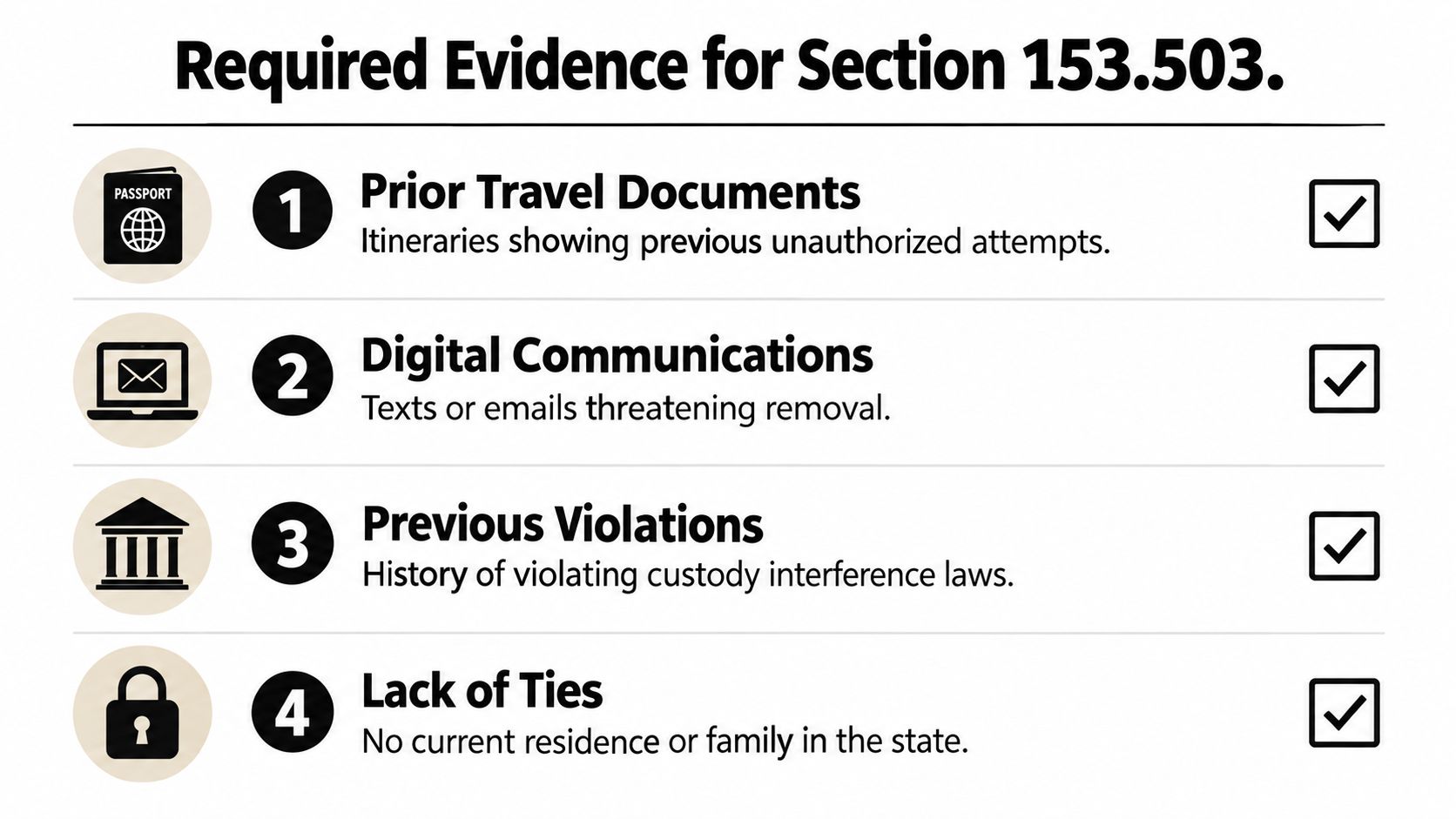
- Threats or statements: Messages about leaving permanently, taking the child away, or refusing to return after travel can be important.
- Travel preparation: Flight planning, visa activity, passport applications, or efforts to obtain replacement documents may help establish a developing plan.
- Past conduct: A history of withholding the child, violating possession rights, or disregarding custody orders may carry weight.
- Connections outside Texas: Strong ties to another country, limited ties to Texas or the United States, or a destination where recovery could be difficult may be relevant.
- Sudden life changes: Selling property, closing accounts, leaving employment, withdrawing a child from school, or concealing an address can support concern when combined with other evidence.
- Statements from witnesses: Relatives, teachers, friends, or others who heard threats or learned of travel plans may provide useful testimony.
None of these facts automatically proves abduction risk. A parent's foreign citizenship, language, or family abroad isn't enough by itself. The court considers the complete pattern and asks whether the evidence creates a reasonable basis for protective action.
Turning anxiety into an organized record
Save original communications instead of relying only on memory. Keep texts, emails, social-media posts, school notices, travel confirmations, passport-related documents, financial records, and names of people who may have relevant knowledge. Don't edit screenshots in a way that removes dates, phone numbers, or surrounding messages.
Write down a timeline while events are fresh. Note what was said, when it happened, who witnessed it, and how it relates to the child's travel or location. A short, factual timeline can help your attorney present the cause-and-effect chain clearly.
For a closer look at the statutory factors, review this guide to Texas Family Code § 153.502 abduction risk factors. If travel appears imminent, don't confront the other parent in a way that could increase danger or cause evidence to disappear. Speak with a Texas family-law attorney and ask about immediate court options.
The Step by Step Process for Filing a Prevention Petition
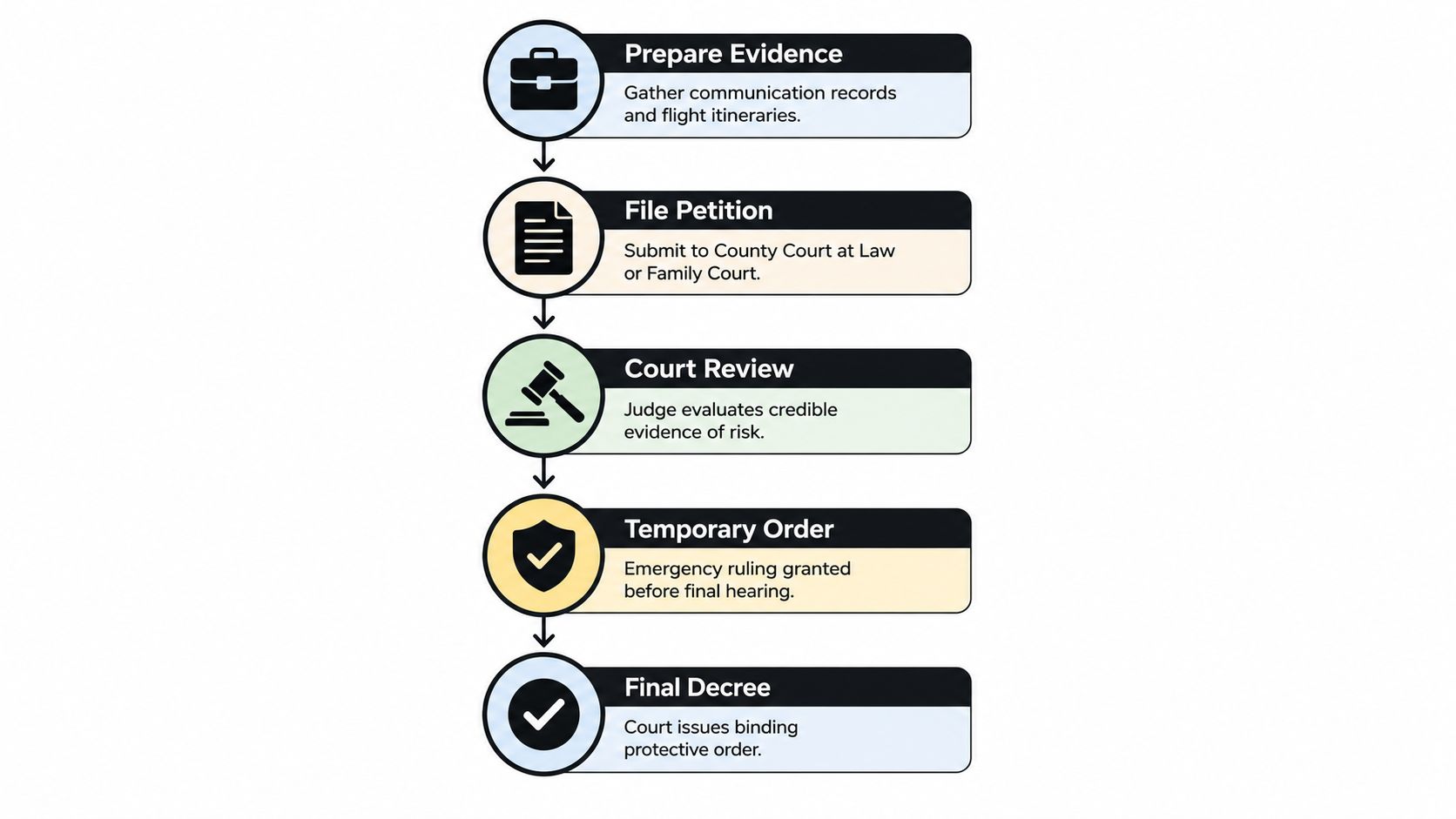
Filing for protection can feel intimidating, especially when you're trying to act quickly. The court needs a clear request, specific facts, and proposed safeguards that match the risk. A well-organized filing helps the judge understand both the urgency and the legal basis for relief.
Start with the existing custody case
First, identify whether you already have a custody order, an ongoing divorce or parentage case, or no family-law case at all. Gather the current order, prior pleadings, the child's identifying information, and any records showing the other parent's possession and access rights.
Your petition or motion should explain:
- The existing legal relationship: Identify the conservatorship arrangement and possession schedule.
- The specific risk: Describe conduct, statements, travel plans, or prior violations.
- The supporting evidence: Attach or organize communications, records, and witness information.
- The requested safeguards: Ask for only those restrictions needed to protect the child, such as passport surrender, travel limits, supervised possession, or a bond.
- The urgency: Explain why waiting for an ordinary hearing could expose the child to harm or make recovery harder.
If the danger appears immediate, ask your attorney whether temporary emergency relief is appropriate. Texas courts may consider temporary orders concerning a child's safety and possession, but the exact procedure depends on the case, court, notice requirements, and facts. A discussion of emergency procedures appears in this guide to emergency ex parte custody orders in Texas.
Expect court review and service
The judge reviews the pleadings and supporting evidence, then decides what process is required. In an emergency, the court may issue temporary relief before a full hearing, but temporary action generally leads to another hearing where both sides can present evidence. The other parent must usually receive legally proper notice and service unless the court authorizes a different procedure allowed by law.
At the hearing, stay focused on facts rather than accusations. Explain why a specific measure protects the child and how it can preserve safe contact where appropriate. If family violence is part of the history, read Custody When There Is a History of Family Violence for information about how abuse or violence changes custody presumptions.
A parent shouldn't hide a passport, remove the child from school, or change travel arrangements based only on personal fear. Court orders matter, and violating an existing order can create new legal problems. If you believe the child faces immediate danger, contact emergency services while seeking urgent legal help.
Specific Remedies and Protective Measures a Judge Can Order
Section 153.503 gives Texas courts a structured set of tools. The judge doesn't have to choose between doing nothing and ending all contact. The order can be customized to the evidence, the child's needs, and the level of risk.
The six main remedy categories
A different managing conservator may be appointed when the existing arrangement doesn't adequately protect the child. Managing conservatorship concerns parental rights and decision-making, so a change can affect who makes important choices and how the child's residence is handled.
Supervised visitation may require the parent's possession to occur with an approved supervisor or in a controlled setting. This can protect the child while allowing contact to continue when unsupervised possession creates an unacceptable risk.
Removal and school-disruption limits can restrict taking the child from a geographic area, changing the child's school, or otherwise disrupting the child's routine without court approval.
Passport and travel controls may require surrender of passports, prohibit applications for replacement travel documents, or restrict international travel. These measures directly address the practical ability to move a child across a border.
A child-abduction bond may require financial security designed to help cover recovery costs or create a financial incentive to follow the order. The bond is a court-ordered safeguard, not a punishment imposed automatically in every case.
Law-enforcement assistance may authorize cooperation with appropriate authorities when enforcement becomes necessary. The wording and scope depend on the order and the facts before the judge.
Prevention and recovery serve different purposes
A preventive order acts before the child leaves the court's reach. A recovery system responds after the child is missing. That difference matters because locating a child abroad may involve foreign courts, unfamiliar procedures, translation issues, and practical delays.
Bring Them Home Texas reported that 983 children were safely recovered through AMBER Alert from the program's start in 1996 through December 31, 2019. That figure illustrates the value of recovery systems, but it also shows their reactive nature. The child must already be missing before an alert can help.
| Feature | Prevention Orders (§153.503) | Reactive Recovery (AMBER/NCMEC) |
|---|---|---|
| Timing | Acts before an abduction occurs | Responds after a child is missing |
| Main tools | Passport controls, travel limits, supervision, bonds, and enforcement terms | Alerts, reporting, coordination, and recovery efforts |
| Court involvement | Texas judge sets conditions in advance | Authorities respond to an alleged disappearance |
| Practical goal | Keep the child safe and within enforceable court protections | Locate and recover the child after removal |
| Parent's focus | Present credible evidence of potential risk | Report the violation quickly and provide identifying details |
The National Center for Missing & Exploited Children has also noted that a 2025 Texas law requires every missing child reported to Texas law enforcement to be reported to NCMEC within two hours. This rapid-reporting rule strengthens response after a child goes missing, while § 153.503 helps address the danger before that point.
Balancing Prevention With Standard Custody and Visitation
An abduction prevention order usually operates within the larger custody framework. Texas uses terms that can sound technical but are easier to understand in practice. Joint managing conservatorship generally means both parents share certain rights and duties, although it doesn't necessarily mean equal time or identical decision-making power.
Possession and access describe the parenting schedule. A possession schedule may establish regular weekdays, weekends, holidays, school breaks, exchanges, and communication. A geographic restriction may limit where the child can live, which can make an international move inconsistent with the existing order.
The child's best interests remain central
Section 153.002 makes the child's best interest the court's primary consideration. A judge may therefore impose travel controls while preserving a safe relationship with both parents. For example, the order might require supervised visits, advance notice of travel, surrender of passports, or communication during approved contact rather than eliminating parenting time without a factual basis.
The court weighs safety against stability and family relationships. A parent who wants to travel may need to provide a destination, dates, contact information, and a reliable return plan. A parent seeking restrictions should explain the specific evidence supporting each request rather than treating every international connection as proof of danger.
A carefully written order can protect a child without turning every parenting exchange into a confrontation.
Mothers and fathers can both seek protection and both may need to respond to allegations. A mother shouldn't assume the court will accept fear without documentation. A father shouldn't assume allegations will be ignored because he has a right to possession. Each parent should follow the existing order, preserve communications, and present evidence focused on the child's safety and stability.
The same approach helps grandparents and caregivers. They may have important information or concerns, but their legal role depends on the facts and the existing case. A lawyer can help determine whether their evidence supports a parent's request or whether they need separate relief.
Enforcement Penalties and Interstate Legal Complications
Obtaining an order is only part of the protection. Everyone affected by the order must understand its exact terms, including travel deadlines, passport requirements, exchange locations, supervision rules, and notice obligations. A vague understanding can lead to accidental violations, while deliberate violations can create urgent legal consequences.
What to do after a suspected violation
If the other parent appears to be violating the order, take these steps:
- Read the order carefully: Confirm the specific provision involved and the effective date.
- Preserve proof: Save messages, travel details, school information, location data, and witness contacts.
- Call law enforcement when appropriate: If the child is in immediate danger or an abduction is occurring, contact emergency services and provide the custody order.
- Contact your attorney promptly: Your lawyer can evaluate contempt proceedings, enforcement requests, emergency relief, and communication with relevant authorities.
- Avoid self-help retaliation: Don't withhold the child from lawful possession or escalate the exchange unless an emergency requires immediate safety action.
A court may address a violation through contempt proceedings and other enforcement remedies. Depending on the conduct and the order, the parent may also face criminal consequences or forfeiture of an abduction bond. The exact outcome depends on the wording of the order, the evidence, intent, and applicable law.
Crossing state or international borders
State lines can complicate jurisdiction, but they don't automatically erase a Texas custody order. The Uniform Child Custody Jurisdiction and Enforcement Act, commonly called the UCCJEA, provides rules for jurisdiction and recognition between states. This overview of UCCJEA home-state jurisdiction in Texas explains why the child's history and the existing custody case matter.
International removal creates additional challenges. Texas authorities may need to coordinate with federal agencies, foreign authorities, and courts in the destination country. Recovery procedures can vary based on the country and the documents available. If the child has already left, provide authorities and your attorney with the order, identifying information, passport details, travel records, and recent communications.
Texas' broader response system includes rapid reporting coordination. NCMEC's report about the 2025 Texas reporting requirement underscores why immediate reporting matters, but prevention remains the stronger position when credible risk can be shown before departure.
Next Steps and Securing Your Family's Future
You don't have to solve an abduction concern alone. A practical response begins with calm, organized action and a clear understanding of what the court can and cannot do.
Immediate checklist
- Gather the order: Obtain every current custody, visitation, and travel-related document.
- Build a timeline: Record threats, travel plans, passport activity, missed exchanges, and other relevant events.
- Preserve original evidence: Keep messages, emails, documents, and witness information in a secure place.
- Identify the requested protection: Consider whether the facts support passport controls, supervised possession, travel limits, a bond, or another measure.
- Seek legal advice quickly: Ask a Texas family-law attorney whether temporary or final relief is appropriate.
- Protect communication: Keep messages factual, brief, and focused on the child. Don't make threats or promises you can't keep.
The central lesson is simple. Section 153.503 gives Texas courts preventive tools, and credible evidence helps the judge choose safeguards that fit the actual risk. Those tools work alongside the best-interests standard, existing conservatorship orders, and possession schedules.
If you need help with a child custody or visitation case in Texas, our experienced attorneys can guide you every step of the way. Contact The Law Office of Bryan Fagan, PLLC today for a free consultation.
The Law Office of Bryan Fagan, PLLC helps Texas parents address custody orders, emergency requests, passport restrictions, visitation concerns, and enforcement issues involving abduction risk. Visit Law Office of Bryan Fagan, PLLC to schedule a free consultation and discuss a protection strategy built for your family.


