 Skip to content
When your child's future is on the line, understanding your rights matters most. You may be facing repeated hearings, conflicting parenting plans, or serious concerns about school, medical care, safety, or the child's relationship with the other parent. Then the judge mentions an amicus attorney, and it can feel like another lawyer has entered the case without your permission.
An amicus attorney can play an important child-focused role in a Texas custody case. The attorney isn't hired to represent the mother, the father, or the child as a traditional client. Instead, the court appoints the lawyer to investigate facts and help the judge evaluate the child's best interests. The role also changed significantly under legislation effective September 1, 2025, so older online explanations may no longer describe what an amicus attorney can do.
When a Judge Brings in an Amicus Attorney in a Texas Custody Case
Sarah and Michael live in Travis County. They have a seven-year-old son, but they can't agree about his school, his therapy schedule, or whether he should spend time with a certain relative. Each parent believes the other is making the child's life harder. After several hearings, the judge says on the record that neither proposed parenting plan adequately addresses the child's needs.
At that point, the judge may decide that the court needs an independent investigation. The court can appoint an amicus attorney to gather information, speak with people connected to the child, review records, and present factual findings relevant to the child's welfare.
That appointment doesn't mean the judge has decided Sarah or Michael is unfit. It means the court believes the dispute is too complicated, too conflicted, or too important to resolve using only the parents' competing accounts.
Situations that may lead to an appointment
An amicus attorney may be considered in disputes involving:
- Relocation: One parent wants to move, while the other believes the move would harm the child's stability or relationship with both parents.
- Alienation allegations: Each parent claims the other is influencing the child against them.
- Substance use concerns: A parent raises concerns about alcohol, drugs, or unsafe supervision.
- Mental health concerns: The court needs reliable information about treatment, functioning, or the child's emotional safety.
- Blended-family conflict: Stepparents, half-siblings, relatives, or household rules create ongoing disagreement.
- Complex caregiving questions: The parents disagree about school performance, therapy, medical compliance, or daily routines.
Texas Family Code Chapter 107 defines an amicus attorney as a court-appointed lawyer who assists the court in protecting a child's best interests. In most private custody-related cases, appointment is discretionary. A government-filed suit is different because Texas law bars an amicus appointment in suits filed by a governmental entity. In certain private termination cases, the court must appoint an amicus attorney or attorney ad litem unless the child's interests are already adequately represented by a non-conflicted party. Texas Family Code Chapter 107 provides the statutory framework.
Practical meaning: An amicus appointment adds an independent fact-gathering layer. Parents should expect the court to examine consistency, documentation, and the child's day-to-day experience, not just each parent's courtroom statements.
This guide explains what the role means, how the September 2025 changes affect the investigation, how fees work, and how mothers, fathers, grandparents, and caregivers can prepare without turning the process into another personal battle.
What an Amicus Attorney Does Under Texas Law
A parent may tell the court, “My child wants to live with me.” The other parent may describe the same situation differently. An amicus attorney gives the judge an independent review of the family's circumstances and advocates for the child's best interests. The attorney does not represent either parent and generally is not bound by the child's preferred outcome as a traditional lawyer would be by a client's instructions.
Texas Family Code Section 107.005 requires an amicus attorney to review the facts and advocate for the child's best interests. The attorney must explain the role to the child, warn that information shared may be used to assist the court, and become familiar with American Bar Association standards for attorneys handling custody matters. Texas Family Code Section 107.005 describes these responsibilities.
The investigation is independent
Within the appointment order's limits, an amicus may interview parents, the child, teachers, counselors, relatives, and others with relevant information. The attorney may review school, medical, and therapy records, along with calendars, text messages, and parenting communications. Depending on the order and circumstances, the attorney may also coordinate with a mental health professional when speaking with the child.
Suppose Sarah says Michael misses therapy appointments, while Michael says Sarah withholds scheduling information. The amicus may compare appointment records, messages, and provider information. That process works like checking a disputed story against the underlying records. The question is not which parent sounds more convincing. The question is whether the available evidence shows a consistent pattern affecting the child.
Parents should therefore preserve organized records, answer questions directly, and identify the difference between firsthand knowledge and assumptions. An amicus is not collecting accusations. The attorney is building information the court can evaluate.
The child's wishes matter, but they do not control the amicus
If the child consents, the amicus must communicate the child's objectives to the court. The attorney's primary duty remains the child's best interests. A child may prefer one home because of friends, household rules, comfort, or an adult's influence. That preference may matter, but it does not automatically determine conservatorship or possession.
For a plain-language discussion, see Does a Child Get to Choose Which Parent in Texas?, which explains how a child's wishes may factor into a Texas custody decision.
An amicus is not a mediator. Mediation helps parents negotiate an agreement, while an amicus investigates and provides information to the court. The attorney is not automatically a trial witness either. Courtroom participation depends on applicable law, the appointment order, and the case's facts.
Conversations with the amicus should not be treated as private attorney-client discussions for a parent. TexasLawHelp's explanation of amicus and ad litem attorneys provides context about this court-focused process.
Amicus Attorney vs Guardian Ad Litem vs Attorney Ad Litem
Texas custody cases can involve several court-appointed professionals, and the names sound similar. Their duties are different. The appointment order should identify the role clearly, but parents should still ask their own lawyer to explain what the individual can investigate, report, or argue.
| Role | Statutory Basis | Primary Duty | Party Status | May Testify |
|---|---|---|---|---|
| Amicus attorney | Texas Family Code Chapter 107, Subchapter A | Investigates facts and assists the court with the child's best interests | Generally not a traditional party representative | The attorney may function as a witness or make recommendations to the judge under the applicable appointment and law |
| Guardian ad litem | Texas Family Code Chapter 107, Subchapter B | Owes the child fiduciary duties and protects the child's welfare | Has full party status | May be called as a witness |
| Attorney ad litem | Texas Family Code Section 107.061(h) | Provides legal services for the child through the guardian ad litem's appointment | Represents the child's legal interests | May participate as permitted by the role and court order |
How the roles look in practice
Suppose a Harris County judge appoints an amicus in a dispute over school attendance and a proposed move. The amicus may gather records, interview the family, and provide factual information within the scope of the appointment. After the September 2025 changes, the amicus's ability to offer opinions about conservatorship or possession is limited by statute.
A guardian ad litem has a different legal position. Because the guardian ad litem has full party status and fiduciary duties, that professional may participate in the case in a more formal way and may be called to testify.
An attorney ad litem is also different. The role focuses on legal services for the child rather than an independent investigation of the entire family system. In a Dallas County case, an attorney ad litem may advise the child about legal rights and advocate according to the governing appointment, while an amicus focuses on information that helps the judge evaluate the child's welfare.
Parents often confuse the amicus with a child's personal lawyer. That confusion can lead to unrealistic expectations. A child's stated preference may be communicated, but the amicus isn't required to argue for whatever the child requests.
For a more detailed explanation of another court-appointed role, review what a guardian ad litem does in Texas custody litigation. The key is to identify the appointment before deciding how to communicate, what records to provide, and what objections may be available.
How a Texas Court Appoints an Amicus Attorney
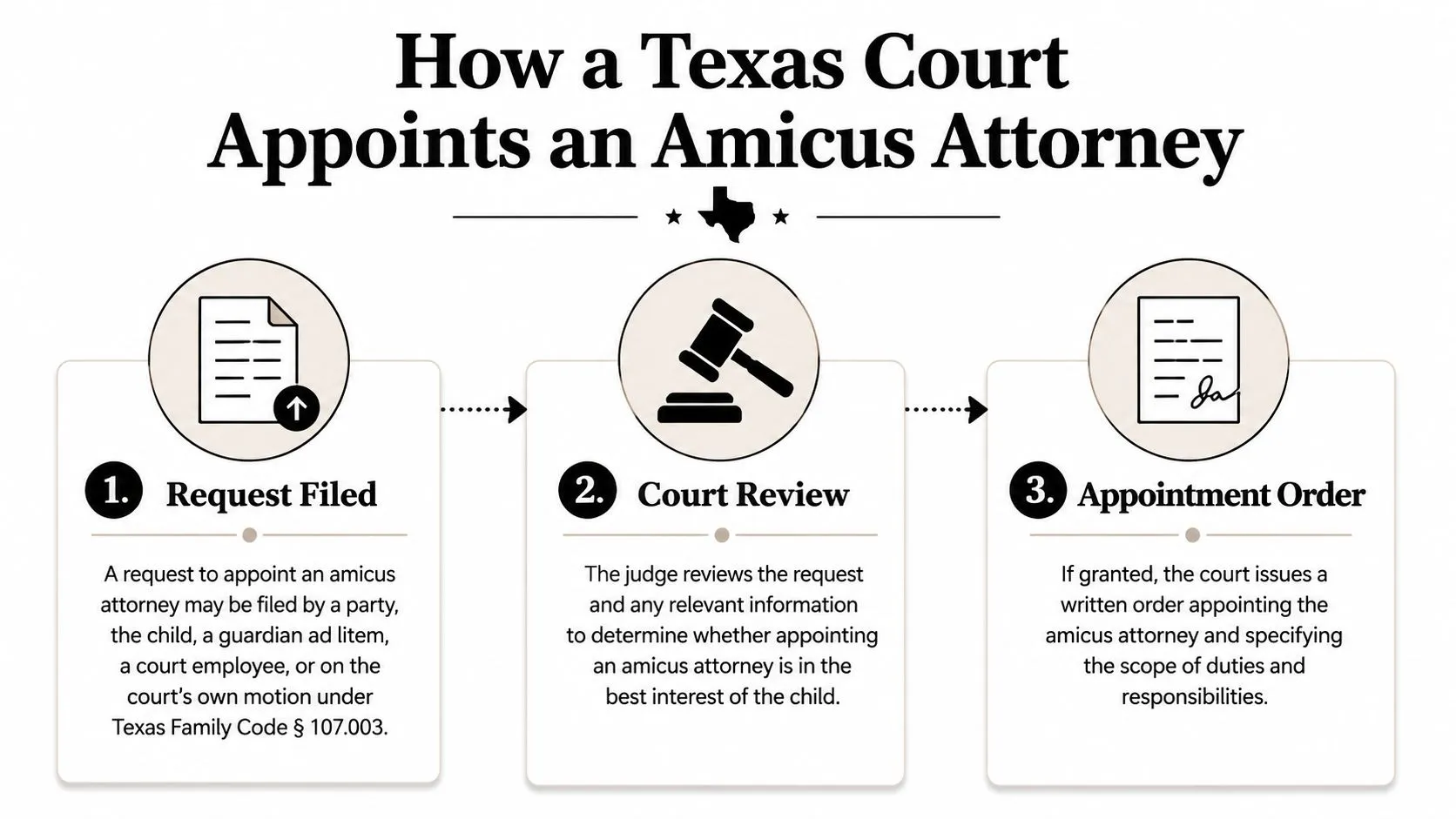
An amicus appointment usually begins with a written request from a parent, conservator, the child through counsel, or the court's own motion. The request should explain why the court needs an independent child-focused investigation. General accusations are less useful than specific facts tied to school, health, safety, caregiving, communication, or the proposed parenting schedule.
The judge then considers whether an appointment would help resolve the child's best-interest issues. Texas Family Code Chapter 107 gives the court authority to appoint an amicus in appropriate cases, but appointment is discretionary in most private custody disputes. The judge may decide that the existing evidence is enough, appoint an amicus, or choose another court-appointed role authorized by law.
Notice and the hearing
Parents generally should receive reasonable notice and an opportunity to be heard before the court appoints an amicus, unless a lawful exception applies. At the hearing, each parent may explain why an appointment is necessary, why it isn't necessary, or why another appointment would better serve the child.
A parent opposing appointment might argue that the issues are narrow, the records are already available, or the added expense would create hardship. A parent requesting appointment should identify the unresolved questions and explain why a neutral investigation would help the judge make a child-centered decision.
The appointment order should define the attorney's scope, duties, authority, and fee arrangement. Parents should read the order carefully because it controls what the amicus is expected to do. Once the order issues, track every deadline for deposits, interviews, document production, hearings, responses, and objections.
A custody evaluation is not the same as an amicus appointment, although both can involve investigation and child-focused information. Parents may find it useful to review what a custody evaluation means in Texas before deciding what questions to raise with counsel.
Before the hearing: Write down the exact factual problem the appointment would address. “We disagree” is less useful than “The child's school attendance records and therapy schedule conflict with the proposed possession plan.”
What Changed in September 2025 for Amicus Attorneys
The most important recent development for anyone researching amicus attorney Texas custody is the statutory change effective September 1, 2025. The new law narrows what an amicus attorney may do in custody disputes and adds qualification and continuing legal education requirements for appointments made on or after that date. The 2025 Texas legislation is the starting point for reviewing the amendment.
Older explanations often describe an amicus as a professional who investigates, advocates for the child's best interests, and makes recommendations about custody arrangements. That description can mislead parents handling a newer appointment. Under the amended framework, Section 107.002 expressly bars an amicus attorney from offering an opinion or recommendation regarding conservatorship or possession of a child.
| Duty or Power | Before Sept. 1, 2025 | After Sept. 1, 2025 |
|---|---|---|
| Investigate family facts | Could investigate relevant circumstances | Continues to investigate relevant circumstances |
| Interview the child and parties | Could conduct interviews | Continues to conduct interviews within the appointment's scope |
| Review records | Could review school, medical, therapy, and other relevant records | Continues to review relevant records |
| Communicate findings | Could report findings to the court | Continues to report findings to the court |
| Recommend conservatorship | Could offer broader custody-related recommendations under the older framework | May not offer an opinion or recommendation about conservatorship |
| Recommend possession or access | Could address proposed schedules under the older framework | May not offer an opinion or recommendation about possession or access |
| Qualifications and education | Governed by the earlier appointment framework | New qualification and CLE requirements apply to covered appointments made on or after the effective date |
What the difference looks like
Under the older framework, an amicus might have recommended joint managing conservatorship with a 60/40 possession schedule. Under the newer framework, the amicus must stop at reporting observations and factual findings. The judge, not the amicus, weighs that evidence and decides conservatorship and possession.
This change matters for preparation. A parent shouldn't assume that a favorable investigation will result in a recommended parenting plan. Instead, the parent must provide reliable evidence that allows the judge to apply the best-interest standard directly.
The legislative change appears designed to address concerns that an amicus could make decisions that functioned like custody rulings without being the judge. In practical terms, the amicus is more clearly an investigator and reporter, while the court retains responsibility for deciding the outcome.
That doesn't make cooperation less important. It makes accuracy more important. School records, medical compliance, caregiving history, communication patterns, and documented routines may shape the factual record even when the amicus can't recommend who should have primary possession.
Who Pays the Amicus Attorney in Texas Custody Cases
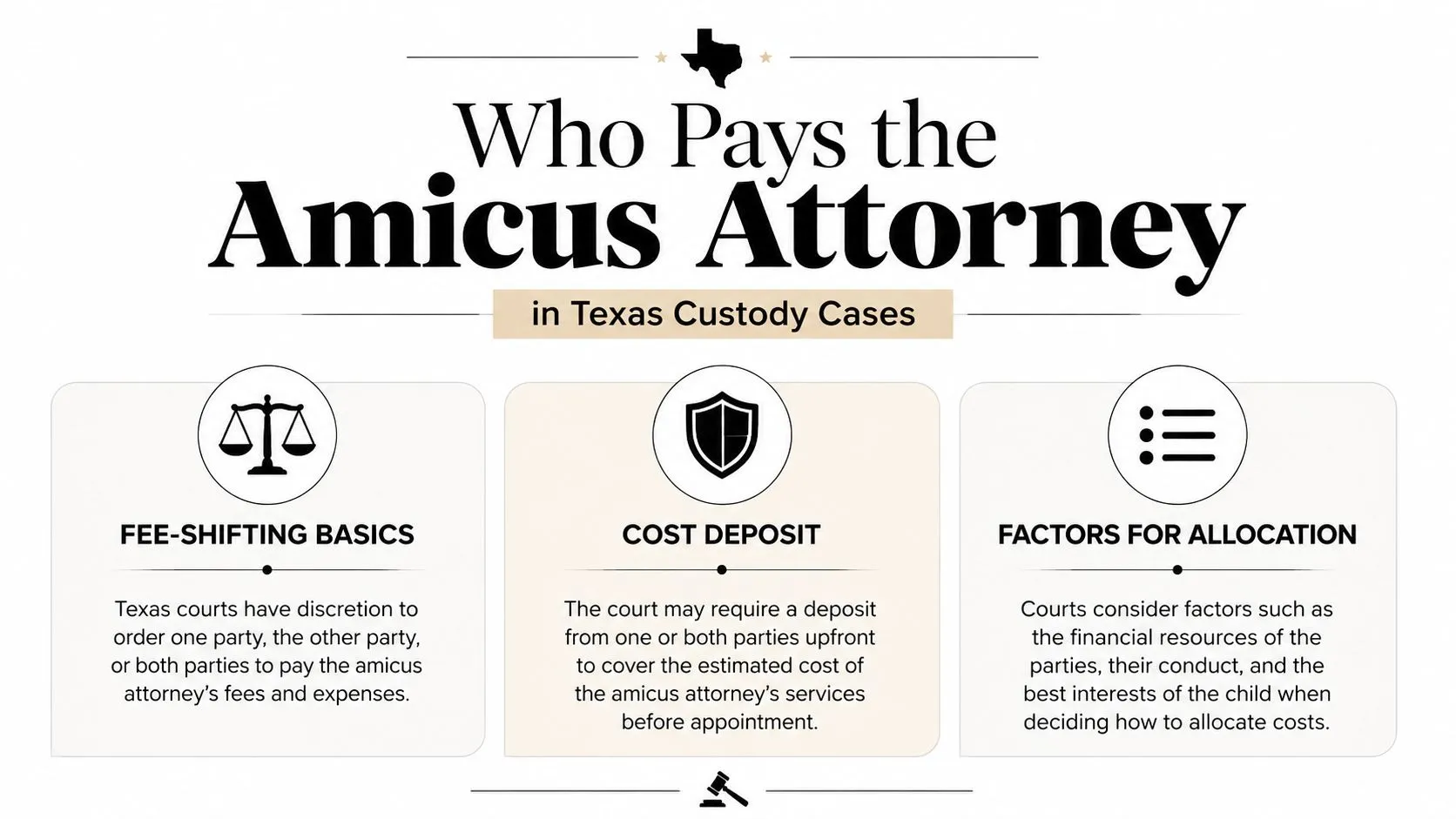
An amicus appointment can affect a family's litigation budget. In a private suit, Texas Family Code Section 107.024 allows the court to award the amicus's reasonable and necessary fees, court costs, and expenses to one or more parties. The court must consider customary county rates, set reasonable and necessary compensation, require a cost deposit at appointment, and may order additional funds before the final hearing. Texas Family Code Section 107.024 provides the statutory fee framework.
The judge may divide the cost between both parents, assign more of it to a parent with greater financial resources, or consider whether one party's conduct created the need for the appointment. There isn't one automatic payment rule for every case. The order should say who pays, when payment is due, and what happens if the deposit is exhausted.
Questions to raise about fees
Before work begins, ask your lawyer to review:
- The deposit: Determine how much the court requires before the amicus starts work and whether additional funding may be requested.
- The billing scope: Confirm whether interviews, records review, travel, reports, hearings, and communications are included.
- Itemized invoices: Request billing that identifies the work performed, date, time, and expense rather than a vague balance.
- Allocation: Gather financial information that supports a fair argument about each parent's ability to contribute.
- Hardship: Tell counsel promptly if the required deposit creates a serious financial problem.
Texas law refers to customary county rates rather than setting one statewide price. A parent should not rely on internet estimates or assume that an hourly charge is reasonable without reviewing the appointment order, local practice, the attorney's qualifications, and the actual work performed.
If you believe a fee is unreasonable, your attorney can help you ask the court to review the charge, require itemized billing, limit work to the appointment's scope, or address financial hardship. Do not ignore an invoice. Unpaid court-ordered fees may create additional enforcement problems.
The following video offers additional general context about amicus attorney fees and custody litigation:
How Parents Can Prepare for an Amicus Attorney
When an amicus enters your case, treat the investigation like a parallel fact review. A parent who relies only on emotional testimony may leave important details unclear. A parent who organizes records around the child's actual life gives the court a clearer way to evaluate safety, stability, school, health, and caregiving.
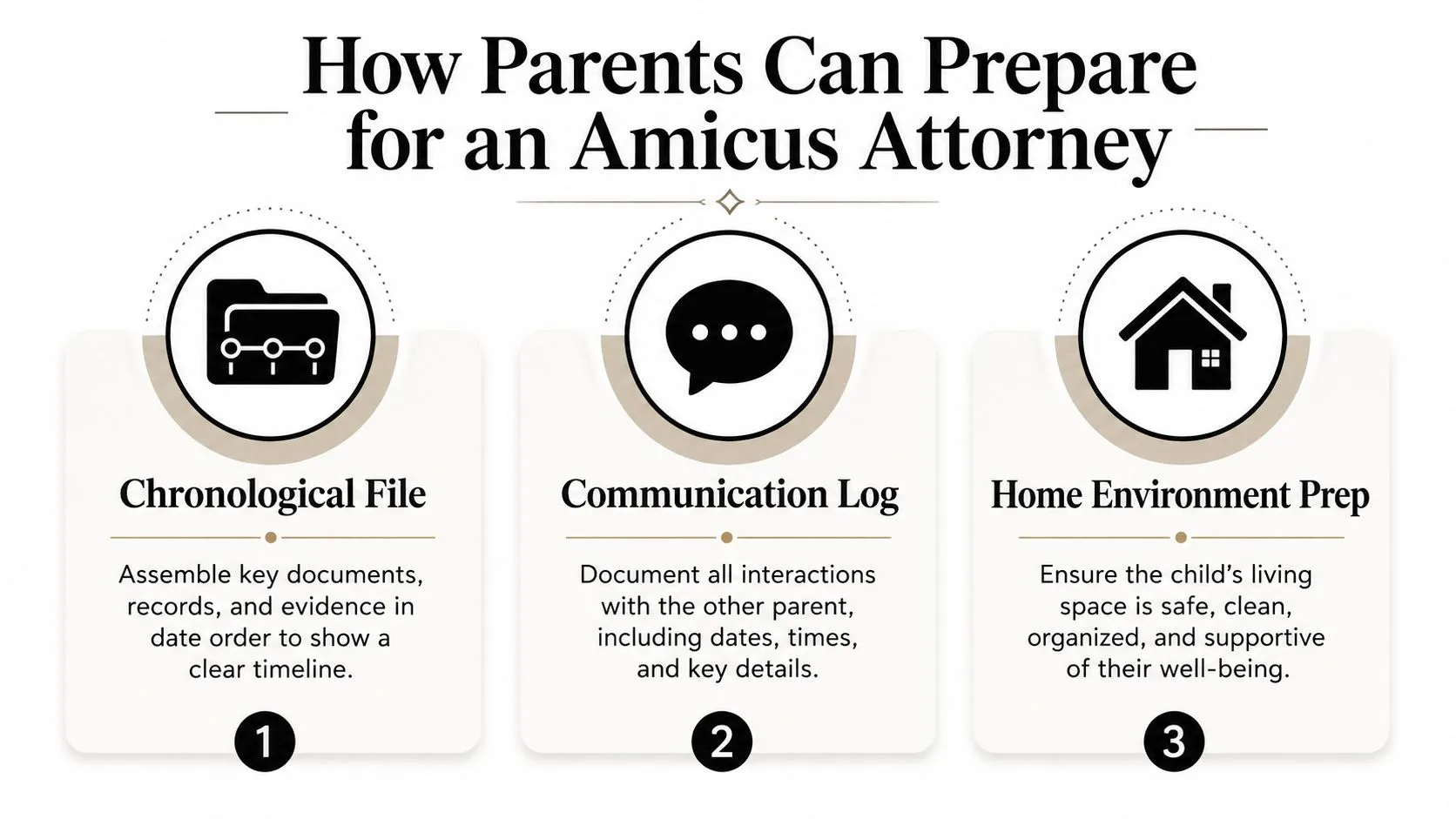
Start with a chronological file. Put school records, medical authorizations, therapy notes, parenting communications, possession exchanges, and major decisions in date order. Label each item so your attorney can find it quickly and explain why it matters.
Build a child-focused record
Keep a communication log that records missed calls, schedule changes, requests for information, transportation problems, and decisions about school or medical care. Use neutral language. “The other parent is impossible” doesn't identify a fact. “The exchange was scheduled for 6 p.m.; the message changing the location arrived at 5:35 p.m.” gives the amicus something verifiable to examine.
Prepare the home environment without staging it. The child's sleeping space, school materials, medication storage, household routines, and transportation arrangements may all help explain how the proposed plan would work. Don't coach the child or ask the child to choose sides. Avoid angry posts and disparaging texts because an amicus may examine how each parent supports the child's relationship with the other parent.
A motion or response should use specific language tied to the child's circumstances. For example:
“The requesting party asks the court to appoint an amicus attorney to investigate the child's school attendance, therapy schedule, proposed relocation, and each parent's ability to maintain a consistent routine. The request is based on the attached records and communications, not on generalized disagreement.”
That wording isn't a substitute for advice from your lawyer, but it shows the difference between a factual request and a personal accusation.
Parents who want to improve the organization and clarity of legal content may also find the AISEOGrow law firm playbook useful as a general resource for structuring client-facing legal information. For courtroom preparation, review how to prepare for a custody hearing.
Mothers and fathers should use the same basic approach. The question isn't which parent can present the angriest story. The question is which evidence helps the court understand the child's needs and the practical effect of each proposed arrangement.
Key Takeaways and Next Steps for Texas Families
An amicus attorney in a Texas custody case serves the court, not either parent. The attorney may investigate the family's circumstances, interview people, review records, communicate the child's objectives when appropriate, and report factual findings relevant to the child's best interests. Parents shouldn't treat the amicus as a personal lawyer, mediator, or confidential advocate.
The legal framework changed for appointments made under the newer framework effective September 1, 2025. An amicus attorney may no longer offer an opinion or recommendation about conservatorship or possession, so parents must prepare evidence that lets the judge make those decisions. Older articles that describe broad custody recommendations may not apply to your appointment.
Texas Family Code Section 153.002 states that the child's best interest is the controlling standard in custody cases. In plain English, the judge starts with the child's safety, stability, health, and emotional well-being, rather than treating the dispute as a contest between adults. Joint managing conservatorship also doesn't automatically mean equal parenting time. Conservatorship concerns legal rights and decision-making, while the possession order sets the practical schedule. Texas Family Code Chapter 153 contains the governing custody provisions.
Parents should also remember that detailed possession rules can affect school breaks, holidays, summer time, and notice requirements. Grandparents face separate standing and proof rules. Under Section 153.432, a biological or adoptive grandparent seeking access must attach an affidavit alleging facts showing that denial would significantly impair the child's physical health or emotional well-being. Texas grandparent access law explains that threshold.
Collect your records, follow the appointment order, protect your communications, and work through your own attorney when questions arise. If you're considering an appointment, opposing one, responding to an investigation, or seeking a custody modification, individualized advice can help you avoid mistakes that affect both cost and credibility.
If you need help with a child custody or visitation case in Texas, our experienced attorneys can guide you every step of the way. Contact The Law Office of Bryan Fagan, PLLC to discuss an amicus appointment, custody modification, possession dispute, or preparation strategy during a free consultation.


