
Texas law does not set a fixed testimony age for children in custody cases, but in nonjury custody hearings a judge must interview a child 12 or older in chambers if requested, while live courtroom testimony is uncommon and limited by Chapter 104 safeguards. A child's preference can matter, but the child doesn't get to choose the custodial parent just by stating a preference.
When your child's future is on the line, it's natural to fear the worst. You may be sitting in a Harris County courthouse hallway, holding a briefcase tightly and imagining your eight-year-old daughter being sworn in, questioned by lawyers, and forced to choose between her parents.
That frightening picture usually isn't how Texas custody cases work. Texas family courts generally look for ways to hear a child's perspective without placing the child in the middle of the parents' dispute. The important question isn't only whether a child can testify in custody court in Texas. It's how the court can hear the child safely, fairly, and within the rules of the Texas Family Code.
Parents dealing with conflict, substance use, or other difficult family circumstances may also benefit from understanding resources about addiction within family relationships. Legal preparation and emotional support often belong together when a child is carrying stress from an adult dispute.
Walking Into Court With Your Child on Your Mind
A parent walking into family court may expect a dramatic courtroom scene. The parent may picture the child sitting in the witness box, answering questions under pressure while both sides listen. That concern is especially strong when the child is young, anxious, or already struggling with tension between households.
Texas custody proceedings are generally nonjury matters governed by Texas Family Code Chapter 153. In these cases, the judge decides conservatorship, possession, and access after reviewing the evidence. The judge isn't only asking which parent has the stronger emotional argument. The court is trying to determine an arrangement that serves the child's welfare.
That's why the court often uses a private interview instead of live testimony. A child may be heard in the judge's chambers, away from the public courtroom and the formal pressure of a witness stand. The details depend on the case, the judge's procedures, and whether a party, an amicus attorney, or the child's attorney ad litem requests the interview.
Practical rule: A request for the child to be heard isn't the same as asking the child to decide the case.
The distinction matters for mothers, fathers, grandparents, and caregivers. A mother may worry that the other parent is pressuring the child. A father may believe the child's wishes are being ignored. A grandparent may be concerned about safety or stability. Each person may need a different legal response, including evidence from adults, records, witnesses, or a professional evaluation.
The court also separates a child's direct statements from professional opinions about custody. Texas Family Code Section 104.008 generally limits expert recommendations about who should have custody unless the opinion comes from a qualified custody evaluation under Chapter 107, as described in Texas custody materials discussing the child's ability to be heard.
Your child's voice can matter without making your child responsible for the result. The judge still has the responsibility to evaluate the full record and enter orders based on the child's best interest.
How the Best Interest Standard Shapes Custody in Texas
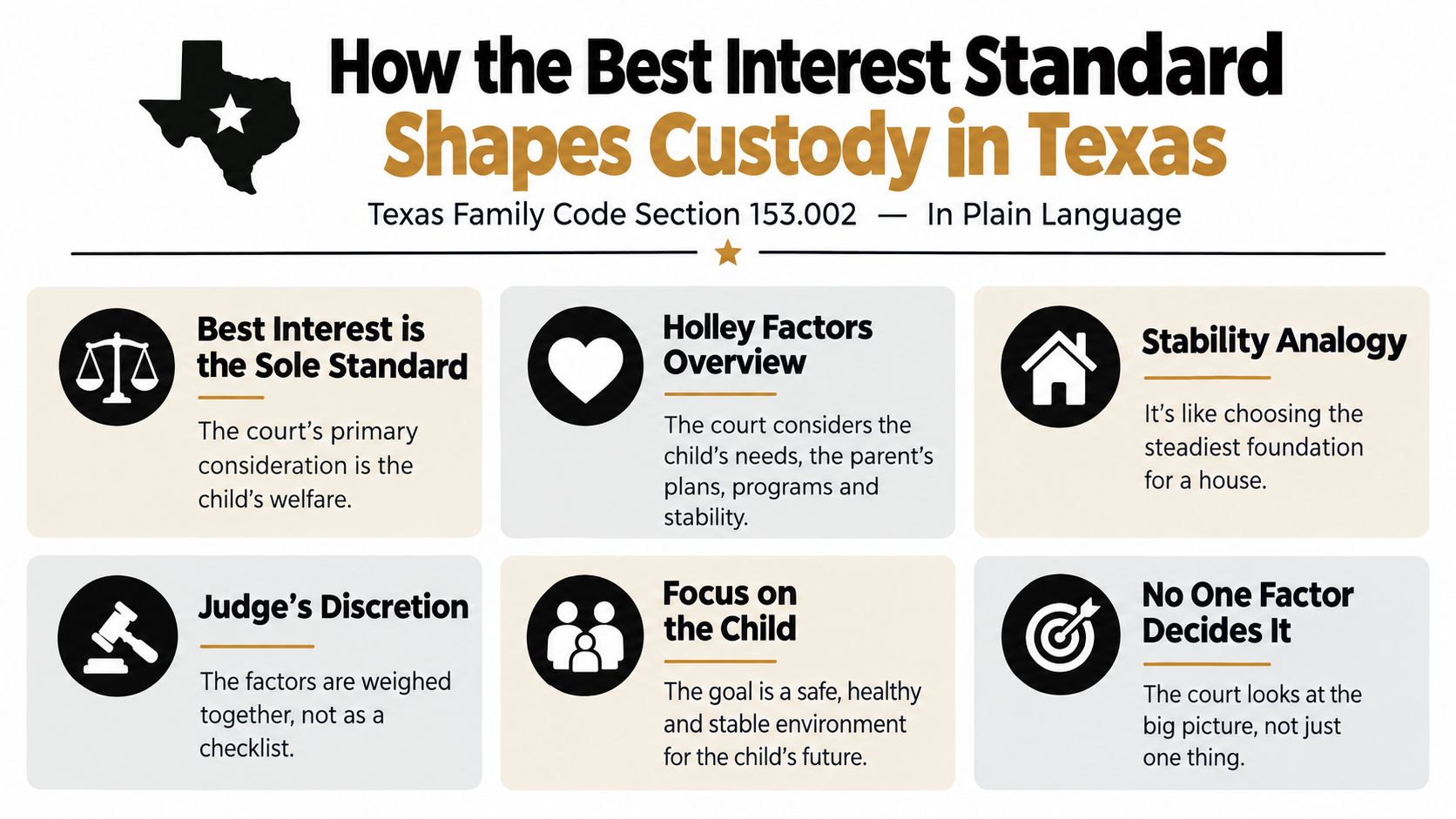
Texas Family Code Section 153.002 provides the controlling standard: the best interest of the child. In plain English, the judge focuses on what arrangement protects the child's safety, stability, emotional needs, and development, rather than treating custody as a reward for one parent.
A child's preference is one part of that inquiry. Texas courts may consider factors associated with the best-interest analysis from Holley v. Adams, including the child's desires, the child's present and future emotional and physical needs, the plans proposed by each parent, the stability of each home, and any conduct that may affect the parent-child relationship. The judge weighs these considerations together rather than applying a mechanical checklist.
You can think of the analysis as a scale with several pans. The child's wishes sit in one pan. The child's need for consistency sits in another. Each parent's history, ability to cooperate, home environment, and proposed parenting plan add more weight. One statement from the child may influence the scale, but it doesn't control the balance.
What the standard means for parents
A joint managing conservatorship means both parents share certain rights and duties concerning the child. It doesn't necessarily mean equal time, equal decision-making in every matter, or an identical possession schedule. One parent may have the exclusive right to determine the child's primary residence, while both parents remain joint managing conservators.
A possession schedule sets out when the child stays with each parent. It can address weekends, holidays, school breaks, exchanges, transportation, and communication. The court evaluates the schedule through the same best-interest lens. A schedule that looks equal on paper may not serve a child who needs predictability, medical care, school support, or protection from conflict.
The child's statement may help the judge understand the child's experience. It may reveal fear, a strong bond, a preference for routine, or concerns about a household. But the judge must test that information against the rest of the evidence. The child's voice is important because it helps complete the picture, not because it replaces the judge's duty.
The 12-Year-Old Threshold and How Texas Treats Younger Children
A parent may hear that a child is “old enough to choose” and assume the court will follow that choice. Texas law works differently. Texas Family Code Section 153.009 sets an age-based procedure for hearing a child's wishes, not a right for the child to decide custody.
In a nonjury custody proceeding, the court must interview a child who is 12 years of age or older in chambers if a party, the amicus attorney, or the child's attorney ad litem requests the interview. That request creates a path for the child to speak privately with the judge. It does not turn the child into an automatic courtroom witness or give the child a custody vote. For a fuller explanation of how a preference may count, see this guide to how and when a Texas child's preference actually counts.
The interview generally concerns the child's wishes about conservatorship or the child's primary residence. The judge controls the setting and questions. Depending on the court's procedure, the conversation may be recorded or handled through procedures that preserve the appropriate legal record. A private interview is more like giving the judge a direct window into the child's experience than handing the child the decision.
For a child under 12, the statute gives the court discretion. The judge may interview the child, but no automatic requested-interview right applies. Age, maturity, circumstances, and the child's ability to communicate reliably can affect whether the judge chooses to hear from the child.
Parents should explain the difference carefully. A younger child may be heard, but the judge may decline an interview. A child 12 or older can trigger the statutory interview process when a qualified request is made, but the interview still does not guarantee a particular result.
| Child's Age | Statutory Right to Interview | Court's Discretion | Likely Vehicle |
|---|---|---|---|
| Under 12 | No automatic requested interview right | Judge may interview the child | Private interview or other evidence, depending on the case |
| 12 or older | Interview required in a nonjury custody proceeding when properly requested | Judge controls the manner and scope | In-chambers interview about wishes |
| Any age | No automatic right to choose a parent | Court evaluates the full record | Testimony, interview, records, witnesses, or qualified evaluation |
The Texas State Law Library explains this difference in its Texas child custody guidance. A separate enforcement dispute, such as Enforcing a Texas Custody and Possession Order, concerns whether an existing order was followed, not whether the child should be interviewed.
In Chambers Versus in Open Court What the Rules Actually Allow
The in-chambers interview and live courtroom testimony serve different purposes. The private interview lets the judge listen directly to the child's views in a controlled setting. Open-court testimony places the child into the formal evidence process, where testimony may be sworn, questioned, challenged, and included in the trial record under applicable rules.
For most parents, the private interview is the path they're asking about when they say, “Can my child testify?” The judge may speak with the child away from the courtroom audience and the direct confrontation of the parties. The exact attendance and recording arrangements depend on the court's procedures and the orders in the case.
Texas Family Code Chapter 104 adds safeguards when a child's testimony is taken in a custody matter. Texas Children's Commission materials explain that a child may not be compelled to testify in open court during the proceeding. The law also allows alternative means of receiving testimony in appropriate child-custody matters, including testimony from another state.
The two paths side by side
| Feature | In-Chambers Interview (§153.009) | Open-Court Testimony (§104.001 et seq.) |
|---|---|---|
| Main purpose | Hear the child's wishes directly | Receive formal testimony as evidence |
| Setting | Private chambers or another court-approved setting | Courtroom or approved alternative setting |
| Who requests it | Party, amicus attorney, or child's attorney ad litem | Usually addressed through formal evidentiary procedure |
| Child's role | Speaks privately with the judge | May be sworn and subject to formal questioning |
| Public exposure | More limited than courtroom testimony | Greater courtroom exposure unless protections apply |
| Result | Preference is weighed with all other evidence | Testimony is evaluated under evidence rules |
Parents should also understand the difference between an amicus attorney and an attorney representing a parent. An amicus attorney assists the court and may investigate issues affecting the child, but doesn't function as the mother's or father's personal lawyer. A helpful explanation of the child-focused roles appears in what a guardian ad litem does in a Texas custody case.
A private interview doesn't mean the conversation is casual or irrelevant. It can become part of the court's decision-making process. At the same time, a parent shouldn't assume that an interview will be treated exactly like sworn testimony. Ask counsel how the judge handles the record, who may attend, and whether the court reporter will be present.
How to Request or Object to a Child Interview Step by Step
A parent considering a child interview should begin with the specific purpose. Is the child mature enough to explain a preference? Is the child being pulled into adult conflict? Does the child have information that other evidence can't fairly present? The answer can affect whether requesting the interview supports the child's welfare or increases pressure.
Requesting the interview
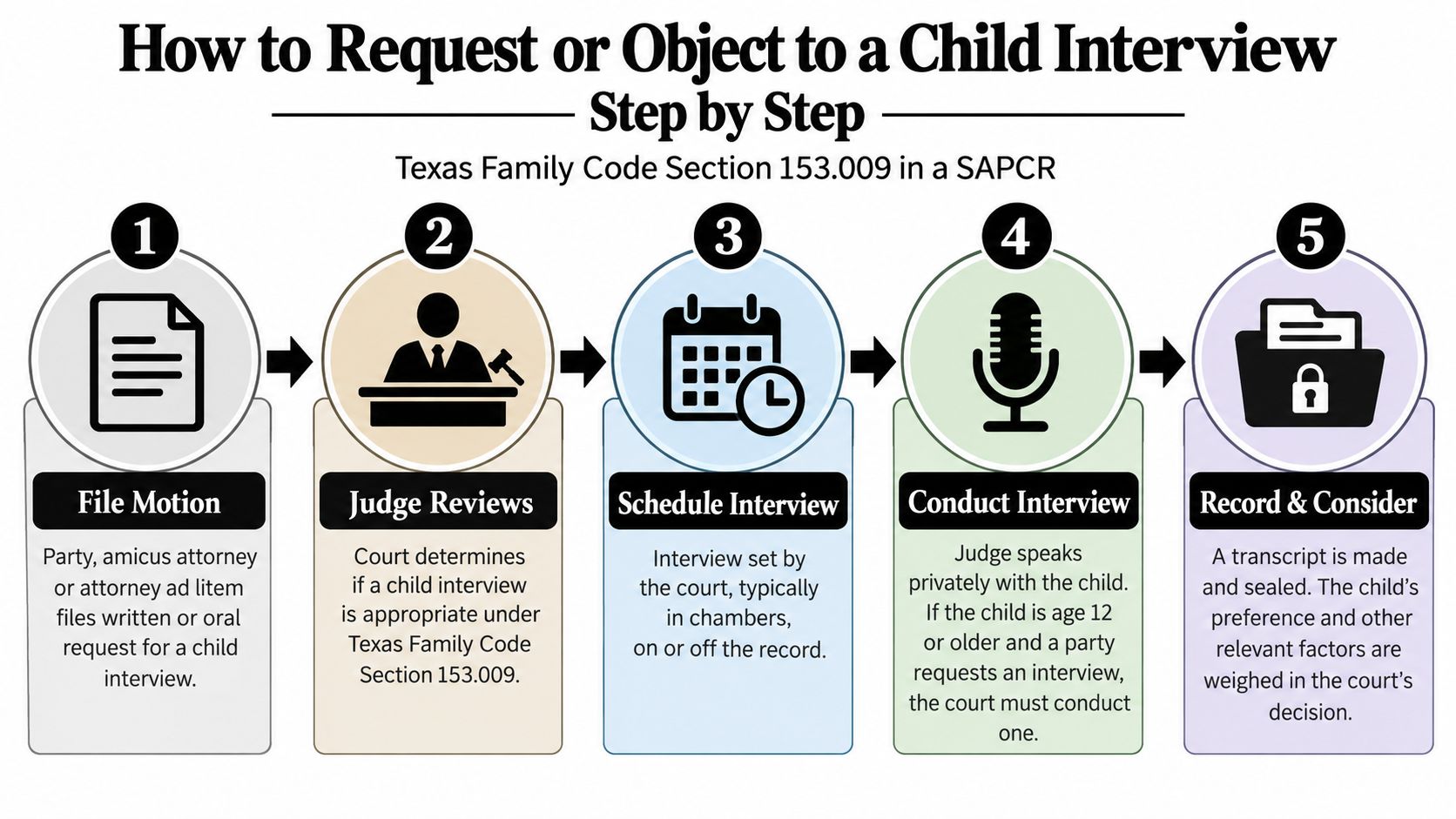
A party may request an in-chambers interview under Section 153.009. The request may be made in writing or orally, depending on the stage of the case and the court's procedures. An amicus attorney or the child's attorney ad litem may also request it.
A practical sequence looks like this:
- Identify the reason. Connect the request to the child's wishes, needs, safety, or stability, not only to gaining a tactical advantage.
- Raise it with counsel. Discuss the child's age, maturity, emotional condition, and the evidence already available.
- File or present the request. Follow the local court's requirements for motions, notices, and hearings.
- Confirm the setting. Ask whether the interview will occur in chambers, whether it will be recorded, and who may be present.
- Prepare without coaching. Tell the child only that the judge wants to listen. Don't script answers or suggest what the child should say.
Objecting or asking for safeguards
A parent who believes an interview could harm the child can raise an objection. The objection should explain the concern through the best-interest standard in Section 153.002. Examples might include severe anxiety, evidence of coaching, fear of retaliation, or a concern that the child is being forced to choose sides.
Depending on the facts, counsel may ask the court to limit the interview, create a record, use another professional process, or consider a qualified custody evaluation under Chapter 107. Parents should also clarify whether the proceeding involves sworn testimony under Chapter 104. The legal treatment may differ from a private preference interview.
Preparation matters: Tell your child to be honest, listen carefully, and understand that the judge makes the decision. Don't promise a particular result.
For a plain-language discussion of the question Does a Child Get to Choose Which Parent in Texas?, remember that the child's wishes are evidence, not an order. The court's job remains broader than recording a preference.
Beyond Testimony the Other Ways a Child Is Heard
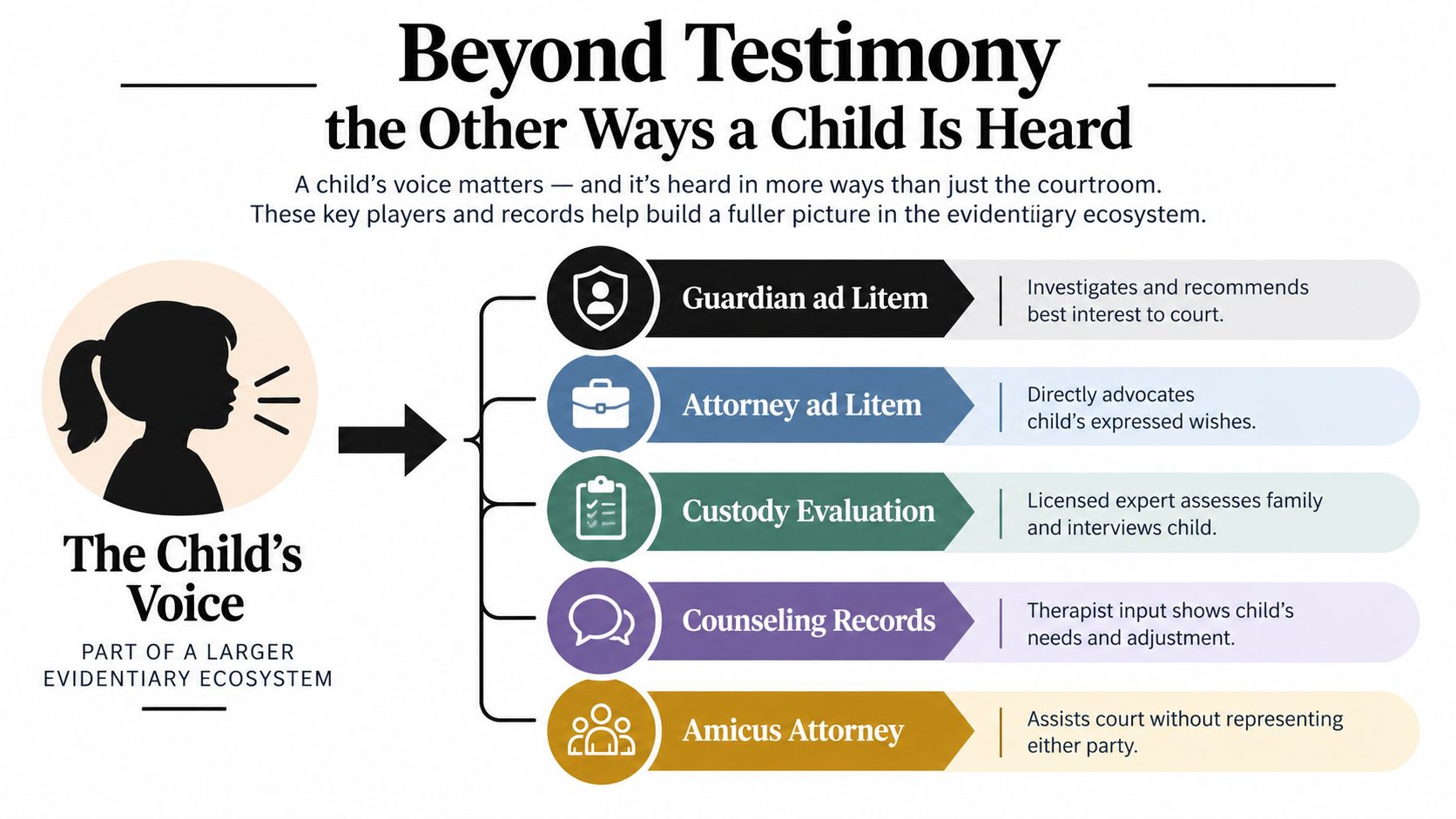
A child doesn't have to sit on the witness stand for the court to understand the child's life. Texas custody cases can involve several professionals and records that provide context about the child's relationships, needs, adjustment, and safety.
A guardian ad litem focuses on the child's best interest. An attorney ad litem represents the child and advocates for the child's expressed wishes. An amicus attorney assists the court without representing either parent. These roles are different, so parents should read the appointment order carefully and ask what authority each professional has.
A custody evaluation under Chapter 107 may provide another structured way to assess the family. The evaluator can interview family members and review relevant information, then provide opinions within the limits of the appointment and applicable law. Texas Family Code Section 104.008 limits unsupported expert recommendations about custody unless they come from a qualified custody evaluation under Chapter 107. Parents can learn more through this explanation of what a custody evaluation is in Texas.
Abuse-related statements require careful handling
Texas law also recognizes that a child's out-of-court statements may matter in abuse-related cases. Under the Texas Child Protection Law Bench Book materials, a recorded oral statement by a child 12 or younger about alleged abuse may be admissible in a Title 5 proceeding when specific reliability and recording requirements are met.
Those safeguards include an audio-visual recording, competent equipment and operator, no attorney present when the statement was made, no leading questions used to elicit the statement, and availability of the interviewer for testimony or cross-examination. Parents shouldn't assume that every statement made to a therapist, relative, teacher, or parent automatically becomes admissible evidence.
The broader point is practical. A child's perspective may reach the court through an interview, a qualified evaluation, a professional investigation, a properly preserved recording, or testimony from another person. Your attorney can help determine which path protects the child while presenting reliable evidence.
Misconceptions Parents Bring Into the Courthouse
Parents often arrive with understandable but inaccurate assumptions about children and custody. Correcting those assumptions early can prevent a child from being pressured and can help a parent choose a procedure that fits the case.
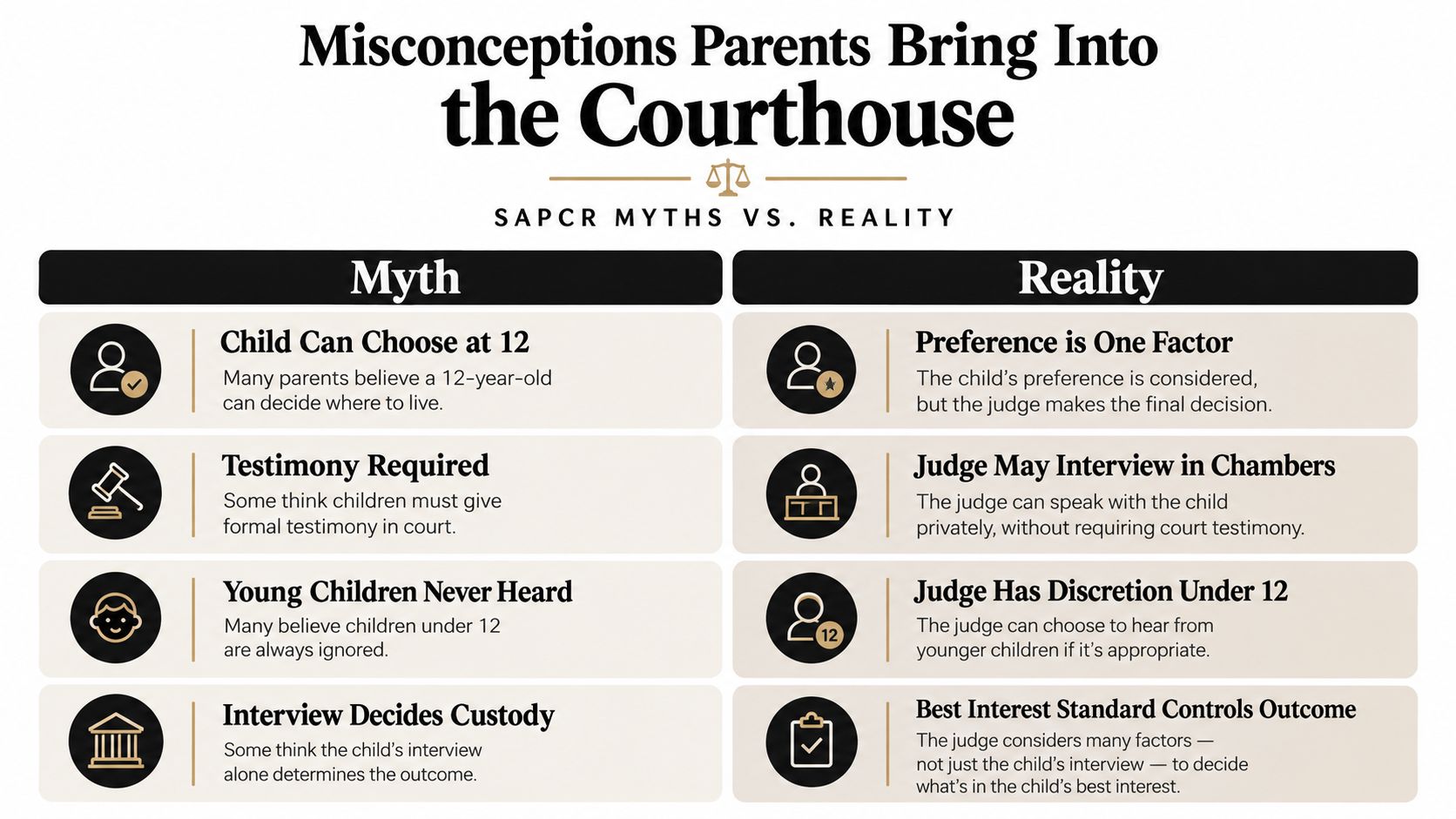
Myth one, a child can choose at 12
A child who is 12 or older may be interviewed in chambers when the statutory request is made in a nonjury custody proceeding. That doesn't give the child power to select the primary residence or dictate the possession schedule.
The judge still applies Section 153.002 and considers the complete record. A child may strongly prefer one home because of friends, rules, comfort, fear, or influence. The court must evaluate what the preference means in context.
Myth two, testimony is required
The court doesn't generally need to place a child in open court just because one parent wants the child's opinion heard. An in-chambers interview may provide a more suitable setting. Chapter 104 safeguards also limit when and how a child may be compelled to testify in open court.
Myth three, younger children have no voice
Children under 12 don't have the same statutory interview pathway, but the judge may still interview a younger child. The court may also consider other reliable evidence about the child's needs and experiences.
Myth four, an interview guarantees a custody win
An interview is not a guaranteed result. The judge may hear a child's preference and still select a different arrangement after considering safety, stability, parental conduct, and the child's broader needs.
Parents should also avoid making the child a messenger, investigator, or emotional support person. If your child is showing anxiety or struggling with divided loyalty, consider age-appropriate evidence-based parenting help NYC or a qualified local provider, while keeping legal and clinical advice separate.
Before filing: Talk with your attorney about the likely benefit, emotional cost, recording procedure, and alternatives to an interview.
The Law Office of Bryan Fagan, PLLC helps Texas mothers, fathers, grandparents, and caregivers evaluate child interviews, possession schedules, conservatorship disputes, modifications, enforcement matters, and related custody concerns. Visit Law Office of Bryan Fagan, PLLC to learn about arranging a free consultation for guidance suited to your family's facts. If you need help with a child custody or visitation case in Texas, our experienced attorneys can guide you every step of the way. Contact The Law Office of Bryan Fagan, PLLC today for a free consultation.