
When your child's future is on the line, understanding your rights matters most.
You may be here because pickup day came and went, and your child never arrived. Or maybe you're the parent thinking, “I don't feel safe sending my child today, but can I legally say no?” Those are heavy moments. They're emotional, urgent, and often confusing.
The short answer to can a mother keep the child away from the father in Texas is that it depends on two things above all else: whether legal paternity has been established and whether a court order already exists. Texas law does not give one blanket answer for every family. The legal path changes based on those papers.
That's why two families can have very different rights even if their situations look similar from the outside. A father with established paternity and a signed court order stands in a very different legal position than an unmarried father who has never signed an Acknowledgment of Paternity or gone to court.
Texas courts also decide custody based on the best interests of the child, which means the judge focuses on the child's safety, stability, emotional needs, and long-term well-being. In plain English, the court asks: what arrangement helps this child grow up safely and steadily?
The Question Every Texas Parent Asks
A mother calls after a breakup and says, “He keeps asking to see our child, but we were never married, and there's no order. Can I say no?” A father calls with the opposite fear: “She won't let me see my son. Is that legal?”
Both parents are asking the same question from different sides.
Texas law can feel unfair when you're living in the middle of a family crisis. It can also feel surprisingly strict. Many parents assume biology alone settles custody rights. In Texas, it often doesn't. Legal rights come from legal status, not just from what everyone informally knows to be true.
Why the answer isn't always yes or no
Texas Family Code Chapter 153 uses a gender-neutral standard in custody cases. Under Texas Family Code § 153.003 and the rules summarized here, courts are prohibited from discriminating based on sex or marital status in custody decisions. Texas no longer follows the old “tender years doctrine” that favored mothers. Once paternity is established, fathers and mothers have the same right to seek custody and visitation.
But there is one place where people get tripped up. If the parents were never married and the father has not established paternity through an Acknowledgment of Paternity (AOP) or court order, the mother keeps sole legal authority by default. In that narrow but very common situation, she can refuse visitation.
Practical rule: In Texas, feelings, family expectations, and handshake agreements don't control custody. Legal documents do.
The questions that decide your next move
Before you act, ask yourself:
- Was paternity legally established through an AOP or court case?
- Is there already a custody order that sets conservatorship and possession?
- Is there an immediate safety risk to the child?
- Are you trying to solve a long-term problem with a short-term self-help decision?
Those answers matter because they determine whether withholding a child is lawful, risky, or a direct violation of a court order.
The Power of Paper Paternity and Court Orders
In family law, paper changes everything.
Parents often say, “We agreed he could see the child every weekend,” or “We've always done it this way.” That may work until conflict starts. Once conflict starts, informal agreements don't give either parent much protection.
Two documents that control the situation
The first key document is an Acknowledgment of Paternity, often called an AOP. This is the legal step that establishes a father's status when the parents were not married. Without that legal status, he may have no enforceable right to possession or decision-making.
The second key document is a court order, often entered in a Suit Affecting the Parent-Child Relationship (SAPCR). A SAPCR is the court case Texas uses to decide custody, visitation, support, and parental rights when there is no divorce case handling those issues.
According to TexasLawHelp's explanation of parents' rights when no custody orders exist, when there is no court order, Texas expects parents to work together, but neither parent can file an enforcement action to force visitation. That means one parent can temporarily withhold the child without immediate legal penalty until the other parent files a SAPCR.
If you're gathering records for a paternity or custody case, organized paperwork matters. Parents and attorneys often rely on reliable document services for law firms when they need court-ready copies, exhibits, and file sets that are easy to present clearly.
| Situation | Mother's Authority | Father's Rights |
|---|---|---|
| No court order, unmarried, paternity not established | Mother has sole legal authority by default | No enforceable rights to visitation or decision-making |
| No court order, paternity established | Parents may both have legal standing, but there is still no enforceable schedule | Father can seek conservatorship and possession through court |
| Court order in place | Must follow the order | Must follow the order and can enforce it if denied |
Before and after legal paperwork
This is the easiest way to think about it. An AOP is the key that opens the door. A court order is the rulebook that tells everyone how the house works.
Without those papers, many parents assume they can call the shots based on what feels fair. Texas courts don't work that way. If you need help understanding the first step, this guide on establishing paternity for custody in Texas explains how fathers move from informal parenthood to enforceable legal rights.
The biggest custody mistakes often happen before anyone ever gets to court. Parents rely on assumptions instead of legal documents.
When No Court Order Exists What Are Your Rights
For unmarried parents, the no-order situation causes the most confusion.
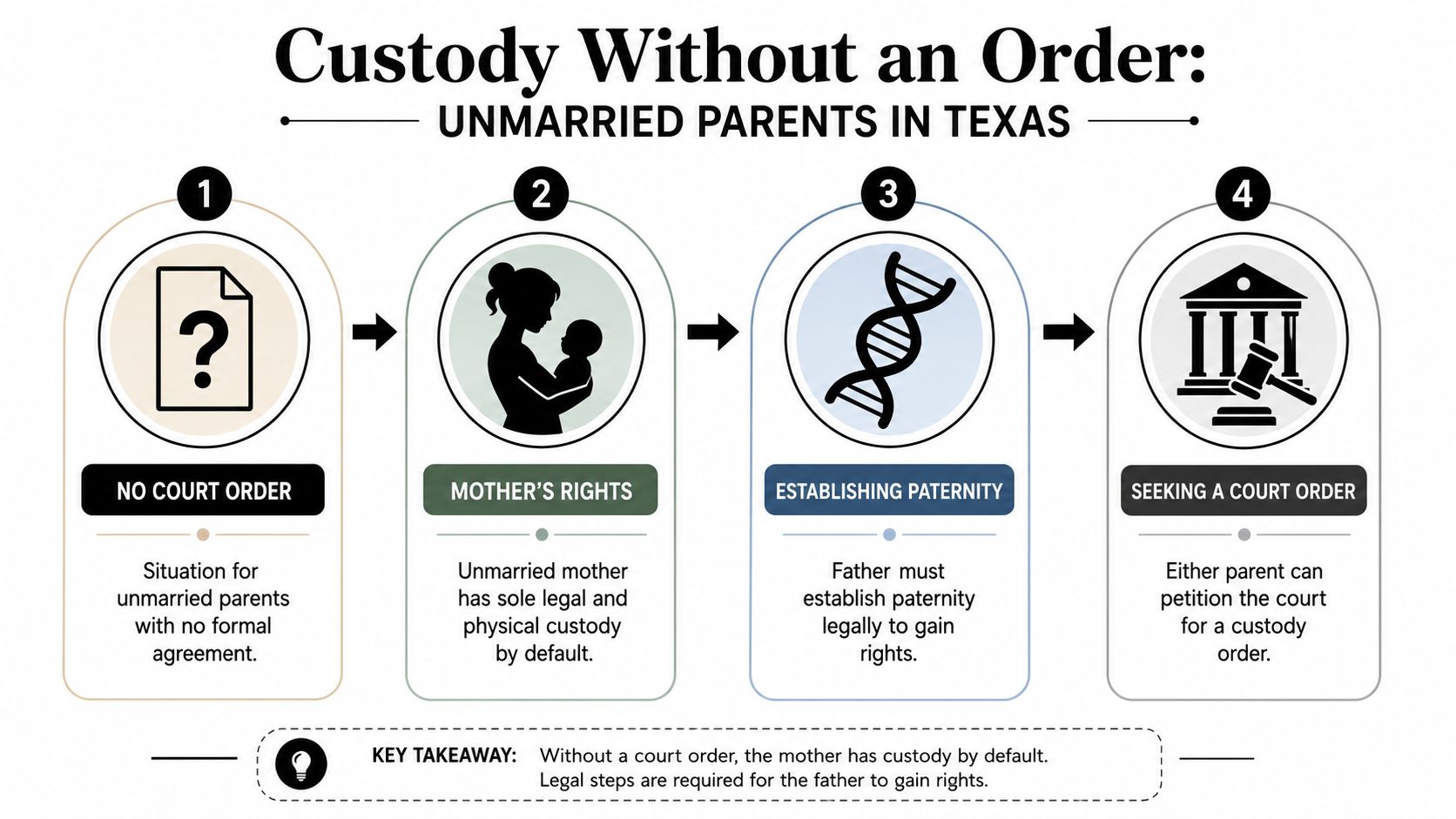
If there's no court order and the father has not established legal paternity, the mother starts with sole authority. Under the Texas law summary here, courts cannot discriminate based on sex or marital status, but without established paternity through an AOP or court order, an unmarried mother retains sole legal authority and can legally refuse visitation.
What that means for mothers
If you are the unmarried mother and there is no order, you may be the only parent with current legal authority. That doesn't mean every decision to block contact is wise. It means the legal starting point is different than many fathers expect.
Still, if your real concern is safety, stability, school, or conflict, court is usually a better answer than a long standoff. A judge can create enforceable rules instead of leaving both parents in a legal gray area.
A factual overview of Custody for Unmarried Parents in Texas can help clarify how custody works when the parents were never married.
What fathers must do to gain rights
For fathers, this part is hard to hear but important: if paternity is not legally established, you may not yet have the right to force visitation. The solution is action, not argument.
A father usually needs to do one of these:
Sign an AOP
If both parents agree, signing an Acknowledgment of Paternity may establish legal paternity.File a paternity case
If there is disagreement, the court can decide paternity, sometimes with DNA testing.Request custody orders in the same process
Once paternity is established, the father can ask for conservatorship, possession, and decision-making rights.
Plain-English custody terms
Some legal terms sound more complicated than they are:
- Best interests of the child means the court chooses the arrangement that best protects the child's welfare.
- Joint managing conservatorship usually means both parents share major rights and duties, such as decisions about school or medical care.
- Possession schedule is the calendar for when each parent has the child.
Without a court order, that possession schedule doesn't exist yet. That's why conflict grows so fast in no-order cases.
Following the Rules With a Custody Order
Once a Texas judge signs a custody order, the legal question changes. At that point, a parent usually cannot decide on their own to stop visits just because they're angry, frustrated, or tired of conflict.
What a custody order actually does
A custody order names the parents' legal roles and sets the rules. In Texas, you'll often see terms like:
Joint managing conservatorship
This usually means both parents share important parental rights and duties.Possession schedule
This is the visitation schedule. It tells each parent when the child is with them.Rights and duties
These cover decisions about education, medical care, and other major parts of the child's life.
A court order is not a suggestion. It is the family's legal operating manual.
Parents who want a clearer written framework often need to focus on what Parenting Plans in Texas Custody Cases must address, including decision-making and possession details.
Common mistake parents make
One parent says, “He was late last week, so I'm keeping the child this weekend.” Another says, “She owes support, so I'm not bringing the child back until she pays.”
That's not how enforcement works. Child support and visitation are separate issues. A parent usually cannot cancel court-ordered possession as punishment.
If fathers are trying to understand how courts view their position once paternity and orders are in place, Fathers' Rights in Texas Custody Cases explains how Texas law treats fathers in conservatorship decisions.
A signed order gives structure to co-parenting. It also limits self-help. Parents must use legal remedies when the other side breaks the rules.
Why this matters so much
The order protects both parents and the child. It gives the child predictability. It gives each parent clear authority. And if someone refuses to follow it, the other parent can ask the court to enforce it.
Without that order, everyone argues about what was “supposed” to happen. With it, the court can look at the exact wording and act.
Emergency Situations When You Can Legally Deny Visitation
There are rare moments when a parent may need to deny visitation because the child faces a real and immediate risk. This is the exception, not the normal rule.
If paternity has not been legally established, an unmarried father has no right to visitation under the Texas DFPS Parent Helpline guidance. In that setting, the legal issue is different. But when a court order already exists, you should assume the order must be followed unless there is a genuine emergency.
Examples of true emergencies
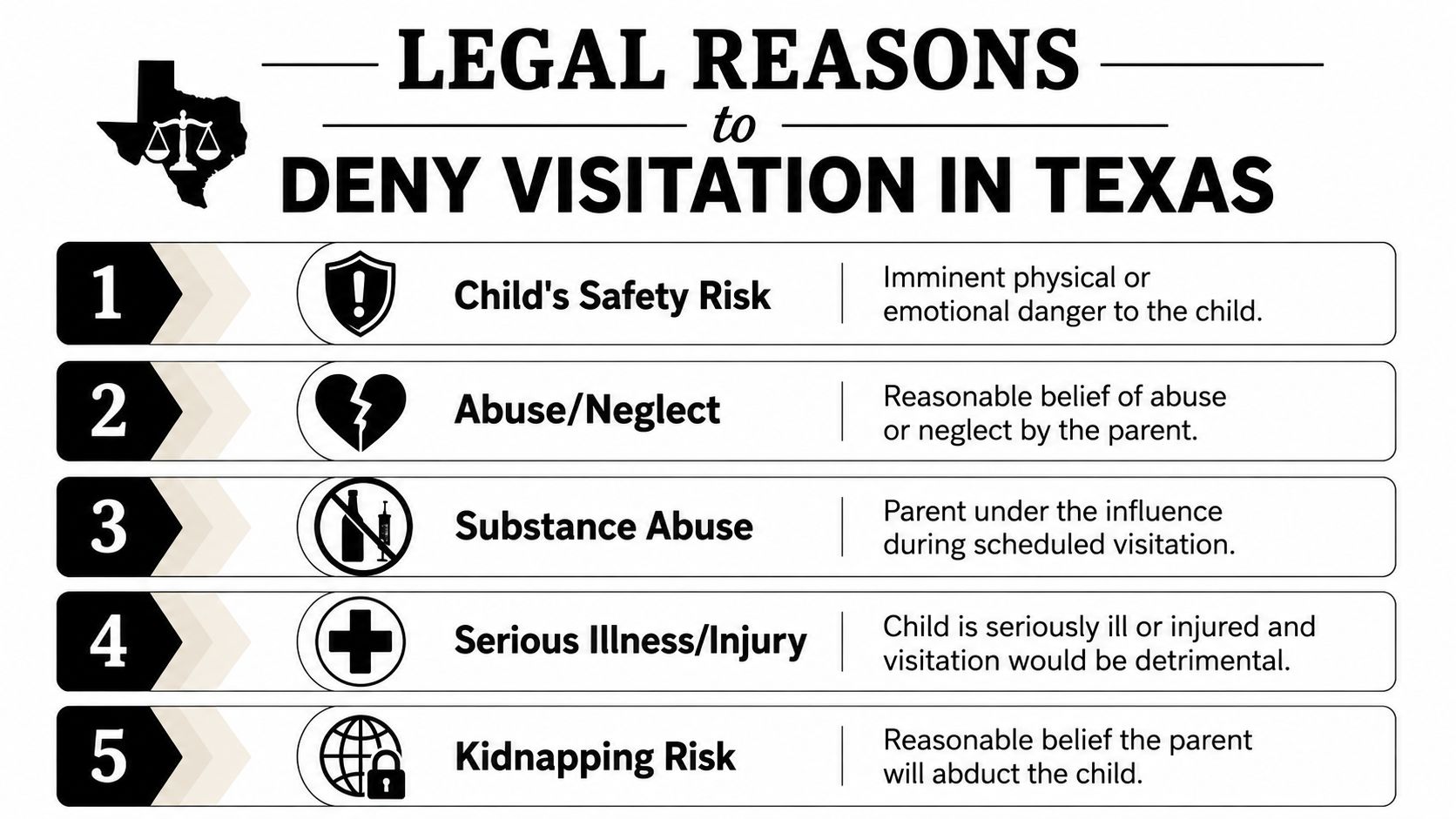
A lawful emergency usually involves immediate danger, such as:
- Current substance use that makes the parent unsafe to supervise the child
- Credible threats of violence toward the child or the other parent
- Reasonable belief of abuse or neglect
- Serious illness or injury that makes the exchange harmful to the child
- A real kidnapping risk
This video gives additional practical context on urgent custody concerns.
What is not usually a legal emergency
Parents often confuse a serious frustration with a legal emergency. These usually do not justify withholding a child on your own:
- The child says they don't want to go
- The other parent is behind on child support
- You and the other parent had an argument
- The other parent is dating someone new
- You think the other household has looser rules than yours
If there is no immediate danger, your safest move is usually to comply with the order and file for a change, not to create your own new rule.
What to do if danger is real
If your child is at risk, move quickly and carefully:
- Call law enforcement if needed
- Document what happened with messages, photos, medical records, or witness information
- Contact a family law attorney immediately
- Ask the court for emergency relief, such as temporary restrictions or emergency orders
For parents facing a fast-moving crisis, this resource on an emergency custody order in Texas can help explain the legal path.
The Consequences of Wrongfully Withholding a Child
Wrongfully keeping a child from the other parent after a court order is in place can backfire badly.
Texas judges expect parents to follow signed orders. If one parent blocks scheduled possession without a valid emergency reason, the denied parent can go back to court and file a Motion to Enforce. That asks the judge to enforce the existing order and punish violations.
What the court can do
A judge may respond in several ways:
- Hold the violating parent in contempt of court
- Order make-up visitation
- Require payment of the other parent's attorney's fees
- Issue stronger, more detailed orders to prevent future violations
- Consider jail time in serious contempt cases
Those consequences matter because courts care greatly about stability and compliance. A parent who ignores the order can damage their credibility with the judge.
Civil trouble can become criminal trouble
There is also a difference between violating a family court order and crossing into criminal conduct. In more severe situations, a parent's actions may raise issues related to interference with child custody.
That's one reason self-help is so risky. A parent may think, “I'm only keeping my child safe” or “I'm only missing one weekend,” while the court sees a deliberate violation of a direct order.
Courts usually respond better to a parent who documents concerns and files the right motion than to a parent who takes control without permission.
If you believe the order no longer protects your child, the answer is usually to ask the court to modify it, restrict it, or enforce it. It is rarely wise to rewrite it yourself.
Your Next Steps A Practical Guide for Mothers and Fathers
When emotions run high, parents often make legal decisions in the heat of the moment. Slow down. Match your next step to your exact situation.
If you're a mother who believes the child is in danger
Take immediate, practical steps:
- Call 911 if the risk is urgent
- Save proof such as texts, photos, videos, hospital paperwork, or witness names
- Write down dates and details while your memory is fresh
- Speak with a family law attorney quickly about emergency court action
If your concern involves verifying a person's history as part of a broader safety review, some parents also look into identity-based screening options such as an FBI background check. That is not a substitute for a court order, but it can be one part of gathering information.
If you're a father being denied court-ordered time
Your strongest moves are usually the calmest ones:
- Document every denial
- Show up as ordered unless your lawyer tells you otherwise
- Avoid angry texts, threats, or confrontations
- Ask about filing a Motion to Enforce
If you're an unmarried father with no order
Start with legal standing:
- Establish paternity
- File for a SAPCR
- Request conservatorship and a possession schedule
A practical option for parents who need help with paternity, custody, visitation, emergency orders, or modifications is Law Office of Bryan Fagan, PLLC, which handles Texas family law matters involving parental rights and child-related court orders.
Key takeaway
If you're asking whether a mother can keep a child away from the father in Texas, the answer depends on the paperwork, the legal relationship, and the presence or absence of immediate danger. No court order means one set of rules. Established paternity changes the picture. A signed custody order changes it again.
The safest path is almost always the legal path.
If you need help with a child custody or visitation case in Texas, our experienced attorneys can guide you every step of the way. Contact The Law Office of Bryan Fagan, PLLC today for a free consultation.