
When your child's future is on the line, understanding your rights matters most.
Maybe you're looking at plane tickets for a family visit. Maybe you've been offered a job in another state. Maybe you're worried the other parent is about to leave Texas with your child and not come back on time. In all of those situations, the same question comes up fast: Can a parent take a child out of state without permission in Texas?
The short answer is, sometimes for travel, rarely for relocation, and never based on guesswork.
In Texas, the answer depends on three things more than anything else: whether a court order exists, what that order says, and whether the trip is a short visit or a permanent move. That distinction matters because parents often treat travel and relocation like they're the same issue. Texas courts usually do not.
If you're trying to protect your time with your child, or avoid making a mistake that could damage your custody case, start with the rules you have. If you need a simple written consent form for a trip, it can help to review sample parental authorization templates so the travel details are clear and documented. If you're also sorting out broader decision-making authority, this explanation of custodial parent rights in Texas is a useful companion.
Your Rights and Risks When Traveling with Your Child
A lot of parents ask this question when they're not trying to break rules at all. They're trying to plan a holiday, attend a funeral, visit grandparents, or let their child see cousins during school break. The problem is that good intentions do not replace legal permission.
Texas family law separates everyday parenting from court-ordered boundaries. A quick trip may be allowed. A move that changes the child's home, school, and access to the other parent usually requires much more. Even when parents share joint managing conservatorship, which often means they share major rights and duties regarding the child, one parent still may not have unlimited power to change the child's residence.
Travel and relocation are not the same
A temporary trip usually means the child is leaving Texas for a limited purpose and returning. A relocation means the child's primary home is changing in a way that affects possession schedules, school, and the other parent's access. Possession schedules are the calendar rules in a court order that say when each parent has time with the child.
Practical rule: If the plan changes where the child lives, not just where the child visits, treat it like a relocation issue until a lawyer confirms otherwise.
Start with a simple decision tree
Use this framework before you book anything:
- No court order exists: You need to know whether both parents have equal rights, or whether paternity has been legally established.
- A court order exists: Read every line about travel, notice, consent, passports, and geographic limits.
- The trip is temporary: Confirm dates, destination, return plan, and whether your order requires notice or written agreement.
- The trip is permanent or open-ended: Stop and treat it as a modification issue, not a travel issue.
The most expensive mistakes usually come from assuming a short trip and a move are close enough. In Texas, they usually aren't.
The Starting Point When No Custody Order Exists
A parent packs for what they call a short trip to another state. The other parent hears about it after the child is gone. By the time anyone agrees on whether it was travel or a move, the case is already in court.
That is the risk when no custody order exists. The problem is not just who has rights. The problem is how fast a judge may have to sort out a misunderstanding that one parent treated as temporary and the other parent sees as relocation.
Under Texas Family Code § 151.001, parents often start from equal rights to possession when no custody order is in place. But equal rights do not create a free pass to take the child out of Texas without agreement. If one parent leaves and the other objects, the objecting parent can file a Suit Affecting the Parent-Child Relationship, or SAPCR, and ask the court for temporary orders, including return of the child, as discussed in this overview of moving out of state with a child and no custody agreement.
Courts usually focus less on who left first and more on what the parent was doing. Was this a weekend visit with a confirmed return date, school still in place, and belongings still in Texas? Or was it an open-ended move dressed up as travel?
That distinction matters.
Start with the right question
If there is no order, ask these questions in this order:
- Is paternity legally established?
- Is the child leaving Texas briefly for a defined trip, or is the child's home functionally changing?
- Is the other parent informed and in agreement, preferably in writing?
- If the other parent objects, are you prepared for an emergency hearing within days?
Parents get into trouble when they skip straight to, “I'm a parent, so I can decide.” That argument is weak in a courtroom, especially if the facts look more like relocation than travel.
A SAPCR is the case that asks the court to set conservatorship, possession, child support, and related rights. Once that case is filed, the judge can issue temporary orders to stabilize the situation quickly. The court may also sign a Temporary Restraining Order, or TRO, to prevent further removal or require the child's return while the case is pending. If a parent ignores those orders, contempt becomes a real possibility.
Unmarried parents need to check paternity first
In unmarried-parent cases, the first legal question is often not travel. It is parentage.
Under Texas Family Code § 160.201, if paternity has not been established, the mother generally starts in the stronger legal position. That can affect who has immediate decision-making authority before the father establishes legal parentage or obtains court orders, as noted earlier in the same Texas relocation source.
For fathers, delay is expensive. Informal involvement with the child may matter factually, but enforceable rights usually depend on established paternity and court orders.
For mothers, a temporary legal advantage can disappear fast if the move looks calculated to cut off the other parent before a judge can act. I have seen parents hurt their own credibility by assuming silence or delay meant consent.
Temporary trip or relocation? Use the facts, not the label
Parents often describe a plan as travel because the word sounds harmless. Judges look at conduct.
A court is more likely to treat the situation as temporary travel if the child has a return date, the parent keeps the child's Texas home base intact, school enrollment is unchanged, and the trip has a clear purpose such as vacation or visiting family. A court is more likely to see relocation if the parent quits a Texas job, ends a lease, transfers schools, moves the child's belongings, or gives vague answers about when the child will be back.
If you are dealing with future restrictions on where a child can live, this explanation of how geographic restrictions work in Texas custody orders helps explain what courts often put in place once a case is filed.
What parents should do right away
For any parent without an order in place, the safest approach is usually simple and disciplined:
- Put the travel dates, destination, and return date in writing.
- State whether the trip is temporary and keep documents that support that statement.
- Avoid one-way tickets, school withdrawals, or lease terminations unless you are prepared to litigate a relocation case.
- File promptly if the other parent has taken the child and you believe the trip is becoming a move.
- If paternity is not established, address that immediately.
A useful starting point for the bigger relocation issues is Parental Relocation and Move-Away Cases in Texas, which explains how courts handle disputes when a parent wants to move with a child.
Judges notice preparation, honesty, and whether a parent protected the child's stability. They also notice when a parent tried to create a new status quo first and explain it later.
If there is no order, treat out-of-state travel as a legal risk assessment, not a casual parenting choice.
Navigating Travel with an Existing Custody Order
Once a Texas court has signed a custody order, that document becomes your rulebook. Don't go by memory. Don't go by what the other parent said last year. Read the order itself.
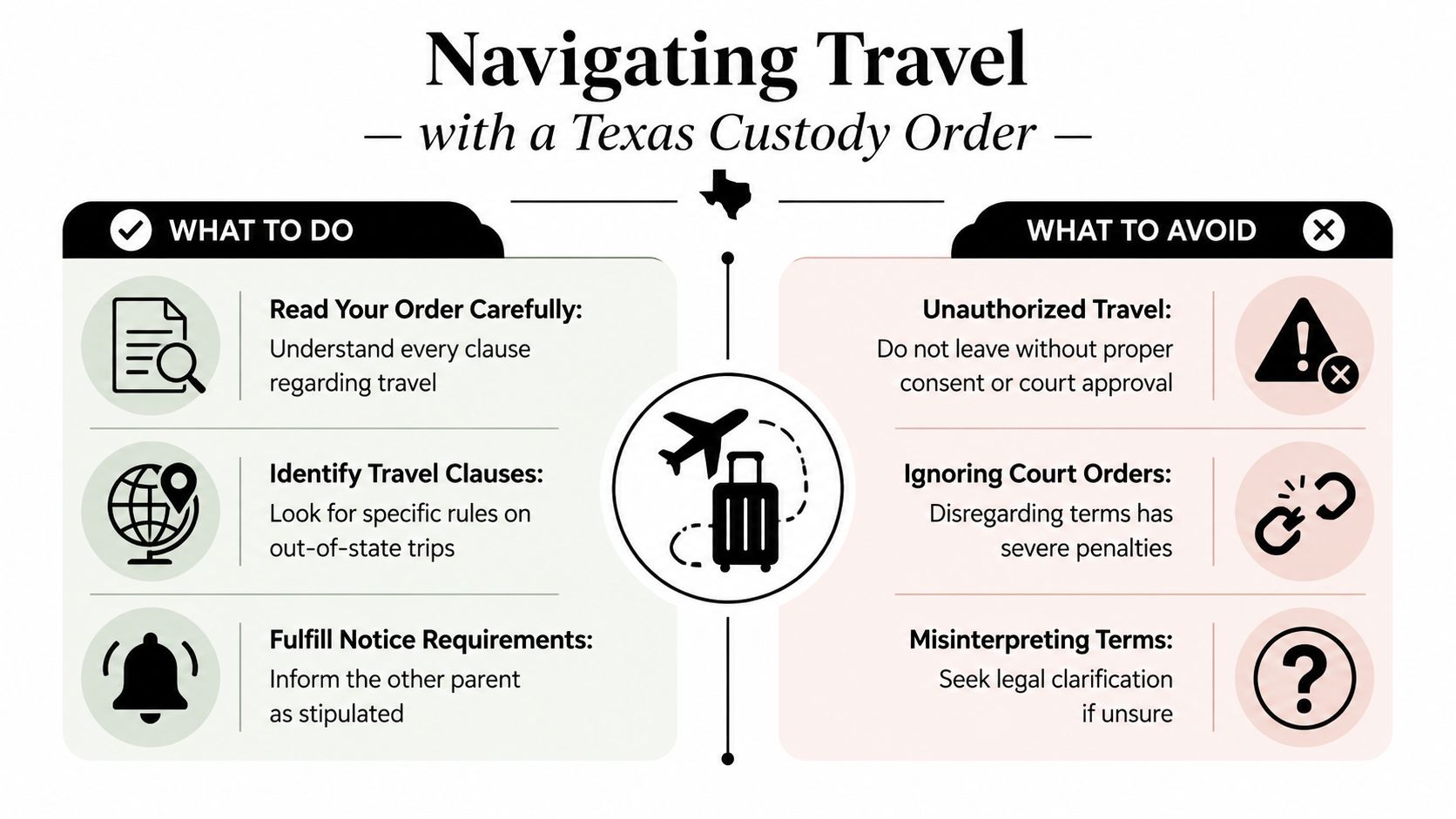
Many Texas orders appoint parents as joint managing conservators. That term doesn't always mean equal time. It usually means the parents share certain rights and duties, while the order assigns who determines the child's primary residence and how possession schedules work. If you want a clearer breakdown of those roles, Parental Rights and Duties in Texas Conservatorship explains the specific rights and duties allocated between conservators.
The first clause to find is the geographic restriction
A geographic restriction limits where the child's primary residence can be. Many orders tie the child's residence to one county or a group of nearby counties. If your order has that language, read it carefully and precisely.
If a custody order includes a geographic restriction, a parent who moves the child outside that area without the other parent's written agreement or a court order modifying the arrangement is violating the order and may face contempt, fines, jail time, or an order returning the child, according to this explanation of unauthorized relocation in Texas custody cases.
For a deeper look at how to read those limits, review this guide on geographic restrictions in Texas custody orders.
Temporary travel versus a residential move
Parents often misunderstand the nuances involved. A vacation to Colorado is not the same as enrolling the child in school in Colorado. A week with relatives is not the same as signing a new lease and calling it temporary.
Use this comparison:
| Situation | Likely issue |
|---|---|
| Short trip with return date and compliance with order | Travel |
| Open-ended stay that disrupts the possession schedule | Potential violation |
| New home, school, or daycare outside the restricted area | Relocation |
| Leaving without notice when the order requires notice | Enforcement risk |
Read the travel clauses line by line
Some orders say little about out-of-state travel. Others are very specific. Look for language about:
- Written notice: Your order may require advance notice before travel.
- Itinerary sharing: Dates, destination, and contact information may need to be provided.
- Consent requirements: Some orders require written agreement for certain trips.
- Passport issues: International travel has added layers, especially for minors.
Texas family law also intersects with federal passport rules. For minors under 16, both parents must sign for the child's passport application through dual parental consent, as described in this discussion of parental kidnapping and travel without a custody order.
If your order is silent, that doesn't automatically mean every out-of-state trip is safe. It means you need to evaluate the trip's impact on the child's residence and the other parent's court-ordered time.
A practical reading method
When reviewing your order, highlight three categories in different colors if that helps:
Residence terms
Find who has the right to designate the child's primary residence and where.Access terms
Find the possession schedule, holiday schedule, and exchange rules.Travel terms
Find notice, passport, and consent language.
Parents usually get into trouble when they read only the possession section and ignore the residence section. The residence language often controls whether the child can leave the area at all.
Permanently Moving Understanding Texas Relocation Laws
A parent leaves Texas for a week with the child. That is usually a travel issue. A parent enrolls the child in a new school, signs a lease in another state, and plans to make that state the child's home. That is usually a relocation case, and the legal risk is much higher.
That distinction matters because parents often misread a move as just a longer trip. Texas courts focus on what changes the child's primary home, daily routine, and ability to keep a meaningful relationship with the other parent. If the answer is yes, the case usually belongs in the modification process, not the travel rules.
If an order is already in place, the parent considering a move often needs to file to change it. This overview of how a Texas custody order can be changed explains the process.
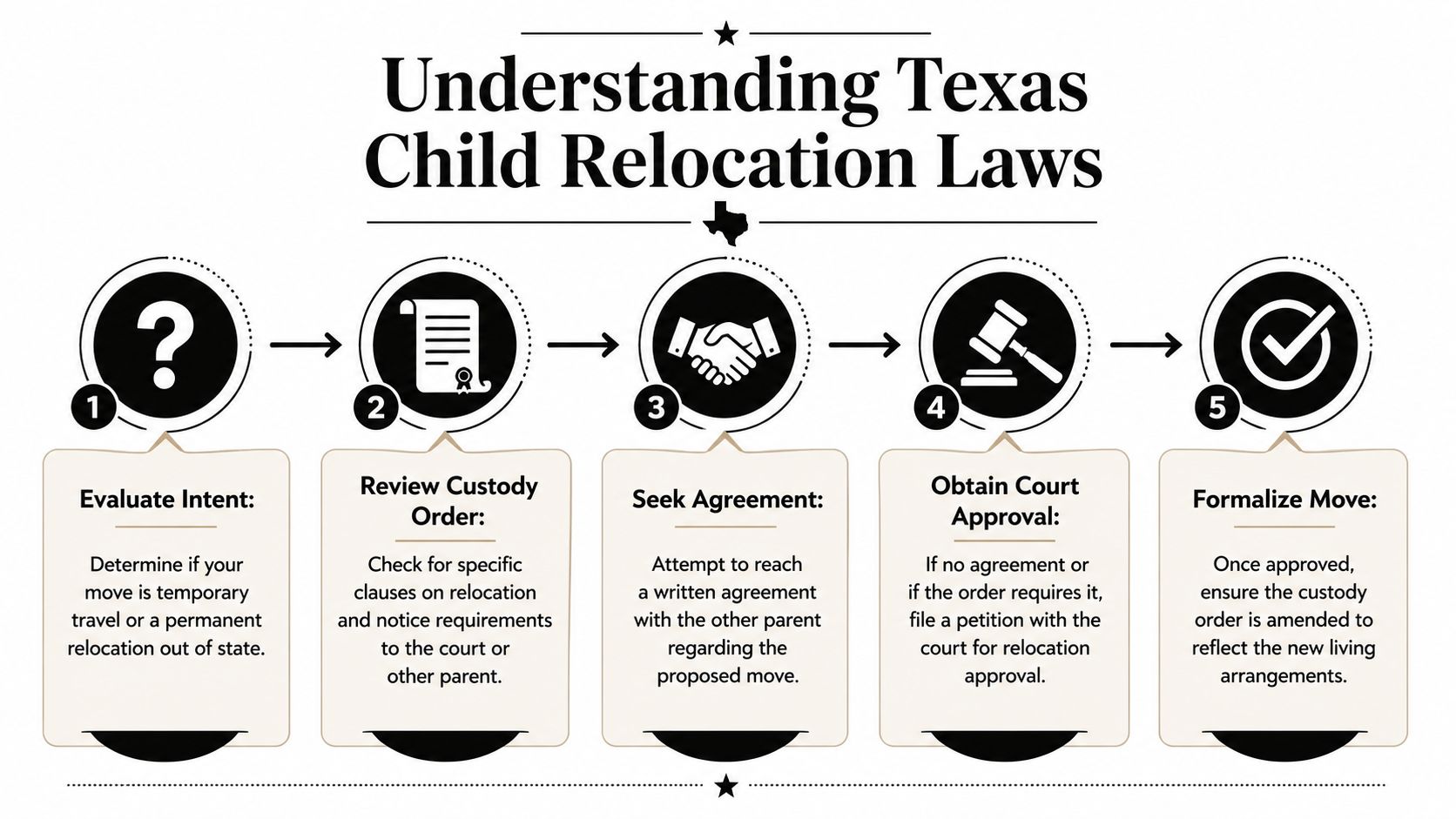
A simple decision tree for relocation
Start with three questions.
1. Is there a custody order now?
If no order exists, a parent still should not assume a permanent move is safe. A sudden out-of-state move can trigger an SAPCR filing in Texas and a fast request for temporary orders about where the child must live.
2. Does the order give one parent the right to designate the child's primary residence?
If yes, read the geographic restriction carefully. Many Texas orders limit the child's residence to one county or a group of counties. Moving outside that area without court approval can set up an enforcement fight quickly.
3. Is the plan temporary travel or a real change of home base?
A hotel stay, vacation, or family visit usually raises one set of issues. A move tied to a new job, new housing, new school, or a one-way plan raises another. For interstate cases, parents should also understand how child custody works across state lines, because crossing state borders does not erase a Texas court's authority.
What courts actually examine
Relocation cases turn on the child's best interest, but judges apply that standard to concrete facts. They look at school stability, family support, the child's needs, the distance involved, the cost and realism of travel for visits, and whether the move will weaken the child's bond with the other parent.
The parent asking to move needs more than a good reason for the adult. A better job, lower rent, or help from relatives may matter, but the court still asks how the child benefits and how the other parent's relationship will be preserved in a workable schedule.
Helpful proof often includes:
- A specific reason for the move, supported by documents if possible
- A proposed address and school plan
- A revised possession schedule with transportation details
- A plan for phone and video contact
- Evidence that the request is centered on the child, not on shutting out the other parent
Here is the embedded video that walks through relocation issues in a practical format:
Notice, modification, and timing mistakes
Many Texas orders require written notice before a parent changes the child's residence. In practice, a parent planning an out-of-state move often needs to give formal notice and ask the court to modify the order before relocating, as explained in this discussion of how relocation affects child custody agreements.
The worst mistake is acting as if approval is automatic. Parents hurt their cases when they sign a lease, accept school enrollment, quit a Texas job, or tell the child the move is final before the judge has ruled. Judges notice whether a parent treated the other parent's rights and the court's authority seriously.
Texas usually keeps control of the case
The UCCJEA decides which state has authority over custody disputes. In many relocation disputes, Texas keeps jurisdiction because Texas entered the original order and the legal requirements for shifting the case to another state have not been met.
A fast move across state lines does not usually create a new home court overnight. If the move was not authorized, the Texas court can still issue orders affecting return of the child, possession, and future conservatorship terms.
Crossing the state line first does not make the move lawful. The safer reading is simple. If the child's home is changing, get legal guidance and court approval before treating the move as final.
What works best is a realistic plan supported by facts. What fails is wishful reading of the order. In relocation cases, that difference often decides who keeps the right to choose where the child lives.
When Unauthorized Travel Becomes Parental Kidnapping
This is the point where family law problems can turn into something much more serious. Parents sometimes assume that if they are the mother or father, they can't be accused of kidnapping their own child. Texas law does not treat the issue so easily.

Texas law recognizes that parental kidnapping can occur even without a formal custody order. When a parent violates an order's travel terms, the other parent can seek contempt penalties that include fines up to $1,000 per violation, possible 90-day jail sentences, and an order returning the child to Texas, as explained in this discussion of child custody across state lines and related interstate issues and the underlying legal analysis of unauthorized removal.
Civil consequences and criminal exposure are different
In family court, the first response is often civil enforcement. One parent asks the judge to enforce the existing order, order the child's return, and punish the violation through contempt. That can affect conservatorship, possession, and credibility in every future hearing.
Criminal exposure is a separate problem. The same conduct that violates a custody order may also lead to criminal investigation when a parent unlawfully removes or restrains a child without the other parent's consent.
Why courts treat these cases so seriously
Texas courts focus hard on child stability. A child who is suddenly removed from school, routine, and regular contact with a parent is at the center of the harm. The legal system is not just protecting paperwork. It is protecting continuity in the child's life and the other parent's rights.
That's also why “I thought I was allowed” can be a weak defense if the order was clear, or if the circumstances obviously looked like relocation rather than a brief trip.
Common missteps that create major risk
Some patterns show up again and again:
- Turning a vacation into a move: The parent leaves for a visit, then announces they're staying.
- Ignoring written terms: The order required notice or consent, and the parent skipped both.
- Cutting off communication: The child is away, and the other parent can't get a clear return date.
- Trying another state first: A parent files elsewhere and hopes Texas loses control.
Courts often react more strongly to secrecy than to disagreement. Parents who communicate and seek orders before acting are in a far safer position than parents who disappear and explain later.
If you're asking whether can a parent take a child out of state without permission Texas is a simple yes-or-no question, this section is why the answer is no. The consequences of getting it wrong can extend far beyond one missed exchange.
Emergency Steps to Protect Your Child and Custody Rights
If the other parent has already taken your child out of state without permission, the most important move is speed. Don't wait to see if things calm down on their own. Delay can make recovery harder and can complicate jurisdiction, enforcement, and the child's stability.
Start by gathering every document you have. That includes the custody order, any written messages about the trip or move, school records, travel details, and screenshots showing what the other parent said and when they said it.
Immediate action plan
Take these steps in order as quickly as possible:
Call a Texas family law attorney
You need to know which emergency filing fits your facts. In some cases, the right step may involve a TRO, emergency enforcement, or a request for immediate return.File in the Texas court with jurisdiction
If Texas issued the custody order, that court often remains the place to act. If there is no order, a SAPCR may be needed right away.Ask for emergency relief
Depending on the case, that may include a Temporary Restraining Order or other emergency orders to stop further removal and seek the child's return.Consider a writ of habeas corpus when appropriate
In child custody cases, that is a court order demanding that the child be brought before the court so the judge can address possession rights.
What to document right now
Your notes matter. Keep them organized and factual.
- Dates and times: When the child left, when exchanges were missed, and when communication changed.
- Statements by the other parent: Save texts, emails, and voicemails.
- Location details: Anything showing where the child may be staying.
- Impact on the child: Missed school, missed medical appointments, or broken routine.
Involve the right people
Law enforcement may be appropriate in some cases, especially if there is a clear order being violated or a serious safety concern. If the situation escalates or the child's location is unknown, families also often look to the National Center for Missing & Exploited Children for guidance and support.
The goal is not panic. The goal is a clear record, fast legal action, and a focused effort to bring the child back under lawful court supervision.
Next Steps to Secure Your Child's Future
The biggest mistake in these cases is assumption. Parents assume a temporary trip doesn't matter. They assume no order means no limits. They assume a move will be forgiven later if the reason sounds understandable.
Texas courts usually expect more than assumption. They expect clarity, notice, and lawful action.
Key takeaway
Keep these points in front of you:
- Check whether a custody order exists
- Read the exact language on residence, travel, and possession
- Treat temporary travel and permanent relocation as different legal issues
- Get written agreement when needed
- Go to court before a move, not after one
- Act fast if the other parent leaves without authority
For parents trying to protect a child during stressful transitions, legal safety and digital safety often overlap. If you're dealing with travel, separation, or cross-state conflict, this guide to children's online safety can help you think through communication, privacy, and protection issues outside the courtroom as well.
A grounded path forward
Mothers, fathers, grandparents, and caregivers all run into this issue from different angles. Some are trying to preserve a bond. Some are trying to create stability after a breakup. Some are trying to stop a crisis before it gets worse.
Whatever side of the issue you're on, the rule is the same. Do not rely on assumptions when your child's residence or out-of-state travel is involved. Gather your order, gather your records, and get legal advice that fits your exact facts.
If you need help with a child custody or visitation case in Texas, our experienced attorneys can guide you every step of the way. Contact The Law Office of Bryan Fagan, PLLC today for a free consultation.