 Skip to content
When your grandchild's future feels uncertain, understanding your rights matters most.
You may be reading this because something in your family doesn't feel safe or stable. Maybe your grandchild has been staying with you more and more. Maybe a parent is struggling, absent, or making choices that worry you. Maybe you're asking the question many loving grandparents ask in a quiet, painful moment: Can grandparents get custody in Texas?
The short answer is yes, sometimes. But Texas law does not give grandparents an automatic right to custody or visitation. Courts start from the position that parents, not grandparents, make decisions for children. That doesn't mean you're powerless. It means you need to follow a very specific legal path, and the details matter.
Texas custody law also uses words that can feel unfamiliar at first. Best interests of the child means the court focuses on what arrangement most protects the child's safety, stability, emotional needs, and overall well-being. Joint managing conservatorship is the Texas term often used when adults share major rights and duties involving a child, such as decisions about education and medical care. Possession schedules are the court-ordered calendars that say when each person has time with the child.
For mothers and fathers reading along, these same core ideas matter in divorce cases, custody modifications, and enforcement actions. Parents often need help understanding how courts decide conservatorship, how visitation works, and when an existing order can be changed. If your family situation overlaps with grandparent involvement, these rules can affect everyone in the case.
A Grandparent's Worry A Legal Question
Your granddaughter has slept at your house four nights this week. You packed lunches, signed a school form, and made sure she got to class. Her parent keeps saying this is temporary. You are left asking a hard question. Are you only helping, or are you already carrying the kind of day-to-day responsibility Texas courts may count as actual care, control, and possession?
That distinction matters more than many grandparents realize.
A lot of custody cases begin in this gray area. A grandparent steps in to keep life stable. Bills get paid. Medicine gets picked up. Bedtimes happen under your roof. From the family's point of view, you are doing what love requires. From the court's point of view, the details matter. The judge will look closely at whether you were acting like an occasional helper or whether you were filling the parent role in a real, continuous way.
That is one of the hidden traps in these cases. Grandparents often wait to ask legal questions until the child has been with them for months. By then, important proof may already be missing. School records, medical records, text messages, and dates on a calendar can make the difference between “I was babysitting a lot” and “I had actual care, control, and possession.” A good starting point is this explanation of how Texas handles non-parent custody cases.
Texas courts do allow grandparents to seek custody in some situations. Still, the law starts with a strong preference that parents make decisions for their children. That means a grandparent usually has to clear two separate hurdles. First, you must show the court has the legal right to hear your case at all. Second, if there is an emergency, you have to be careful not to assume a short-term order will automatically turn into a permanent one. That gap catches families off guard.
A temporary order is a lot like a bandage. It can protect the child for the moment, but it does not finish the healing. Some grandparents get emergency relief, breathe for the first time in weeks, and then learn the harder fight is still ahead. Others never get that far because they cannot prove the child was in their care in the way the law requires.
If you feel confused, that is normal. Family life is messy, and legal rules ask for clean proof. Your love for your grandchild matters. So does your paperwork, your timeline, and your ability to show exactly what role you have been playing in the child's daily life.
Parents should pay attention to this too. If a grandparent becomes extensively involved in daily care, that can affect how the court views stability, safety, and who has been meeting the child's needs. These cases are emotional for everyone involved, but they are often decided by specific facts, carefully documented, over time.
The First Hurdle Establishing Legal Standing in Texas
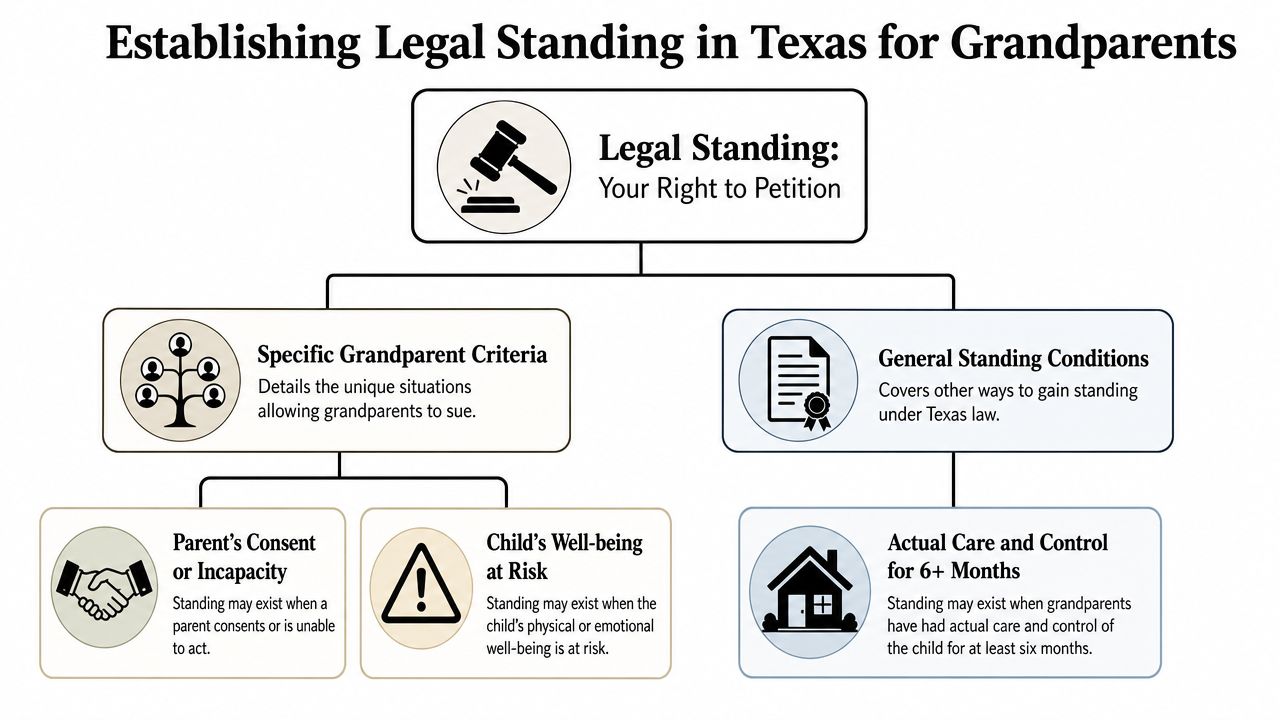
Before a judge can decide where a child should live, the judge asks a simpler question. Do you have the legal right to file this case? In Texas, that right is called standing.
For grandparents, standing is the courthouse door. If you can't open it, the court won't reach the rest of your concerns.
Common paths to standing
Texas law recognizes certain situations where a grandparent may have standing to file a custody case. These can include circumstances where the child's parents are divorced, a parent is incarcerated, declared incompetent, or deceased, the child has been abused or neglected, the parent-child relationship has been terminated by court order, or the grandparent has had actual care, control, and possession of the child for at least six months immediately before filing, as discussed in this summary of non-parent custody in Texas.
If you're trying to understand when grandparents may seek possession or access, Grandparent Access and Custody in Texas gives a helpful overview of when grandparents can seek possession or access to a grandchild.
The six-month rule is more than babysitting
Many people often get confused about this.
A grandparent may gain standing by showing actual care, control, and possession of the child for at least 6 months. But that phrase has real weight. The court is not asking whether the child spent a lot of time at your home. The court is asking whether you were acting like a de facto parent.
According to the Texas State Law Library guide on grandparents' custody standing, many petitions fail because the care looked like consensual babysitting rather than necessary day-to-day parenting.
Practical rule: If the parent still made the major decisions and you simply provided frequent childcare, the court may treat that as help, not legal standing.
What judges look for during that six-month period
Think of it this way. A babysitter watches the child. A parent figure makes the calls.
Useful proof may include:
- School involvement: You enrolled the child, signed school paperwork, or communicated with teachers.
- Medical decisions: You took the child to appointments and handled treatment decisions.
- Daily authority: You set routines, discipline, meals, transportation, and supervision.
- Financial support: You paid for ordinary living expenses, not just occasional extras.
- Independent responsibility: You weren't merely filling in while a capable parent remained in charge.
Keep a timeline. Save texts, school notices, appointment records, receipts, and calendars. Write down dates while they're fresh. Courts often care less about broad statements like “I've raised him for months” and more about specifics like “I transported him to school every weekday, signed his attendance paperwork, and took him to the dentist.”
Why standing feels unfair
Many grandparents feel shocked here. They've done the work, but they don't have the paperwork.
That's why this first hurdle matters so much. If you're asking can grandparents get custody in Texas, the first honest answer is this: only if you can show the law gives you the right to ask.
Custody vs Visitation Understanding Your Legal Options
Once you have standing, the next question is what you want the court to order.
Some grandparents need conservatorship, which is the Texas word often used for custody. Others need possession and access, which means court-ordered visitation. Those are not the same request, and the difference matters.
A simple analogy helps. Asking for custody is asking to become the new driver of the child's daily life. Asking for visitation is asking for legally protected time in the passenger seat of the child's schedule.
Conservatorship compared with visitation
| Feature | Conservatorship (Custody) | Possession and Access (Visitation) |
|---|---|---|
| Basic purpose | Gives a grandparent legal authority over major parts of the child's life | Gives a grandparent set time with the child |
| Daily role | Often involves housing, school, medical care, and routine decisions | Focuses on contact and relationship, not primary control |
| Texas term | Managing conservatorship or another conservatorship role | Possession and access |
| What you must show | Strong proof that the child's current situation is unsafe or seriously harmful, or that the law supports placing the child with you | Proof tied to legal standards for access, not just that visits would be pleasant |
| Practical effect | You may become the person handling day-to-day parenting tasks | You preserve regular contact through an enforceable schedule |
| Responsibility level | High. You take on major parental duties | More limited. Time with the child is protected, but authority stays narrower |
Which option fits your situation
Some grandparents ask for custody when visitation is the more realistic fit. Others ask only for visits when the child needs a stable home and a responsible adult making daily decisions.
If your concern is immediate safety, schooling, medical care, or consistent housing, custody may be the issue. If your bond is being cut off and the child is suffering emotionally, visitation may be the more targeted request.
For families handling layered caregiving issues, it can also help to understand how courts approach decision-making for vulnerable adults. This guide to guardianship for adults gives useful background on a related area of family caregiving law, though child custody follows different Texas rules.
A word for mothers and fathers
Parents often hear these terms in their own cases too. In a divorce or modification, one parent may seek a change in conservatorship while the other argues about possession schedules. Those schedules govern when each parent has time with the child. Texas does not treat time alone as the only issue. Courts also look at who makes major decisions and whether a joint managing conservatorship arrangement is workable for the child.
Proving Your Case The Best Interest of the Child Standard
Even with standing, you still have to prove your request matches the best interests of the child. This standard sits at the center of Texas family law.
That phrase can sound soft and open-ended. In practice, judges look for concrete facts. They consider the child's emotional and physical needs, the stability of each home, the abilities of the adults involved, the plans each adult has for the child, and any danger or disruption in the current situation. Lawyers often group those ideas under the Holley factors, which are common decision-making guideposts in Texas custody cases.
Better for the child is not enough
Many grandparent cases encounter difficulty here.
A grandparent usually can't win by showing, “My home is calmer,” or “I'd do a better job.” The legal bar is higher. Under Texas Family Code standards discussed in this article on the basics of Texas grandparent rights, a court may only order grandparent possession or access if the grandparent proves by a preponderance of the evidence that denying access would significantly impair the child's physical health or emotional well-being.
That's a serious standard. It asks for evidence of likely harm, not just a preference for your home.
What strong evidence looks like
A judge is usually looking for proof that can be checked and tested, not just heartfelt testimony.
Useful evidence may include:
- Records from school: Attendance problems, repeated tardiness, or communications showing instability.
- Medical documents: Missed care, untreated needs, or records tied to the child's condition.
- Messages and emails: Communications showing abandonment, unsafe behavior, or prolonged absence.
- Witnesses: Teachers, counselors, relatives, neighbors, or others who've seen what the child is living through.
- Photographs and timelines: Clear, dated information about conditions, injuries, or repeated disruptions.
If you want a broader look at how courts evaluate these issues, this discussion of best-interest factors in Texas custody cases can help.
A courtroom rewards specifics. “She's unstable” is an opinion. “The child missed school repeatedly, changed homes often, and lacked needed medical follow-up” is evidence.
Keep your focus on the child
The strongest cases stay centered on the child, not the adult conflict. Judges can usually tell when a case is fueled by anger toward a parent instead of concern for a child's well-being.
That same advice applies to mothers and fathers in custody disputes. If you're asking to change conservatorship, expand parenting time, or protect your possession schedule, your case becomes stronger when you focus on the child's needs instead of the other adult's flaws.
Navigating the Court Process Step by Step
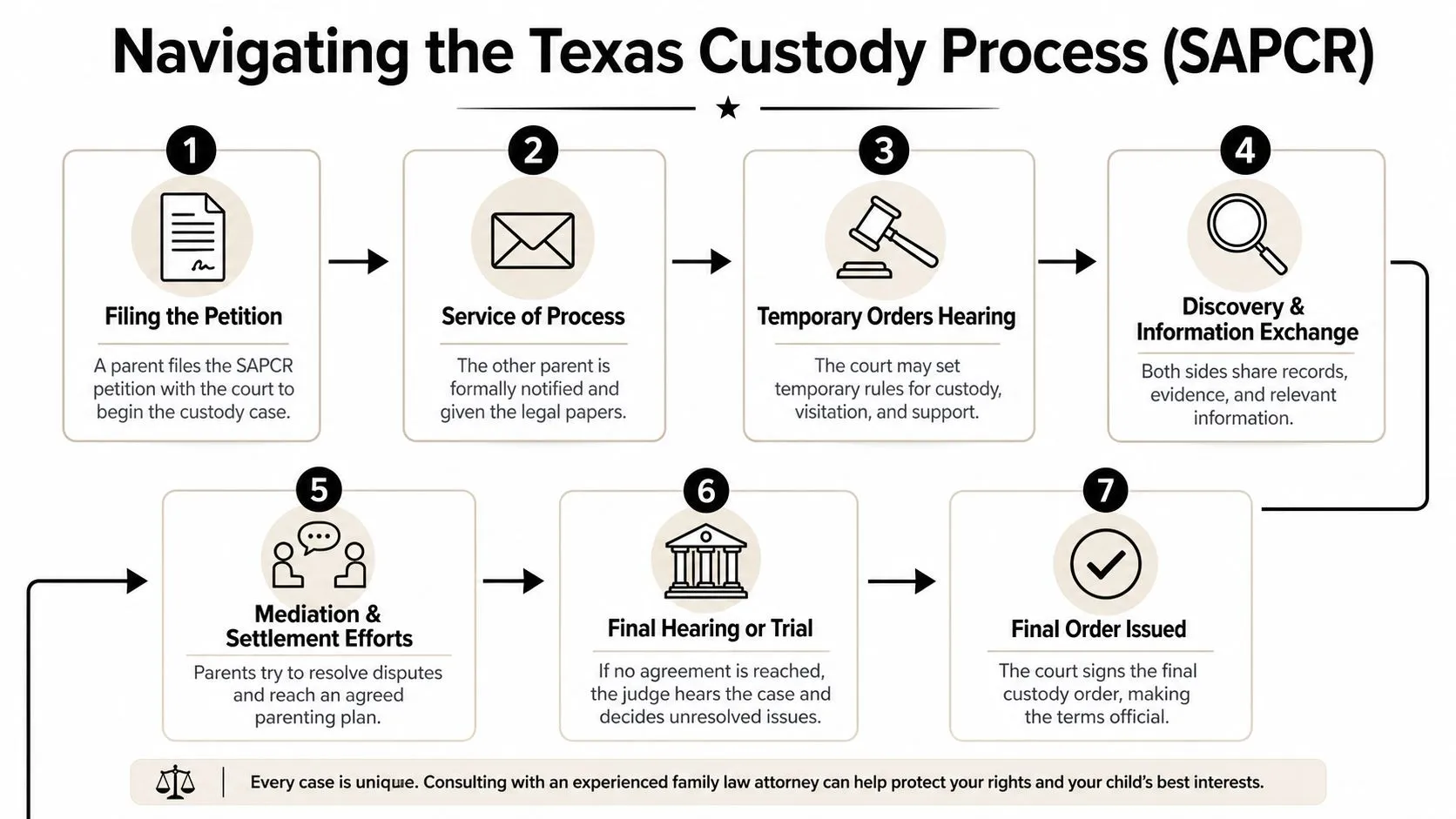
A grandparent custody case in Texas usually moves through a formal process called a Suit Affecting the Parent-Child Relationship, often shortened to SAPCR.
The process can feel intimidating at first, but it helps to think of it as a series of checkpoints. Each step has a purpose. Each one asks for preparation.
What a SAPCR involves
A grandparent seeking custody or visitation must file a SAPCR, formally submit a petition, present evidence such as documents or witness statements, and potentially attend a hearing where the court decides whether the requested order serves the child's best interest, as described in this overview of the Texas SAPCR process for grandparents.
The usual path through court
Filing the petition
This starts the case. The petition tells the court who you are, what legal relief you want, and why the law allows you to ask for it.Service on the parents
The parents must receive legal notice. This isn't optional. Due process requires each party to know a case has been filed.Temporary orders hearing
If immediate structure is needed, the court may address temporary rules while the case is pending.Discovery and information exchange
Both sides gather records, communications, and other evidence. This stage often reveals whether the facts are as serious as claimed.Mediation
Many courts require parties to try settlement before trial. Mediation is a structured negotiation with a neutral third party.Final hearing or trial
If no agreement is reached, the judge hears testimony, reviews evidence, and makes decisions.Final order
The court signs a written order that controls rights, duties, conservatorship, and possession terms.
Why patience matters
A SAPCR is rarely fast. Even when a grandparent has a compelling concern, courts still move through procedure. That can feel frustrating when a child's daily life is unstable.
Court procedure doesn't mean the judge doubts your concern. It means the judge needs admissible proof and a lawful process before changing a child's legal relationships.
Preparation that helps
These habits can make the process easier to manage:
- Keep one case folder: Put school records, medical notes, calendars, and messages in one place.
- Use a running timeline: Add dates as events happen. Don't trust memory alone.
- Stay child-focused in communication: Assume a judge may someday read your texts.
- Learn the basic terms: Conservatorship, possession, access, and modification all mean different things in Texas family court.
For mothers and fathers, this same process often appears in divorce, paternity, and modification cases. A parent seeking to change an existing order still needs evidence, clear requests, and a workable plan for the child.
What to Do in an Emergency Securing Immediate Protection
Some situations can't wait. If a child faces immediate danger, a grandparent may need to seek emergency relief right away.
That could involve asking for an emergency custody order or other temporary court action when there is a serious risk to the child's physical safety or emotional well-being.

Temporary protection is not final custody
This is one of the biggest hidden pitfalls for grandparents.
An emergency order can create immediate stability, but it usually does not end the case. A high percentage of grandparents who win emergency orders later abandon their cases because they don't realize the order is temporary, often lasting only a few weeks, and they aren't prepared for the longer evidence-heavy fight for permanent custody. This timing issue is discussed in this article about the Texas child custody case timeline.
That misunderstanding can be heartbreaking. A grandparent may feel relief after the first hearing, only to discover that the true battle is still ahead.
What you should do right after an emergency order
If the court grants short-term protection, start preparing for the next stage immediately.
- Stabilize the child's routine: School attendance, medical care, meals, sleep, and counseling matter.
- Preserve evidence: Keep every record tied to the emergency and what happened after.
- Build a long-term plan: Judges want to know how the child will be cared for beyond the crisis.
- Ask what the next hearing will address: Temporary and final hearings serve different purposes.
If you need background on urgent filings, this guide to an emergency custody order in Texas explains the basic framework.
A short video can also help you understand the fast-moving nature of these cases:
The hidden gap between now and later
Emergency relief is like getting a child out of a storm shelter line and into the building. It handles the immediate threat. It doesn't answer every long-term question.
Courts still need to know where the child will live, who will handle education, how medical care will be managed, and whether the grandparent can provide ongoing stability. If you treat the emergency hearing as the finish line, you may lose momentum at the point where planning matters most.
Key Takeaways and Next Steps for Texas Grandparents
A lot of grandparents reach this point feeling two things at once. Relief that they understand the rules better, and worry that the rules seem stacked against them.
Both reactions are normal.
The short answer to "can grandparents get custody in Texas" is yes, sometimes. The harder truth is that many cases turn on two hidden trouble spots that families do not see at first. First, you must show the court you have legal standing to file. For many grandparents, that means proving the child lived with them in a parent-like role for the required six-month period. Second, if the case began with an emergency order, you must be ready for the stretch between immediate protection and a final custody decision. That gap is where strong cases can weaken if the proof is thin or the plan for the child is unclear.
Texas courts also start with the parental presumption. The judge begins with the idea that a fit parent usually acts in the child's best interest. A grandparent is asking the court to step past that starting point, so careful proof matters more than good intentions.
What to gather first
Start building your file like you are putting together a child's school binder. Each paper has a purpose. Alone, one record may not say much. Together, they show a pattern.
Gather and organize:
- A clear care timeline: When the child lived with you, who got the child ready for school, who made meals, who handled bedtime, and who took the child to appointments.
- Proof tied to the six-month rule: School forms, medical records, mail, caregiver authorizations, or messages showing the child was living in your home and you were acting as the day-to-day caregiver.
- School records: Attendance notes, report cards, discipline records, teacher emails, and notices about missed assignments or behavior changes.
- Medical records: Appointment summaries, prescription information, discharge papers, counseling records if available, and vaccination records.
- Messages with the parents: Texts and emails about care arrangements, missed pickups, safety concerns, substance use, or requests for you to take over parenting tasks.
- Photos and written notes: Conditions in the home, injuries, missed school, or repeated disruptions in the child's routine.
- Witness information: Teachers, counselors, neighbors, coaches, relatives, or family friends who saw who was caring for the child.
- Your child-related expenses: Receipts for clothing, food, school supplies, medical costs, and transportation.
If you are missing some of these items, do not panic. Start with what you have and organize it by date.
Focus your energy on the legal questions that matter
Courts respond to facts they can test. They do not make custody decisions based only on fear, frustration, or a belief that you may be the more stable adult.
Ask yourself:
- Can I prove standing, especially the six-month caregiving requirement if that is the path my case depends on?
- Can I show specific facts that affect the child's safety, stability, health, schooling, or emotional well-being?
- If I already got emergency relief, am I prepared to show the court why the child's long-term placement should stay the same?
Those questions help separate a strong concern from a legally workable case.
A steady next step
If the child may be in immediate danger, get legal advice right away and act quickly. If there is no present emergency, but you have been filling the parent's role for a meaningful period, talk with a family law attorney before filing. A case can rise or fall on details that seem small at home, such as exact dates, who signed school paperwork, or who took the child to the doctor.
One option for families dealing with custody, visitation, modifications, and emergency orders is Law Office of Bryan Fagan, PLLC, which handles Texas family law matters involving parents, grandparents, and caregivers.
If you need help with a child custody or visitation case in Texas, our attorneys can guide you through the process. Contact The Law Office of Bryan Fagan, PLLC today for a free consultation.


