
When your child's future is on the line, understanding your rights matters most. Maybe you're a mother who remarried and wants your child to share the family surname. Maybe you're a father concerned that changing the name would weaken your relationship or ignore an established paternity order. You may be a grandparent or caregiver trying to keep school, medical, and court records consistent.
A request to change a child's last name in Texas can feel very personal, but the court treats it as a legal decision about the child's identity and welfare. The right strategy is to connect the request to the child's existing custody, paternity, and conservatorship circumstances, not to treat it as a simple paperwork task.
Why a Texas Child Name Change Is a Court Matter
A parent may stand in a school office with a marriage certificate, divorce decree, or family records and expect a routine update. The clerk may still ask for something more important, a court order specifically changing the child's legal name. Under Texas Family Code Chapter 45, a child's surname doesn't change automatically when a parent marries or divorces. The Texas State Law Library explains that a judge must approve the request and find that the change serves the child's best interest. Texas child name-change guidance confirms that the process is court supervised.
That rule protects more than a line on a birth certificate. A child's legal name may appear in paternity findings, conservatorship orders, possession schedules, school records, medical files, travel documents, and child support records. Changing it without notice could create confusion or make it harder for another parent to exercise legal rights.
Practical rule: A marriage certificate or divorce judgment may explain why you want the change, but it doesn't replace the required name-change order for the child.
The best-interest standard in everyday language
“Best interest of the child” means the judge asks whether the requested surname supports the child's overall stability, identity, and well-being. The question is not, “Does a parent prefer this name?” The question is whether the change helps this particular child, considering the family's circumstances.
A judge may listen to facts about the child's relationship with each parent, the reason for the request, the child's experience using the current name, and whether the proposed name would create or reduce confusion. The Texas Bar identifies concerns such as embarrassment, inconvenience, and confusion as factors a court may consider when reviewing the request. Texas Bar information about child name changes
The two problems I see most often are failing to disclose an existing Suit Affecting the Parent-Child Relationship, commonly called a SAPCR, and assuming the judge will accept a parent's preference without supporting facts. A SAPCR is the court case that establishes or changes conservatorship, possession, access, and other parent-child rights. If a name request collides with that case, the court needs to know.
For a practical overview of the legal process, review this guide to changing a child's name in Texas. The safest approach is to treat the surname decision as part of the child's larger family-law picture.
Who Can File and Where the Case Belongs
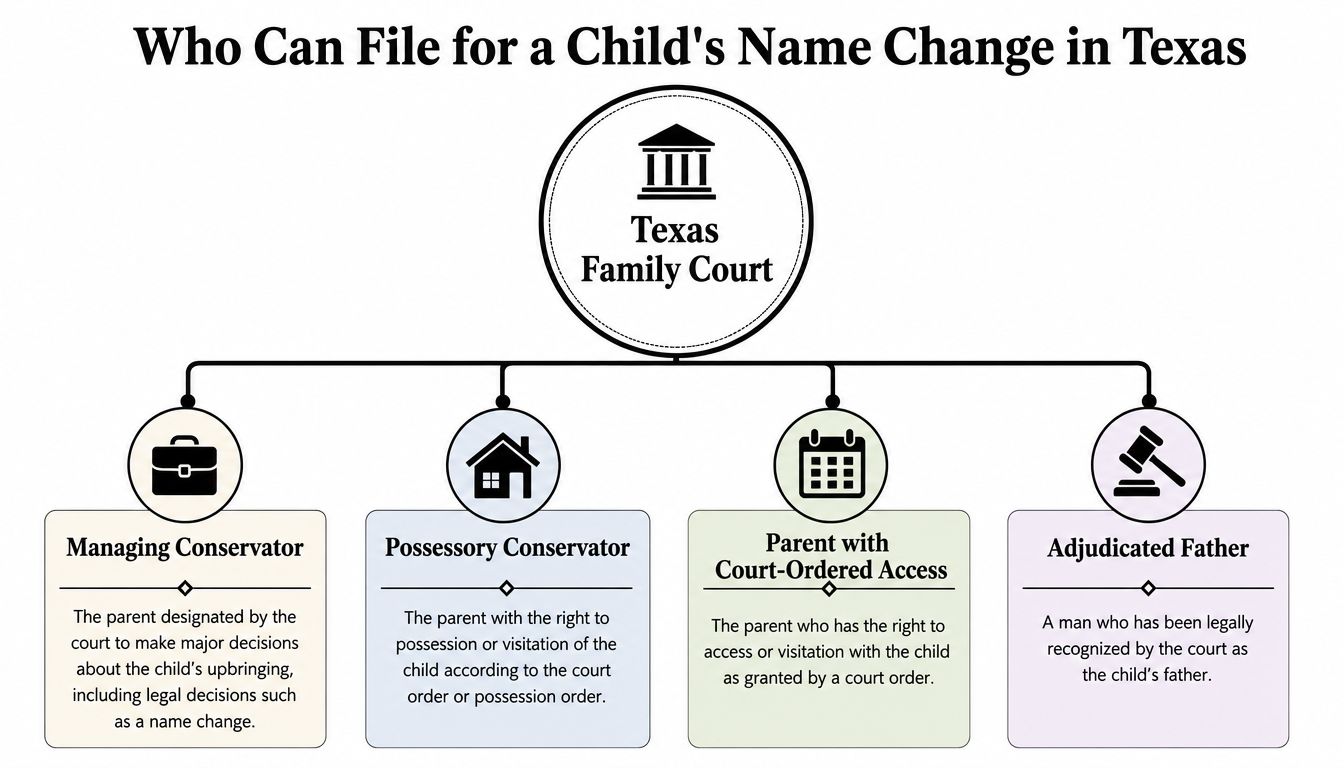
Texas limits who may start a child name-change case. Under Chapter 45, a parent, managing conservator, or guardian may file the petition in the county where the child resides. A managing conservator is a person with court-granted legal rights and duties concerning the child, including authority over certain major decisions. A guardian has legal responsibility for the child without necessarily being the child's parent.
The verified data also recognizes that a possessory conservator or a parent with court-ordered access may have an important legal connection to the child, but filing authority must be confirmed from the governing order and the person's current legal status. Don't assume that being listed on a birth certificate, paying support, or having visitation automatically answers every standing question.
Start with the child's county
The petition generally belongs in the county where the child resides. That filing rule helps keep the case tied to the child's actual home and discourages a parent from selecting a courthouse because it seems more favorable. Families who share time across counties should review the child's primary residence and every existing order before filing.
The petition must also disclose whether another court has continuing jurisdiction over the child. Texas Law Help explains that a child name-change petition is usually a separate lawsuit, rather than a routine request inside a divorce or modification case, unless the matter arises in adoption or paternity proceedings. Texas child name-change filing guidance addresses the required information and filing framework.
If an existing SAPCR is pending or already controls the parent-child relationship, venue and jurisdiction require careful review. A paternity case can also affect the path. Texas appellate authority recognizes that a court may approve a name change in a paternity proceeding when the request is made for good cause. Parents dealing with uncertain parentage should review establishing paternity for custody in Texas before treating the surname issue as separate from parentage.
A child's voice is not the same as a child's choice
Texas requires written consent when the child is 10 or older. That gives an older child a direct voice, but it doesn't mean the child alone decides the outcome. The judge still applies the best-interest standard.
For a focused explanation of how a child's wishes factor into a Texas custody decision, remember the distinction between preference and legal authority. A child may express a view, while the court remains responsible for the final decision.
Getting Consent From Both Parents, the Child, and the Court
Consent can make a name-change case more orderly, but parental agreement doesn't eliminate the need for judicial approval. The court still needs a proper petition, required disclosures, and an order stating that the change serves the child's best interest.
The practical differences are easiest to see side by side.
Three consent paths for a Texas child name change
| Scenario | Who Must Consent | Typical Court Response |
|---|---|---|
| Both parents support the request | The required legal decision-makers should sign the appropriate documents or appear as required, and a child age 10 or older must provide written consent | The judge can review the agreed facts and decide whether the requested name serves the child's best interest |
| One parent objects | The non-terminated parent must receive formal notice and an opportunity to object; a child age 10 or older must still provide written consent | The judge weighs the evidence rather than treating one parent's preference as controlling |
| A non-parent seeks the change | The filer must qualify under the applicable legal rules, provide notice to required parties, and establish why the request benefits the child | The court closely reviews standing, family relationships, notice, and the child's welfare |
Texas law requires written consent from a child who is 10 or older, and that consent must accompany the petition. The statutory petition also must identify the child's current name, residence, requested new name, reason for the request, continuing court jurisdiction, and any applicable sex-offender registration requirement. Texas Family Code Chapter 45 sets out this structured process.
When one parent objects
An objection doesn't automatically end the case, but it changes the work required. The petitioning parent must serve the non-terminated parent or managing conservator and present facts supporting the child's welfare. The court may consider whether the request would create confusion, affect the child's relationship with either parent, or address a practical or emotional problem.
A parent's absence from the child's life, abandonment, safety concerns, or domestic violence may matter when supported by admissible evidence. Avoid turning the hearing into a list of personal grievances. Focus on facts that connect the proposed name to the child's stability and well-being.
A father who fears losing his connection to the child should document consistent involvement, parenting time, school participation, and financial support. A mother seeking the change should explain the child-centered reason without suggesting that a new surname can erase the other parent. The same standard applies to both parents.
Filing the Petition and Moving Through the Hearing
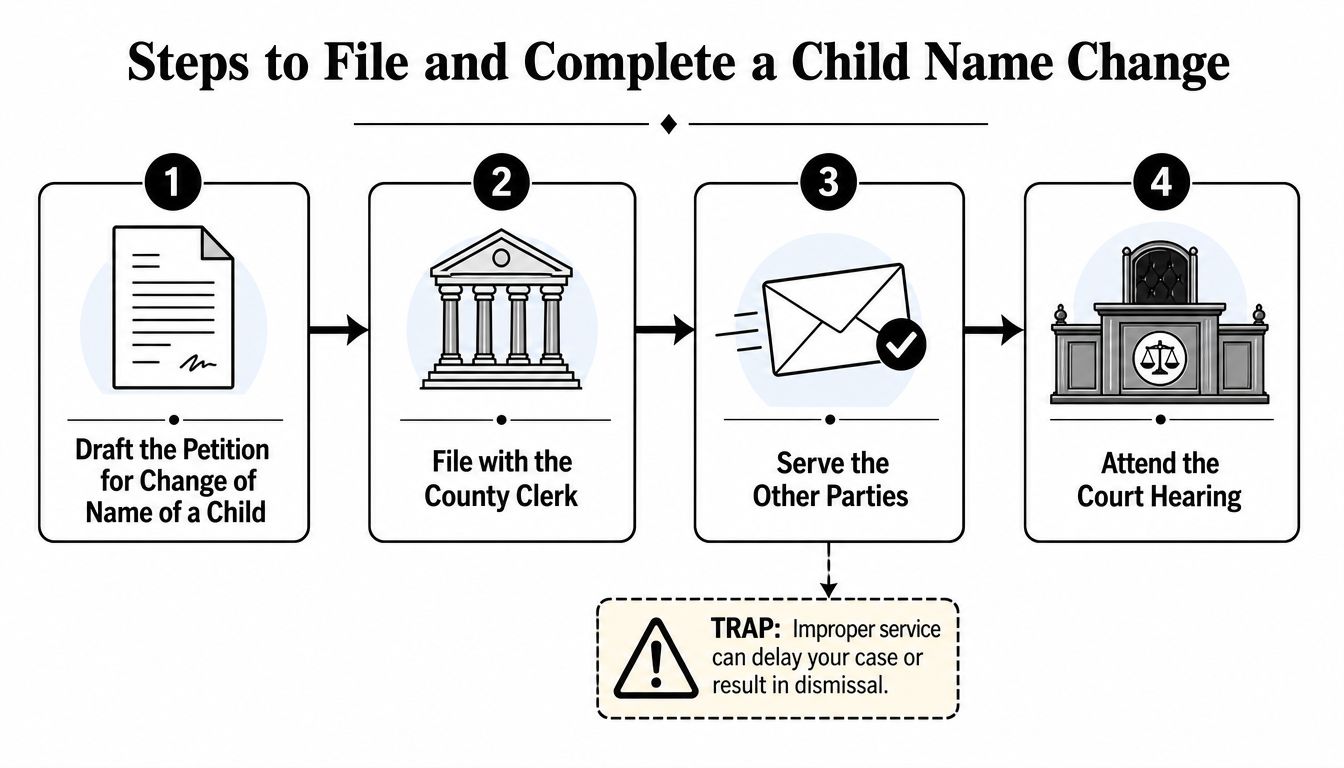
The process starts with a verified petition for change of name of a child. “Verified” means the petitioner confirms the facts under oath or in the manner required by the court. The petition should identify the child's current name and residence, the requested name, the reason for the request, whether another court has continuing jurisdiction, and whether the child has a sex-offender registration obligation.
File in the proper county and check the local district clerk's requirements. Depending on the court and case posture, the filing may involve a civil case information sheet and supplemental paperwork connected to an existing SAPCR. A filing that omits the current custody case can create avoidable problems.
Notice is where many cases fail
Texas requires personal service on each parent whose parental rights haven't been terminated, as well as any managing conservator or guardian who must receive notice. A constable, sheriff, or authorized process server generally handles service. A waiver of citation isn't casual permission. It must be completed in the form required by law, including the required sworn acknowledgment.
If the other parent can't be located, the court may require a different form of notice, such as service by publication, but publication isn't a shortcut you choose because personal service feels inconvenient. You must follow the court's requirements before asking for alternate service.
Texas Law Help identifies omitted service, missing consent for a child age 10 or older, and filing in the wrong type of case as recurring procedural mistakes. Texas guidance on changing a child's name also emphasizes that the name-change request is generally a separate lawsuit unless it is part of adoption or paternity proceedings.
Prepare for the hearing
At the hearing, the judge may ask about the child's identity, parentage, conservatorship history, reason for the change, and effect on the child. Bring the existing orders, proof of service, the child's written consent when required, and evidence supporting the best-interest finding.
The other parent may argue that the request is retaliatory, unnecessary, confusing, or harmful to the parent-child relationship. Answer directly. A strong presentation shows how the proposed name fits the child's real life, rather than relying on anger from the divorce or custody dispute.
This short educational video may help you understand the general process:
Costs, Timelines, and What Slows the Process Down
Texas doesn't use one statewide fee or schedule for every child name-change case. County filing charges, service expenses, and any publication requirement vary. Because the verified data doesn't provide reliable statewide amounts or standard hearing windows, you shouldn't rely on an online estimate without checking the clerk's office in the county where the child lives.
The bigger cost issue is often procedural delay. A clean, agreed filing may move more efficiently than a contested case, while disputes over parentage, service, or existing custody orders can expand the work. Before comparing costs, compare the legal posture.
Common sources of delay
- Unresolved paternity: If legal parentage hasn't been established, the court may need to address that issue before the name request can be resolved.
- Difficult service: An out-of-state parent, a parent who can't be located, or a military service member may require special procedures and additional court review.
- Related SAPCR litigation: A pending custody modification, enforcement proceeding, or conservatorship dispute can complicate the court's review of the surname request.
- Fee-waiver issues: A person who can't afford filing costs may need to submit an inability-to-pay affidavit and follow the court's procedure for deciding it.
- A contested hearing: An objection requires notice, preparation, evidence, and a judicial decision instead of a simple agreed presentation.
| Scenario | Estimated Costs | Typical Timeline |
|---|---|---|
| Agreed request with complete documents | County filing and service charges, subject to local requirements | Often more efficient than a contested matter, depending on the court's calendar |
| Request requiring alternate service or additional filings | Filing, service, and possible publication-related expenses | May take longer because the court must review notice efforts |
| Contested request tied to custody or paternity issues | Court charges plus legal preparation and hearing expenses | Can extend substantially when related disputes remain unresolved |
Parents should also separate general court-cost information from advice about their specific filing. A resource discussing typical court costs in LA may provide broader context, but it doesn't replace a Texas county clerk's current requirements or a Texas family-law evaluation.
Don't build your plan around a promised deadline. Gather the existing custody and paternity orders first, confirm the correct county, identify every person entitled to notice, and prepare the best-interest evidence before filing. Those steps address the problems that most often force a parent to redo work.
After the Order Is Signed, Putting the New Name to Work
A signed order is the legal turning point, but it isn't the end of the family's administrative work. The new surname must be carried consistently across records that affect the child's education, healthcare, identification, travel, and daily exchanges between parents.
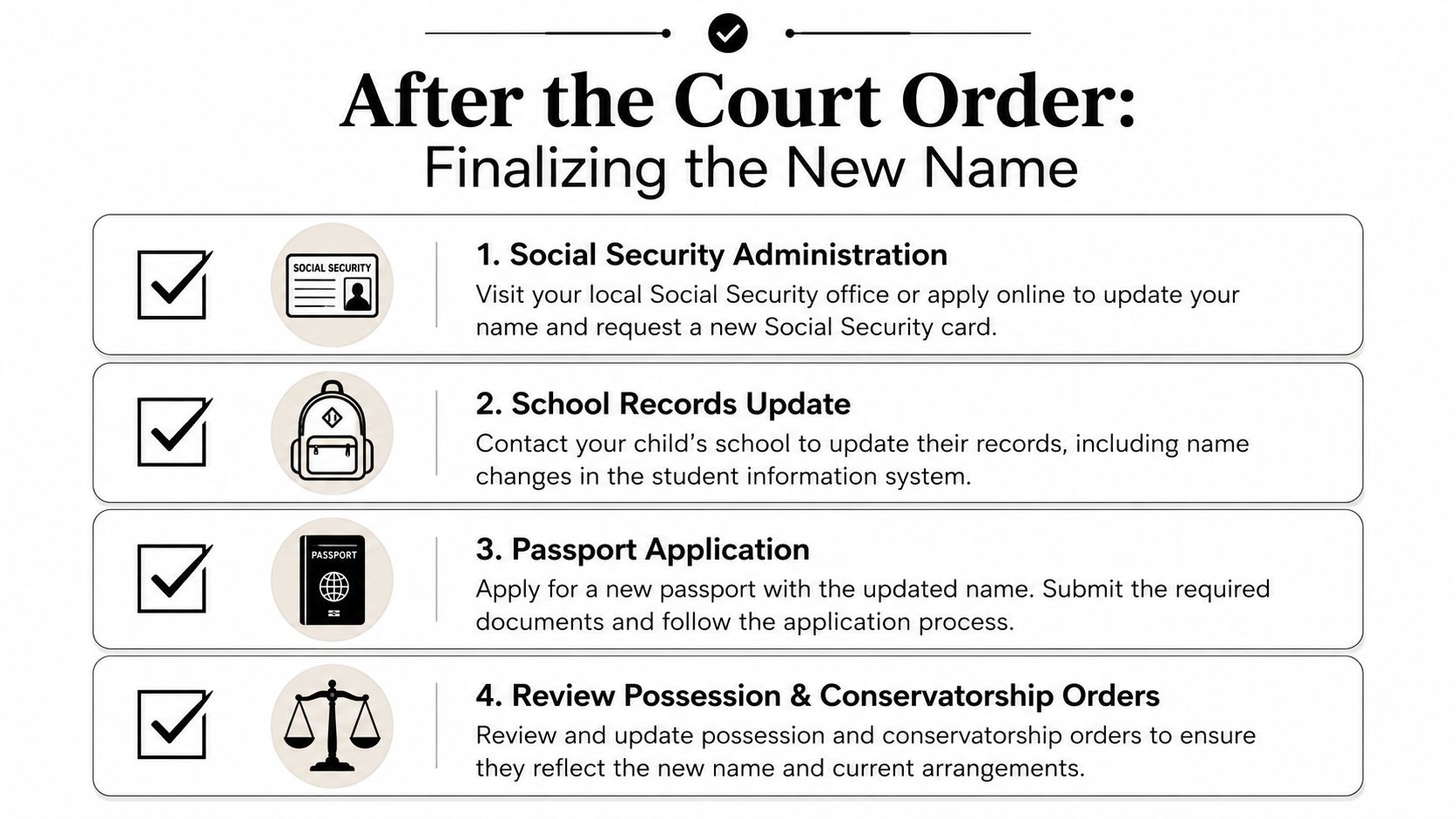
Start by obtaining certified copies of the order and following the Texas vital-record process for an amended birth record. The order authorizes the legal change, while the amended record becomes an important document for proving the child's updated identity. Keep the prior order and the new order together in the family file.
Update records in a deliberate order
Use the signed order and amended birth record when working with agencies. Each office may have its own documentation rules, so call ahead instead of assuming one document works everywhere.
- Social Security Administration: Ask what certified documents are required to update the child's record.
- School and childcare records: Provide the legal documentation to enrollment staff, teachers, and transportation personnel.
- Medical and dental offices: Update patient charts, insurance records, prescriptions, and emergency contacts.
- Travel documents: Review passport records and any travel consent letter or court language that uses the former surname.
- Financial and support records: Check child support, insurance, benefit, and account records for mismatched names.
Keep custody documents consistent
A surname change doesn't automatically rewrite conservatorship rights, possession schedules, or access terms. Joint managing conservatorship means both parents share legal rights and duties under the court's order, although the order may assign certain decisions to one parent. A possession schedule sets when each parent has the child, where exchanges occur, and how holiday or travel arrangements work.
Review exchange logs, school pickup authorizations, medical forms, travel letters, and copies of every custody order. If a parent violates the existing possession terms, a name change doesn't solve that problem. Families dealing with that separate issue can review enforcing a Texas custody and possession order without confusing enforcement with the surname case.
Keep a certified copy of the final custody order with the name-change order. If you need to locate or verify that document, use this step-by-step guide to obtaining a copy of a final custody order in Texas.
The practical checklist is simple: secure the court order, request the amended birth record, update federal and school records, revise medical and travel documents, and compare every custody-related record for consistency. Handle the updates calmly, and give both parents the same clear documentation whenever the order requires shared decision-making.
If you're weighing a child surname change alongside custody, paternity, support, or visitation concerns, Law Office of Bryan Fagan, PLLC can review the existing orders, assess the best-interest issues, and help prepare the petition and hearing strategy. Schedule a free consultation to discuss your family's facts and the legal steps available to you.
If you need help with a child custody or visitation case in Texas, our experienced attorneys can guide you every step of the way. Contact The Law Office of Bryan Fagan, PLLC today for a free consultation.