 Skip to content
When your child's future is on the line, understanding your rights matters most. You may be trying to respond to a sudden move, a deployment notice, missed exchanges, or a safety concern while also keeping your child's routine steady. In El Paso, those problems can become more complicated when parents live in different counties, move because of military service, or face enforcement questions across jurisdictions.
A child custody lawyer in El Paso can help you identify the correct legal path, gather useful evidence, and present a child-focused request under Texas law. The Law Office of Bryan Fagan, PLLC helps mothers, fathers, grandparents, and caregivers understand conservatorship, possession, support, enforcement, and emergency relief without losing sight of the family behind the case.
When Your Child's Future Is on the Line in El Paso
Consider a parent who learns that the other parent may leave El Paso after accepting a job elsewhere. The current order may allow regular possession, but the new plan could disrupt school, transportation, holidays, and the child's relationship with both parents. If the relocating parent is also a service member preparing for deployment, the usual assumptions about absence and custody may not fit the situation.
Another parent may face a different crisis. The other household has become unsafe, the child has missed exchanges, or a parent has taken the child outside the geographic area named in an order. The parent knows something needs to happen quickly but doesn't know whether to request an emergency order, file a modification, seek enforcement, or address jurisdiction first.
Those choices matter. Texas courts don't change custody arrangements because one parent is angry, worried, or dissatisfied with a schedule. Courts look for the legal standard that matches the problem and evidence that connects the requested relief to the child's best interests. In an emergency, generalized concern usually isn't enough. The request must be supported by specific, firsthand facts showing an immediate risk, and emergency relief generally must connect to an underlying SAPCR, divorce, or modification case. Parents dealing with immediate danger can review this explanation of emergency ex parte custody orders while seeking individualized legal advice.
Practical rule: Don't wait until the next missed exchange or planned move to start organizing your case. The strongest custody decisions usually come from clear records, specific requests, and early preparation.
Texas has a large child-welfare system that also affects how courts and agencies handle parental rights and placement concerns. The federal Child Welfare Outcomes dashboard reported 17,225 children in foster care on September 30, 2024, down from 29,916 in 2020, while the foster care entry rate remained 1.2 per 1,000 children in both 2023 and 2024. Texas has more than 7.6 million children under 18, according to the data summarized by Modern Family Law. That background helps explain why some El Paso custody disputes intersect with emergency orders, conservatorship, placement stability, visitation, reunification, and child-protection standards.
How Texas Determines Child Custody and Conservatorship
Texas Family Code Chapter 153 generally uses conservatorship instead of the everyday word “custody.” Conservatorship describes a parent's legal rights and duties. Possession and access describe when the child is physically with each parent. Keeping those ideas separate prevents a common mistake: assuming shared legal rights automatically create equal overnight time.
Texas Family Code § 153.002 makes the child's best interest the primary consideration when a court appoints managing conservators. El Paso County family courts handle custody, paternity, and post-judgment matters within that statewide framework. The court's question isn't which parent deserves to win. It's which arrangement best protects the child's safety, stability, development, and relationship with appropriate caregivers. You can read more about conservatorship in Texas before meeting with counsel.
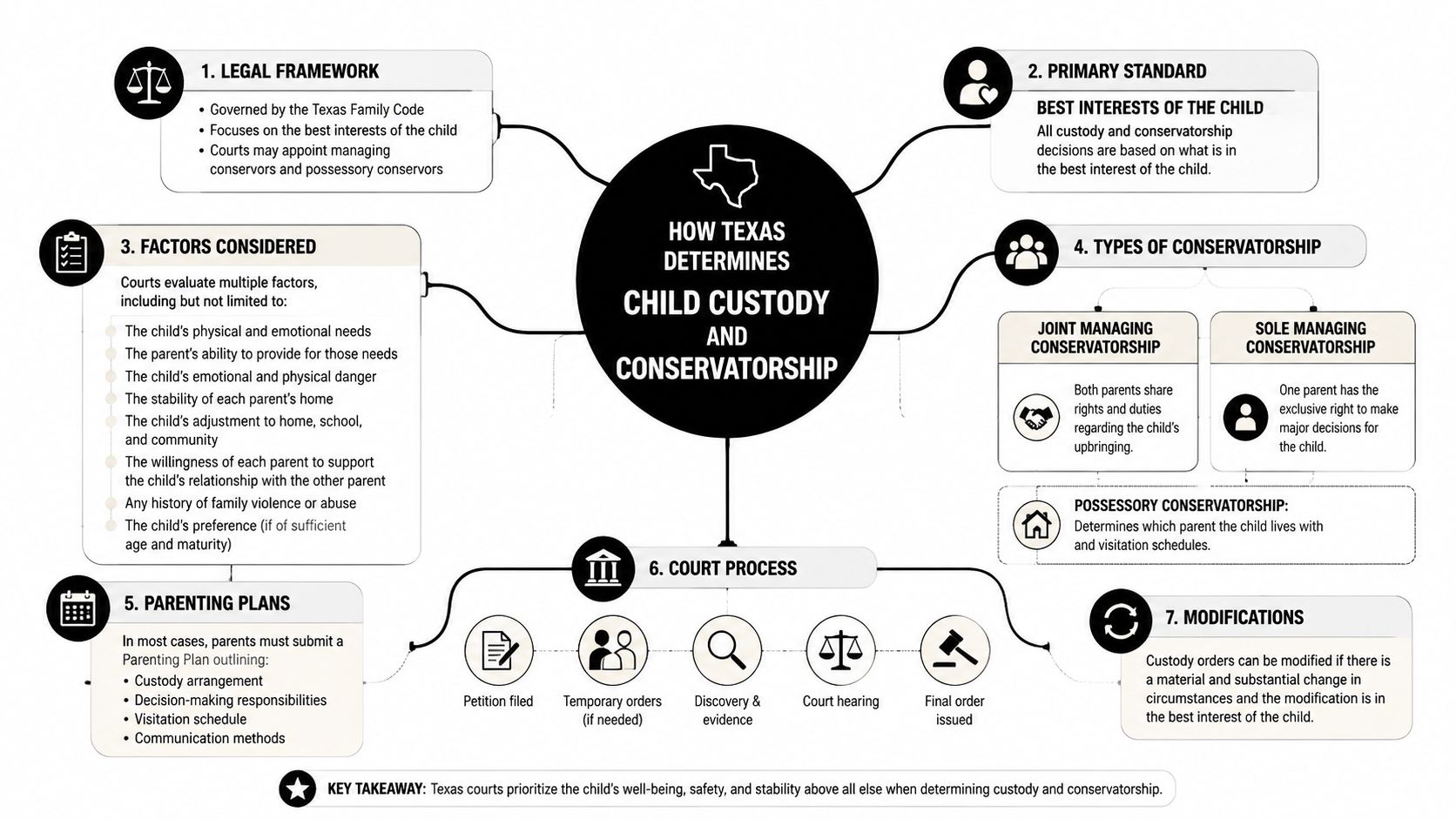
Joint and sole managing conservatorship
Texas commonly starts with joint managing conservatorship, meaning both parents share certain rights and duties. The statute doesn't require equal or nearly equal physical possession. One parent may have the child most of the time under the possession schedule while both parents retain specified decision-making rights.
The statewide guide referenced in the verified legal background estimates joint managing conservatorship is ordered in about 90% of cases. Joint Managing Conservatorship in Texas is therefore important to understand, but the label alone won't tell you who chooses the child's school, who consents to medical care, or where the child primarily lives. The order must specify whether each right is exercised independently, jointly, or exclusively.
A sole managing conservator has exclusive authority over rights the court assigns to that parent. A court may consider that structure when evidence shows serious safety concerns, persistent conflict, or an inability to make important decisions together. Sole managing conservatorship doesn't automatically erase the other parent's right to possession or access, because the final order controls those details.
What “best interests” means in practice
Texas courts often consider the Holley factors, which include the child's desires, emotional and physical danger, each parent's abilities, the stability of each home, and each parent's plans. These factors aren't a rigid checklist. A judge can weigh other child-centered facts that help explain what arrangement will work.
For a young child, useful evidence may include medical instructions, school communications, attendance information, reliable transportation plans, and a parent's demonstrated ability to maintain routines. Parents should also learn about age-appropriate needs and how to support your child's development so their proposed schedule reflects the child's actual stage and needs.
Your gender doesn't decide the result. Mothers and fathers both need to show consistent caregiving, sound judgment, respect for the order, and a realistic plan. A parent who asks for primary possession should explain how school, healthcare, transportation, communication, and the other parent's involvement will work after the court grants the request.
What to Expect During an El Paso Custody Case
A custody case usually begins with a Suit Affecting the Parent-Child Relationship, commonly called a SAPCR. A SAPCR can establish conservatorship, possession, access, support, and other orders when parents aren't addressing those issues in an existing divorce case. Paternity may need to be established before a father can obtain enforceable rights, and grandparents or caregivers may need a different legal basis to request standing and relief.
The case then moves through several possible stages. The exact path depends on the facts, the existing orders, and whether the parents can reach a workable agreement.

The main procedural milestones
Filing and service: One party files the petition, and the other party receives formal notice unless the parties use a lawful alternative. Your petition should state the orders you're asking for, including geographic restrictions and specific possession terms when those issues matter.
Temporary orders: The court may establish an interim possession schedule, address support, allocate expenses, and restrict removal from a defined geographic area while the case continues. Temporary orders stabilize the child's life. They don't automatically decide the final result.
Evidence gathering: Each side may collect school, medical, communication, employment, travel, and safety records. Preserve original messages and organize them by date. A single dramatic message rarely explains the full parenting pattern.
Negotiation or mediation: Many parents resolve disputes through structured negotiation or mediation. A settlement should address ordinary weeks, holidays, transportation, notice, travel, electronic communication, medical decisions, school decisions, and future moves.
Discovery and preparation: When the dispute remains contested, attorneys may request documents, written answers, or testimony. Preparation should focus on admissible evidence, not a long list of every grievance in the relationship.
Final hearing or trial: The judge hears evidence and enters orders based on the child's best interests and the legal requests properly before the court.
Enforcement or modification: After final orders, a parent may need enforcement when the other party violates the order, or modification when circumstances materially and substantially change.
Parents should review a practical Texas child custody case timeline and ask counsel how El Paso County procedures may affect hearings, filings, and records. The county's local family-court rules specifically include custody, paternity, and post-judgment matters.
The timeline is rarely predictable enough to justify promises. A parent can help the case by following every temporary order, keeping exchanges calm, communicating in writing, and preparing a proposed schedule that serves the child rather than punishes the other parent. The same preparation applies when reviewing Fathers' Rights in Texas Custody Cases, because Texas law evaluates fathers through the same conservatorship and best-interest framework.
A short video can also help parents understand the general process before a consultation:
Common Custody Scenarios That Require Legal Action
Not every custody problem calls for the same filing. A routine schedule disagreement may require enforcement or negotiation. A planned move may require modification and a geographic analysis. A safety crisis may demand emergency relief supported by firsthand evidence.
Modification after circumstances change
Texas Family Code § 156.101 generally requires proof of two elements: a material and substantial change in circumstances since the prior order, and the requested change being in the child's best interest. The parent asking for modification carries the burden of building that connection. A new work schedule, school problem, relocation plan, changed medical need, or breakdown in co-parenting may matter, but the evidence must show why the existing order no longer serves the child.
Texas typically restricts a request to change primary custody filed within one year of the prior order. A sworn affidavit must support a statutory exception before the case can proceed. The exceptions include endangerment, voluntary relinquishment for six months, or a child who is 12 or older stating a preference, subject to the statute and the court's best-interest analysis. A child's preference isn't an automatic decision.
Emergency relief and immediate danger
Emergency orders require focused proof. Bring firsthand facts describing what happened, when it happened, who observed it, and why the child faces immediate risk. Unsupported conclusions, recycled rumors, and arguments about the other parent's personality generally don't provide the court with the detail it needs.
Emergency relief usually connects to an underlying SAPCR, divorce, or modification proceeding. Temporary orders can stabilize possession and may prohibit removal beyond a geographic area defined by the court. If you're worried about immediate harm, preserve photos, messages, medical records, police information, school reports, and witness details without exposing the child to coaching or repeated questioning.
Military deployment, relocation, and enforcement
Military families need advice that accounts for deployment, mobilization, temporary duty, housing changes, and communication limits. Texas recognizes deployment or mobilization as a distinct basis that can support modification without the usual separate material-change showing, while still protecting access to temporary orders. The six-month voluntary-relinquishment rule also doesn't apply when the primary custodian is on active-duty military deployment.
Relocation across El Paso County or across state lines can affect school transportation, possession exchanges, geographic restrictions, and continuing jurisdiction. The court with continuing exclusive jurisdiction usually controls the case, so filing in a new location doesn't automatically transfer authority. Cross-county enforcement may require careful review of the existing order, the filing court, and where the alleged violation occurred.
| Scenario | Legal Standard | Key Exception or Note |
|---|---|---|
| Standard modification | Material and substantial change plus the child's best interest | A sworn affidavit may be required for a request filed within one year |
| Emergency custody request | Specific, firsthand facts showing immediate risk | Usually tied to an underlying SAPCR, divorce, or modification case |
| Military deployment or mobilization | Statutory deployment-related basis may support modification | Deployment receives distinct treatment under Texas law |
| Voluntary relinquishment | Primary custodian voluntarily relinquishes possession for six months | The rule doesn't apply during active-duty military deployment |
| Relocation or cross-county move | Best interests, changed circumstances, and the existing order's terms | Continuing exclusive jurisdiction may control where the case proceeds |
Don't frame every dispute as an emergency. That can weaken credibility. Don't treat a real safety concern as a routine scheduling conflict either. A lawyer should match the request to the evidence and the relief the court can legally grant.
How to Choose the Right Child Custody Lawyer in El Paso
The right attorney should understand Texas custody law and the practical realities of El Paso families. Ask whether the lawyer regularly handles SAPCR cases, modifications, enforcement, emergency requests, paternity matters, and possession disputes. You also need someone who understands military schedules, relocation, geographic restrictions, and the difficulty of coordinating exchanges across county lines.
Questions that reveal useful experience
Ask direct questions during the consultation:
- What legal path fits my facts? The answer should distinguish modification, enforcement, emergency relief, and jurisdiction instead of treating every problem as “custody.”
- What evidence matters most? Look for a plan involving dates, records, witnesses, school or medical information, and firsthand safety facts.
- How do you approach settlement? A capable lawyer should explain when mediation may protect the child's stability and when trial preparation is necessary.
- How will communication work? Ask who handles updates, how quickly urgent issues receive attention, and how documents will be shared.
- What should I avoid? Good advice often includes warnings against withholding possession without legal grounds, arguing through the child, deleting messages, or violating temporary orders.
- How are fees handled? Request a clear explanation of billing, retainers, expected expenses, and what work requires separate approval.

A consultation should leave you with a realistic assessment, not a guarantee. No ethical attorney can promise that a judge will choose a particular parent or schedule. The lawyer should identify strengths, weaknesses, missing documents, immediate deadlines, and the likely consequences of each available option.
The Law Office of Bryan Fagan, PLLC handles custody, visitation, paternity, child support, enforcement, modification, emergency orders, military matters, and relocation disputes for Texas families. Its approach includes negotiation and litigation, with advice customized to the parent's legal position and the child's needs. Whether you're a mother seeking protection, a father establishing rights, or a grandparent exploring standing, you deserve to be heard without turning the case into a personal battle.
A good consultation should replace panic with a plan. Bring the current order, a timeline, relevant messages, school and medical records, and a short list of the outcome you want.
Key Takeaways and Your Next Steps
Texas custody law is child-centered, but it isn't vague. Courts apply the best-interest standard to concrete facts about safety, stability, parenting abilities, the child's needs, and each parent's plan. Joint managing conservatorship doesn't mean equal possession, so your order must be read carefully to determine decision-making rights, primary residence, geographic limits, and the possession schedule.
A modification requires more than dissatisfaction with an old order. You generally need to prove a material and substantial change and show that your proposed change serves the child's best interest. Requests made within one year face an additional procedural barrier, while statutory exceptions may apply when endangerment, voluntary relinquishment, or a child's stated preference is involved.
Emergency relief follows a different track. The court needs specific, firsthand facts showing immediate danger, and the request usually must connect to an underlying case. If you're dealing with deployment, mobilization, relocation, or a move across county lines, don't rely on a generic custody schedule. Review the order's geographic language and jurisdiction before choosing where or how to file.
Build your action plan
Start with the current order. Mark the provisions about possession, exchanges, travel, primary residence, decision-making, notice, and geographic restrictions. Then create a dated timeline of what changed, how the change affects your child, and what relief you're requesting.
Gather evidence that answers the judge's practical questions:
- Safety: What happened, when did it happen, and what firsthand proof exists?
- Stability: How will your proposed plan protect school, healthcare, sleep, transportation, and routines?
- Co-parenting: Can you show specific communication failures or successful cooperation?
- Relocation: Where will the child live, attend school, and exchange possession?
- Military service: What dates, orders, housing changes, and communication plans affect possession?
- Enforcement: Which exact provision was violated, and what records prove the violation?
Parents often focus on the stress of moving belongings or vehicles while overlooking the custody consequences of a relocation plan. Practical planning resources about moving a car across the country may help with logistics, but transportation arrangements should also be evaluated against the possession order and the child's best interests.
You don't have to solve the entire dispute before seeking advice. A focused consultation can help you determine whether you need a SAPCR, modification, emergency request, enforcement action, or a jurisdiction review. Bring the documents you have, explain the facts plainly, and let counsel identify what matters legally.
If you need help with a child custody or visitation case in Texas, our experienced attorneys can guide you every step of the way. Contact The Law Office of Bryan Fagan, PLLC today for a free consultation.
The Law Office of Bryan Fagan, PLLC provides family-focused guidance for El Paso-area custody disputes involving conservatorship, visitation, support, enforcement, emergency orders, military deployment, and relocation. Visit Law Office of Bryan Fagan, PLLC to schedule a free consultation and discuss the legal strategy that fits your family's facts.


