 Skip to content
When your child's future is on the line, understanding your rights matters most. You may be in Lubbock, staring at custody papers, trying to understand what the court wants, or wondering whether the other parent can move your child away from you. Fear is normal, but confusion can cost you valuable time.
A child custody lawyer in Lubbock can help you identify the legal issue, protect your relationship with your child, and choose a practical path forward. Texas custody law uses terms such as conservatorship, possession, access, and best interests. Those terms matter, but they don't have to remain confusing.
This guide explains how Texas courts approach custody, how West Texas distance affects parenting time, when emergency relief may be available, and why grandparents, step-parents, and other caregivers face special filing rules. The Law Office of Bryan Fagan, PLLC helps Texas families address custody, visitation, support, paternity, enforcement, modification, relocation, and emergency custody concerns with personalized legal guidance.
When Your Child's Future Feels Uncertain
A parent in Lubbock may receive custody papers after an ordinary weekday. The other parent may have filed a case without warning, threatened to change the child's school, or announced plans to move. Suddenly, questions about dinner, school pickup, medical care, and weekends have become legal questions.
Don't ignore the paperwork. A missed response, informal agreement, or emotional text exchange can affect how the court understands your position. Read every document carefully, preserve messages and records, and seek advice before signing an agreement or making promises about possession.
Texas custody cases aren't decided by which parent feels more hurt. The court focuses on the child's welfare under Texas Family Code Section 153.002, which makes the child's best interest the primary consideration in conservatorship, possession, and access decisions (Texas Family Code Section 153.002).
Practical rule: Be calm in writing, consistent in parenting, and precise about what you want the court to order.
You may be a mother seeking stability and support, a father trying to establish paternity and regular parenting time, or a caregiver who has raised a child when the parents couldn't. Your legal strategy should match your facts, not assumptions about gender or family structure.
What to do first
- Protect immediate safety: If your child faces violence, abuse, or serious danger, ask about protective orders and emergency custody procedures immediately.
- Preserve evidence: Keep school records, medical information, calendars, messages, photographs, and records showing your involvement.
- Follow existing orders: Don't withhold possession or change exchanges unless a valid order or immediate safety concern supports that action.
- Get focused advice: A lawyer can distinguish a difficult co-parenting conflict from a situation that requires court intervention.
You don't have to solve the entire case today. You do need to understand your next legal step before the other parent, a deadline, or a crisis makes the decision for you.
How Texas Defines Custody and Conservatorship
Texas usually uses conservatorship instead of the everyday word “custody.” Conservatorship concerns legal rights and duties, such as decisions about education, health care, and the child's legal matters. Possession and access concern the time a parent spends with the child.
Think of conservatorship as the authority to help steer the child's life. Possession is the parenting calendar. One doesn't automatically determine the other.

The main conservatorship arrangements
Joint Managing Conservatorship means both parents share the legal status of managing conservators. It doesn't necessarily mean equal time, identical authority, or a conflict-free relationship. The order should identify which rights each parent exercises independently, jointly, or exclusively.
Sole Managing Conservatorship gives one parent the primary managing role. The other parent may still receive possession, access, and specific decision-making rights unless the court restricts them for safety or another legally supported reason.
Possessory Conservatorship generally describes a parent who has possession and access but isn't assigned primary decision-making authority. This role still matters. Regular, meaningful parenting time can be central to a child's stability and a parent's relationship.
Texas statutory conservatorship provisions were standardized through Family Code Chapter 153 in 1995, with key provisions showing an effective date of April 20, 1995 (Texas Family Code Chapter 153). Those provisions continue to shape Lubbock cases because local courts apply statewide Texas standards.
For a deeper explanation of managing and possessory roles, review conservatorship in Texas. Parents seeking representation in conservatorship, possession, and access matters under Chapter 153 can also review Texas Child Custody Lawyer.
Best interest is the controlling standard
The court doesn't decide custody by awarding a prize to the parent who appears more sympathetic. It evaluates the child's needs, safety, stability, and relationships. The Texas Supreme Court's Holley factors commonly guide that analysis, including:
- The child's wishes: The court may consider the child's preferences when appropriate.
- Emotional and physical needs: The judge looks at present needs and likely future needs.
- Danger or harm: Abuse, violence, neglect, and other safety concerns can carry serious weight.
- Parental abilities: The court evaluates each parent's ability to meet daily and long-term needs.
- Available support: Helpful programs, relatives, school resources, and community support may matter.
- Proposed plans: A workable plan for school, medical care, transportation, and routines is stronger than a vague promise.
- Home stability: Consistency and safety matter more than appearances.
- Acts and omissions: The court considers conduct affecting the child and any explanation for it.
A mother doesn't automatically receive primary custody, and a father doesn't automatically receive limited visitation. The court applies facts to the child's best interests. Parents should also plan for practical needs beyond the calendar, including securing child support coverage when support obligations and household stability require attention.
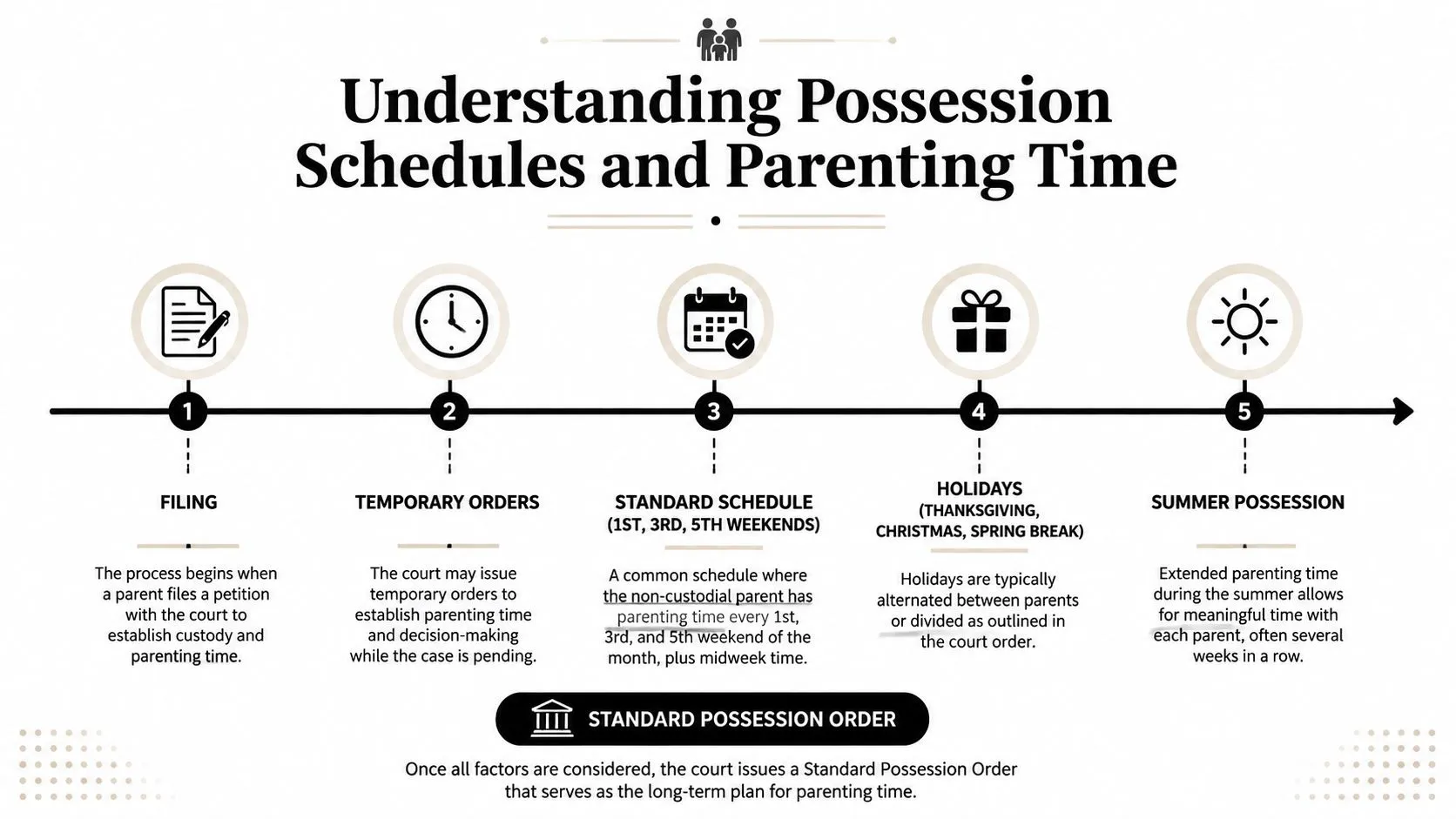
Understanding Possession Schedules and Parenting Time
After legal decision-making comes the question parents ask first: When will I see my child? Texas possession schedules provide a framework, but the distance between homes can change the calendar significantly.
The Standard Possession Order is a default structure in many Texas custody cases. When parents live 100 miles or less apart, the possessory conservator generally receives weekend possession beginning at 6 p.m. Friday and ending at 6 p.m. Sunday, a Thursday period, and extended summer possession (Texas Standard Possession Order).
Distance changes the practical answer
West Texas families often face longer drives between homes, schools, jobs, and extended family. A schedule that works for two parents living near the same Lubbock school may fail when one parent lives far outside the area.
Section 153.3171 provides a newer timing rule for parents who live 50 miles or less apart (Texas Standard Possession Order). That rule can give parents more flexibility in arranging exchanges and parenting time when travel is manageable.
The written order should address more than ordinary weekends. Parents need clear terms for:
- Holidays: Thanksgiving, Christmas, and school breaks may follow a different rotation.
- Summer: Extended summer possession requires advance planning around work and travel.
- Transportation: The order should identify who drives, where exchanges occur, and how delays are handled.
- Notice: Travel, activities, and schedule changes should have workable notice rules.
- Communication: Parents should know how the child can communicate with the other parent during possession.
A schedule isn't successful merely because it looks equal on paper. It must fit school attendance, extracurricular activities, work obligations, transportation, and the child's age and needs.
Fathers and mothers should plan from the same standard
A source discussing Texas parenting-time data places fathers at about 33% of custody time, or roughly 120.5 days per year, compared with national figures of about 35% for fathers and 65% for mothers (Texas family-law statistics). Those figures aren't Lubbock-specific, and they don't decide an individual case.
The important point is practical. Fathers don't automatically receive only occasional visits, and mothers don't automatically receive most of the calendar. Each parent should present a specific, child-focused plan supported by reliable evidence. For a detailed review of scheduling rules, see the Texas Standard Possession Order.
Grandparents, Step-Parents, and Nonparent Custody Rights
A grandparent who has provided daily care may feel like a parent. A step-parent may have attended school meetings, medical appointments, and bedtime routines for years. Those relationships matter emotionally, but Texas law doesn't give every caregiver an automatic right to file for custody or visitation.
For a grandparent or other relative seeking managing conservatorship, Texas law requires satisfactory proof that the child's present circumstances would significantly impair the child's physical health or emotional development, or that both parents, or the surviving parent or managing conservator, filed or consented to the suit (Texas nonparent custody standard).
That is a demanding standard. Showing that a relative could provide a cleaner home, more money, or a calmer routine usually isn't enough by itself. The legal question focuses on significant harm in the child's present circumstances, not whether another adult might parent differently.
The 2025 reforms raise the filing stakes
Texas custody-law reforms effective September 1, 2025 narrow standing for nonparents, require sworn affidavits, and eliminate independent step-parent custody standing (2025 Texas Family Code amendments). “Standing” means the legal right to bring a particular case. If a person lacks standing, the court may dismiss the filing before reaching the underlying family dispute.
Step-parents should be especially careful. A strong emotional bond doesn't automatically create independent custody standing. The step-parent may need to evaluate adoption, consent, current court orders, or another statutory pathway with counsel.
Grandparent access can disappear
Texas also restricts grandparent possession or access in situations involving parental death, termination or relinquishment of parental rights, and adoption or pending adoption by a nonstepparent (Texas grandparent access limits). Once a statutory pathway disappears, waiting can have serious consequences.
A caregiver's love is important evidence of a relationship. It isn't a substitute for proving the legal elements required by statute.
Grandparents and extended caregivers should preserve proof of caregiving, school involvement, medical support, communications, and safety concerns. They should also avoid making accusations they can't support. A careful legal review early in the process is more useful than filing a petition based only on family history.
Modifying Custody Orders and Seeking Emergency Relief
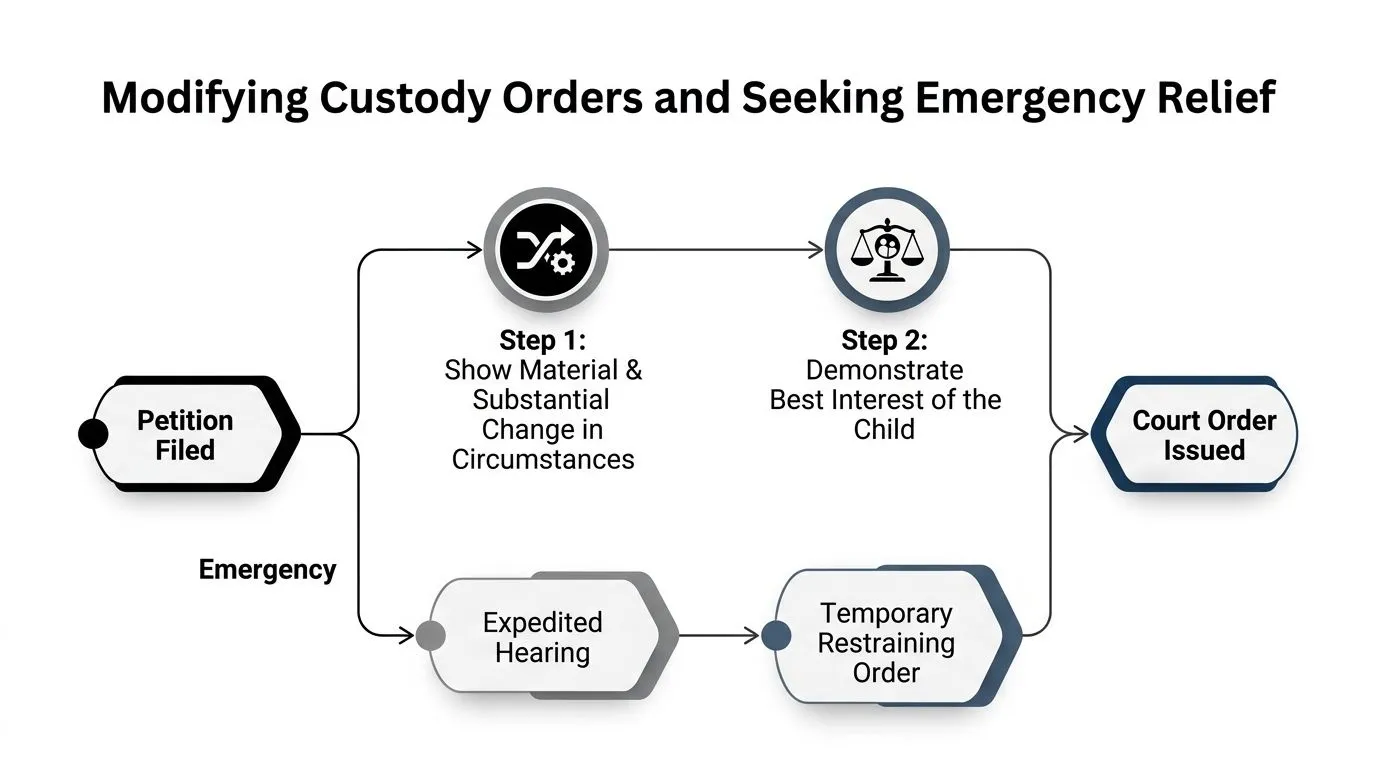
An existing custody order doesn't change simply because circumstances have become difficult. To modify custody or visitation, Texas courts generally require proof of a material and substantial change in circumstances and proof that the requested change serves the child's best interest (Texas custody modification guidance).
“Material and substantial” means more than a routine disagreement. A parent who dislikes the other parent's bedtime rules may not have enough for a modification. A relocation that disrupts school, serious substance abuse, family violence, or another significant change may present a stronger basis.
Start with the correct legal path
A modification case should connect the changed circumstance to the requested order. For example, if a parent relocates, explain how the move affects school, transportation, exchanges, and the child's daily stability. If family violence is involved, identify the conduct, dates, reports, witnesses, injuries, threats, and effect on the child.
TexasLawHelp identifies possible statutory grounds that can include a child abuse conviction or probation, a family violence conviction or probation, increased expenses caused by a residence change, or the death of a parent or conservator (Texas custody modification guidance).
Emergency concerns require immediate action
Don't wait for a routine hearing if your child faces immediate danger. Lubbock-area legal aid identifies protective orders, child custody, child support, modification, and enforcement among its family-law services (Lubbock legal aid FAQ). That local resource reflects a practical reality: a parent may need safety protection and temporary custody guidance at the same time.
Possible steps include:
- Document the emergency: Preserve messages, photographs, police information, medical records, and witness details.
- Identify immediate protection: Ask whether a protective order, temporary restraining order, or emergency custody request fits the facts.
- File the appropriate pleadings: Emergency relief must be presented through the correct court process.
- Prepare for a prompt hearing: Bring focused evidence showing danger and the relief needed.
- Follow every temporary order: Once issued, the order controls until the court changes it.
For additional procedural context, review emergency ex parte custody orders. Emergency filings should be truthful, specific, and limited to genuine safety concerns. Misusing emergency procedures can damage credibility and intensify the dispute.
Choosing the Right Child Custody Lawyer in Lubbock
The right lawyer should do more than repeat the law. You need someone who listens to the facts, explains risks plainly, and builds a plan around your child's schedule, safety, school, and relationship with each parent.

Prepare before the consultation
Bring materials that help counsel understand the case quickly:
- Existing court orders: Include temporary orders, final orders, enforcement rulings, and modifications.
- Communication records: Organize texts, emails, co-parenting messages, and missed-exchange information by date.
- School and medical records: Provide attendance information, appointment details, special needs information, and relevant provider communications.
- A parenting timeline: Write down major events, moves, incidents, and periods of caregiving.
- Witness information: List teachers, relatives, counselors, neighbors, and others with firsthand knowledge.
Don't flood your lawyer with unsorted screenshots if a concise timeline can explain the same issue. Accuracy and organization make legal advice more useful.
Ask direct questions
A productive consultation should address:
- Has the lawyer handled conservatorship and possession disputes in West Texas?
- How does the lawyer approach mediation when cooperation is realistic?
- When is litigation necessary?
- Who will communicate with you and prepare filings?
- How does the firm explain fees, billing, and expected case expenses?
- What facts help or hurt your requested parenting plan?
Be cautious about anyone who guarantees a particular custody result. No responsible lawyer can promise what a judge will do. Transparency matters more than confident predictions.
The Law Office of Bryan Fagan, PLLC provides family-law representation involving custody, visitation, paternity, child support, modification, enforcement, relocation, and emergency custody orders. Its approach emphasizes personalized legal solutions for mothers, fathers, grandparents, military families, and other Texas caregivers rather than treating every family dispute the same way.
Your Next Steps to Protect Your Child and Your Rights
Start by identifying what kind of problem you have. Is there no court order? Is an existing order being violated? Has a parent moved, changed jobs, become unsafe, or stopped following the possession schedule? The answer determines whether you may need an original custody case, enforcement action, modification, or emergency relief.
Remember the core distinctions:
- Conservatorship addresses decision-making rights and duties.
- Possession and access address parenting time.
- Best interest controls the court's decision.
- Distance can shape the possession calendar.
- Modification requires a material and substantial change plus best interest.
- Nonparent cases require careful standing analysis, especially under the reforms effective September 1, 2025.
Mothers and fathers should document consistent caregiving, communicate respectfully, and propose workable schedules. Grandparents and step-parents should confirm that a valid legal pathway exists before filing. If safety is the concern, don't treat the matter like an ordinary scheduling disagreement.
You're facing one of the hardest legal problems a family can experience, but you don't have to go through it alone. Gather your records, protect your child's immediate safety, and speak with a qualified Texas family-law attorney before making a decision that could affect your relationship with your child.
If you need help with a child custody or visitation case in Texas, our experienced attorneys can guide you every step of the way. Contact The Law Office of Bryan Fagan, PLLC today for a free consultation.
The Law Office of Bryan Fagan, PLLC helps Texas parents and caregivers with conservatorship, possession, visitation, modifications, enforcement, child support, and emergency custody matters. Schedule a free consultation to discuss your Lubbock or West Texas custody concerns and identify the next step for protecting your child and your parental rights.


