
When your child's future is on the line, understanding your rights matters most. A parent in Edinburg may be holding a summons and wondering whether to sign anything. A father in Pharr may be trying to understand why a missed exchange could become a legal problem. A grandparent in Mission may be asking whether a close relationship with a child is enough to request visitation.
These situations can feel personal and overwhelming, but Texas custody law gives families a legal framework. The right child custody lawyer in McAllen can help you understand that framework, protect your relationship with your child, and focus the case on facts that matter.
When Your Child's Future Is on the Line in McAllen
A parent in the Rio Grande Valley might open the mail and find a summons connected to the Hidalgo County Courthouse on South McColl. The paperwork may mention a Suit Affecting the Parent-Child Relationship, or SAPCR, and use terms such as conservatorship, possession, and access. If you've never dealt with Texas family court, the language can make an already painful situation feel even more confusing.
Custody disputes rarely mean that one parent is "bad." Families seek court orders after divorce, separation, relocation, military orders, changes in a child's needs, or concerns involving the Texas Department of Family and Protective Services. Some parents need an initial order. Others already have an order but need to enforce or modify it.
Texas law controls these disputes through Texas Family Code Chapter 153. The law moved away from older assumptions that favored mothers or fathers automatically and toward a child-focused best-interest analysis. A Texas Law Review discussion traces an important point in parental-rights doctrine to the U.S. Supreme Court's recognition of parents' constitutional liberty interests in child-rearing in 1923, while also describing Texas's later statutory standing for some nonparents in parent-like roles. Read the Texas Law Review discussion of Texas custody history.
Why Hidalgo County procedure matters
The State of Texas sets the legal rules, but Hidalgo County courts manage the daily process. Local parents may encounter the 430th, 431st, 432nd, 433rd, 464th, 468th, and 469th District Courts, along with Master Court #1 and the Child Protection Court of the Rio Grande Valley. The local Domestic Relations Office focuses on effective co-parenting and reducing conflict for Hidalgo County families.
Master Court #1 hears Title IV-D child-support cases in Hidalgo and Starr counties. The Child Protection Court of the Rio Grande Valley West has operated since 1999 and handles almost all child-protection and welfare cases in Hidalgo and Starr counties, according to Hidalgo County's official court information. That structure matters when a custody issue overlaps with child support or CPS involvement.
This guide explains Texas custody vocabulary, the SAPCR process, possession schedules, modification and enforcement, and practical questions for mothers, fathers, grandparents, and caregivers in McAllen, Mission, Edinburg, Pharr, and Weslaco.
Texas Custody Terms Every McAllen Parent Should Know
Texas uses different words than everyday conversation. “Custody” usually becomes conservatorship, and “visitation” becomes possession and access. These terms describe separate rights, so understanding the difference helps you ask for an order that fits your family.
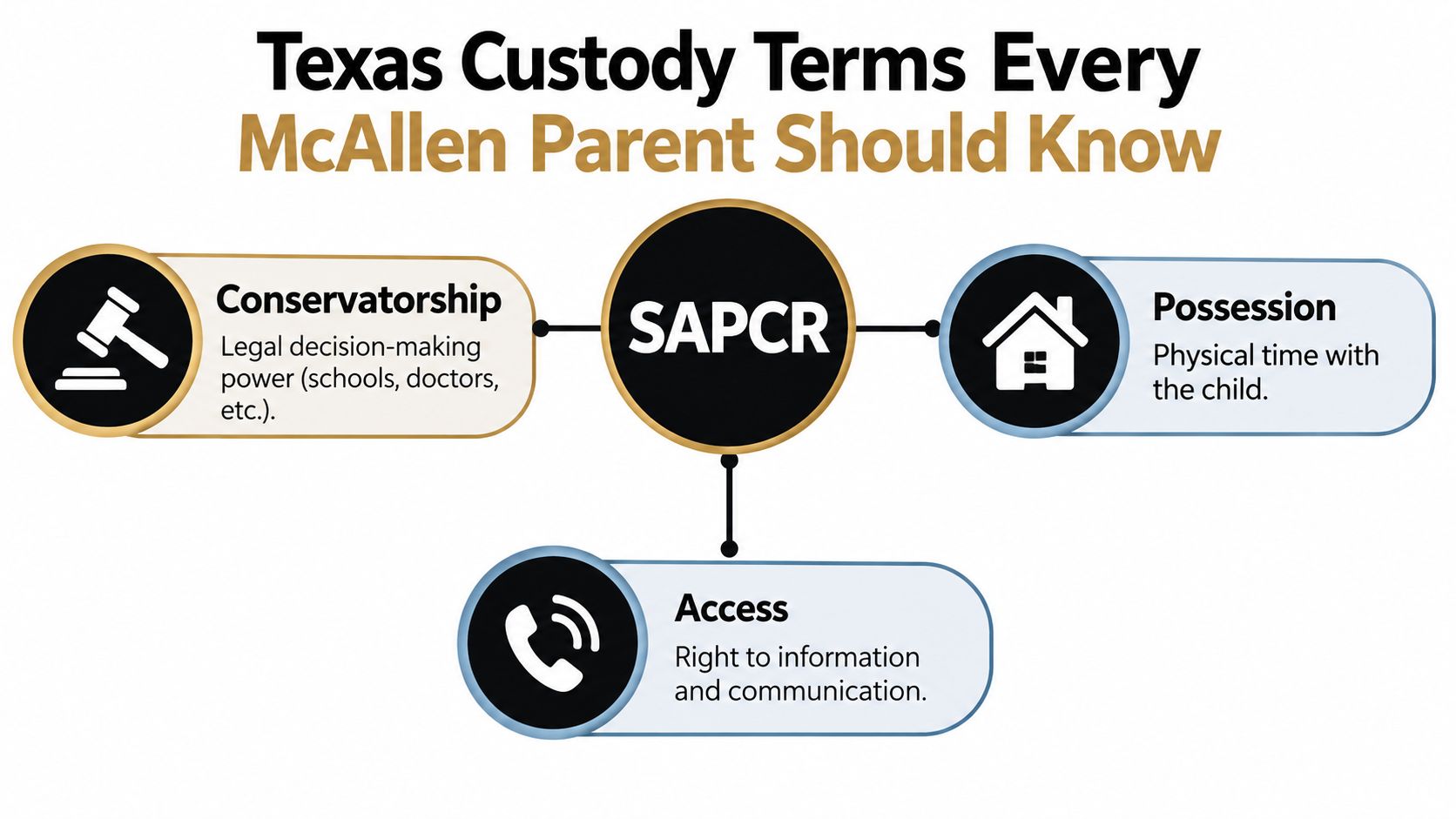
Conservatorship is decision-making authority
A managing conservator has legal rights and duties involving the child. Those decisions can include education, medical care, psychological treatment, and other important parts of the child's life. A joint managing conservatorship means both parents share those rights and duties, although the order may divide specific decisions between them.
Joint managing conservatorship doesn't always mean equal physical time. One parent may have the exclusive right to determine the child's primary residence, while both parents share other decision-making responsibilities. A Texas explanation of joint managing conservatorship can help clarify how managing and possessory roles differ.
A sole managing conservator is the parent given primary legal authority. The other parent may still receive possession and access unless the court finds that restrictions are necessary for the child's safety or welfare. A possessory conservator has court-ordered time and access but may not have the same decision-making rights as a managing conservator.
Possession and access are separate from decision-making
Think of conservatorship as who may make important decisions, possession as where the child spends physical time, and access as communication or information rights. Access might include phone calls, video communication, school records, and medical information, depending on the order.
The Standard Possession Order, or SPO, provides a schedule commonly used for children age three and older. The law treats that schedule differently for children under three, because younger children may need a more customized transition plan. A parenting plan must address the practical details of raising a child, as explained in Parenting Plans in Texas Custody Cases.
Parents may also see child support, which is addressed under Chapter 154, and mediation, where a neutral person helps parents try to reach an agreement. Hidalgo County filings may also involve a fingerprint and criminal background check. These steps aren't a judgment about your character. They help the court evaluate the legal issues before it.
How Texas Courts Decide Custody and Possession
The controlling question is the best interest of the child. Texas Family Code Section 153.002 makes that standard the court's primary consideration. A judge isn't deciding which parent “wins.” The judge is deciding which arrangement supports the child's safety, stability, emotional needs, and development.
The familiar Holley factors guide that analysis. A Hidalgo County judge may consider the child's emotional and physical needs, each home's stability, the abilities of each parent, the child's relationships, and any history of family violence under Chapter 71. Evidence may include school records, medical information, caregiving history, communication records, witness testimony, and facts showing whether a parent supports the child's relationship with the other parent.
Safety comes before shared parenting
Texas policy generally favors frequent contact with both parents when that contact supports the child's development and best interests. But Chapter 153 also states that a court may not appoint joint managing conservators when credible evidence shows a history or pattern of family violence, abuse, or neglect. Safety concerns can therefore change the entire structure of a case.
A parent seeking restrictions should identify concrete facts, not only general fear. A parent opposing restrictions should be prepared to show safe conduct, reliable caregiving, and compliance with existing orders.
Practical rule: Ask for a schedule that matches the child's actual needs, not simply the schedule that feels most equal to adults.
For children age three or older, Texas presumes the Standard Possession Order is in the child's best interest. That presumption doesn't automatically apply to children under three. A court may create a different schedule for a younger child and consider factors related to attachment, routine, caregiving, and the child's needs. Texas guidance on visitation and possession orders explains that distinction.
| Scenario | Weekday Time | Weekends | Holidays | Notes |
|---|---|---|---|---|
| Child age three or older | Often includes a weekday period or overnight under the applicable order | Commonly follows the Standard Possession Order pattern | Allocated according to the order | The court can tailor terms to the child's best interest |
| Child under three | May use shorter or graduated periods | May differ from the standard pattern | Can be specially arranged | The court considers the child's age and circumstances |
| Modified possession order | Set around the family's needs | May account for distance, work, or special needs | May require detailed exchange terms | A modified order can address transportation and safety concerns |
A 50/50 schedule isn't automatic. It may be workable when both parents live near the child, communicate safely, and can manage school, medical care, transportation, and daily routines. A parent's work schedule, the distance between homes, and the child's health or developmental needs can support a different arrangement.
The McAllen Custody Case Process Step by Step
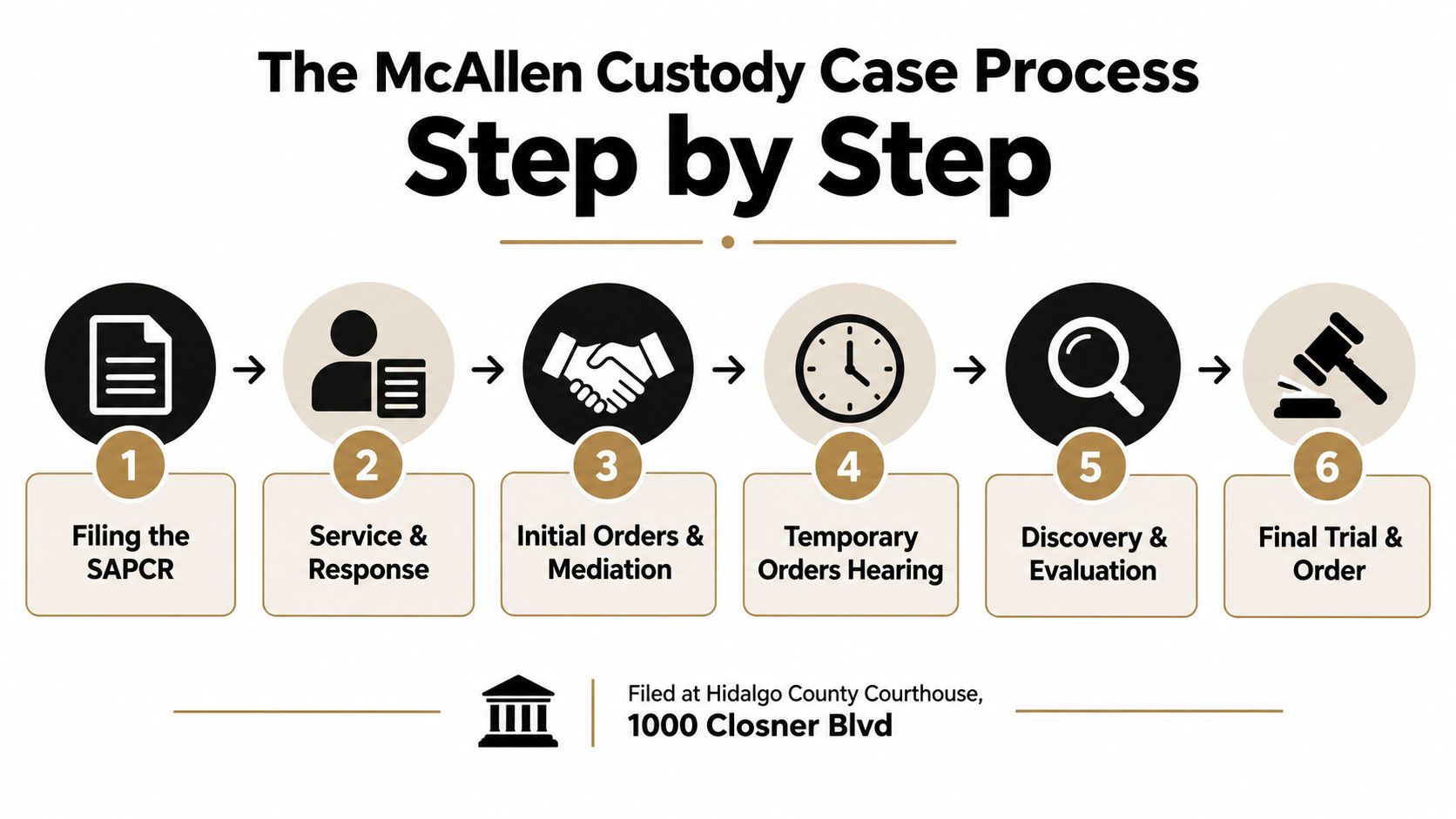
A custody case usually begins with a SAPCR, the court action used to request orders concerning a child. A parent may file in the appropriate Hidalgo County court or use the state's electronic filing system, eFileTexas. The petition identifies the child, the parents, the requested conservatorship, possession, access, support, and other relief.
From petition to temporary orders
After filing, the other parent must receive legally valid notice, often called service. The responding parent may file an answer or waiver and should avoid ignoring the case. A temporary-orders hearing can address where the child will live, temporary support, possession, school decisions, and safety restrictions while the case continues.
Master Court #1 is especially relevant to Title IV-D child-support matters in Hidalgo and Starr counties. CPS-related matters generally involve the Child Protection Court of the Rio Grande Valley West, which focuses on child-protection and welfare proceedings. The court handling your case depends on the type of proceeding and the orders requested.
Evidence, settlement, and trial
Mediation gives parents a chance to resolve some or all issues with help from a neutral mediator. If the parents reach an agreement, the agreement can be presented for entry as a court order. If they don't, the case may involve discovery, requests for documents, written questions, depositions, and evaluations when appropriate.
Parents may also be ordered to complete Parent Education and Family Stabilization courses. At each appearance, expect the judge or court professional to focus on the child's routine, safety, financial support, and the parents' ability to follow temporary instructions.
A final trial allows each side to present evidence and witnesses. The judge then signs a final order, often called a final decree or final SAPCR order. For a plain-language overview of the sequence, see this step-by-step custody case timeline in Texas.
A short overview is also available here:
Services the Law Office of Bryan Fagan Provides for Local Families
Different custody problems require different filings. A parent establishing legal fatherhood needs a different strategy from a parent seeking emergency protection or enforcing missed possession.
Match the legal service to the problem
| Family situation | Legal focus | Common goal |
|---|---|---|
| Unmarried parents | Paternity and conservatorship | Establish legal father status and request custody or possession rights |
| Immediate danger | Emergency or ex parte relief | Seek rapid court protection when facts show urgent risk |
| Missed visits or withheld possession | Enforcement | Ask the court to enforce the existing order |
| Major life change | Modification | Request a new order based on a legally recognized change |
| Planned move | Relocation | Address residence restrictions and the child's relationship with both parents |
| Parents in different states | UCCJEA issues | Determine which state has authority over custody matters |
| Military deployment | Military-related protections | Address deployment, communication, and temporary schedule changes |
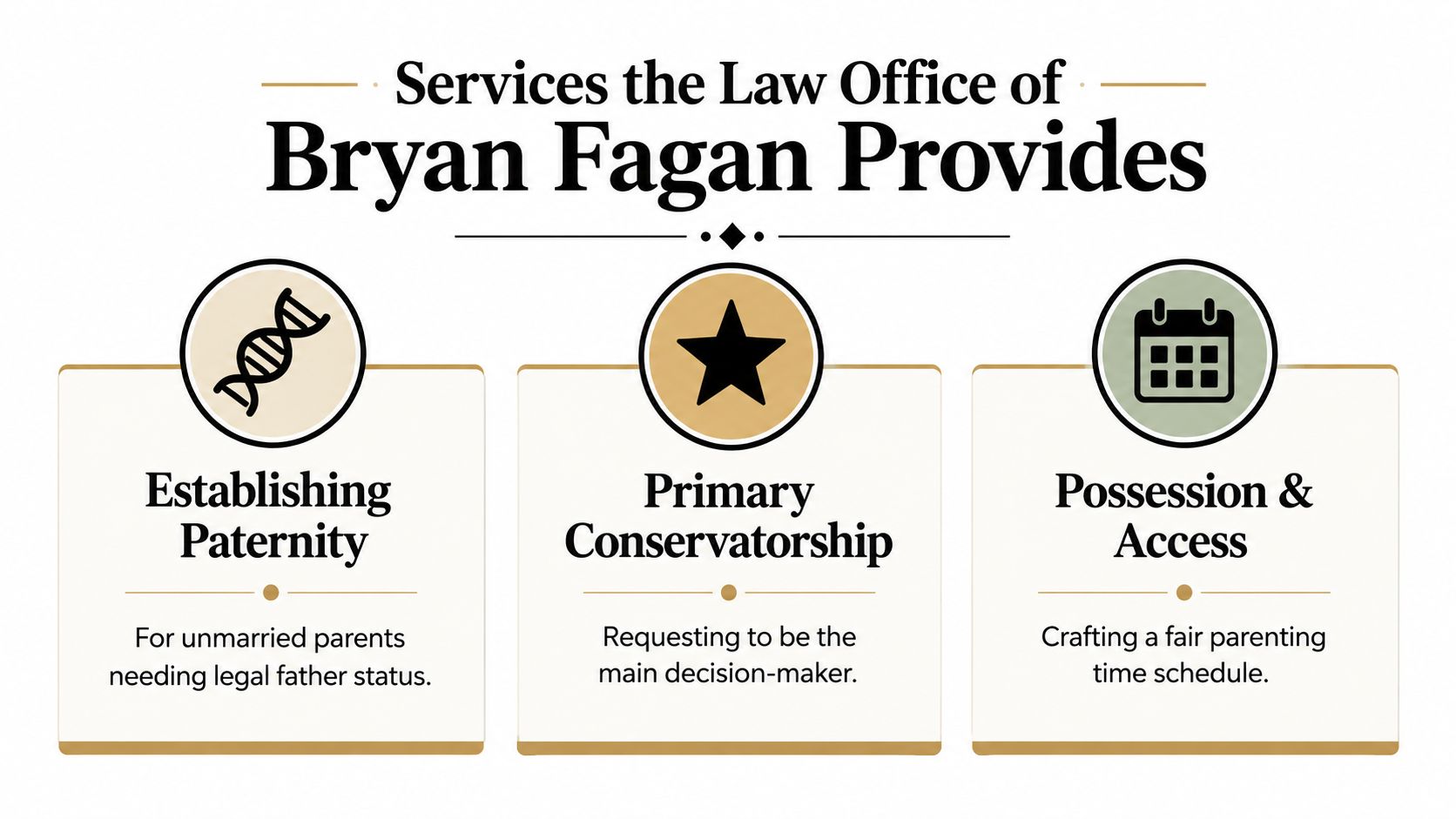
Paternity matters under Texas family law can establish the legal relationship needed for a father to request conservatorship, possession, and access. An emergency request requires specific facts showing why ordinary scheduling isn't enough. Courts may issue temporary or emergency orders when the evidence supports immediate action.
Modification and enforcement are separate. A parent who wants to change an order generally files a modification case. A parent reporting denied possession or other violations may need an enforcement action. Texas guidance explains that informal agreements don't change a SAPCR custody or support order. The Texas State Law Library's custody guidance addresses that distinction.
Relocation cases often turn on geographic restrictions, transportation, school continuity, and the child's ongoing relationship with each parent. Interstate matters may involve the Uniform Child Custody Jurisdiction and Enforcement Act, or UCCJEA. Military families may also need to consider the Servicemembers Civil Relief Act and deployment-based modifications.
The Law Office of Bryan Fagan, PLLC handles paternity, conservatorship, possession and access, emergency custody, enforcement, modification, relocation, interstate, and military-related family-law matters.
How to Choose the Right Custody Lawyer in McAllen
A consultation should help you evaluate the lawyer, not pressure you into an immediate decision. Look for someone who understands Texas Family Code Chapter 153 and can explain how that law applies to your child, your evidence, and your requested schedule.
Credentials matter, but local judgment matters too
Board certification in family law can demonstrate focused experience. Active involvement with the Hidalgo County Bar Association may show familiarity with the local legal community. Ask whether the lawyer has handled SAPCR trials, not only negotiated settlements or mediation.
Parents may also ask about courtroom experience in Hidalgo County district courts, including the 370th and 398th District Courts and other courts that may hear related family matters. Because court assignments and procedures can vary, a lawyer should explain which court or docket is likely to handle your case instead of making assumptions.

Bring these questions to the consultation:
- Strategy: What facts support the possession schedule I'm requesting?
- Process: Which filings, hearings, mediation, and evidence should I expect?
- Communication: Who will respond to routine questions, and how will updates be handled?
- Fees: Is billing hourly, flat-fee, or a combination?
- Settlement: What are the risks and benefits of resolving the case without trial?
Be cautious if a lawyer guarantees an outcome, pressures you to settle immediately, refuses to explain the engagement letter, or seems unfamiliar with local masters, judges, and courtroom procedures. No lawyer can promise what a judge will decide. A careful lawyer can explain options, risks, and the evidence needed to support your position.
Cost, Fees, and Payment Options for Texas Custody Cases
There is no reliable universal price for a McAllen custody case. The final cost depends on whether the parents agree, how many issues remain contested, how many hearings occur, whether discovery is necessary, and whether specialized witnesses or evaluations become part of the case.
A consultation should clarify the difference between court filing costs, attorney time, and case expenses. Ask what the initial retainer covers, how replenishment works, whether hearings are billed separately, and whether the firm accepts credit-card payments or other payment arrangements. Don't assume a flat fee includes every hearing or trial preparation task.
| Case Type | Estimated Cost Range | Notes |
|---|---|---|
| Initial SAPCR | Varies by case | Cost depends on agreement, service, temporary orders, mediation, and trial needs |
| Custody modification | Varies by case | Evidence of a material and substantial change may require focused discovery |
| Enforcement | Varies by case | The number and seriousness of alleged violations affect preparation |
| Contested trial | Varies by case | Witnesses, exhibits, depositions, and courtroom time can increase work |
The right question isn't only, “What's the cheapest option?” It's also, “What work does this fee structure cover, and what risk remains if the case is underprepared?” Local familiarity with Hidalgo County dockets and the Master Court #1 system may help counsel organize filings and hearing preparation, but every case still requires individualized work.
For a practical discussion of billing questions, review child custody attorney fees in Texas before your consultation. Bring your court papers, prior orders, and a written list of concerns so the lawyer can give a more useful explanation of likely tasks and expenses.
Next Steps and FAQs for Parents in the McAllen Area
Start by preserving information. Gather existing orders, school and medical records, messages about exchanges, calendars showing missed possession, relocation details, and documents related to employment or military service. Keep communication with the other parent focused on the child, and don't delete messages that may later help explain what happened.
A free consultation can be more productive if you write down your goals before the meeting. Tell the lawyer whether you need an initial SAPCR, a temporary order, an enforcement action, a modification, or advice about relocation. Don't sign an agreement from the other side until you understand what rights it changes.
Common questions from Hidalgo County parents
How long will a custody case take?
There isn't one guaranteed timeline. An agreed order may move differently from a contested case involving temporary hearings, discovery, mediation, and trial. Your lawyer should explain the procedural stages and identify what facts may create delay.
Can a grandparent request custody or visitation?
Grandparents don't have an automatic right to access. Under Texas Family Code Sections 153.432 and 153.433, a qualifying grandparent must meet threshold requirements and show that denying access would significantly impair the child's physical health or emotional well-being. Family conflict or a close relationship alone may not satisfy that burden. Texas State Law Library information on grandparents' rights provides the statutory overview.
What if the other parent repeatedly denies visitation?
Don't rely on informal arguments or self-help. Preserve the dates, requested exchanges, messages, and expenses, then ask a lawyer about enforcement. Texas materials explain that possession schedules depend partly on where parents live, and the Attorney General's parenting-time schedule guidance discusses scheduling and exchange logistics.
Texas law updates effective in 2025 strengthened remedies for repeated denial of possession or access. Independent legal coverage describes possible consequences after three contempt findings, including mandatory jail exposure, double makeup time, attorney's fees, and a possible custody modification. Because enforcement remedies depend on the order and the facts, get case-specific advice before filing.
Can a custody order be changed?
Yes, but a parent must generally prove that the change serves the child's best interest and satisfy a statutory ground. Texas guidance identifies a material and substantial change in circumstances, parental agreement, or a child who is at least 12 and expresses a preference in chambers. The same guidance discusses a six-month primary-care transfer rule, with an exception for active-duty military deployment. Texas guidance on material and substantial changes explains these requirements.
How does military deployment affect possession?
Deployment can require temporary planning for communication, exchanges, and caregiving. It doesn't automatically erase the parent-child relationship. A lawyer can help address deployment-related changes while protecting the child's stability and the service member's rights.
Key takeaway: A clear order, careful documentation, and early legal advice can prevent a difficult family problem from becoming a larger courtroom dispute.
If you need help with a child custody or visitation case in Texas, our experienced attorneys can guide you every step of the way. Contact The Law Office of Bryan Fagan, PLLC today for a free consultation.
The Law Office of Bryan Fagan, PLLC helps McAllen-area parents with SAPCR filings, custody modifications, enforcement, emergency orders, relocation, paternity, and military-related custody concerns. Visit Law Office of Bryan Fagan, PLLC to schedule a free consultation before you sign an agreement or respond to a custody filing.