 Skip to content
When your child's future is on the line, understanding your rights matters most. You may be trying to plan school pickups in Midland, fit parenting time around an oilfield rotation, or keep a child connected to both parents during a deployment or move. The legal questions can feel urgent, but the emotional weight is just as real.
A child custody lawyer in Midland can help turn that uncertainty into a workable plan. Texas courts use the language of conservatorship, possession, and access, but those terms describe everyday decisions, such as who makes medical choices, where a child spends holidays, and how parents exchange information. The aim isn't to win a label. It's to create stability that works for your child and your family's actual schedule.
When Your Child's Future Feels Uncertain in Midland
On a Tuesday morning, parents may sit outside a Midland County courtroom with folders in their hands and questions they can't answer alone. One parent is worried about whether the proposed schedule will work with school pickups. The other is thinking about weekend travel across the Permian Basin, missed exchanges, or a child who feels caught between two homes.
The court file may include a petition, financial records, and proposed orders. For the parents, though, it represents bedtime routines, parent-teacher meetings, holidays, medical appointments, and the fear that a decision made in court could change a relationship with a son or daughter. A custody case rarely feels like an ordinary legal dispute.
A useful starting point: The judge isn't deciding which parent deserves a child more. The court is deciding what arrangement serves the child's best interests under Texas law.
That distinction matters for mothers and fathers alike. A mother seeking primary possession may need to show how her proposed schedule supports school attendance, healthcare, and continuity. A father seeking expanded visitation may need to present a realistic plan for transportation, work hours, and regular involvement. A grandparent or caregiver may need to address a child's immediate safety and living arrangements before a longer-term custody question can be resolved.
What parents usually need answered
Most families want practical answers to the same concerns:
- Who makes important decisions? Texas orders can divide or assign rights involving education, medical care, and other major choices.
- How much time will each parent have? Possession schedules set the actual days, weekends, holidays, and exchange terms.
- Can the current order change? A modification requires a statutory basis, not merely frustration with the existing arrangement.
- What happens during an emergency? Temporary or emergency orders may address immediate concerns while the case continues.
Texas custody outcomes remain heavily shaped by the best-interests-of-the-child standard. National and state-oriented custody data commonly place fathers at about one-third of parenting time, roughly 33% in Texas and about 35% nationwide, as discussed in this Texas family law breakdown. At the Texas 33% level, that represents about 120.5 days per year for fathers, compared with 244.5 days for the other parent, figures that show why precise schedules and strong evidence matter.
This guide explains how Chapter 153 works, what a Midland custody case may involve, how parents handle relocation and deployment, and how grandparents and caregivers can protect a child's stability. You'll also see what to gather before meeting with counsel, so your first conversation can focus on decisions rather than confusion.
How Texas Custody Law Works
A Midland parent may work rotating shifts at a rig, serve through a deployment cycle, or live several communities away from the other parent. Texas custody law must translate those realities into specific legal rights and workable time with a child.
Texas law generally uses conservatorship instead of the everyday word “custody.” Conservatorship identifies a parent's legal rights and duties, such as access to school or medical information and authority over particular decisions. Possession and access describe when a parent spends time with the child, related concepts but distinct ones.
Under Chapter 153 of the Texas Family Code, a court must specify each conservator's rights and duties. Any limitation on parental rights requires written findings. Pleadings and evidence should therefore address the exact decisions, exchanges, and access terms in dispute rather than request a broad “custody” result. The Texas Family Code provisions on conservatorship provide the statutory framework.
The three main conservatorship arrangements
Joint managing conservatorship gives both parents the legal status of managing conservators. The order can divide decision-making, assign one parent the exclusive right to decide a particular issue, and give both parents access to information. It can also set a possession schedule that reflects school, distance, and work obligations. This explanation of conservatorship in Texas provides further context on managing and possessory roles.
Sole managing conservatorship gives one parent the primary legal decision-making role. The other parent may still receive possession, access, and information rights unless the court imposes specific restrictions based on the child's circumstances.
Possessory conservatorship generally describes a parent's role in exercising possession and access under the order. A parent can have meaningful time with a child without holding the exclusive right to determine the child's primary residence.
| Conservatorship Type | Decision-Making Rights | Typical Possession Role |
|---|---|---|
| Joint managing conservatorship | Rights and duties are shared or divided by the order | One parent may have primary residence, while both receive scheduled time |
| Sole managing conservatorship | One parent receives the primary decision-making authority | The other parent may receive possession or supervised access |
| Possessory conservatorship | The order defines available rights and duties | The parent exercises the possession and access the order permits |
Why possession schedules matter
The standard possession order is the presumptive minimum time for a joint managing conservator who is not awarded the exclusive right to determine the child's primary residence, according to Texas Family Code Chapter 153. Parents may request a different schedule that fits the child's age, school routine, distance between homes, or work demands.
For a Midland family, that may involve an overnight shift, a rotating rig schedule, long drives between communities, deployment-related changes, or holiday travel. A local lawyer can connect those facts to calendars, transportation plans, communication records, and other evidence. The court applies the child's best interests, including emotional and physical needs, stability, and meaningful community connections. A proposed schedule should show how it works in daily life.
A parent seeking representation in conservatorship, possession, or access matters under Chapter 153 can review the role of a Texas Child Custody Lawyer. The legal strategy should center on the specific rights, duties, and schedule that support the child, rather than relying on labels alone.
What the Custody Process Looks Like Step by Step
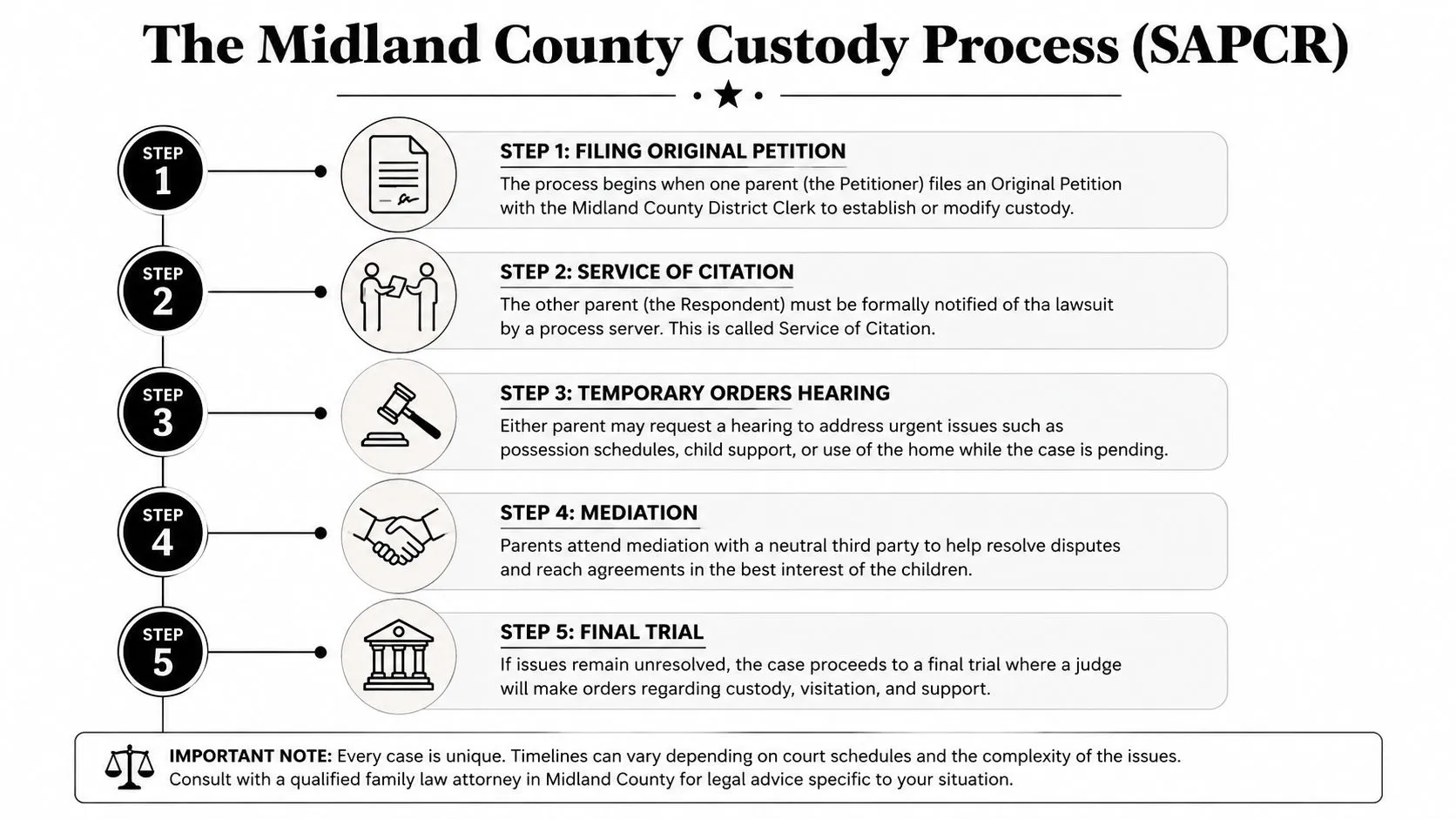
A Midland custody case often begins with a Suit Affecting the Parent-Child Relationship, commonly called a SAPCR. This is the court proceeding used to establish conservatorship, possession, access, child support, and related parent-child orders.
Filing and notice
The case generally starts with an Original Petition that identifies the child, the parents, and the orders being requested. The other parent must receive legal notice through service of citation or another legally valid method. Until notice and response issues are handled, the case can't move forward in the ordinary way.
Parents should treat the first filing as a planning document. If the petition asks for a schedule that doesn't reflect school, childcare, transportation, or work realities, correcting that later may require additional litigation.
Temporary orders
Temporary orders address the period while the SAPCR is pending. They may establish temporary possession, child support, decision-making rights, communication rules, or protections related to safety. For a parent worried about missed exchanges or an unstable routine, temporary orders can provide structure before the final hearing.
Midland parents may also need to complete a regional parenting class and coordinate with the Midland County Domestic Relations Office. These local requirements and procedures can affect how a family prepares for hearings, exchanges information, and follows an interim order.
Mediation and final hearing
Mediation gives parents a chance to negotiate a parenting plan with the help of a neutral mediator. If the parents reach an agreement, the court may review and enter the agreed order. If they don't, the disputed issues proceed toward a final bench trial or jury trial, depending on the claims and the decisions the parties make.
The statutory waiting period before a final divorce hearing is commonly described as 60 days, but the duration of a custody case depends on service, discovery, temporary orders, mediation, contested evidence, and the court's docket. Uncontested matters may resolve sooner than contested cases, which can take substantially longer. The Texas custody case timeline can help parents understand the sequence without assuming every case follows the same calendar.
Changing or Enforcing a Custody Order
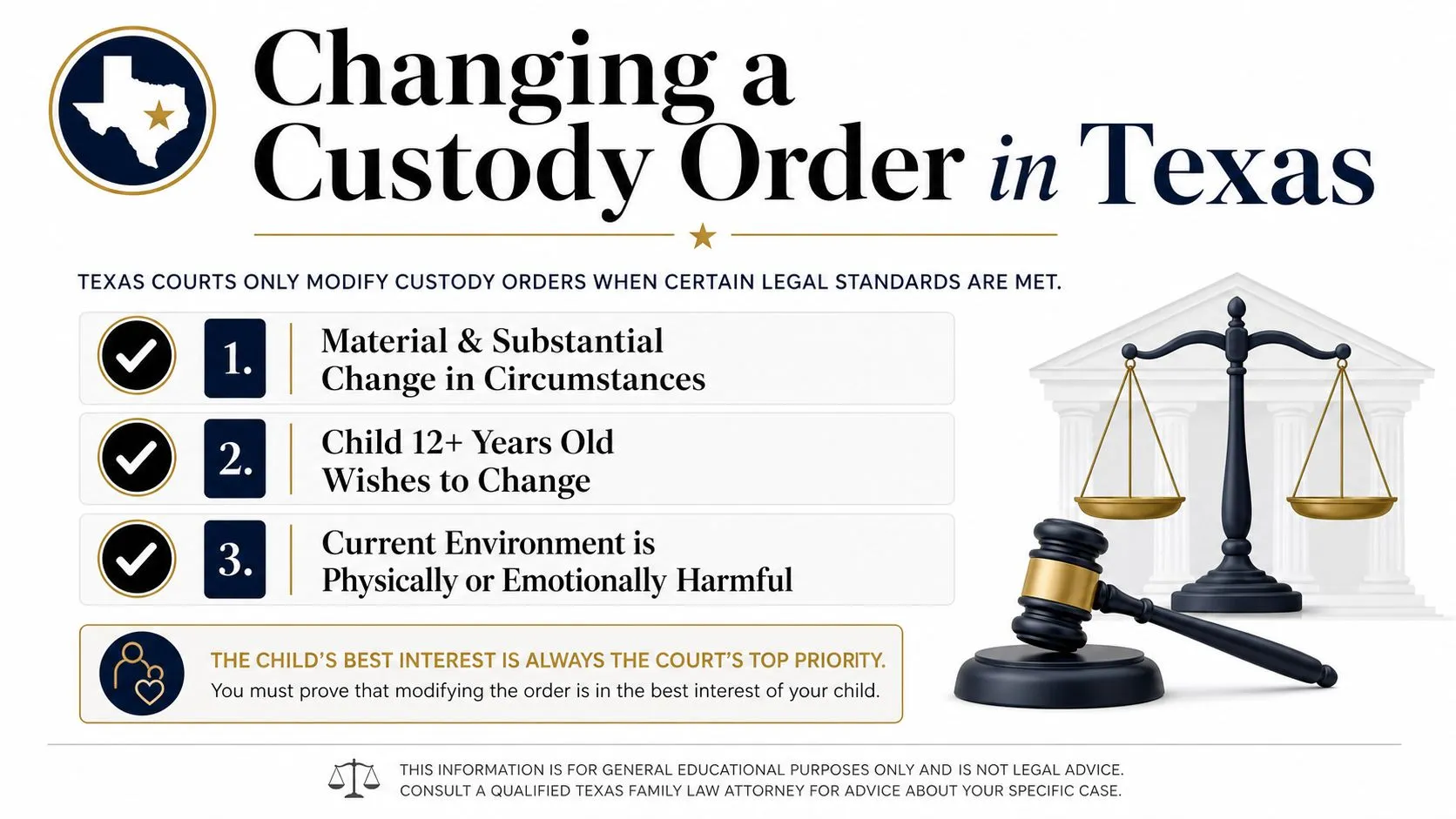
A custody order doesn't change because one parent is unhappy with it. Under Texas Family Code Section 156.101, a court may modify conservatorship, possession, or access only when the change serves the child's best interests and a statutory trigger exists.
The three listed triggers are:
- A material and substantial change in circumstances. This might involve a significant change in employment, residence, caregiving, health, school needs, or family conditions.
- A child at least 12 years old expresses a preference in chambers. The child's preference is considered, but it doesn't automatically control the judge's decision.
- The primary conservator voluntarily relinquishes primary care and possession for at least six months.
These standards appear in Texas Family Code Section 156.101. The statute does not make a teenager's preference an automatic transfer, and it doesn't make every job change enough for modification. The evidence must connect the requested change to the child's welfare.
Evidence that helps explain the change
A Midland parent may need school attendance records, daycare logs, medical information, calendars, text messages, emails, and testimony from teachers or counselors. The strongest evidence usually answers practical questions. Who handles weekday care? Has the child's school routine changed? Does the proposed schedule reduce missed exchanges or support consistent medical care?
A parent returning from a deployment, accepting a job in the Delaware Basin, or facing a transfer away from Midland should preserve records before filing. Keep messages in their original form, save orders and notices, and write a dated timeline while events remain clear.
Enforcement is different from modification. If a parent withholds possession, refuses an exchange, or violates a specific order, the remedy may involve an enforcement action. Don't retaliate by withholding the child in return. Bring the order, document the missed possession, and seek advice about the proper court remedy.
Military Families, Relocation, and Grandparent Rights
Midland families often plan around two demanding work patterns, military service and oil-patch employment. Both can create sudden changes in location, hours, and childcare. Texas law doesn't treat a deployment or a move as automatic permission to change where a child lives. A parent may need a modification or temporary order, especially when the existing order includes a geographic restriction.
For military families, deployment-related provisions can help preserve the child's relationship with the service member. A deployment may justify temporary arrangements, communication plans, or make-up possession after the service member returns, but parents should seek specific orders rather than rely on informal promises. The Texas provisions addressing military deployment and relocation should be reviewed with counsel because the exact order and facts matter.
A geographic restriction may limit the child's primary residence to a defined county or area. A proposed move to Houston, Carlsbad, or another rig town can affect school, transportation, and the other parent's access. The parent requesting relocation should present a detailed plan, including housing, school arrangements, travel, communication, and how the move supports the child's best interests.
Grandparents face a separate standing analysis. Texas law allows a grandparent to seek possession or access, but the grandparent must file an affidavit with supporting facts alleging that denying access would significantly impair the child's physical health or emotional well-being. If the affidavit doesn't contain facts that could support relief, the court must dismiss the case under Texas Family Code Section 153.432.
Provisions that may affect families
| Issue | Texas Family Code Section | What It Does for Midland Families |
|---|---|---|
| Deployment and military service | Chapter 153 provisions | Supports planning for temporary changes and preserving possession during service-related absences |
| Relocation | Chapter 153 and applicable orders | Requires attention to geographic restrictions, notice, and the child's best interests |
| Grandparent access | Section 153.432 | Requires specific facts supporting significant impairment before the case can proceed |
| Emergency protection | Section 105.001 | Allows temporary relief when immediate safety or family-violence concerns require court action |
Kinship care deserves attention in West Texas. DFPS reported 16,251 children in care at the end of August 2025, with 82.3% in family-like homes, and reported that exits from care had decreased over the past five fiscal years while kinship efforts rebounded in FY 2025, according to Texas DFPS monthly data. These figures show why grandparents, relatives, and temporary caregivers may need advice about emergency custody, supervised access, reunification, and temporary orders.
Families dealing with a move can also benefit from practical relocation planning resources, including this guide to moving from Boston to the Mid-Atlantic. The legal question remains distinct, but careful planning for distance, transportation, and household transitions can help parents prepare a more workable proposal.
Working With a Midland Custody Attorney
A first consultation works best when you bring organized facts, not a perfect legal argument. The attorney needs to understand the child's routine, the existing order, the disputed events, and what outcome would create stability.
Bring these materials:
- Existing court order: Include every page, attachment, and later modification.
- School and medical records: Bring attendance information, school communications, appointment records, and relevant provider notes.
- Written timeline: List important events in date order, including missed exchanges, moves, deployments, threats, and major caregiving changes.
- Messages and emails: Save screenshots and, when possible, preserve the complete conversation with dates and identifying information.
- Pay stubs: These may help counsel discuss child support issues and income information.
- Questions: Write down what you're worried about, what you want to request, and what you don't understand.

What representation may involve
Family law firms commonly explain fees through an initial consultation charge, followed by retainer or hourly billing. Separate expenses may include filing fees, service of process, and expert witnesses, such as custody evaluators or child psychologists. Ask for a written explanation of billing practices, replenishment requirements, communication methods, and which tasks are billed separately.
Your relationship with counsel should include confidentiality and clear communication expectations. A lawyer may help draft temporary orders, prepare a parenting plan, exchange information, negotiate at mediation, and present evidence at a final hearing. You should also understand who will handle routine communication and how quickly urgent issues are addressed.
Local familiarity can matter because counsel who regularly works with the 318th District Court and Midland County procedures may better understand filing practices, scheduling expectations, and local courtroom routines. That doesn't replace preparation, but it can help your evidence fit the way the court will evaluate the dispute.
A parent can compare attorneys by asking how they approach cooperative settlement, contested hearings, relocation, military schedules, enforcement, and emergency relief. The best child custody lawyer consultation guide can help you develop questions without assuming that one lawyer fits every family.
Key Takeaways and Your Next Steps
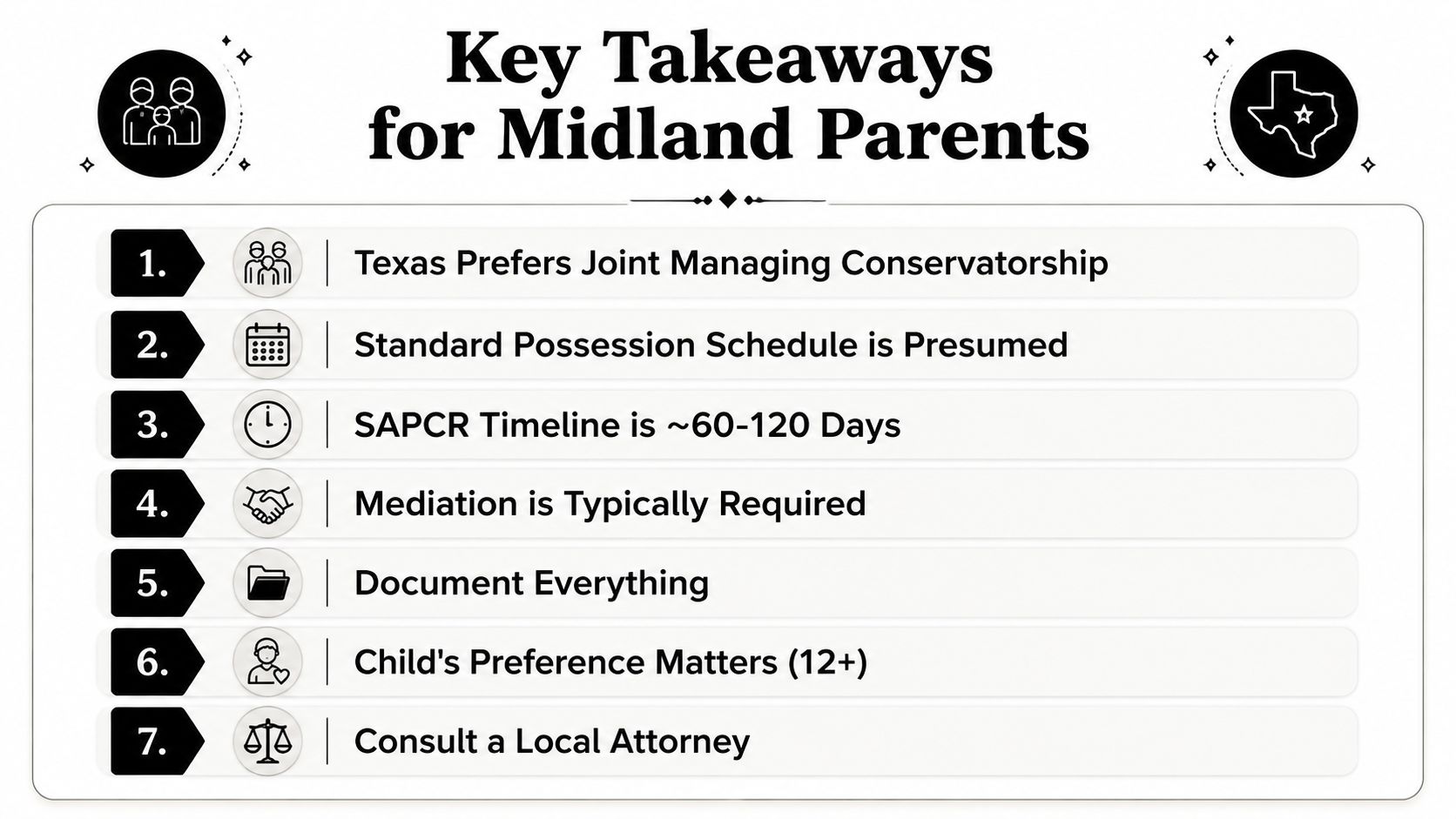
A Midland custody dispute becomes easier to manage when you separate the legal labels from the child's daily needs. Texas law generally favors joint managing conservatorship, but that doesn't automatically create equal parenting time. Possession schedules are separate from decision-making rights, and the standard possession order serves as a presumptive minimum in the circumstances described by Chapter 153.
Keep these seven lessons in mind:
- Joint managing conservatorship is common, but the order can divide specific rights.
- A standard possession schedule is presumed in the statutory circumstances, though families may seek a different plan.
- A SAPCR includes a 60-day waiting period before a final divorce hearing, while the full case timeline depends on the issues and court schedule.
- Mediation may help resolve disputes, but parents should prepare as though evidence will be needed at trial.
- Documentation matters, especially for school routines, medical care, exchanges, communications, and work schedules.
- A child's preference can matter at age 12 or older, but the judge still evaluates the child's best interests.
- Local legal guidance can translate Chapter 153 into a practical plan for a Midland courtroom and a Permian Basin family.
Three steps to take now
First, gather records. Collect the current order, school and medical documents, calendars, messages, and any safety-related information. Don't edit or delete communications that may later help explain what happened.
Second, map the schedule. Write down work rotations, commute times, childcare, school transportation, holidays, and the time each parent can consistently provide. A realistic plan is more useful than a schedule that looks equal on paper but fails during the school week.
Third, schedule a consultation before the problem becomes urgent. Early advice can help you understand whether you need a new SAPCR, modification, enforcement action, or emergency order. It can also prevent avoidable mistakes, such as violating an existing order or filing without the evidence needed to support your request.
A prepared parent isn't the parent who creates the most conflict. A prepared parent knows the order, preserves the evidence, and asks for a plan that protects the child's stability. Clarity beats conflict, and careful preparation gives you a stronger position in any Texas custody matter.
If you need help with a child custody or visitation case in Texas, the Law Office of Bryan Fagan, PLLC can help you evaluate conservatorship, possession schedules, modifications, enforcement, relocation, military custody, and emergency orders. Contact the firm to schedule a free consultation and discuss a practical plan for your family.


