
When your child's future is on the line, not knowing what your custody order allows can make every exchange, school decision, and medical appointment feel frightening. You may be wondering whether you're allowed to speak with a teacher, approve counseling, choose a doctor, or spend time with your child during a holiday.
Texas uses the legal term conservatorship instead of custody. The most important distinction is between managing conservatorship, which focuses on decision-making authority, and possessory conservatorship, which focuses mainly on possession and access. Understanding that divide can help you protect your relationship with your child and respond thoughtfully when the other parent disagrees.
Understanding Your Role in Your Child's Life
Consider a parent who receives a court order and sees the words “sole managing conservator” and “possessory conservator.” The parent may assume the first title means one person has every parental right and the second means the other parent has little more than scheduled visits. That assumption often creates unnecessary fear and conflict.
Under Texas Family Code Chapter 153, conservatorship answers two separate questions. Who has authority to make major decisions for the child? And when does each parent have possession of the child? Texas substantially modernized its conservatorship law in 1995, when Chapter 153 took effect on April 20, 1995. The chapter continues to shape orders involving conservatorship, possession, access, and parental rights. Texas Family Code Chapter 153
A managing conservator generally holds the authority connected to major decisions, such as designating the child's primary residence. A possessory conservator generally has parenting time under a court order and retains important parental rights, but usually doesn't have final authority over most major decisions. When one parent is appointed sole managing conservator, the other parent is usually named possessory conservator, according to Texas information about parental rights.
Why the labels matter in daily life
Suppose your child needs counseling after a difficult family transition. You may want to understand the emotional needs involved before discussing the legal issue with your co-parent. A parent resource such as information for parents on child therapy can offer general guidance about supporting a child through therapy, while your court order determines who may authorize particular treatment.
The possessory parent's role is not erased. During possession, that parent generally provides daily care, exercises reasonable discipline, supports the child, and may direct moral and religious training unless the court has limited those rights. The parent may also retain access to health, education, and welfare information.
The practical question is not “Who has custody?” It's “Who can make this decision, and when does each parent have time with the child?”
A court order may give one parent the exclusive right to designate primary residence while preserving meaningful possession and access for the other. That structure can protect stability without treating either parent as a stranger. Mothers, fathers, grandparents, and caregivers all benefit from reading the order carefully rather than relying on informal labels.
Managing vs. Possessory Conservatorship Rights
A school form needs a signature. A doctor recommends treatment. Your child asks to attend counseling. In each situation, the answer depends on the exact rights assigned in the court order, not on which parent spends more nights with the child.
A joint managing conservatorship gives both parents a legal role, but the order may assign their powers differently. One parent may have the exclusive right to designate the child's primary residence, while both parents share consultation or information rights. A sole managing conservator may hold certain decisions alone. A possessory conservator may still make day-to-day choices during possession and retain access to important records. The Texas explanation of possessory conservatorship can help clarify how that role works in practice. The statutory framework allows the court to spell out these responsibilities. The Joint Managing Conservatorship in Texas resource explains the presumption favoring joint conservatorship and why it does not promise equal decision-making or equal possession.
Decision-Making Authority Comparison
| Decision Type | Managing Conservator | Possessory Conservator |
|---|---|---|
| Designating the child's primary residence | May hold the exclusive right, depending on the order | Usually cannot make the final designation |
| Major educational choices | May hold exclusive or shared authority under the order | May consult and access school information, but may lack final say |
| Invasive medical treatment | May hold exclusive or shared authority under the order | Usually cannot authorize the decision alone unless the order permits it |
| Daily care during possession | Exercises care under the order | Exercises daily care and reasonable discipline during possession |
| Non-invasive medical and dental care | May make decisions according to assigned rights | Generally may consent during possession unless limited |
| Moral and religious training | May have shared or exclusive rights | May direct training during possession unless restricted |
| Health and education records | Has access, subject to the order and applicable law | Generally retains access to records and information |
| School activities and provider communication | May participate and consult | Generally may attend activities and communicate with providers |
A possessory conservator may lack final authority over primary residence, major educational choices, invasive medical care, or psychological treatment. That limitation does not remove the parent from the child's life. Texas law generally preserves rights to receive information, consult with doctors and school officials, receive emergency notice, and attend school activities. The Texas Family Code rights and duties provision sets out the statutory framework for these rights.
Reading the order before acting
Parents can run into enforcement problems by relying on memory or on what they think “primary custody” means. Read the provisions addressing education, medical care, psychological treatment, records, travel, residence, and possession. A parent may have independent authority for one issue, shared authority for another, and no final authority for a third.
The parent who has possession may be allowed to consent to routine, non-invasive medical care during that period. That authority may not extend to invasive treatment or a permanent school change. If the language is unclear, asking a lawyer to interpret the order before acting can prevent an avoidable dispute. The order is the working map for daily parenting decisions, so keep a copy accessible and check its specific wording before signing, scheduling, or changing anything important.
How the Standard Possession Order Works
Texas doesn't treat visitation as an informal promise to see a child “when convenient.” The Standard Possession Order, often called the SPO, provides a detailed calendar for possession. For parents who live 100 miles or less from the child's primary residence, the default schedule generally gives the possessory conservator the first, third, and fifth weekends of each month, from 6 p.m. Friday to 6 p.m. Sunday. The schedule also includes a Thursday evening visit during the school term, from 6 p.m. to 8 p.m. Texas Family Code Section 153.312 sets out these standard weekend and weekday mechanics.
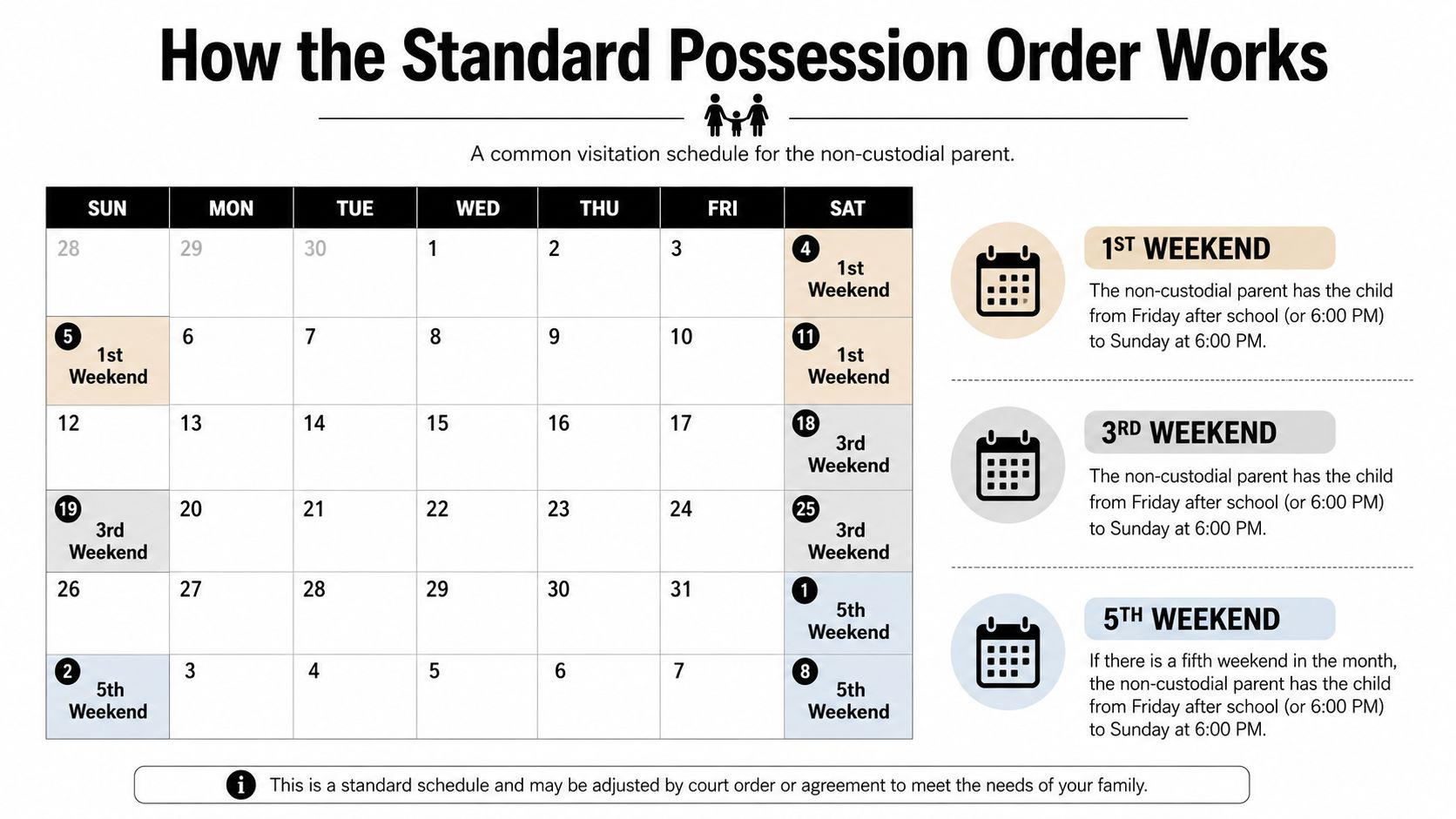
The schedule also assigns spring-break possession in alternating odd and even years. In many cases, it allows 30 days of summer possession. For children age three and older, Texas law creates a rebuttable presumption that the Standard Possession Order is in the child's best interest, subject to the specific statutory framework and the facts of the case. A Texas custody guide explaining the Standard Possession Order describes the schedule's weekend, holiday, and summer mechanics.
What the calendar means in practice
The managing conservator generally handles the child's primary residence and the baseline exchange logistics. The possession order then identifies when the possessory conservator receives the child and when that period ends. Under the default framework, the managing conservator is generally responsible for surrendering the child at the beginning of the possessory conservator's period. Texas conservatorship and possession rules show how these roles operate together.
This schedule matters because time-bounded rights are easier to enforce than vague promises. A parent who is repeatedly denied possession should preserve the order, messages, missed exchanges, and related records. A parent who expects to exercise possession should arrive on time, follow exchange terms, and communicate in writing when a genuine emergency affects the schedule.
The SPO is a default, not a command that every family must follow without adjustment. Parents may agree to a different arrangement when it serves the child, and courts may order variations when the default schedule doesn't fit the child's needs or the family's circumstances. The Texas Standard Possession Order Explained focuses on how the default Texas visitation schedule works.
A schedule can look simple on paper and still create daily problems involving school activities, transportation, work shifts, holidays, and communication. Parents should identify those pressure points before signing an agreement or asking the court to adopt a schedule.
For a closer look at how possession operates, review the Texas Standard Possession Order, then compare its language with the exact order in your case.
How Texas Courts Decide the Best Interest
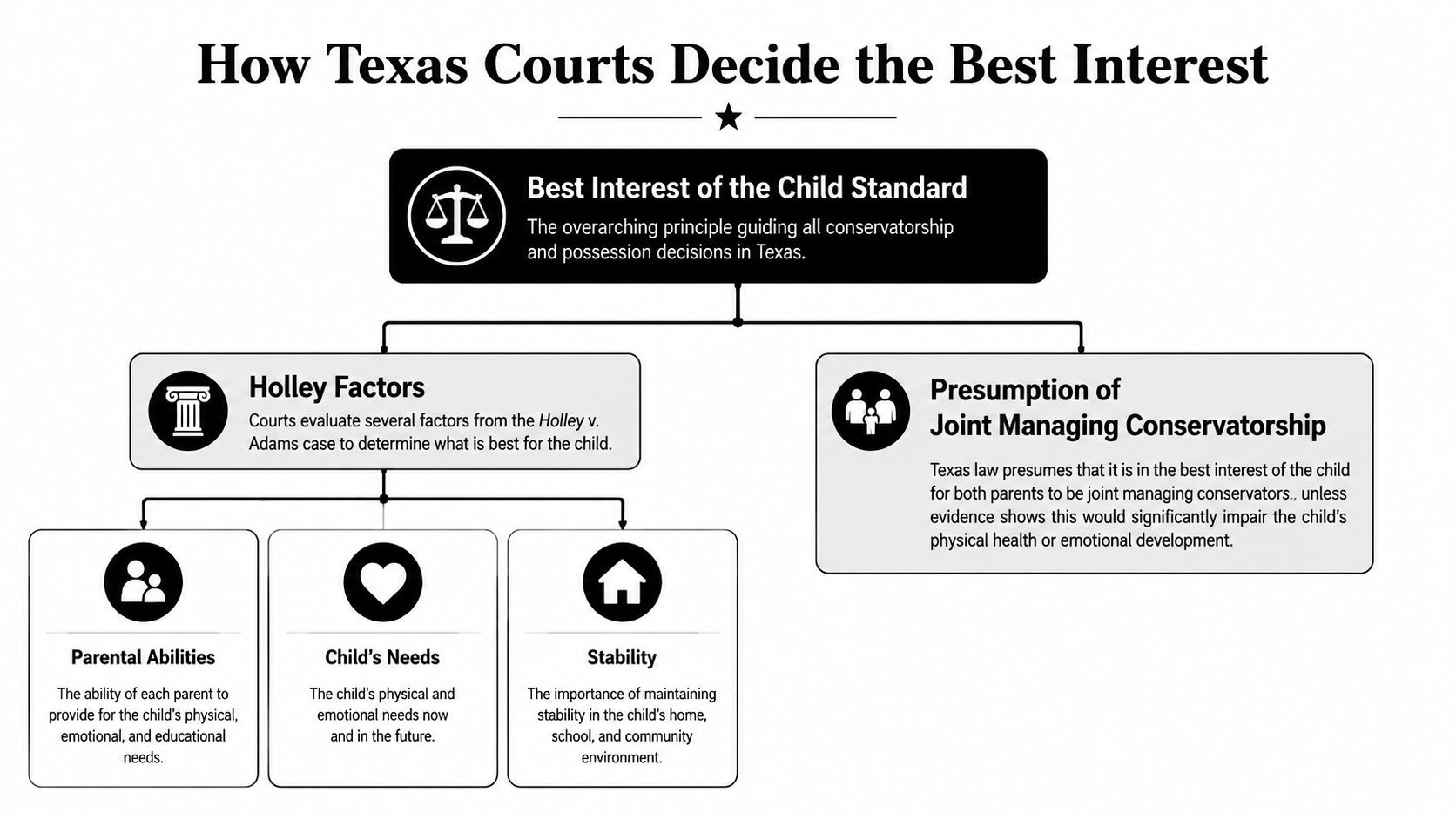
Texas courts begin with one controlling standard: the best interest of the child. Texas Family Code § 153.002 makes the child's best interest the primary consideration in conservatorship, possession, and access decisions. The phrase doesn't mean a judge chooses the parent who seems more likable. It means the court studies the child's needs, safety, relationships, and future welfare. Texas Family Code Section 153.002
What judges evaluate
Texas courts commonly use the Holley factors, which help organize the best-interest analysis. These factors consider the child's present and future needs, each parent's abilities, the stability of each proposed home, the plans each parent has for the child, available support programs, conduct affecting the parent-child relationship, and any explanation for that conduct.
A parent's evidence should answer practical questions:
- Daily parenting: Who handles school routines, appointments, meals, transportation, and homework?
- Parental abilities: Can each parent meet physical, emotional, educational, and developmental needs?
- Stability: Does each proposed home offer reliable care and a workable routine?
- Future planning: Does the parent have a realistic plan for school, activities, medical care, and exchanges?
- Safety: Is there evidence of family violence, substance abuse, neglect, or other conduct that may endanger the child?
- Support network: Can relatives, childcare providers, counselors, schools, or other services help meet the child's needs?
A presumption favoring joint managing conservatorship doesn't prevent a court from appointing one parent sole managing conservator. Evidence of endangerment can affect both decision-making and possession. The court may also limit possession or require protective conditions when the facts show that unrestricted access would not serve the child's safety or welfare.
Building evidence that helps the judge
Bring records that connect your concerns to the child's experience. Relevant materials may include school communications, medical records, calendars, messages about missed exchanges, photographs of unsafe conditions, and documentation from law enforcement or service providers when appropriate. Avoid placing the child in the role of messenger or investigator.
A judge needs organized facts, not a child caught between competing stories.
Parents can also learn from practical safety resources, including this child protection guide by Superstar Nannies. It isn't a substitute for legal advice or a court order, but it may help caregivers think clearly about safety policies and supervision.
Mothers and fathers should prepare the same way. Courts don't award rights based on gender alone. They examine the child's circumstances and the evidence presented. A parent who has made mistakes can explain the circumstances, show responsible changes, and present a credible plan for continued stability.
Special Scenarios for Military and Grandparents
Military families often need a custody plan that works during deployment, training, relocation, and sudden schedule changes. A parent's military service doesn't erase the parent-child relationship, but distance can make ordinary possession terms difficult to follow. The order should address notice, transportation, communication, holiday periods, and what happens when a service obligation interrupts scheduled possession.
A deployment may require temporary adjustments without changing the long-term structure of conservatorship. Parents should avoid relying only on verbal promises. A written agreement or court-approved modification can clarify how the child will maintain contact, who will provide day-to-day care, and how possession will resume after the service member returns.
Relocation requires early attention
Relocation can affect the managing conservator's ability to designate the child's primary residence and the possessory conservator's ability to exercise regular possession. A move may change school transportation, weekend exchanges, holiday travel, and the practical value of the existing geographic restriction.
Before moving, review the residence provisions and any geographic limits in the order. If the move would interfere with possession, the parent may need an agreement or a court order. A possessory parent who learns about a planned move should document the expected effect on travel, school, and parenting time rather than responding only with anger.
Grandparent and nonparent standing
Grandparents and other relatives may have strong emotional bonds with a child, but standing is a threshold legal question. Standing means having the legal ability to ask the court for a particular order. Texas guidance explains that grandparents and other relatives face threshold barriers, and a grandparent generally can't seek possessory conservatorship unless there is already an open case involving the child. Texas guidance on who may seek custody or visitation discusses these limits.
That means a grandparent may need to establish more than a loving relationship. The legal pathway may depend on the existing case, the child's circumstances, and whether the law permits the requested relief. Grandparents should get advice before filing because choosing the wrong legal request can waste time during an already stressful family crisis.
Modifying and Enforcing Custody Orders
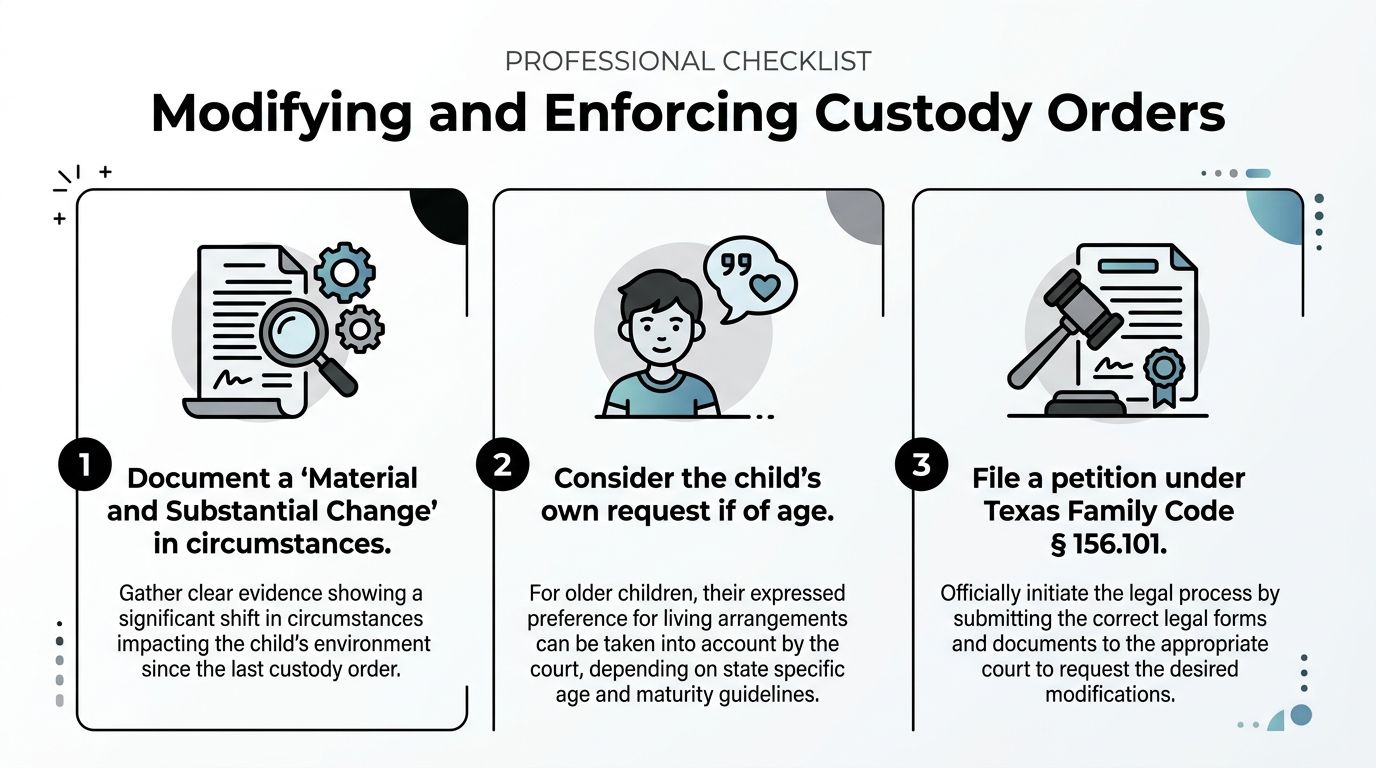
A custody order isn't always permanent, but a parent can't change it because the current schedule feels inconvenient. Texas Family Code § 156.101 allows modification only when the change is in the child's best interest and a recognized trigger exists. Those triggers include a material and substantial change in circumstances, a child age 12 or older expressing a preference in chambers about the primary residence decision-maker, or voluntary relinquishment of primary care and possession for at least six months. Texas Family Code Section 156.101
A practical modification roadmap
- Document the change: Identify what changed, when it changed, and how it affects the child. A new work schedule, relocation, safety concern, school issue, or repeated failure to follow the order may matter, but the facts must be connected to the child's best interest.
- Consider the child's request: If the child is at least the statutory age for the relevant modification ground, the child's preference may be considered in chambers. The child doesn't control the outcome, and parents should never pressure the child to choose sides.
- File the appropriate petition: A modification case must state the legal basis and requested relief. The court will compare the requested change with the existing order and the child's best interest.
Enforcement needs precision
If a managing conservator denies possession, or a possessory conservator fails to return the child, preserve the exact order and document each event. Keep messages, dates, exchange details, school records, and witness information. Don't retaliate by withholding the child or creating a new schedule without legal authority.
Emergency situations may require faster action. Parents seeking temporary custody help can review temporary custody order information from SMB Law, PC, while recognizing that the proper filing depends on the facts and the court's authority. A Texas family lawyer can evaluate whether enforcement, modification, or emergency relief is the right path.
Next Steps for Protecting Your Parental Rights
The managing versus possessory distinction isn't a ranking of which parent matters more. It separates decision-making authority from possession time. A managing conservator may control primary-residence decisions, while a possessory conservator may still provide daily care, attend school activities, access records, and maintain a meaningful relationship with the child.
Start with your order. Highlight provisions about primary residence, education, medical care, therapy, records, transportation, holidays, and exchanges. Then create a simple parenting calendar and keep communication focused on the child's needs. If you're a mother, father, grandparent, or caregiver, your next step should match your legal role and the relief you need.
You may need help establishing paternity, creating a parenting plan, requesting primary conservatorship, protecting possession during deployment, responding to relocation, enforcing missed parenting time, or seeking an emergency order. The Law Office of Bryan Fagan, PLLC handles Texas custody, visitation, conservatorship, child support, enforcement, modification, military, relocation, and emergency custody matters. Personalized legal advice can help you understand which facts matter and what action is safest for your child.
If you need help with a child custody or visitation case in Texas, our experienced attorneys can guide you every step of the way. Contact The Law Office of Bryan Fagan, PLLC today for a free consultation.