
When your child's future is on the line, understanding your rights matters most.
If you're dealing with custody and child support in Texas, you're probably carrying more than legal questions. You may be worried about where your child will sleep, how bills will get paid, whether the other parent can keep you from seeing your child, or whether a judge will really hear your side. Those fears are common, and they deserve clear answers.
Texas law gives parents a framework, but it doesn't always use everyday language. Words like conservatorship, possession, net resources, and modification can make a hard situation feel even heavier. The good news is that once you break the process into parts, it becomes much easier to understand and act on.
Understanding How Texas Courts Decide Custody
A parent can walk into court worried about one question and leave realizing there are two. Who makes the big decisions for the child, and when is the child with each parent? Texas treats those as separate issues, which is why custody cases can feel confusing at first.
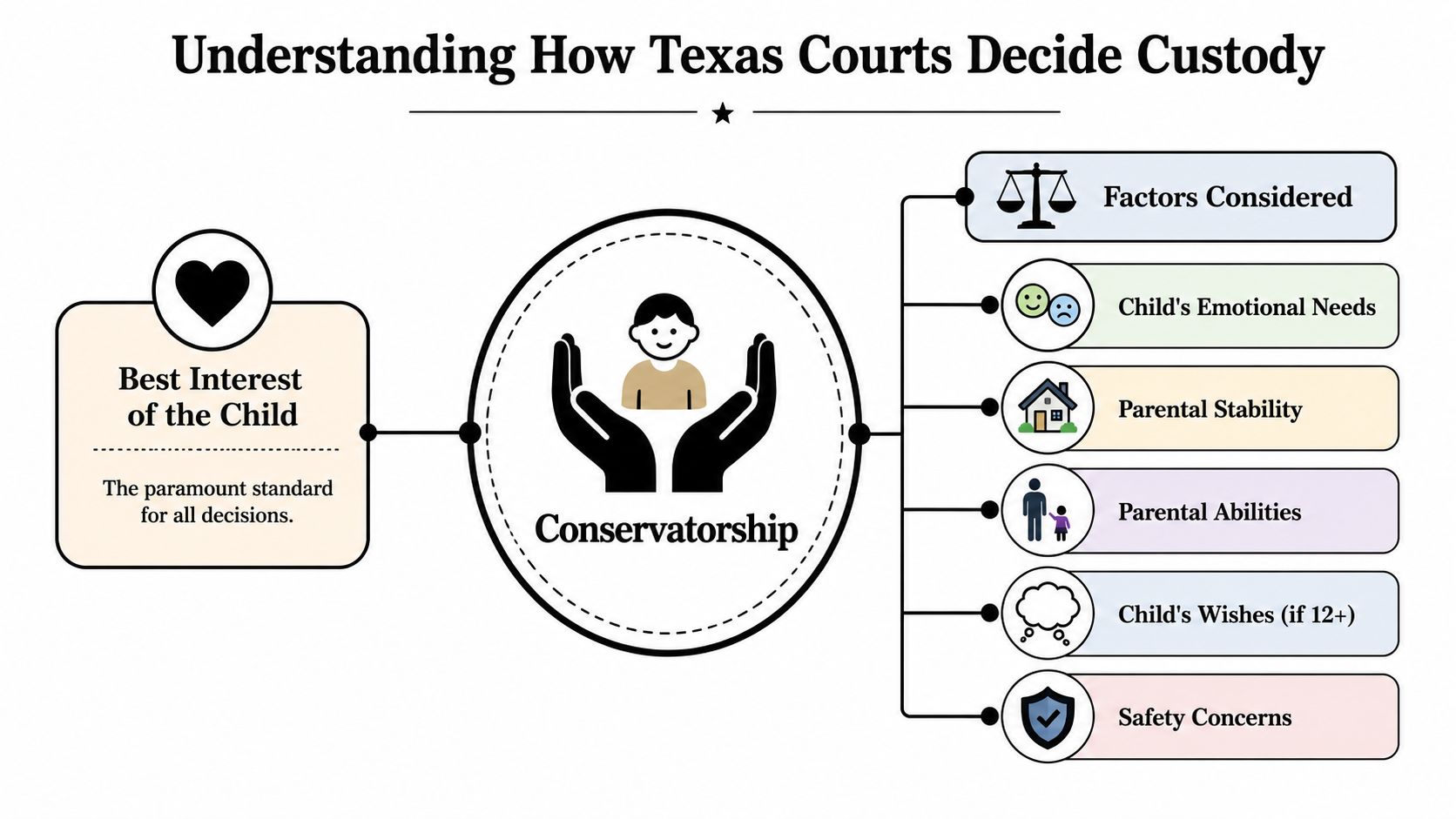
In Texas, the legal word for what many parents call custody is conservatorship. That term focuses on rights and duties. It covers matters like educational decisions, medical care, and who can decide where the child primarily lives. Time with the child is handled separately. That distinction matters because a parent can share decision-making authority and still have a set possession schedule rather than equal time. It also matters because child support often connects more closely to the parenting arrangement in daily life than parents expect, even though support and conservatorship are different legal questions.
The court's guiding rule is the best interest of the child. That phrase can sound broad, but judges apply it to practical details. They look at how the child is doing, what each parent has been doing, and what arrangement gives the child safety, stability, and healthy support over time.
Joint managing conservatorship and sole managing conservatorship
Texas courts often start with the presumption that parents should be appointed Joint Managing Conservators under Texas Family Code § 153.131, as explained in this discussion of child custody in Texas. A Joint Managing Conservatorship, or JMC, usually means both parents keep important rights and duties toward the child.
That does not mean a 50-50 schedule. It does not even mean both parents make every decision together. One parent may have the exclusive right to choose the child's primary residence, while both parents share other decision-making responsibilities. A good way to understand JMC is to picture a job description, not a calendar.
A Sole Managing Conservatorship gives one parent more of those decision-making rights. Courts tend to use that arrangement when the facts show that shared decision-making would put the child's well-being at risk, such as cases involving family violence, serious substance abuse, neglect, or other safety concerns.
Practical rule: Judges focus on what arrangement helps the child live safely and steadily, not on which parent presents better in court.
What judges look at
Parents often hope one fact will settle the case. In real hearings, judges usually look for patterns that show how each parent functions over time.
Common factors include:
- Daily caregiving history: Who handles school mornings, homework, meals, appointments, and ordinary routines.
- Home stability: Whether the parent can provide a steady, safe environment with consistent care.
- Parent-child relationship: How involved each parent has been in the child's emotional, educational, and day-to-day life.
- Safety issues: Abuse, neglect, family violence, substance abuse, or unsafe living conditions can heavily affect the result.
- The child's preferences: In some cases, an older child's wishes may be considered, but they do not control the outcome by themselves.
Family violence deserves special attention. Under Texas Family Code § 153.004, a court may not appoint parents as joint managing conservators if there is credible evidence of a history or pattern of child neglect or physical or sexual abuse. The court can also limit or deny access if the evidence supports that result.
For many parents, this is the point where custody and support start to feel intertwined. A judge decides conservatorship based on the child's best interest, not on who pays more support. But the final custody structure can shape where the child lives most of the time, which parent receives support, and how each household handles the child's daily expenses. The law keeps those questions separate. Real life does not feel separate.
If you want a closer look at the reasoning courts use, this guide on how judges make custody decisions in Texas explains the process in plain language.
Possession Schedules and Visitation Rights
Many parents feel some relief once they learn that Texas doesn't leave visitation entirely open-ended. Courts often use standard schedules that create predictability for both households. That structure can reduce conflict and help children know what to expect.
The legal term for visitation is usually possession and access. Conservatorship answers who has rights and duties. Possession schedules answer when the child is with each parent.
Standard possession and expanded possession
Texas parents often hear about the Standard Possession Order, or SPO, and the Expanded Standard Possession Order, or ESPO. The expanded version gives the non-primary parent more time.
Effective January 1, 2026, Texas courts adopted the Expanded Standard Possession Order as the presumptive schedule for parents living within 50 miles of each other, and that schedule gives the non-primary parent about 46 to 48% of parenting time, according to Texas divorce and custody statistics.
That's a meaningful shift. It reflects a stronger default toward keeping both parents actively involved when the facts support it.
If you want a focused explanation of how the expanded schedule works, The Expanded Standard Possession Order (ESPO) in Texas explains how the expanded schedule gives the non-primary parent more time.
What this looks like in everyday life
A possession order usually covers:
- Weekends: Which parent has the child on specified weekends.
- School-year time: Pickups and returns tied to school schedules.
- Holidays: Thanksgiving, winter break, and spring break are often divided in alternating years.
- Summer: The order may give one parent an extended summer period.
A schedule isn't just a calendar. It's a set of rules that helps avoid arguments about pickup times, missed weekends, and holiday confusion.
A good possession order is specific enough that both parents can follow it without guessing.
For many families, the biggest point of confusion is the difference between “joint custody” and “equal time.” They are not the same. A parent can share major decision-making authority and still have less than half of the overnights, depending on the order.
When a child's preference matters
Parents also ask whether a child can choose where to live. The short answer is that a child's wishes may matter, but they don't control the case. A judge still decides based on the child's best interest.
That means a parent shouldn't pressure a child to “pick sides.” Courts tend to view that badly, and it puts emotional weight on the child that no child should carry.
For a practical explanation of the usual schedule parents see in court, this article on the standard visitation schedule in Texas is a helpful starting point.
How Child Support Is Calculated in Texas
A parent may leave a custody hearing thinking, “At least we settled where the kids will stay,” and then get blindsided by the next question: “What will child support be?” That reaction is common in Texas cases. Conservatorship and possession address parenting roles and time with the child. Child support addresses money. They are legally separate issues, but in real life, parents feel them at the same time.
Texas usually starts child support with a formula. That gives families a clearer starting point, but the formula still depends on getting the income numbers right.
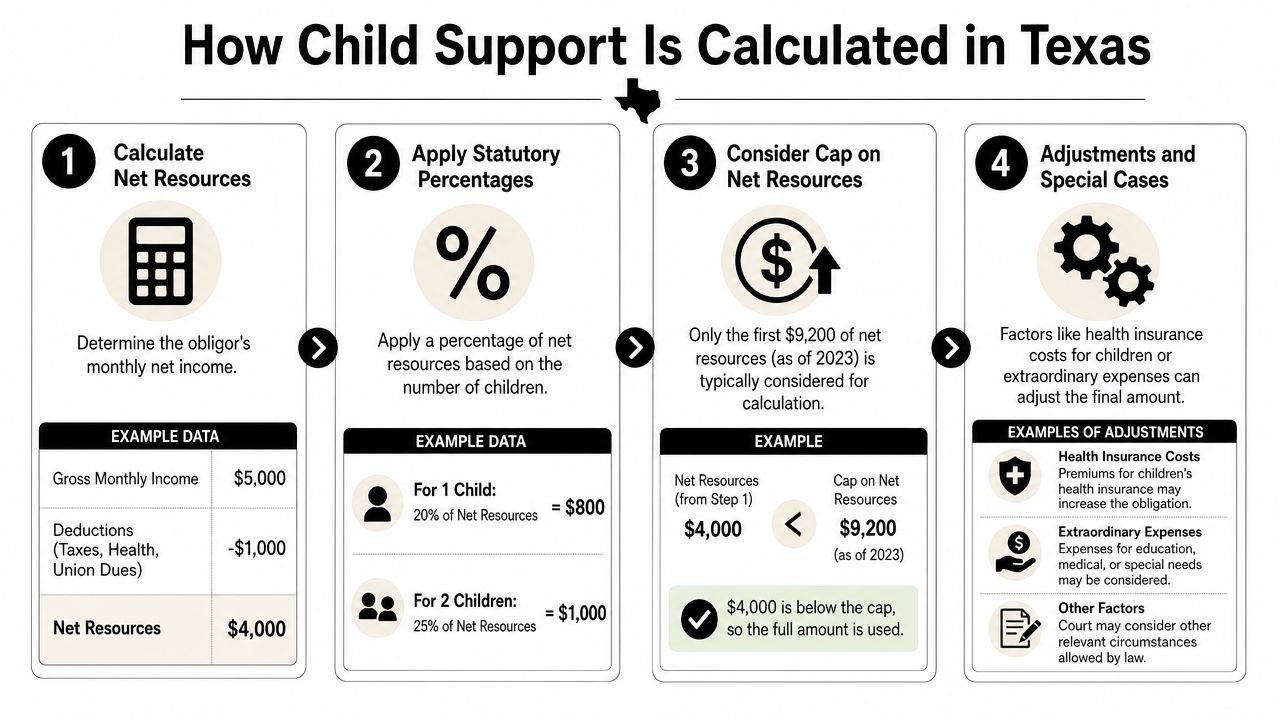
The first point to understand is that Texas child support is generally based on the obligor's net resources. The obligor is the parent ordered to pay support. Courts do not begin with gross pay, and they do not use the other parent's income in the basic guideline calculation. Under Tex. Fam. Code §154.125, the court applies guideline percentages to the obligor's net monthly resources after allowed deductions.
Step one is net resources, not paycheck totals
Many parents often struggle with this.
A salary number on a job offer, a yearly W-2 amount, or a rough guess from a paycheck stub does not answer the legal question by itself. The court looks at net monthly resources, which usually means income after certain deductions the law allows. If you estimate support from gross income alone, your estimate may be too high or too low.
That confusion matters because parents often connect support to parenting time in a way Texas law does not. A parent may say, “I have the child more than people realize, so support should automatically change.” Sometimes a schedule matters to the overall case, but the guideline calculation itself still begins with the paying parent's net resources. The custody order and the support order affect the same family budget, even though they are calculated under different rules.
Texas also has low-income child support guidelines, which can change the result for parents with limited net resources. For qualifying obligors, the percentages are lower than the standard guideline amounts, as explained in Texas child support guidance.
Step two is applying the statutory percentages
Once the court identifies the correct net-resources figure, it applies the guideline percentage tied to the number of children before the court:
| Number of children | Guideline percentage |
|---|---|
| 1 child | 20% |
| 2 children | 25% |
| 3 children | 30% |
| 4 children | 35% |
| 5 or more children | 40% |
Those percentages look simple on paper. The hard part is usually the step before them. If the income figure is wrong, the final support number will be wrong too.
Courts may also consider whether the paying parent has a duty to support other children. That does not erase support. It can affect how the guideline amount is adjusted.
The 2025 change that affects higher-income parents
As of September 1, 2025, the maximum net monthly resources cap will increase from $9,200 to $11,700, and that changes the highest guideline amount the court calculates under the cap, according to this breakdown of Texas family law changes.
That update matters most in higher-income cases. The percentages still apply, but they apply to a larger amount of net resources before the court reaches the separate question of whether support above the cap is appropriate.
Using that updated cap, the guideline maximums are:
- One child: $2,340
- Two children: $2,925
- Three children: $3,510
- Four children: $4,095
For parents with existing orders, this change does not usually rewrite the old order by itself. A parent normally has to ask the court for a modification if the facts and timing support one.
Here is a short video that walks through child support issues in Texas:
Four questions that usually decide the starting number
If you are trying to make sense of a possible support amount, focus on these four questions:
- Which parent will be the obligor under the expected order?
- What are that parent's net monthly resources under Texas law?
- How many children are before the court in this case?
- Do low-income guidelines or support obligations for other children affect the calculation?
That framework gives parents a practical way to organize pay stubs, tax records, and questions for counsel. If you want a closer look at the math, this article on how to calculate child support in Texas gives a more detailed walkthrough.
Providing Medical and Dental Support
Monthly child support is only part of the financial picture. Texas orders also deal with a child's medical and dental needs. This aspect often surprises many parents, especially if they thought the support number covered everything.
Usually, the court wants one parent to provide health insurance if it's available at a reasonable cost. If one parent carries the insurance, the order may address how that cost affects the overall support arrangement. If insurance isn't available, the court can use cash medical support as a substitute payment structure.
Insurance coverage and out-of-pocket costs are different
These are two separate responsibilities:
- Insurance coverage: One parent may be ordered to enroll the child in available health or dental coverage.
- Out-of-pocket expenses: Parents may also have to divide costs that insurance doesn't fully pay, such as co-pays, deductibles, prescriptions, or other necessary treatment.
- Cash medical support: If coverage isn't available, one parent may be ordered to pay an additional amount to help meet the child's medical needs.
Parents often get into avoidable fights because one order talks clearly about premiums but says too little about reimbursement procedures. A strong order should say how expenses are shared, how quickly receipts must be sent, and how quickly reimbursement must happen.
Why this part of the order matters so much
Medical costs don't arrive on a neat schedule. A child may need urgent care, braces, therapy, or dental work at the worst possible time for both parents financially. Clear terms reduce stress because they answer questions before the bill shows up.
Keep records as you go. Save explanation-of-benefits statements, receipts, and written communication about treatment.
If you're negotiating an order, don't focus only on the monthly support number. Look closely at who provides insurance, what happens if coverage changes, and how uncovered costs are handled. Those details often drive later disputes.
Establishing Paternity and Modifying or Enforcing Orders
You may be doing everything a parent does. School pickups, doctor visits, bedtime calls, support payments. Then one day a disagreement hits, and you learn a hard truth. In Texas, parenting time and child support are connected in daily life, but they are not the same legal right. A parent can be actively involved and still need a court order to protect that role. A parent can also be owed support even when possession is disputed.
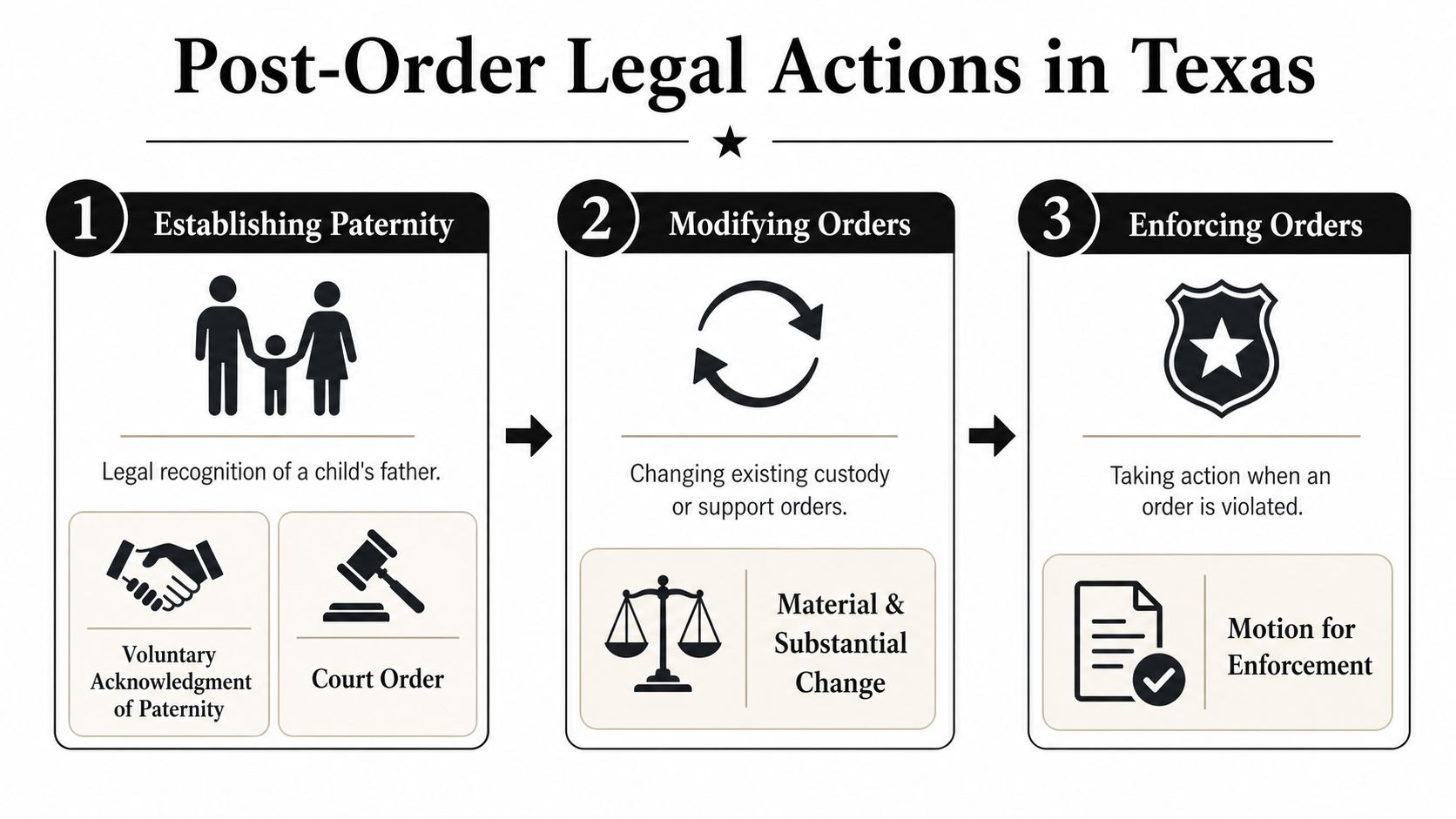
That is why problems after a child is born or after an order is signed often fall into three categories. Paternity, modification, and enforcement.
When an unmarried father wants legal rights
This issue causes a lot of fear and confusion. Many fathers assume that being present at birth, signing the birth certificate, or regularly supporting the child automatically gives them custody or visitation rights. Texas law does not treat those facts as a substitute for legally established paternity.
For unmarried parents, legal paternity usually must be established through a signed Acknowledgment of Paternity (AOP) or through a court case that may include genetic testing and a final order. Until that happens, a father may have a real relationship with the child but no clear, enforceable conservatorship or possession rights.
That gap matters. It affects who can ask the court for visitation, who can make decisions for the child, and how child support is formally addressed.
If you are an unmarried father, the practical question is simple. Do you have a signed AOP and a court order that spells out rights and duties? If not, the next step is usually to get those pieces in place rather than relying on informal cooperation.
When an existing order no longer matches real life
Court orders are snapshots. Families are not.
A schedule that worked for a toddler may stop working once the child starts school. A support amount that made sense two years ago may feel unrealistic after a job loss, a major raise, new medical needs, or a long commute. Parents often adjust informally because it feels faster and less expensive. The problem is that an unwritten fix works only as long as both parents keep agreeing.
A modification asks the court to update custody, visitation, support, or related terms because circumstances have materially and substantially changed. The court is not looking for minor frustration or a temporary inconvenience. It is looking for a real change that affects the child, the parents, or the order's fairness.
Common reasons parents seek modification include:
- A work schedule change that makes exchanges or weekend periods unworkable
- A child's changing needs involving school, health, counseling, or behavior
- A meaningful change in income that affects child support
- Repeated disputes over unclear wording in the current order
- A parent's planned move that affects travel, school, or regular contact
If your day-to-day routine and your signed order no longer match, the order still controls.
That is where many parents get trapped. They assume cooperation today will protect them tomorrow. It may not. In family court, the written order is the map.
When the other parent is ignoring the order
Enforcement is the court's way of responding when one parent does not do what the order requires. That might mean failing to pay support, refusing possession, not returning the child on time, or violating another specific term.
The safest response is usually documentation and legal action, not self-help. If support is missing, parents may pursue enforcement through the court or seek assistance from the Office of the Attorney General. If possession is being denied, a motion to enforce may be appropriate. For either problem, details matter. Keep calendars, payment histories, screenshots of messages, receipts, and notes about missed exchanges.
Specific records help the judge see a pattern instead of a one-time disagreement.
Some parents handle part of the process through the Attorney General, especially for support collection. Others need private counsel when the dispute involves custody, paternity, possession, or a request to modify existing terms. The Law Office of Bryan Fagan, PLLC is one example of a Texas family law firm parents may contact for help with paternity, modification, support, or enforcement issues.
Navigating Special Custody and Support Situations
A mother gets notice that her job is transferring her to another Texas city. A father in the military learns he may be deployed in a few months. A grandparent has been caring for a child every day while a parent struggles with addiction or disappears for weeks at a time. In each of these situations, parents often ask the same question: does custody change, does child support change, or both?
The answer is often more complicated than parents expect. Conservatorship, possession, and child support are separate parts of a Texas case, but real life ties them together. A move may affect the visitation schedule without automatically changing support. A deployment may call for temporary possession terms while leaving legal rights in place. A grandparent may provide daily care, but that alone does not automatically create a right to custody or support.

Military families and relocation concerns
Military service can disrupt the usual calendar quickly. A standard possession order may work well during ordinary times, then become unrealistic because of deployment, training, or a transfer. Texas courts can address those problems with more specific language about notice, virtual contact, transportation, temporary caretaking arrangements, and makeup parenting time after the service member returns.
Child support can raise a separate question. A parent's service status does not erase support duties, but a major change in income or living arrangements may justify reviewing the amount. That is a good example of how custody and support travel on parallel tracks. One part of the order may need adjustment even if the other part stays the same.
Relocation cases create a different kind of strain. Parents are often thinking about housing costs, family help, safer neighborhoods, or a better job. The court is focused on the child's stability, schooling, travel demands, and ability to maintain a meaningful relationship with both parents. Judges usually look closely at the practical details, not just the reason for the move.
Grandparents and emergency issues
Grandparents are often the safety net in a family crisis. They may handle school pickup, doctor visits, meals, and bedtime for months. Even so, Texas law starts with a strong presumption that parents should make decisions for their children.
That means a grandparent does not get automatic custody or visitation rights solely because the grandparent has been significantly involved. In some cases, a grandparent can ask the court for relief under Texas Family Code sections 153.432 through 153.434, but the burden is high. The court generally wants clear proof that the child's physical health or emotional well-being would be seriously harmed without intervention, or that a parent is absent, unfit, or unable to provide proper care.
Parents are often surprised by that rule. Daily help matters, but legal standing and proof matter more.
Emergency cases work differently because the court's first job is immediate protection. If a child faces an urgent risk of abuse, neglect, abandonment, or another serious threat, a Texas court may enter temporary emergency orders quickly. In cases involving more than one state, temporary emergency jurisdiction may also come into play while the court sorts out which state has authority to make longer-term decisions.
Why special cases need careful planning
Special situations usually turn on specific facts. One text message confirming a move. One military order with a report date. One school record showing who has been caring for the child. One medical record documenting immediate danger.
That is why general internet advice often falls short.
If your situation involves deployment, relocation, grandparent care, or an emergency, start building a file early. Keep copies of current court orders, school and medical records, travel information, childcare records, and written communication with the other parent. Those documents help the court see the full picture.
For many Texas parents, the hardest part is understanding that the legal questions may split apart even while the family problem feels like one crisis. Where the child lives, who makes decisions, who pays support, and whether an emergency order is needed may each require a separate analysis. Once you see that structure, the process becomes less mysterious and more manageable.
Your Next Steps and When to Contact an Attorney
It is 9:30 p.m. Your child is asleep. You are staring at texts, a draft court form, and a calculator, trying to answer questions that all feel connected. Who decides school choices? When will your child be with each parent? Who pays support? What happens if the other parent stops following the schedule?
That stress is common. Texas law treats custody and child support as separate issues, but parents live them as one reality. A conservatorship order may decide rights and decision-making. A support order may decide who pays and how much. On paper, they are different tracks. In real life, both shape your child's daily stability.
A helpful next step is to sort your problem into categories before you act. That works like separating a mixed stack of bills, school papers, and medical forms before trying to solve everything at once. Once you know which issue belongs where, the process usually feels less confusing.
Start with a simple checklist
Ask yourself these questions:
- Do I already have a court order? If yes, read the exact wording before relying on memory.
- Is my problem about decision-making, parenting time, money, or enforcement? More than one may apply, but identify each one separately.
- Has something changed since the last order? A job loss, move, new school issue, or safety concern can affect what steps make sense.
- Do I have documents to support my concern? Save messages, payment records, school records, medical records, and calendars.
- Is there any immediate safety risk? If yes, act quickly and get legal advice as soon as possible.
That last question matters most. If your child may be in danger, speed matters more than convenience.
What to do before you call a lawyer
You do not need to know every legal term before getting help. You do need a clear summary of what is happening.
Try to gather:
- your current court orders
- a timeline of major events
- recent communication with the other parent
- proof of income, insurance, or support payments if money is part of the dispute
- school, medical, or childcare records if those issues are involved
This preparation helps in two ways. First, it saves time. Second, it helps a lawyer see whether your issue involves a new case, a modification, an enforcement action, or an emergency request.
When legal help is a smart move
Some parents can handle a straightforward filing with good information and careful attention to detail. Other situations carry enough risk that professional advice can prevent expensive mistakes.
Consider speaking with a Texas family lawyer if:
- there are concerns about abuse, neglect, or family violence
- the other parent is keeping the child from you or refusing to return the child
- you need to establish paternity before custody or support rights can be enforced
- a planned move, military service, or unusual work schedule affects the current order
- income is irregular, self-employment is involved, or support calculations are disputed
- the current order no longer fits your child's needs
- the other parent is ignoring court orders about support, possession, or medical coverage
Legal help is often less about going to court immediately and more about choosing the right path early. Many cases improve once a parent understands what the judge can decide, what evidence matters, and what requests belong in the paperwork.
If you need help with a child custody or visitation case in Texas, the attorneys at The Law Office of Bryan Fagan, PLLC can help you evaluate your options and decide what step to take next.