
When your child's future is on the line, understanding your rights matters most.
You may have just left court, hung up with your lawyer, or opened paperwork that says a custody evaluation has been ordered. For many parents, that moment feels like the floor drops out. You start asking hard questions fast. Is this a sign the judge doubts me? Am I being tested? What if the evaluator gets the wrong impression?
Those fears are common. They're also manageable when you know what this process is about. In Texas, a custody evaluation is a formal investigation used in difficult cases to help the judge decide what arrangement serves the child's best interest. It isn't a contest for the “perfect parent.” It's a closer look at the family, the child's needs, and each parent's ability to provide safety, stability, and healthy parenting.
Your Child's Future Is at Stake Understanding the Custody Evaluation
You read the court order, see the words “custody evaluation,” and your stomach drops. Many parents hear that phrase and worry the court has already made up its mind, or that one nervous answer will define them as a parent. That fear is real, especially if you have never been through family court before.
A custody evaluation works more like a careful fact-finding review than a final judgment. The evaluator's job is to slow the case down, gather information from several angles, and give the judge a clearer picture of your child's daily life, needs, and relationships. In Texas, these evaluations are governed by Texas Family Code Section 107.101 and related provisions.
That distinction matters.
A parent who understands the process usually presents more clearly and with less panic. If you are trying to make sense of the legal framework behind these decisions, it can help to review these top considerations for determining the best interest of the child in Texas custody cases. It gives useful context for why courts ask such detailed questions.
What the evaluation is really doing
An evaluator is usually a licensed mental health professional or another qualified professional appointed to study the family in a structured way. That can include interviews, home visits, records review, conversations with collateral sources, and sometimes psychological testing if the circumstances call for it.
The process works like a wide-angle camera, not a snapshot. One tense moment matters less than the overall pattern. Evaluators are usually asking practical questions such as: Does this parent understand the child's needs? Is the home stable? Does the parent tell the truth even when revealing difficult facts? Can the parent protect the child without pulling the child into adult conflict?
That last point is where many parents get uneasy. They are afraid of being misread.
That fear is understandable, but it helps to know what tends to create a good impression and what tends to create concern. A strong presentation usually looks calm, child-focused, organized, and honest. A weaker presentation often includes exaggeration, rehearsed attacks on the other parent, blaming everyone else, or acting as if the child has no meaningful bond with the other parent.
What it is not
A custody evaluation is not a test for the “perfect parent.” Family courts see real families, not polished ones. Your child may have a messy backpack. You may feel exhausted. Your house may look lived in. None of that automatically hurts you.
Evaluators are usually more concerned with patterns of judgment than appearances. A parent who says, “I was late to pickup twice during a work crisis, and here is how I fixed it,” often comes across better than a parent who insists everything is flawless. Honest self-awareness tends to read as credible.
Here is a useful way to frame it. The evaluator is usually not searching for a parent who never struggles. The evaluator is trying to identify a parent who can handle stress, make safe decisions, and keep the child's needs at the center.
Why this feels so personal
The process can feel invasive because it reaches into the ordinary parts of your life. Your routines. Your communication with the other parent. School records. Medical history. Discipline. The condition of your home. Even your tone in text messages may matter if it shows a larger pattern.
That can leave a parent feeling watched and judged.
There is a purpose behind that level of detail. Judges are often faced with two very different stories about the same family. The evaluator helps sort out what is consistent, what is supported by records, and what daily life looks like for the child when court is not in session.
Preparation helps lower that stress. Before meetings with your lawyer or evaluator, many parents find it useful to organize dates, records, concerns, and questions in one place. A simple guide for legal client intake can help you gather that information in a clear way.
A custody evaluation in Texas often takes time. That can feel frustrating when you want answers now, but the slower pace usually reflects the amount of information being reviewed, not a sign that you are losing ground. Knowing what to expect from a custody evaluation in Texas can take some of the mystery out of the process, and once the mystery starts to fade, parents are often able to respond with more confidence and better judgment.
The Best Interest of the Child Standard in Texas
A parent can walk into a custody evaluation worried about one question more than any other: “What if they get me wrong?” That fear is common. The good news is that Texas law gives the evaluator and the court a specific lens to use. The question is not who tells the most emotional story. The question is what arrangement serves the child's best interest.
That phrase can sound broad until you translate it into daily life. Courts and evaluators are looking at how a child lives. Is the child safe in each home? Are school, medical care, and routines handled consistently? Which parent shows sound judgment under stress? Which parent can meet the child's needs without pulling the child into adult conflict?
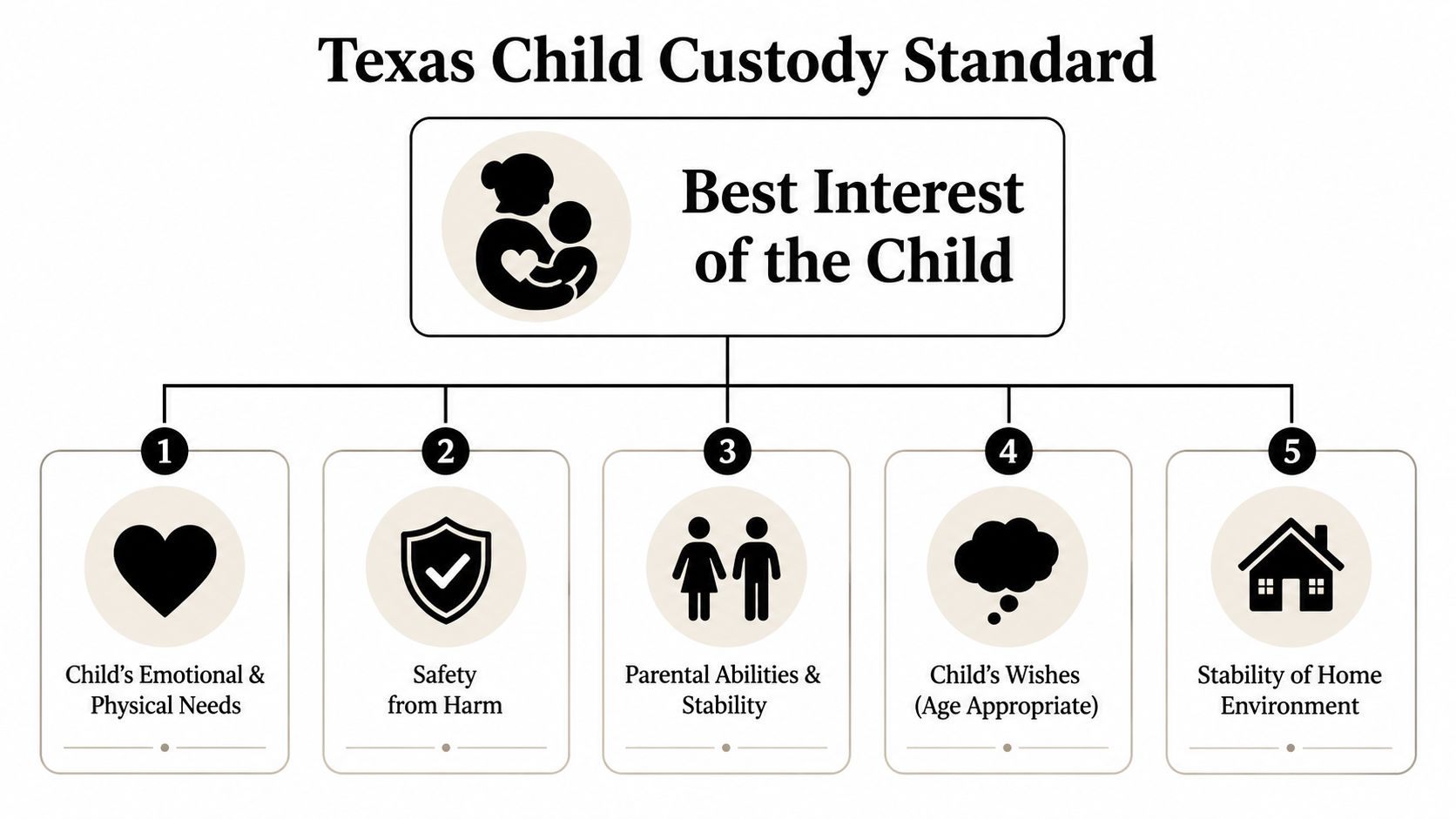
What best interest means in plain English
Texas Family Code §153.002 states the basic rule clearly. The child's best interest is the court's primary consideration in custody matters. Texas Family Code §153.134 also directs courts deciding joint managing conservatorship issues to consider each parent's ability to encourage a positive relationship with the other parent, whether the parents can reach shared decisions, and whether they can put the child's welfare first.
In plain English, the court is asking whether your home and your decisions help a child grow up safely and steadily.
That usually includes a few practical themes:
- Safety comes first. Concerns about family violence, abuse, neglect, substance abuse, or dangerous judgment carry serious weight.
- Stability matters because children live in routines, not legal labels. School attendance, bedtime, homework support, transportation, and medical follow-through often say more than a polished courtroom statement.
- Co-parenting matters when it is safe and appropriate. A parent who protects the child from conflict and avoids using the child as a messenger usually presents better than a parent who keeps score.
- Legal titles do not decide the case by themselves. Joint managing conservatorship does not automatically mean a perfectly equal division of time or authority. The order depends on the child's needs and the parents' circumstances.
How evaluators use this standard
An evaluator uses the best-interest standard the way a doctor uses a checklist during an exam. The evaluator is not trying to decide who feels more hurt. The evaluator is comparing facts, patterns, and parenting choices to the child's needs.
That distinction matters because many parents fear being judged for ordinary imperfections. A messy week, a tense text, or a moment of frustration does not usually decide a case by itself. Evaluators are usually looking for patterns. Do you calm conflict or feed it? Do you focus on the child's needs or on punishing the other parent? Are your concerns specific and supported, or broad and emotional?
A strong presentation often sounds simple and grounded: my child needs consistency, here is the routine I provide, here is how I handle school and medical issues, and here is how I support the child's relationship with the other parent when it is safe to do so.
Parents who want more detail on the legal factors can review these top considerations for determining the best interest of the child in Texas custody cases.
Where parents get tripped up
Many parents assume the court is choosing between the “good parent” and the “bad parent.” Custody cases rarely work that way. More often, the court is comparing two households, two parenting styles, and two versions of what the child needs most right now.
That is why “do” and “don't” thinking helps.
Do stay child-focused. Do answer questions directly. Do bring examples of routines, school involvement, medical care, and communication that show steady parenting. Do acknowledge weaknesses if they exist, then explain what you have done to address them.
Do not turn every answer into an attack on the other parent. Do not exaggerate. Do not assume the evaluator will be impressed by anger, sarcasm, or a long list of old grievances that have little to do with the child's present needs.
The best-interest standard is meant to protect children, but it also gives parents a clearer target. If you understand what the evaluator is measuring, you can prepare in a calmer and more useful way.
The Custody Evaluation Process Step by Step
The process feels less intimidating when you can see the road ahead. In Texas, custody evaluations are governed by Texas Family Code §§ 107.101–107.118 and typically require a minimum of 90 days between the evaluation order and the later hearing so the evaluator has time to gather information and analyze it, according to this explanation of the Texas custody evaluation process.
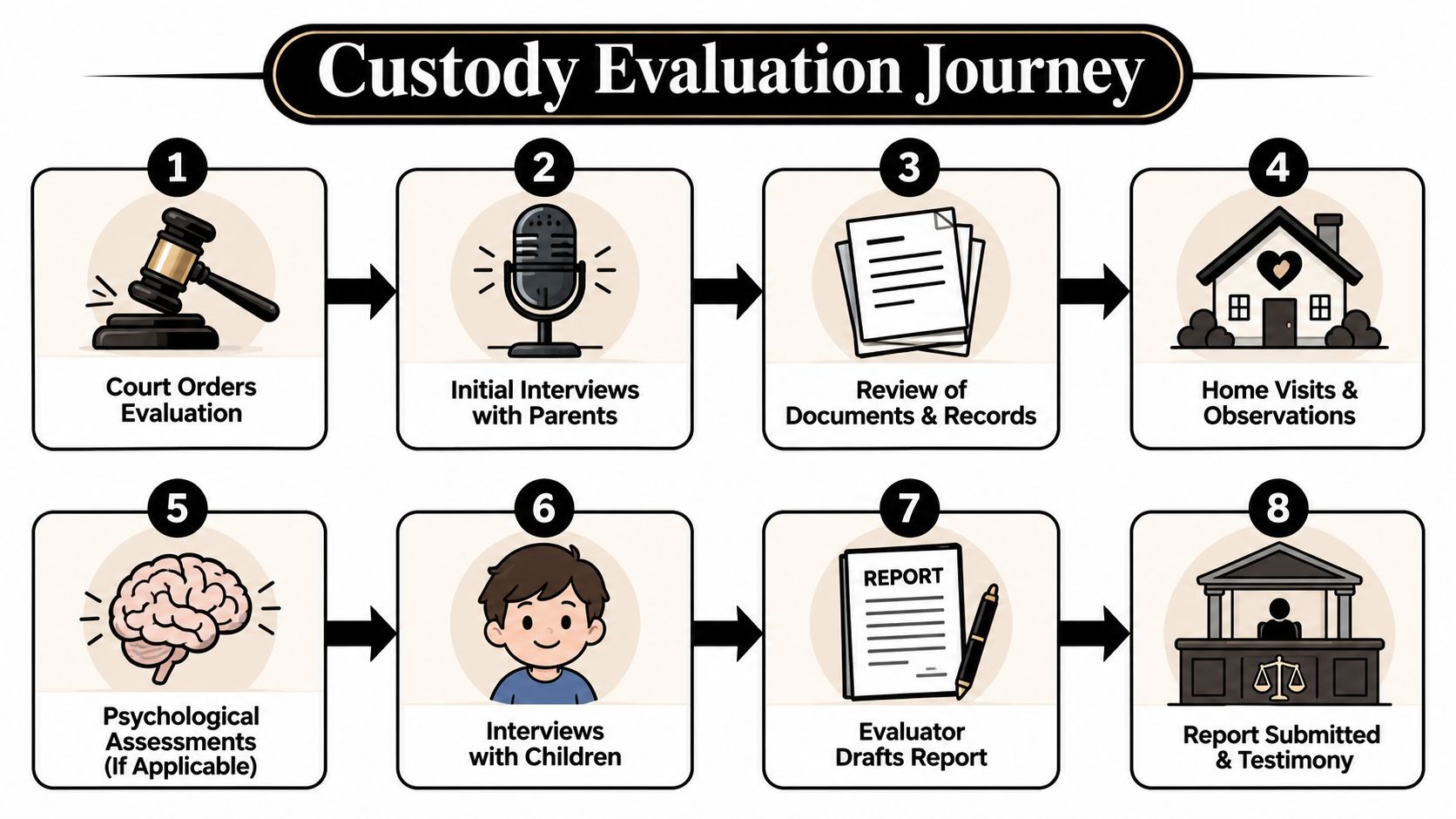
The five main phases
Texas evaluations are commonly described in five phases.
Individual interviews
The evaluator meets with each parent and the child. Parents usually discuss family history, parenting concerns, routines, discipline, communication, and current conflict. Children are interviewed in an age-appropriate way.Home visits
The evaluator reviews each home environment. This is not a white-glove inspection. The question is whether the space is safe, appropriate, and supportive for the child.Collateral interviews
The evaluator may speak with teachers, counselors, doctors, therapists, or other people who have direct knowledge of the child and family.Document review
School records, medical records, prior court papers, and other relevant materials may be reviewed.Written report
The evaluator synthesizes everything into a report for the court with recommendations about conservatorship, possession, and access.
What this looks like in real life
The first parent interview often feels like a mix of personal history and practical parenting questions. You may be asked about your child's routines, school issues, medical needs, discipline style, communication with the other parent, and any allegations in the case.
Then comes the part that catches many people off guard. The evaluator is not only listening to your answers. The evaluator is also watching how you answer. Are you focused on the child? Are your statements consistent? Can you discuss concerns without turning every answer into an attack?
The evaluation process rewards clarity, honesty, and emotional control more than polished speeches.
Children and records are part of the process
Texas law is specific in some important ways. Children who are at least four years old are generally interviewed in an age-appropriate way unless the evaluator decides that interview would not be developmentally appropriate. For children, the interview is not an interrogation. It is a developmentally adapted conversation to understand relationships, routines, and concerns.
Texas law also requires important record gathering. Under Texas Family Code §153.102, the evaluator must obtain relevant school and medical records for the child and review criminal history information and any CPS or law enforcement contact involving abuse or neglect for each person living in the residence, as reflected in the Texas legislative bill text.
Who the evaluator is
The evaluator is a neutral professional. Texas law requires this person to be a licensed mental health professional or qualified social worker who meets statutory qualifications. The evaluator does not represent the mother, the father, or the grandparents. The evaluator serves the court.
That point matters. Parents often enter the process trying to “win over” the evaluator. A better approach is to provide accurate information, strong documentation, and child-centered answers.
How to Prepare for Your Custody Evaluation
Preparation isn't about acting perfect. It's about showing your real parenting life in a clear, organized, credible way.
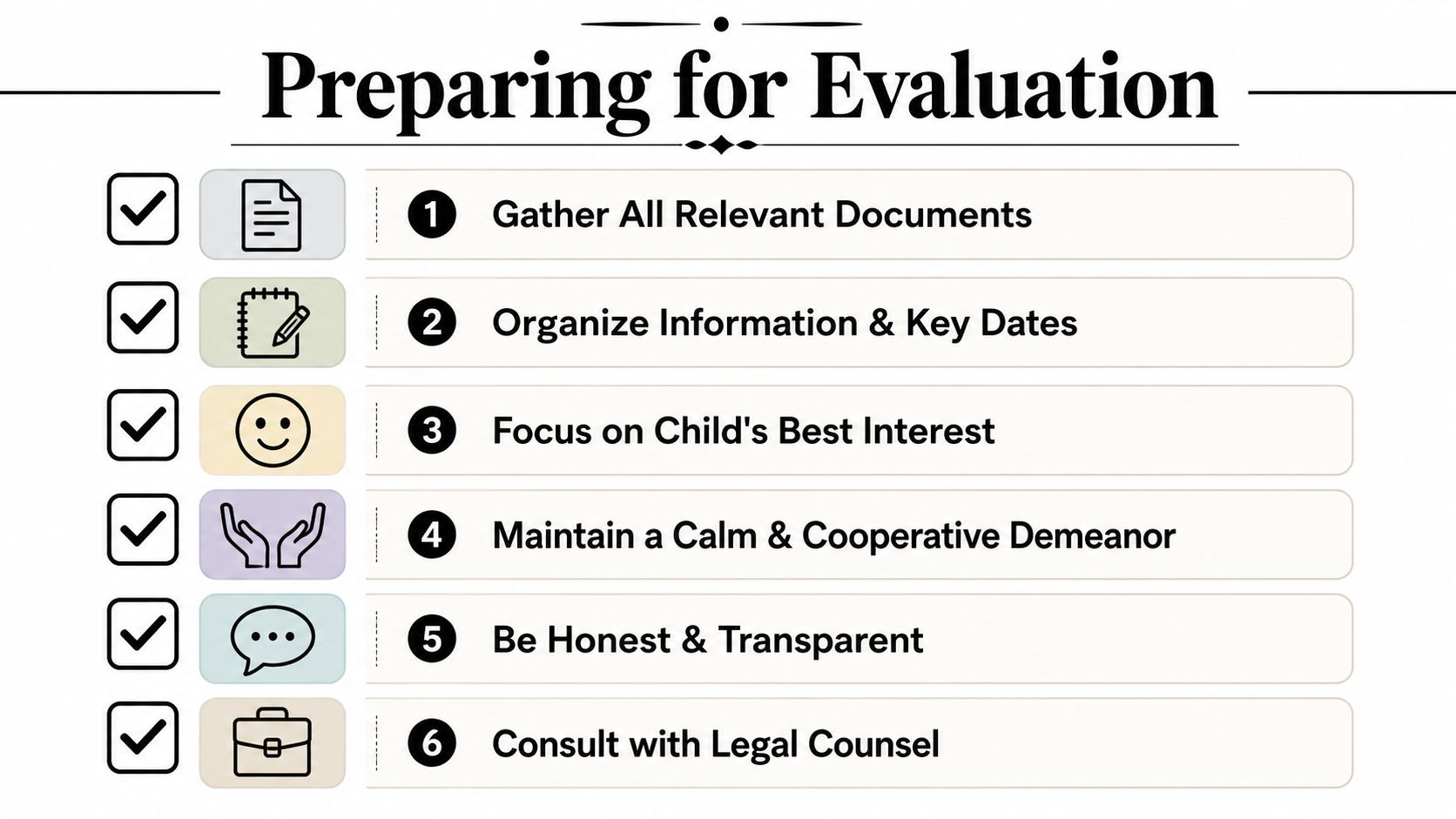
In Texas, private custody evaluations often cost between $3,000 and $15,000, and the process examines nine primary factors, including the emotional relationship between each parent and child, each parent's emotional and psychological stability, and parenting skills. Children over age 4 are interviewed during the process, according to this overview of child custody evaluations in Texas.
Get your documents under control
Start with the basics. Gather records that show your involvement in your child's life and your ability to meet daily needs.
- School information: attendance records, report cards, teacher communications, and notes about tutoring or special services.
- Medical information: appointment records, prescriptions, therapy records if appropriate, and vaccination or treatment history.
- Parenting calendar: who took the child to school, medical appointments, activities, and exchanges.
- Communication records: relevant messages with the other parent that show cooperation, attempts to problem-solve, or child-related concerns.
- Court documents: temporary orders, prior orders, and any pleadings tied to the issues being evaluated.
If medical paperwork feels scattered, a resource on simplifying family health document management can help you build a clean system before records are requested.
Prepare your home without staging it
Your home does not need to look like a furniture showroom. It should look safe, calm, and appropriate for a child.
Focus on practical issues:
| Area | What matters |
|---|---|
| Sleeping space | The child has an age-appropriate place to sleep |
| Safety | Hazards are addressed, medications secured, weapons handled lawfully and safely if present |
| Daily life | Food, clothing, school items, and routine supplies are available |
| Emotional tone | The space feels stable, not chaotic |
Keep in mind: Evaluators usually notice whether a home supports a child's routine, not whether it looks expensive.
Later in your preparation, it may help to review how to prepare for a custody consultation in Texas so your conversations with counsel stay focused and productive.
Here's a useful overview that many parents find calming before interviews:
Do's and don'ts that matter
Some behaviors help immediately. Others hurt even when the parent means well.
- Do be honest. If you made mistakes, own them and explain what changed.
- Do answer the question asked. Long speeches can make you sound defensive.
- Do focus on the child. The evaluator wants specifics about your child's needs, not a broad character attack on the other parent.
- Don't coach your child. Children often show stress when they feel pressured to deliver a message.
- Don't treat the evaluator like your therapist. Be open, but stay purposeful.
- Don't confuse co-parenting with silence. If there are real safety concerns, raise them clearly and support them with facts and documentation.
Legal guidance is important. The Law Office of Bryan Fagan, PLLC handles child custody, visitation, support, paternity, modifications, and emergency custody matters in Texas, which makes attorney preparation especially useful when an evaluation will shape the court's view of your case.
What Evaluators Look For Methods and Red Flags
Parents often ask, “What is the evaluator really trying to figure out?” The short answer is whether your words, behavior, records, and parenting choices line up.

Texas custody evaluators may use standardized forensic tools, including psychological testing such as the MMPI-2, to assess mental well-being. Just as important, communications with the evaluator are non-confidential. Anything you say can be repeated in court testimony, and the rules of evidence do not apply in the evaluator's office in the same way they do in court, as described in this review of custody evaluations and evaluator methods.
The main methods evaluators use
Evaluators usually rely on a blend of sources instead of any single moment.
- Interviews help them hear each parent's explanation of the family history and current concerns.
- Observations show how parent and child interact in real time.
- Testing may reveal stress patterns, emotional functioning, or inconsistencies that need closer review.
- Documents and collateral contacts help confirm or challenge what each parent says.
A parent may sound calm in an interview but have records that show repeated instability. Another parent may be nervous but have consistent school involvement, strong routines, and reliable third-party support. Evaluators compare all of it.
Common red flags
Some red flags are obvious. Some are subtle.
- Hostility dressed up as concern: repeating attacks on the other parent without tying them to the child's needs
- Inconsistency: saying one thing in an interview while records or witnesses suggest another
- Poor insight: not understanding the child's emotional, medical, or school needs
- Undermining the child's relationship with the other parent: unless there is a documented safety issue that justifies restrictions
- Minimizing serious issues: such as violence, substance abuse, or dangerous behavior
If you need to raise a safety concern, describe the behavior, the dates, the effect on the child, and any supporting records. That is very different from venting.
The fear of being misjudged
This is one of the hardest parts of the process. A parent may worry that being emotional will look unstable, or that asking for safety limits will make them appear unwilling to co-parent.
That's why calm detail matters. Don't make the evaluator guess. Explain your concerns in specific, child-focused language. Instead of saying, “He's impossible and the kids hate going there,” say, “The child returned without medication on these dates, missed schoolwork, and reported being left without supervision. I documented each incident and notified the other parent.”
That approach is stronger because it is concrete, measured, and anchored to the child.
After the Report Responding to the Evaluator's Findings
When the report arrives, many parents flip straight to the recommendation page. That's understandable, but it's not the best way to read it. Start with the full picture.
Read the factual summary first. Then review the evaluator's observations, the sources consulted, the concerns identified, and the final recommendations. Look for whether the report accurately reflects the records, interviews, and home facts that were part of the process.
If the report helps your case
A favorable report can become a powerful tool in settlement talks or at a hearing. If the evaluator's recommendations support your position on conservatorship, possession, or access, your attorney can use that report to reinforce the argument that your proposal serves the child's best interest.
That does not mean the case is over. It means you now have a professional opinion that may support resolution. Some custody cases settle after the report because one side sees how the court may view the evidence.
If the report hurts your case
A difficult report is not the same as a final loss. Under Texas Family Code §107.109, the judge alone may accept, modify, or reject the evaluator's recommendations. The evaluator serves the court and the child's interests, not either parent, as explained in this guide to the Texas child custody evaluation process and the judge's role.
That gives you room to respond. Depending on the facts, your lawyer may consider:
- Checking methodology: Were important records missed? Were key witnesses ignored?
- Presenting contrary evidence: School records, medical evidence, communications, or testimony may challenge the report's conclusions.
- Cross-examining the evaluator: If the case goes to hearing, the evaluator may have to explain the basis for conclusions and recommendations.
- Correcting factual errors: Sometimes the report contains mistakes that affect how events were interpreted.
When modification becomes part of the strategy
Some parents receive a report in a case that also involves changing an existing order. In that situation, strategy becomes especially important because the report may influence whether a court sees a material change and what arrangement now serves the child.
If your case involves changing a prior order, this article on how to win a custody modification case can help you understand the larger framework.
A report is influential, but it is still evidence. The judge makes the decision.
Keep your response disciplined
Don't respond to a negative report with panic emails, angry texts, or social media posts. Those reactions can create new problems. Sit down with counsel, mark factual errors, identify unsupported conclusions, and build a response around evidence.
Parents often feel personally rejected by a bad report. That feeling is real. Still, the legal response should stay measured. The strongest challenge is usually calm, organized, and specific.
Frequently Asked Questions About Texas Custody Evaluations
How long does a custody evaluation take in Texas
Texas cases vary, but a court-ordered evaluation is not quick. The process generally requires enough time for interviews, home visits, collateral contacts, records review, and report writing. In some Texas cases, the timeline can stretch well beyond the minimum waiting period between the order and hearing, especially when the facts are contested or the records are extensive.
Will my child be interviewed
Usually, yes, if the child is old enough under the legal rules that apply to the evaluation. Texas law requires age-appropriate interviews for children who are at least four years old unless the evaluator determines such an interview would not be developmentally appropriate, as noted in this explanation of what to expect from a custody evaluation or home study in Texas.
Separate from the evaluator's process, Texas judges must interview a child who is at least twelve years old about custody wishes if a party requests it, according to the Texas State Law Library child custody guide. The child's preference matters, but it does not control the outcome.
How much does a custody evaluation cost
Costs depend on whether the evaluation is private or arranged through court services and on the complexity of the case. Private evaluations can be expensive because they involve multiple interviews, records review, observations, and often testing. Fee allocation is often addressed in the court order, settlement, or case-specific rulings, so parents should review that issue carefully with counsel.
What if I refuse to participate
Refusing to cooperate with a court-ordered evaluation usually creates serious problems. A judge may view nonparticipation as a failure to follow court orders or as an unwillingness to provide information needed to assess the child's best interest. If you have a genuine problem with the evaluator, the process, or scheduling, raise it through your lawyer rather than refusing.
Does the evaluator decide custody
No. The evaluator makes recommendations. The judge decides. That distinction matters because parents sometimes feel defeated after reading the report. A recommendation carries weight, but it is not the final order.
What is joint managing conservatorship
In plain language, joint managing conservatorship usually means both parents share certain rights and duties regarding the child. It does not always mean a 50-50 schedule. One parent may still have the exclusive right to determine the child's primary residence, and the possession schedule may still be unequal based on the child's needs.
What is a possession schedule
A possession schedule is the calendar for when each parent has court-ordered parenting time. Texas has a standard possession order that is presumed to provide reasonable minimum parenting time in many cases, but courts can order a different schedule if that better serves the child's needs, as explained in the Texas Attorney General's parenting time overview.
I'm a father. Will the court treat me fairly
Texas law does not say mothers automatically win custody. Fathers, mothers, grandparents, and other caregivers all need to show how their requested arrangement serves the child's best interest. If you're a father entering this process, focus on documented involvement, consistency, communication, and your plan for meeting the child's daily needs.
I'm a grandparent or caregiver. Does this process still matter to me
Yes. If you are involved in a custody or visitation case, the evaluation may examine your relationship with the child, your home, your caregiving role, and your understanding of the child's needs. The court still applies the same child-focused standard.
What should I do right now
Do three things first:
- Preserve records: keep communications, calendars, school records, and medical documents organized.
- Stabilize routines: school, bedtime, meals, and exchange routines matter.
- Get legal advice early: preparation before the first evaluator interview can shape the entire process.
Key Takeaway
A Texas custody evaluation can feel intimidating because so much is at stake. But the process becomes less frightening when you understand what the evaluator is doing, what the court cares about, and how to present your parenting clearly.
If you take one thing from this article, let it be this: the strongest approach is calm, child-focused, and well documented. Don't aim to sound perfect. Aim to be credible, prepared, and centered on your child's well-being.
If you need help with a child custody or visitation case in Texas, our experienced attorneys can guide you every step of the way. Contact The Law Office of Bryan Fagan, PLLC today for a free consultation.