
When your child's future is on the line, understanding your rights matters most. If family violence has entered a custody dispute, it can feel like you're trying to solve two problems at once, keeping your child safe today and figuring out long-term custody tomorrow. Texas law gives parents a way to do both, and the rules matter because the protective order can control safety even when a custody case is still moving forward.
A parent in this situation often feels stuck between fear and paperwork. One court case may be about conservatorship, the Texas term for custody, while another order is focused on stopping contact, threats, or abuse. In Texas, a family-violence protective order can be filed inside a divorce or a Suit Affecting the Parent-Child Relationship (SAPCR), and if there's a conflict between that protective order and a custody or divorce order, the protective order prevails (Texas State Law Library guidance on getting a protective order).
That two-track setup can be confusing, especially for mothers, fathers, and grandparents who just want a stable plan for a child. The good news is that Texas courts already know these cases often involve both safety and parenting. Texas court data show protective orders are used mostly in family-violence situations, and Texas family law materials explain how those safety orders fit alongside custody orders, temporary orders, and possession schedules (Texas protective order report, Texas Law Help on SAPCR custody cases).
Practical rule: a parenting order tells each parent when they have the child, but a protective order tells everyone where safety lines are drawn.
If you're trying to understand how a protective order can shape custody, visitation, and decision-making in Texas, you're in the right place. You do have legal options, and the right order can protect your child while the court sorts out the rest.
When Safety and Custody Overlap in Texas
The legal problem rarely starts with one dramatic event. Assault, threats, and quieter forms of control over money, messages, or who the child sees can all shape what the court needs to address. Once a SAPCR is filed, the court is not only deciding time with the child, it is also deciding what structure keeps the child safe while the case is pending.
Texas allows a family-violence protective order to be filed inside a divorce or SAPCR, and that matters because families do not always have the luxury of waiting for one case to finish before asking for protection (Texas State Law Library guidance on getting an order). The protective order can run alongside the custody case. If the two orders conflict, the safety order controls. That is an important legal point for parents to understand because it means the court can address danger right away without putting the custody case on hold.
For a worried parent, the overlap can feel overwhelming. One lawyer may be talking about possession schedules, another about emergency protection, and a school may ask who can pick up the child. Those are all connected questions. The law treats them as related, but not identical, because the court is trying to protect the child's best interests while also responding to immediate risk.
When violence is in the picture, the court is not choosing between safety and parenting. It has to look at both.
Texas guidance also says that these orders usually last up to two years. In a divorce or SAPCR, the protective order can stay effective for two years after the final order in that case. That gives families a safety framework while the custody issues are still being resolved. For parents trying to stay calm and organized, that time matters because it lets the court handle parenting questions without losing sight of the risk that started the case.
Understanding SAPCR Conservatorship and Possession in Plain English
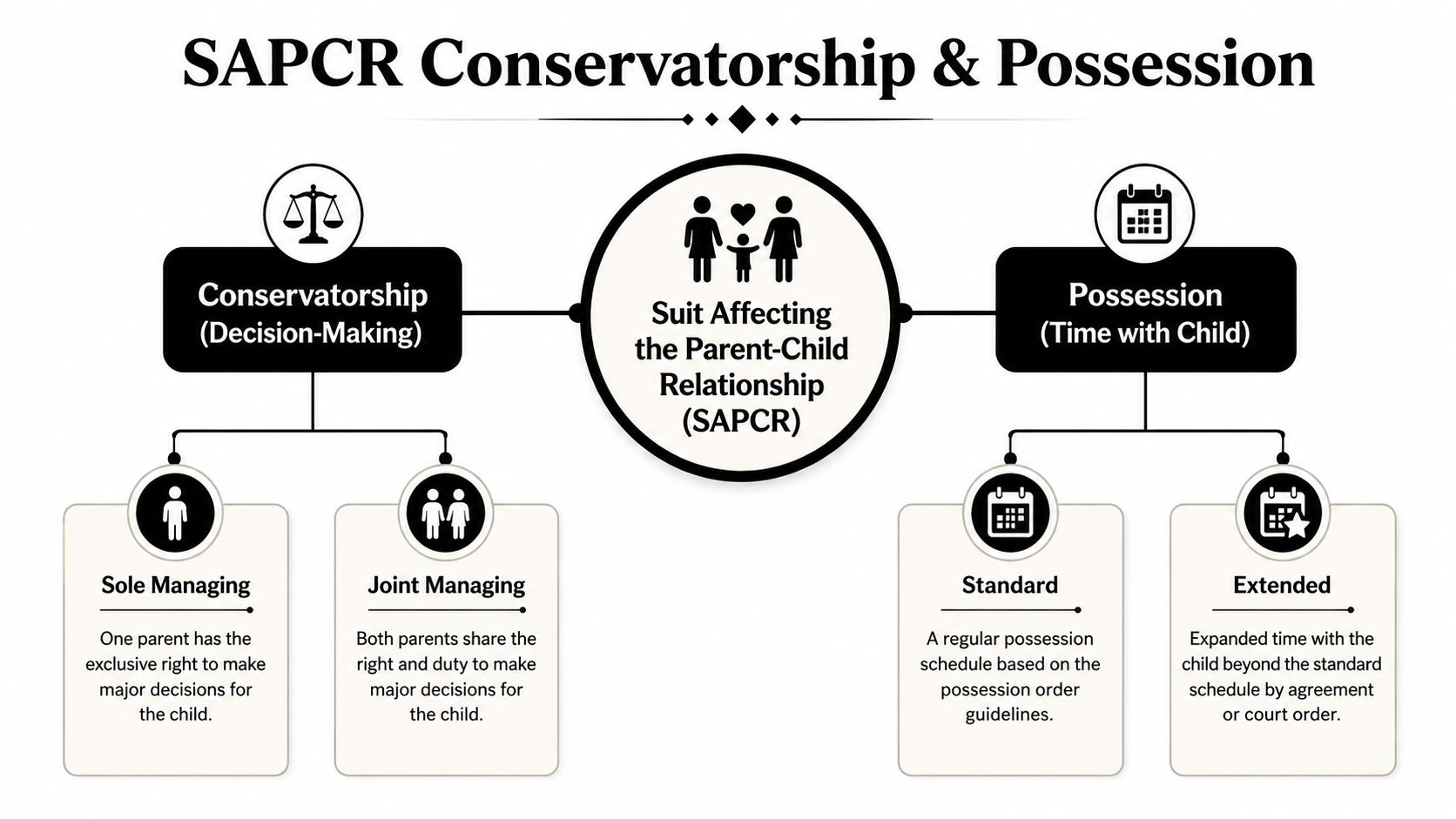
A SAPCR is the court case Texas uses to decide or change a child's legal relationship with parents or other caregivers. In plain terms, it's the case that sets the rules for parenting rights, child support, and time with the child. Texas family law materials also explain that the legal word for custody is conservatorship, not custody, and that temporary orders are different from TROs and protective orders (Texas Law Help on SAPCR custody cases).
Conservatorship means decision-making
Conservatorship answers who gets to make important choices, like education, medical care, and other big parenting decisions. Texas often uses the term joint managing conservatorship when both parents share some decision-making authority, while sole managing conservatorship means one parent has that authority instead. If you want a plain explanation of the presumption favoring joint conservatorship, Joint Managing Conservatorship in Texas is a helpful place to start.
Possession means time with the child
Possession or possession schedules are about when each parent has the child. A schedule can be standard, adjusted, supervised, or limited depending on safety and the child's needs. In many cases, parents think “custody” covers everything, but Texas separates the decision-making piece from the time-sharing piece so the court can tailor each part.
Temporary orders sit in a different lane. They're used to set child custody and support arrangements while the case is pending, while protective orders and TROs are emergency safety tools (Texas Law Help on SAPCR custody cases). That difference is why one family may have a temporary possession schedule and, at the same time, a protective order that restricts contact. They answer different questions.
For readers filing a SAPCR, the form and procedural details matter too, and the Texas family court process can be easier to follow when you see how the documents fit together, including the SAPCR form used in Texas (SAPCR form Texas resource). The key is simple. One order helps the court manage parenting while the case is open, and another order protects people from danger. In a family-violence case, both may be needed at once.
Types of Protective Orders That Intersect With a SAPCR
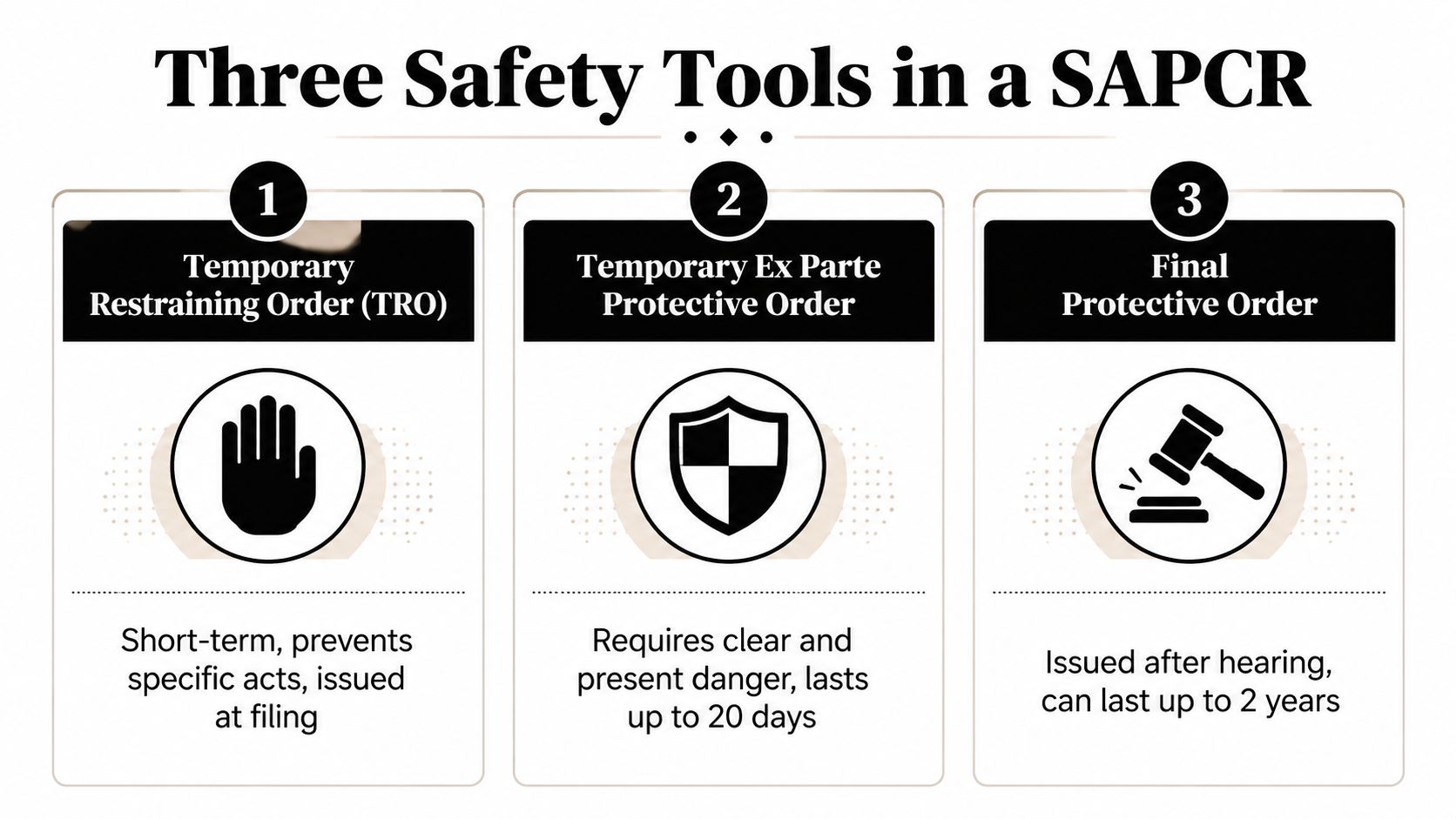
A parent walking into Texas family court may hear three safety tools discussed in the same breath, and the names can blur together fast. A TRO, a temporary ex parte protective order, and a final protective order all deal with safety, but they serve different jobs and do not begin the same way. A TRO is a short-term court stop, a temporary ex parte protective order is an emergency safety shield, and a final protective order comes after a hearing and lasts longer.
TROs and protective orders are not the same tool
A temporary restraining order usually stops specific conduct while a case gets started. A protective order focuses on family violence and the safety steps a court can put in place. For a plain consumer comparison of those two terms, the article on protective order vs restraining order helps separate the language. That difference matters in Texas family court because a parent may ask for the wrong remedy if the core concern is immediate danger.
Temporary ex parte and final orders work differently
Texas Child Welfare Law Bench Book materials explain that a court may issue a protective order after finding that family violence has occurred, and for a temporary ex parte protective order, the court must find a clear and present danger of family violence. The same materials also note that a protective order must be issued in a separate document from the divorce or SAPCR judgment, which keeps the safety order distinct from the parenting judgment. If a protective order is entered before or during a SAPCR, the issuing court shall transfer it to the court handling the SAPCR if the transfer will not negatively affect the safety of any protected person (Texas Child Welfare Law Bench Book, Chapter 3).
Safety overlay, parenting blueprint. The protective order is the safety overlay. The SAPCR order is the parenting blueprint. When they conflict, the safety overlay controls.
That priority is the heart of the issue. A custody order may set exchange times or contact rules, but if the protective order says no contact or requires supervised exchange, the protective order controls. Parents trying to sort out the rules can use this simple guide, the parenting plan answers when the child is with each parent, while the protective order sets the safety boundary for everyone involved.
The split is practical, not academic. One order can keep the case moving, and the other can stop harmful contact, limit proximity, or address a weapon risk when the facts support it. In a family-violence case, a court may need both orders at the same time so the child's schedule and the family's safety are handled in separate tracks.
How to Request a Protective Order Inside or Alongside a SAPCR
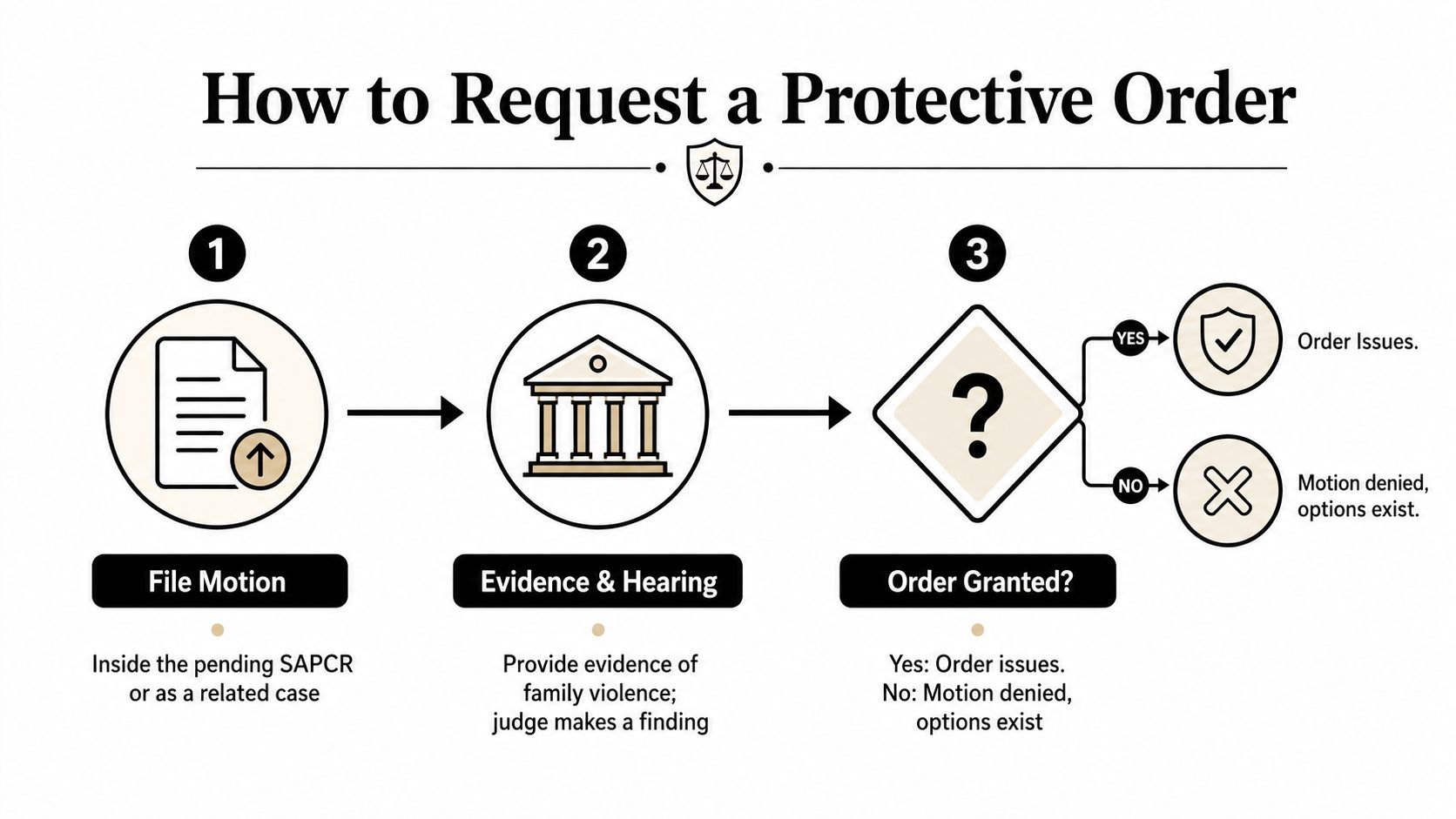
If a protective order hearing is scheduled the same week as a custody hearing, the judge may consolidate them, or may hear the safety request first, depending on how urgent the risk looks. That timing question matters because the family court can be dealing with two tracks at once, the SAPCR for parenting issues and the protective order for safety boundaries. The filing choice usually depends on where the case already is and how quickly protection is needed. In Texas, the request still has to be tied to family-violence facts and presented in a way the court can review quickly.
Start with the filing package
The application should explain what happened, who was harmed, and why protection is needed now. If there is already a SAPCR, the lawyer or parent may ask the court handling that case to hear the protective order request so the judge sees the full picture. The affidavit matters because it gives the judge sworn facts, not just labels.
The filing should also help the court understand coercive control, not only a single assault. If one parent has isolated the other, tracked movements, threatened custody fights to force compliance, or used a weapon to intimidate the family, those details belong in the packet. Screenshots, texts, photos, call logs, witness names, and any report of weapons access can help show the pattern.
If you are comparing filing routes, the Texas filing guide on filing a restraining order in Texas can help with the basic court-process vocabulary. Even when a family uses the wrong casual term, the court still cares about the substance, whether the request is really about emergency safety.
Emergency review, service, and hearing
If the risk looks immediate, the judge may review the request without the other side present for a temporary ex parte order. That is the emergency step. After that, the other parent must be served and given a hearing date, because long-term protection requires the court to hear both sides before entering a final order.
A protective order can run alongside a SAPCR, and if the two conflict, the protective order controls the safety terms. That means the custody order may still address possession and access, while the protective order can restrict contact, limit proximity, or set supervised exchange rules when the facts support that result. The family does not lose the parenting case by asking for protection, and the court does not have to choose only one path.
The safest filings are the ones backed by dates, screenshots, call logs, photos, and clear descriptions of what changed over time. The court is more likely to understand the risk when the story is organized and specific. When a weapon has been shown, threatened, brandished, or newly obtained, say that plainly. When the harm is coercive rather than physical, explain the pressure, the threats, and the control in ordinary words the judge can follow.
How Judges Use Protective Orders to Shape Custody and Possession
An active protective order changes the legal framework. In Texas, custody decisions are supposed to focus on the best interests of the child, and family violence can move a case away from a shared-parenting model and toward tighter limits. Texas guidance on custody and support says that where there is family violence or a parent is absent, one parent may be named a sole managing conservator, which is one of the key legal mechanics parents need to understand when safety concerns affect custody (Texas Child Custody and Support guide).
The court looks past one bad day
A judge shouldn't look only at a single incident if the underlying problem is a pattern. Bench guidance says courts should assess patterns of emotional, physical, financial, and sexual abuse, and look at recent weapon acquisition or access, because violence can be coercive, psychological, or tied to guns and other weapons rather than a single assault (NCJFCJ judicial guide to child safety in custody cases). That matters in 2025 and 2026 because some of the most serious risk in family court cases doesn't look dramatic on paper, yet it still affects whether a child can be safely exchanged, transported, or left alone with a parent.
Evidence that helps the court see the pattern
Judges usually need more than fear. They need a paper trail that shows what happened, how often, and whether the behavior escalated. Useful evidence often includes:
- Texts and emails: messages showing threats, monitoring, repeated demands, or controlling conduct.
- Financial records: proof of financial control, blocked access to money, or forced dependency.
- Medical records: treatment notes or records that match injuries, stress, or trauma.
- Police reports: official reports that anchor the timeline of violence or threats.
- Photos and screenshots: images of injuries, damaged property, or hostile messages.
When a parent is trying to explain why joint conservatorship isn't safe, this kind of documentation helps the judge see the whole context. It also helps if the case involves coercive control or a weapons concern, because a judge may need to tailor exchange rules, drop-off locations, or contact limits. For a fuller discussion of how violence affects parenting outcomes, the custody article on how domestic violence affects child custody is a useful companion.
A judge can only tailor restrictions to the facts that get proved. A clear record gives the court room to protect the child without guessing.
Conflicting orders across cases can undermine safety if the court doesn't have current information about weapons or parallel proceedings. That's why parents should bring every active order, every pending case number, and every safety concern to the same lawyer or court file when possible.
Enforcement Duration Modification and Everyday Safety Planning
Once a protective order is in place, the work changes from asking for protection to keeping the order useful in daily life. If the other parent violates it, call law enforcement right away and show the officer the order. If the child exchange terms in the SAPCR are also being ignored, that is a separate issue, but the protective order still gives officers and the court a clear safety line to enforce.
Parents often worry that asking for a protective order means they are overreacting. Texas court data show that protective orders are used mostly in family-violence situations, including emergency and temporary orders and final protective orders sought for protection from family violence. That matters because it shows the system is meant to be used by parents who are dealing with real danger, not just conflict.
Keep the order working in daily life
After the order is granted, small safety habits can make a real difference. Keep copies on your phone, in your car, and in a safe place at home. Give a copy to schools, daycare providers, and anyone else who needs to know who can and cannot pick up the child.
A few simple habits can help the order do its job:
- Save messages: keep screenshots, call logs, and voicemails that show violations or pressure.
- Write down dates: note every contact attempt, exchange problem, or rule violation.
- Plan exchange locations: use public places or approved handoff points if the order allows contact.
- Update caregivers: make sure grandparents, babysitters, and school staff know the limits.
- Track expiration: mark the order's end date and ask about modification early if safety changes.
The court can modify custody or possession orders when circumstances change, including changes tied to safety. Once the SAPCR is pending, a modification request can incorporate an existing protective order so the judge reviews safety and custody together instead of in separate proceedings. That keeps the case focused on the child's real needs, especially when there are concerns about coercive control or access to weapons.
Keep a paper trail like your child's safety depends on it, because in these cases, it often does.
Parents who need help with order enforcement, exchange conflicts, or a custody modification can also work with a Texas family law attorney who handles both SAPCR and protection-order issues. The Law Office of Bryan Fagan, PLLC is one option for families who need help organizing those moving parts while keeping the child's safety first.
Next Steps to Protect Your Child and Your Parental Rights
If family violence is affecting your custody case, don't try to solve it with guesswork. A protective order can be filed inside a SAPCR, it can override conflicting custody language, and it can shape conservatorship and possession in ways that better protect your child. Texas guidance also says that when family violence is present, one parent may be named a sole managing conservator, which is why the safety facts matter so much in the courtroom (Texas Child Custody and Support guide).
The most important step is to gather the facts in a way the court can use. That means preserving messages, saving records, documenting coercive control, and bringing every active order to the same legal conversation. Mothers, fathers, and grandparents all deserve clarity when a child's stability is at stake, and Texas courts do have tools to protect children while the family law case moves ahead.
Key Takeaway: the right protective order does more than stop contact, it can help the court build a safer custody plan around your child's real needs.
If you're unsure whether to file inside a divorce, alongside a SAPCR, or as part of an emergency request, get legal advice before you make the next move. The right guidance can help you protect your child and avoid mistakes that slow down safety.
If you need help with a child custody or visitation case in Texas, our experienced attorneys can guide you every step of the way. Contact The Law Office of Bryan Fagan, PLLC today for a free consultation.