
When your child's future is on the line, the lack of a marriage license can feel like one more thing standing between you and stability. A parent may be showing up every day, paying bills, and caring for the baby, yet still have no enforceable custody rights until a Texas court signs an order. That's the hard truth many families face, and it's exactly why a SAPCR, a Suit Affecting the Parent-Child Relationship, matters so much in custody for unmarried parents: establishing conservatorship via SAPCR.
In Texas, conservatorship is the legal word for custody. A SAPCR is the case that lets a judge decide custody, visitation, child support, and medical support in one place when the parents are not married, as Texas guidance explains. Texas Law Help also notes that a SAPCR is available when the parents are not married, have signed an Acknowledgment of Paternity, and there are no existing orders about the child. For many parents, that court order is the difference between hoping everyone keeps their word and having something enforceable when conflict starts. Texas Law Help's child custody and conservatorship guide helps show why formal orders matter in unmarried-parent cases.
Why Unmarried Parents Need a Court Order in Texas
A father can be involved and still have no automatic right to custody or visitation if there's no legal order in place. A mother can be doing everything right and still have no child support order she can enforce if the other parent stops helping. That's why informal agreements, even good ones, tend to break down when stress, new relationships, work changes, or distance enter the picture.
Texas uses a SAPCR to turn those shaky arrangements into enforceable rights and duties. The Texas State Law Library describes SAPCR as the vehicle for custody, visitation, and support orders outside divorce, and Texas guidance says the judge can decide custody, visitation, child support, and medical support in the same case when the parents are not married. That matters because a parent usually needs more than a promise. They need a court order that covers pickup times, decision-making, and payment responsibilities in a way a judge can enforce later. Texas State Law Library's child custody and support guide
Practical rule: If the two of you can't calmly talk about school, doctors, holidays, or money, you need orders, not assumptions.
What the court is really trying to do
The family court is looking for a plan that protects the child's daily life and reduces conflict. That starts with paternity, then moves to temporary orders if needed, then to a final order after evidence, negotiation, or trial. For parents, that roadmap can feel intimidating, but it also gives structure to a situation that may have felt chaotic for months.
A good order can answer the questions that keep parents awake at night. Where will the child live? Who makes school and medical decisions? When does each parent see the child? Who pays support, and how is it collected? Those are the practical building blocks of stability, especially when the parents were never married.
For readers comparing custody options, Custody for Unmarried Parents in Texas is a useful factual overview of how custody works when the parents were never married.
Establishing Paternity Before You Can Establish Conservatorship
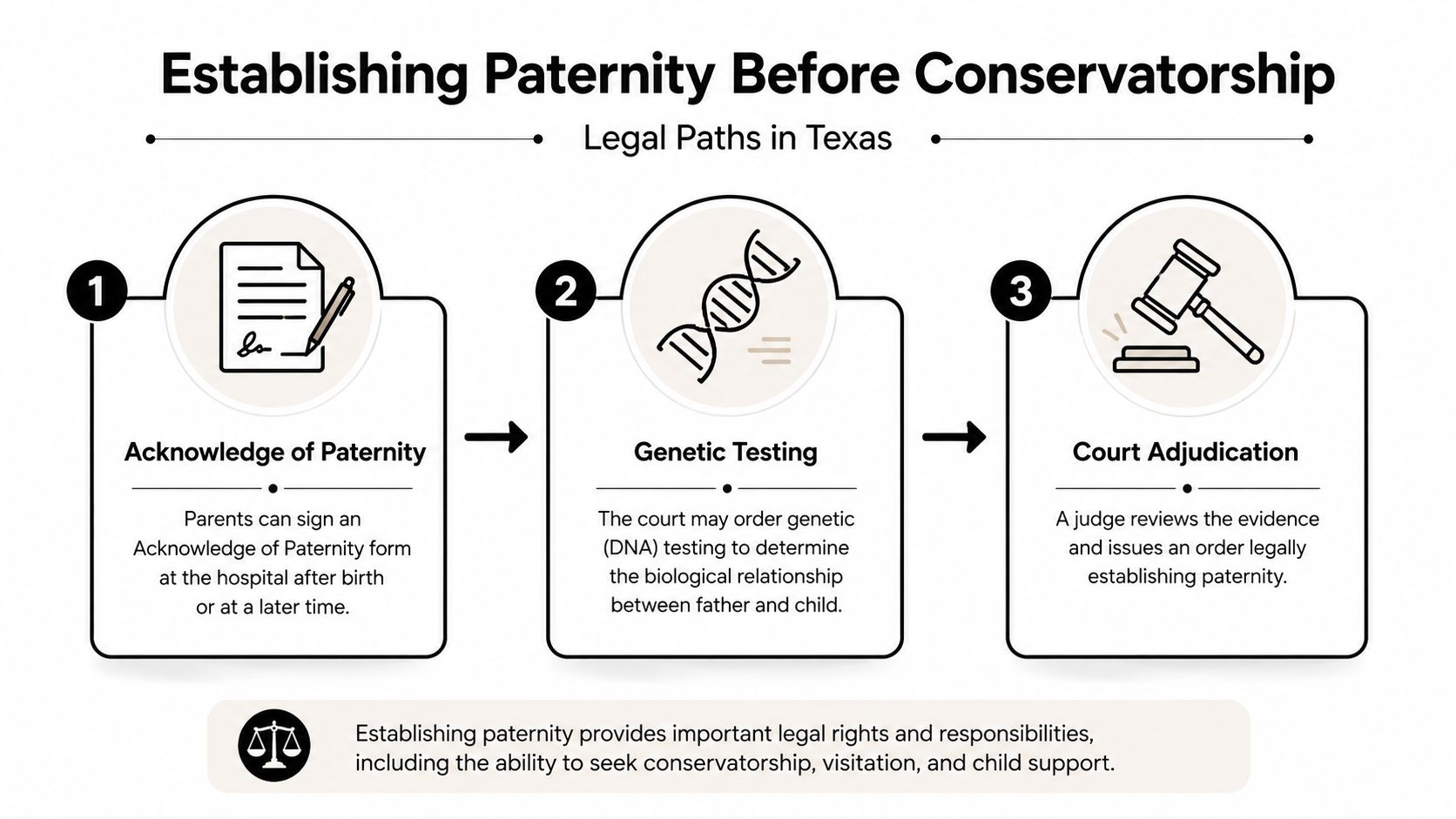
If you're an unmarried father, Texas won't treat biology alone as enough to give you custody or visitation rights. Legal fatherhood has to be established first. Until that happens, the court generally can't enter custody, visitation, or child support orders involving the father, because there isn't yet a legally recognized parent-child relationship for the case to protect. Grinke Stewart Law's explanation of custody and support for unmarried parents states that Texas does not automatically recognize the father as the legal parent unless an Acknowledgment of Paternity is signed or the court establishes paternity through genetic testing.
There are three common paths. One is signing an Acknowledgment of Paternity, often called an AOP, at the hospital or later through the vital records process. Another is asking the court to order genetic testing during the SAPCR. A third is filing a petition to adjudicate parentage when paternity needs to be formally decided. Once paternity is set, the judge can address conservatorship, possession, and support.
Why this matters for both mothers and fathers
Mothers benefit from paternity too, even when they are the ones primarily raising the child. Legal paternity creates a second legal parent, which can mean a child support obligation, access rights, and a clearer path to orders if the other parent disappears or becomes inconsistent. It also reduces the risk that a future dispute will turn into a fight over whether the child has two legal parents at all.
If the child's father is legally recognized, the family can move past guesswork and into enforceable structure. That can include updating the birth certificate where appropriate, gathering the AOP or testing records, and preparing for the rest of the SAPCR. For a helpful factual overview, Establishing Paternity for Custody in Texas walks through the groundwork parents usually need before filing.
A small but important distinction
Biological fatherhood and legal fatherhood are not the same thing. A man may know he is the biological parent, but if the legal steps haven't been completed, he may still be treated as a legal stranger to the case. That's why paternity comes first. Without it, conservatorship arguments don't really have a legal starting point.
Preparing and Filing Your SAPCR Petition
The filing step is where many parents get stuck, not because the law is impossible, but because the procedure feels unfamiliar. Texas guidance says the petition is generally filed in the county where the child has lived for the preceding six months, and the child usually needs a Texas home-state connection for six consecutive months before filing. That venue rule matters because filing in the wrong county can slow the case down before it even starts. A practical checklist often includes the Petition in SAPCR, a Civil Case Information Sheet, and, when relevant, a Standard Possession Order and Income Withholding Order. A family-law filing guide discussing SAPCR venue and forms
The first paper filed tells the court what you're asking for. If paternity is unresolved, the case may need parentage issues folded in. If paternity is already established, the petition can focus on conservatorship, possession, child support, and medical support. The right filing depends on the facts, not on what a form packet happens to include.
Practical rule: If you're unsure about county, paternity, or the exact petition type, slow down before filing. A few careful minutes at the start can prevent weeks of delay later.
What parents usually gather before filing
- Child information: Full name, date of birth, and where the child has lived.
- Parent details: Names, addresses, phone numbers, and any current orders.
- Paternity documents: An AOP, birth certificate information, or testing records if parentage is disputed.
- Case forms: The SAPCR petition and any related support or possession forms.
- Financial information: Helpful when child support or medical support will be addressed.
The practical reality is that filing is only one part of the case. The other parent must still be served, and if the child has ever been involved in another state's custody case, jurisdiction questions can become important. That's why many parents choose to get legal help before filing rather than trying to untangle venue, forms, and service alone. Texas custody resources, including SAPCR Form Texas, can help parents understand the paperwork, but the court still expects accuracy.
A note on fees and representation
Some parents file on their own, while others prefer counsel because the details matter so much. Fees, waivers, and local procedures can vary by county, and a parent who is struggling financially may need to ask about a waiver. The key is to get the case started in the right court with the right information, because a SAPCR is meant to create a stable framework, not just a file number.
Serving the Other Parent and Seeking Temporary Orders
Once the petition is filed, the other parent has to be properly served unless the case is handled by agreement or waiver. That step matters because the court can't usually move forward on final orders until the respondent has notice and a chance to participate. If the other parent doesn't answer, the case can still move, but default procedures come with their own risks and limits.
Temporary orders are the bridge between filing and the final hearing. In a SAPCR, they can set who the child lives with, when each parent has possession, whether child support starts right away, and whether any emergency protections are needed. Texas legal guides also explain that a SAPCR is the case used when parents are not married, and that the court may issue temporary orders while the case is pending before entering a final order. Barton Law Office's SAPCR guide
The first hearing can feel personal, because it is personal. Parents often walk in worried they'll sound emotional or disorganized. The better approach is simple, calm, and documented. Bring school records, medical records, messages about pickup issues, and anything that shows how the child's days are going.
Why temporary orders matter so much
A temporary order can calm a situation that's spinning. It can also expose the underlying issues early, especially if one parent is already blocking contact, changing schedules without warning, or refusing to share information. That early evidence often shapes settlement talks, mediation, and the final trial.
The child's routine often tells the court more than either parent's label for the relationship.
Mediation usually comes after temporary orders or along the way, and many families resolve at least part of the case there. If settlement fails, the judge hears the evidence later and signs a final order. For a practical look at the hearing itself, what happens at a temporary orders hearing in Texas custody cases is a useful related resource. The big lesson is that the case moves in stages, and each stage gives parents a chance to protect the child while the SAPCR is pending.
When Joint Managing Conservatorship Becomes Unrealistic
Texas often starts from the idea that both parents should stay involved. That's why joint managing conservatorship is such a common starting point. But “joint” doesn't always work in real life, and courts know that a shared title doesn't fix a broken co-parenting relationship.
The facts that usually push a judge toward restrictions
When parents can't safely or consistently work together, the court may need tighter limits. That can happen in cases involving family violence, a long pattern of hostile communication, substance abuse, long-distance parenting, or relocation fights. Public guidance often says Texas treats married and unmarried parents similarly and that SAPCRs can set conservatorship, possession, support, and geographic restrictions, but the hard question is whether shared decision-making is workable. In practice, that depends on the evidence. An overview discussing unmarried-parent custody, relocation, and nontraditional family facts
Courts tend to credit concrete proof. That can include police reports, protective orders, text messages, emails, medical records, school records, witness testimony, and expert evaluations when a child's safety or a parent's capacity is at issue. A judge is less persuaded by vague accusations than by a paper trail that shows patterns over time.
What a tighter order can look like
A court doesn't have to choose between a loose handshake and a total loss of contact. It can create a parenting plan with specific pickup times, travel rules, and geographic restrictions so everyone knows what happens next. In higher-conflict cases, that precision matters because broad language is hard to enforce and easy to argue about.
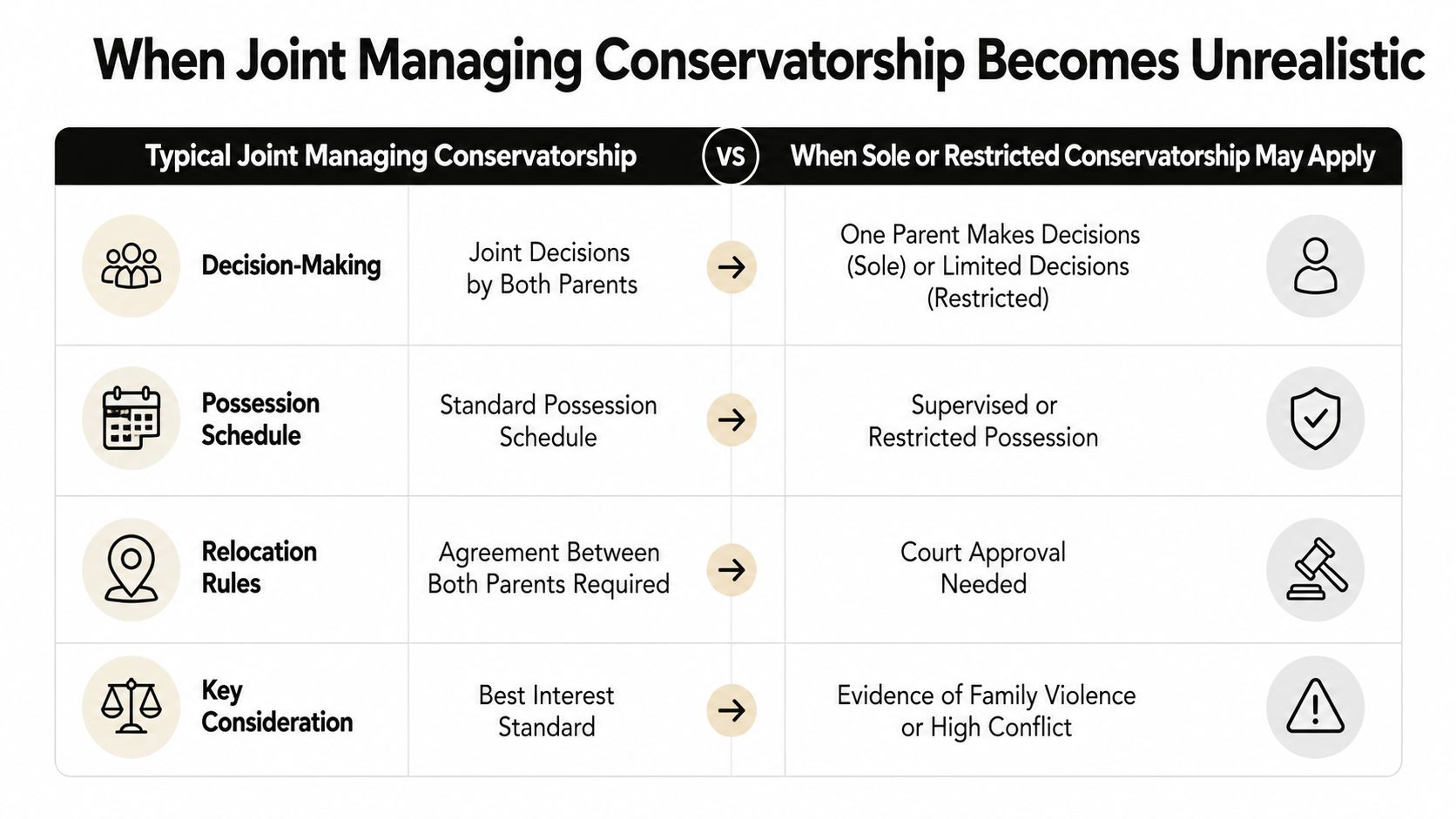
A parent asking for sole managing conservatorship, or for a more restrictive plan, should focus on showing why shared decision-making puts the child at risk or creates constant conflict. That's not about winning a label. It's about making sure the order can be followed by two adults who may no longer be able to work together.
What Goes Into a Final Conservatorship Order
A final SAPCR order is where the case becomes real for everyday life. One parent may call it “custody,” but the order usually breaks down into several parts that each answer a different question. A judge can name the parents as joint managing conservators or, in a more limited case, appoint one as the sole managing conservator.
A standard order often includes a possession schedule, which sets when each parent has the child. That can involve weekends, holidays, summers, and exchange times. Parents often expect the schedule to feel balanced, but balance doesn't always mean equal time. It means a plan the child can live with and the parents can follow.
| Common Component of a Final Texas SAPCR Order | What It Decides | Who It Protects |
|---|---|---|
| Conservatorship | Who has decision-making rights | The child and both parents |
| Possession schedule | When each parent has time with the child | The child's routine |
| Child support | Who pays support and how it's handled | The child's daily needs |
| Medical support | Who carries or pays for health coverage | The child's health care |
| Tax dependency | Who claims the child for tax purposes, if addressed | Financial clarity for both parents |
A few details parents should read closely
Child support and medical support often run together in the order. An Income Withholding Order can be paired with the child support award so payments are collected through payroll rather than left to chance. That reduces the room for arguments later and gives the receiving parent a clearer way to track support. The final order may also assign rights about education, medical care, and sometimes what happens if one parent wants to move.
A parent should ask careful questions before agreeing to a draft order. Who decides if the child changes schools? What happens on birthdays and holidays? Is summer travel limited? Does the order say where the child can live? Those details matter more than legal labels when real life starts testing the agreement.
If a parent's circumstances change later, the order can be modified, but the original wording is what controls until then. That's why the final order should be read slowly and with the child's actual life in mind, not just the courtroom version of the family story.
Enforcing and Modifying the Order Later
A final order is not the end of the road. It becomes the rulebook, and sometimes one parent ignores it. When visitation is withheld, support goes unpaid, or a parent moves without notice, Texas courts can use enforcement tools like a motion to enforce, contempt proceedings, and, in some situations, a writ of habeas corpus.
Modification is different. Texas Family Code §156 allows a court to change conservatorship or support when there has been a material and substantial change in circumstances. That might include relocation, a child changing schools, a parent losing income, a new marriage that changes the home environment, or safety concerns involving the child. The parent asking for the change must come back to court and show why the new arrangement better serves the child.
Enforcement and modification are not the same case
A missed visit is usually an enforcement issue. A major shift in the family's circumstances is usually a modification issue. Courts look at different facts and different legal standards, so choosing the right filing matters from the start.
Key takeaway: Don't file a modification when the actual problem is noncompliance, and don't file enforcement when the underlying issue is that the order no longer fits the child's life.
When a parent decides what to do next, the cleanest path is often the one that matches the problem exactly. That may mean gathering messages, school records, or proof of relocation before filing. It may also mean asking for a revised possession schedule instead of trying to patch an order that no longer reflects reality. For parents already thinking ahead about changes, Modifying a Texas Custody Order is a useful related resource.
Next steps
- Establish paternity if it hasn't been legally set.
- File the SAPCR in the proper county.
- Serve the other parent so the case can move forward.
- Ask for temporary orders if the child needs immediate structure.
- Present evidence at the final hearing so the order reflects the child's best interests.
- Use enforcement or modification later if the order is ignored or no longer fits the child's life.
If you're carrying the weight of a custody dispute as an unmarried parent, you don't have to sort out SAPCR, paternity, temporary orders, and final conservatorship on your own. The team at Law Office of Bryan Fagan, PLLC helps Texas parents understand their options, prepare the right filings, and build custody orders that fit their children's real lives. If you need help with a child custody or visitation case in Texas, our experienced attorneys can guide you every step of the way. Contact The Law Office of Bryan Fagan, PLLC today for a free consultation.