
When your child's future feels uncertain, fear can take over quickly. You may be worried that a co-parent's mental illness creates a safety risk, or you may be the parent living with a diagnosis and afraid the court will treat it as proof that you're unfit. Texas law does neither automatically.
In a custody if parent has mental illness Texas case, the central question is usually functional: how does the condition affect parenting, safety, stability, and the child's emotional and physical needs? A diagnosis by itself doesn't answer that question. Texas courts examine evidence and the child's best interests while protecting parental rights.
Parents sometimes find it helpful to use supportive counseling for a child or teenager during family conflict, such as Interactive Counselling for teens. That kind of support doesn't replace legal advice, but it can help families respond to stress in a child-focused way.
The path forward may involve a regular possession schedule, shared decision-making, supervised visits, counseling, temporary orders, or a modification of an existing order. In the most serious cases, termination of parental rights may be considered, but Texas law sets a much higher standard for that result. Understanding the difference between these options can replace guesswork with a practical plan.
When Your Childs Future Feels Uncertain
Consider a parent named Maria. She has a documented mental health condition, attends treatment, follows her provider's recommendations, and has maintained a steady routine with her child. The other parent is frightened by the diagnosis and asks for sole managing conservatorship. Maria worries that mentioning her treatment history will cause the judge to remove her from the child's life.
Now consider David, who is concerned about his co-parent. He has seen missed school days, unsafe supervision, and unpredictable behavior during exchanges. He doesn't want to punish the other parent for having an illness. He wants the child to be safe and wants the court to understand what has happened.
These parents face different problems, but both need the same legal principle: Texas doesn't treat mental illness as an automatic bar to custody. Under Texas Family Code Section 153.131, courts generally must appoint a parent as sole managing conservator or both parents as joint managing conservators unless that appointment would significantly impair the child's physical health or emotional development. The focus is on the effect of the condition, not the label alone. (Texas custody guidance on mental illness)
Fear does not equal legal proof
A parent's concern may be sincere, but concern alone usually doesn't establish that custody restrictions are necessary. Courts need evidence connecting a mental health condition to parenting problems, such as an inability to supervise, repeated instability, or conduct that threatens the child's physical or emotional wellbeing.
The same principle protects a parent who has a diagnosis. A diagnosis doesn't erase evidence of safe parenting, treatment participation, reliable routines, or a strong parent-child relationship. A court can consider mental health without assuming that every symptom creates danger.
The most useful question is not “What is the diagnosis?” It is “What has the child experienced, and what parenting arrangement protects the child while preserving safe family relationships?”
A child-centered process
This article uses Texas Family Code Chapter 153 as the starting point for conservatorship, possession, and access. It also explains how evaluations, temporary orders, supervised possession, and modifications fit together. If you're a mother, father, grandparent, or caregiver, the goal is to help you recognize what facts matter and what steps can protect both the child and the parent-child relationship.
How Texas Determines Custody and the Best Interest Standard
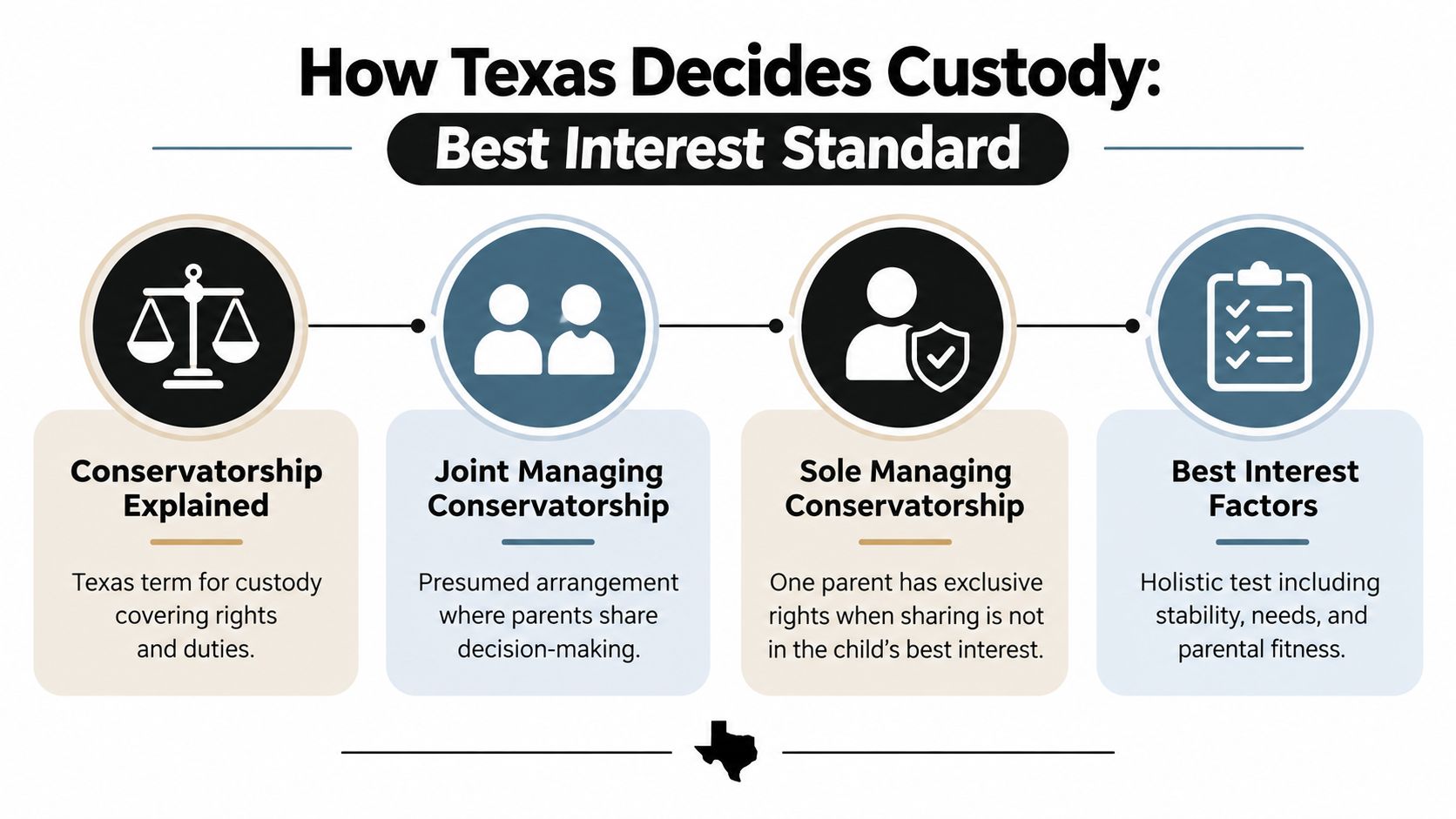
Texas uses the word conservatorship for legal custody. Conservatorship concerns the rights and duties connected to raising a child, including decisions about education, medical care, and daily welfare. Possession and access, often called visitation or parenting time, concern when the child spends time with each parent.
Texas courts apply the best interest of the child standard. In plain English, the judge asks what arrangement will serve the child's safety, emotional needs, stability, and relationship with each parent. Mental health may be relevant, but it's only one part of that larger analysis.
The main custody arrangements
Joint managing conservatorship means both parents share legal rights and duties. It doesn't necessarily mean equal overnight time, and it doesn't guarantee that every decision will be made together. The court's order explains which decisions require agreement and which rights belong to one parent.
Texas begins with a presumption favoring parents as managing conservators unless the evidence shows that arrangement would significantly impair the child's physical health or emotional development. The presumption favoring joint conservatorship and what it means is discussed in Joint Managing Conservatorship in Texas.
Sole managing conservatorship gives one parent exclusive authority over certain major decisions. The other parent may still have possession and access unless the evidence supports restrictions. Sole conservatorship isn't the same as termination of parental rights.
A possession schedule sets out when the child stays with each parent, including regular periods, holidays, school breaks, transportation, and exchanges. A court can tailor that schedule to the child's needs. For example, the order might include gradual increases in possession, supervised visits, or specific exchange conditions when those terms serve the child's best interests.
What the best-interest analysis considers
Texas courts may consider the child's needs, each parent's ability to meet those needs, the stability of the proposed homes, the child's relationship with each parent, and the presence of conflict or safety concerns. Lawyers often refer to the Holley factors, a group of considerations used in Texas best-interest decisions.
The court's analysis considers all factors. A parent who receives mental health treatment, maintains a safe home, attends to school and medical needs, and follows the possession order may present strong evidence of functional parenting. A diagnosis alone doesn't establish the opposite.
How Courts Evaluate Mental Illness Beyond the Diagnosis
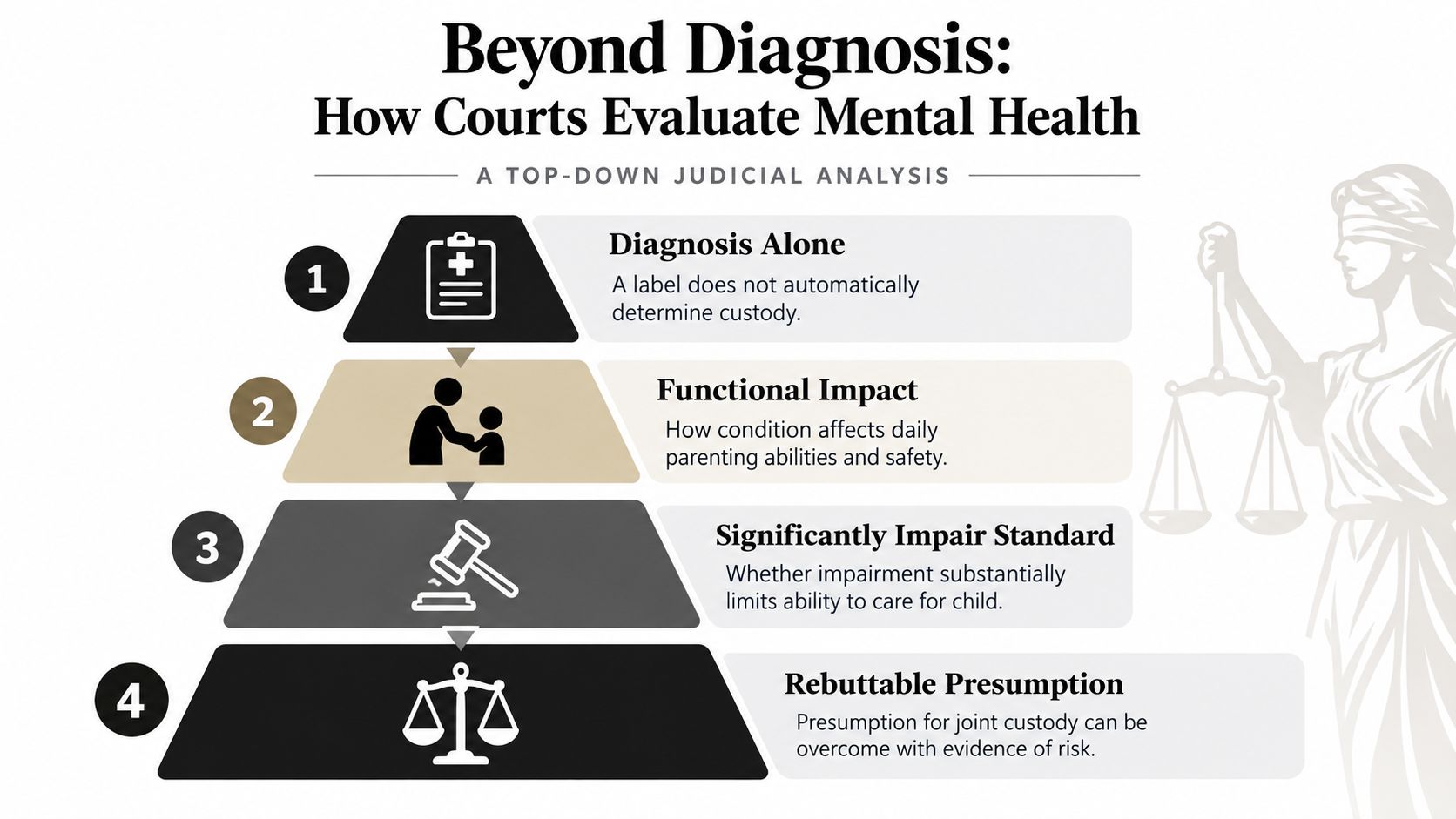
The legal threshold is functional impact. Texas Family Code Section 153.131 generally protects a parent's appointment as managing conservator unless the evidence shows that the appointment would significantly impair the child's physical health or emotional development. The presumption can be overcome, but the court needs evidence showing a meaningful connection between the condition and the child's welfare. (Texas Family Code Section 153.131)
A court may examine documented symptoms, treatment compliance, psychosis, suicidal risk, instability, or unsafe caregiving when those facts relate directly to the child. It may also consider whether the parent recognizes the condition, follows professional recommendations, and uses a reliable support system.
The difference between concern and impairment
A diagnosis may explain a parent's treatment history, but it doesn't automatically show that the parent can't safely care for a child. The court may ask practical questions:
- Can the parent supervise the child consistently?
- Does the parent manage medications and medical appointments responsibly?
- Can the parent maintain routines involving school, meals, and sleep?
- Does the parent respond safely during periods of stress?
- Has the child experienced fear, neglect, or emotional harm connected to the condition?
Those questions help the court choose a proportionate response. The result might be continued joint managing conservatorship, a customized possession schedule, counseling, or supervised possession. A restriction should address an evidence-based concern rather than stigma.
Texas Family Code Section 107.1101 addresses potentially undiagnosed serious mental illness in custody evaluations. If an evaluator identifies that concern and isn't clinically qualified to assess it, Texas law directs a referral for a mental examination and requires the report to address possible effects on the custody recommendations. (Texas Family Code Section 107.1101)
Termination has a much higher threshold
Termination of parental rights is different from changing conservatorship or limiting possession. Under Texas Family Code Section 161.003, the court must find by clear and convincing evidence that the parent has a mental or emotional illness or deficiency that renders the parent unable to provide for the child's physical, emotional, and mental needs. The condition must probably continue until the child turns 18, the child must already have been in DFPS temporary or sole managing conservatorship for at least six months, and the court must make a best-interest finding. (Texas Family Code Section 161.003)
A parent who needs emotional distance from harmful influences may also benefit from learning about the importance of stepping back, especially when building a stable support plan. That personal work doesn't decide custody by itself, but it may support safer choices and more consistent parenting.
For information about how courts may use evaluations, review this guide to psychological evaluations in Texas custody cases.
Evidence That Matters in Texas Custody Cases Involving Mental Health
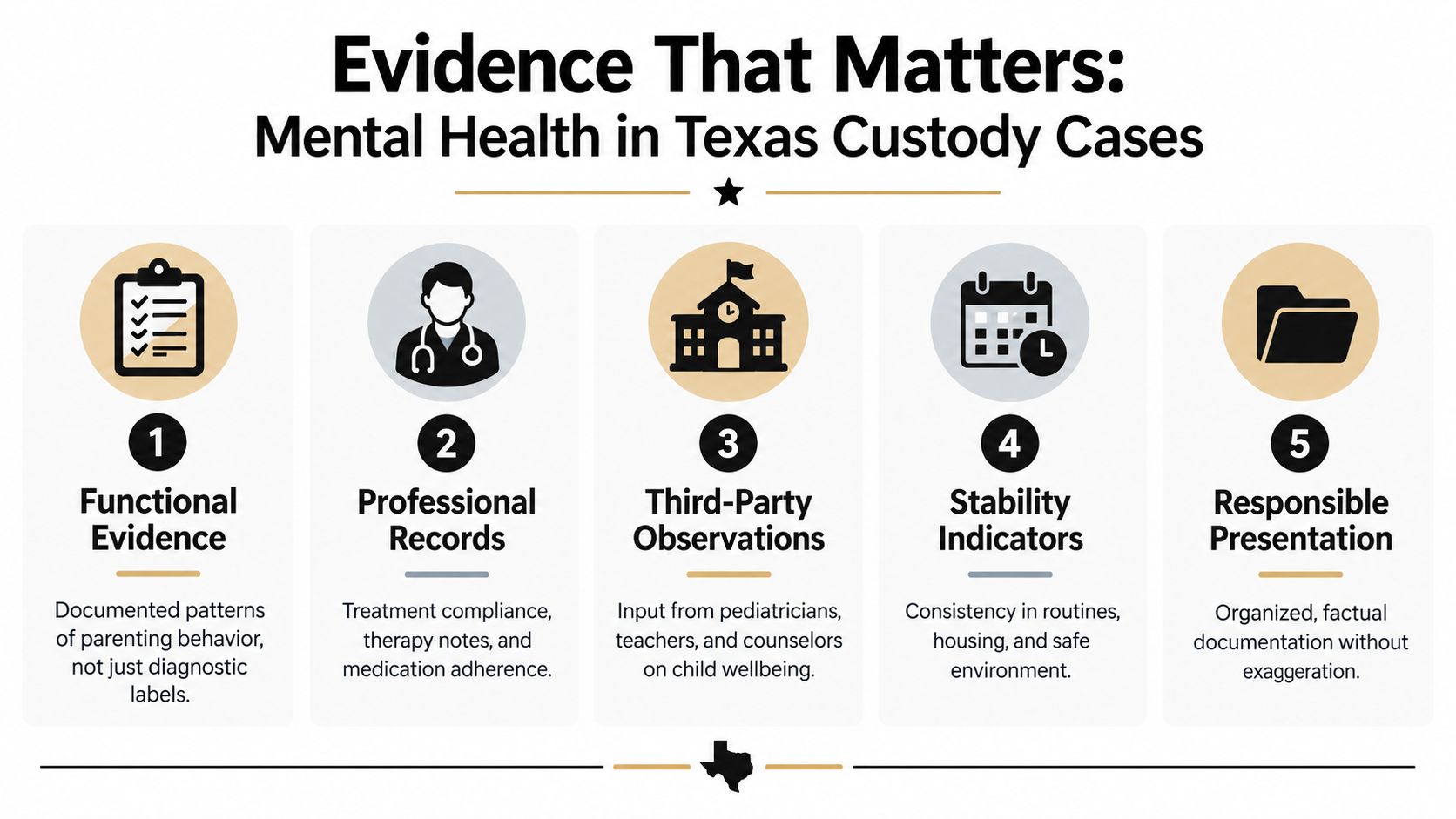
Evidence becomes persuasive when it shows what happened, when it happened, how it affected the child, and whether the concern is continuing. A diagnostic label is usually less useful than a clear record of parenting behavior connected to the child's needs.
Functional records tell the story
Relevant materials may include treatment records, medication history, therapy attendance, school attendance logs, medical appointment information, communications about exchanges, and records of supervision incidents. These documents should be gathered lawfully and reviewed with counsel before filing or sharing them.
A parent who is worried about safety should avoid exaggeration. Write down observable facts instead of conclusions. “The child was left without an available caregiver during the exchange” is more useful than “the other parent is unstable,” particularly when the date, witnesses, and follow-up can be verified.
A parent responding to allegations can create a similarly clear record. Evidence of consistent treatment, safe transportation, dependable routines, completed parenting responsibilities, and compliance with court orders may help show that the diagnosis doesn't prevent effective parenting.
Professional and third-party information
A custody evaluator may review broader parenting and child-impact information. A mental examination can provide clinical information, but Texas law recognizes that a mental examination by itself isn't a complete child custody evaluation. The evaluator still must consider the child's experience, parenting conduct, and other relevant evidence.
Third-party observations may include information from teachers, pediatricians, counselors, relatives, or supervised visitation providers. Their information should focus on the child's wellbeing and observed conduct rather than speculation about a parent's diagnosis.
Parents managing medication should communicate with a licensed medical professional rather than changing treatment on their own. A resource discussing a routine mental health medication safety check may help explain why medication reviews and treatment communication matter, but it doesn't replace individualized medical care or legal advice.
Organize evidence without turning the child into a messenger
A simple timeline can identify patterns without forcing the child to take sides. Keep copies of relevant orders, exchange messages, school records, treatment-related documentation, and witness names in a secure folder. Don't coach a child, ask the child to record the other parent, or use social media posts as a substitute for reliable proof.
For a related discussion of evidence in Texas custody disputes, see what evidence can move a Texas judge in an unfit-parent case. The focus should remain truthful, specific, and tied to the child's best interests.
Emergency Orders Supervised Visitation and Modification Options
Not every mental health concern calls for the same legal response. A parent facing immediate danger may need an emergency order, while a parent facing ongoing but manageable concerns may need a carefully written possession schedule. A parent whose circumstances have changed after a final order may need a modification case.
| Option | When It Applies | What Court Considers |
|---|---|---|
| Emergency or temporary orders | Immediate safety or serious instability requires prompt court action | Current facts, urgency, available evidence, and the child's immediate welfare |
| Supervised possession | Contact may continue safely only with oversight or specific conditions | Whether supervision addresses the identified risk and supports the child's relationship with the parent |
| Counseling or related orders | The court identifies a need for support, evaluation, or improved family functioning | The child's needs, parental conduct, and whether the order is appropriate and enforceable |
| Modification | The existing order no longer serves the child's best interests because circumstances have changed or another statutory trigger applies | Best interests plus a Section 156.101 trigger |
Texas Family Code Section 156.101 requires the requested change to be in the child's best interest and requires one of three triggers: a material and substantial change in circumstances since the prior order, a child who is at least 12 expressing a preference in chambers, or the primary conservator voluntarily relinquishing primary care and possession for at least six months. (Texas Family Code Section 156.101)
Choosing a proportionate response
A temporary order isn't a final determination that a parent is unfit. It establishes rules while the case continues. Supervised possession also doesn't necessarily mean a parent will always need supervision. The court may create conditions that protect the child while allowing the parent to demonstrate safe, consistent parenting.
Counseling orders can address parenting communication, child adjustment, or treatment-related concerns. Texas law also contains procedures involving children with severe emotional disturbance. State materials describe severe emotional disturbance as a mental, behavioral, or emotional disorder that substantially interferes with family, school, or community functioning, and they explain that DFPS generally must discuss a joint managing conservatorship option with a parent or guardian before seeking managing conservatorship to obtain mental health services, unless that option would not serve the child's best interests. (Texas guidance on severe emotional disturbance)
If supervised possession is being considered, review supervised visitation in Texas to understand why courts may use it and how the arrangement can work in practice.
Practical Steps for Both Parents to Protect Your Child and Your Rights
A mental health custody case becomes easier to manage when each parent focuses on conduct, records, and a workable parenting plan. The right steps differ depending on whether you're raising a concern or responding to one.

If you're concerned about the other parent
Start with specific observations. Record missed exchanges, unsafe supervision, school concerns, threats, or other conduct that affects the child. Preserve messages and identify witnesses, but don't involve the child in gathering evidence or make broad claims about a diagnosis.
Then consider a child-focused proposal. Depending on the facts, that could include a neutral exchange location, supervised possession, counseling, a gradual schedule, or clear communication rules. A customized request is often easier for a court to evaluate than a demand based only on fear.
Speak with a family lawyer before filing, especially if you believe an emergency order is necessary. If the child faces immediate danger, prioritize safety and contact appropriate emergency or protective services while obtaining legal guidance.
If you're living with mental illness
Follow your treatment plan and keep personal records of appointments, prescriptions, and recommendations. Don't stop medication or alter treatment because of a custody dispute without speaking with your provider. Build a practical support network that can help with transportation, childcare, exchanges, and periods when symptoms become harder to manage.
Keep communication calm and focused on the child. Arrive for possession on time, follow the order, avoid criticizing the other parent around the child, and tell your attorney promptly about any incident that could become relevant.
Both parents should review the parenting plan carefully. A useful plan addresses decision-making, regular possession, holidays, transportation, exchanges, communication, and what happens when a parent needs temporary support. Parents who are not married or who need to establish legal rights can also review custody for unmarried parents as they develop a plan that fits their family.
Key Takeaways and Next Steps for Texas Families
A diagnosis isn't destiny. Texas custody decisions focus on the child's best interests and the parent's functional ability to provide safe, stable care. Evidence of actual parenting impact matters more than stigma or unsupported assumptions.
Texas has graduated options. Depending on the facts, a court may maintain joint managing conservatorship, assign sole decision-making rights, adjust a possession schedule, order counseling, require supervised possession, or modify an existing order. Termination of parental rights requires a separate and much higher statutory showing.
Both parents have meaningful choices. A concerned parent can document facts and seek child-centered protections. A parent living with mental illness can follow treatment, build support, comply with court orders, and show consistent parenting. Early legal advice can help either parent avoid unnecessary escalation and present the facts clearly.
If you need help with a child custody or visitation case in Texas, our experienced attorneys can guide you every step of the way. Contact The Law Office of Bryan Fagan, PLLC today for a free consultation.
The Law Office of Bryan Fagan, PLLC helps Texas families address custody, visitation, conservatorship, modifications, and emergency orders involving mental health concerns with a focus on practical, child-centered solutions. Visit Law Office of Bryan Fagan, PLLC to schedule a free consultation and discuss the evidence, orders, and next steps that fit your family.