
When your child's future is on the line, understanding your rights matters most. A diagnosis can change daily life overnight, but it doesn't erase either parent's rights or give one parent automatic control. Texas courts still focus on the child's best interests, while accounting for medical care, education, therapy, supervision, stability, and long-term support.
For parents searching for guidance on custody of a child with a disability in Texas, the central question is practical: what court order will protect the child's care today and still make sense as the child approaches adulthood? The answer may involve conservatorship, possession, special education decisions, indefinite support, benefits planning, and guardianship alternatives.
When Disability Changes the Custody Conversation in Texas
A mother in Collin County receives a formal autism diagnosis for her six-year-old. Before the diagnosis, she and the child's father worked together reasonably well. Afterward, the father challenges therapy recommendations, questions the school's proposed services, and demands a possession schedule that ignores the child's medical and bedtime routines.
She's suddenly facing more than a disagreement about weekends. Who gets to decide therapy? Who signs school paperwork? Can the possession schedule accommodate appointments, sensory needs, medication, and recovery time? If the child may never become self-supporting, can support continue after adulthood? Will the family eventually need guardianship, or would a less restrictive arrangement work better?
Those questions belong in the custody case, not in a separate category that gets postponed until later. Texas Family Code Chapter 153 governs conservatorship and possession, while Chapter 154 addresses child support. Under Texas Family Code § 154.302, a court may order either or both parents to support a child for an indefinite period when the child requires substantial care and personal supervision because of a mental or physical disability, won't be capable of self-support, and the disability exists, or its cause is known to exist, on or before the child's 18th birthday. The court must also designate the parent or other person with physical custody or guardianship who receives the support. Texas Family Code § 154.302 reflects a 2019 legislative update effective September 1, 2019.
The emotional strain is real for children, too. Parents may benefit from practical guidance on children's emotional support during divorce, especially when a diagnosis and parental conflict arrive together.
The legal questions that deserve early answers
A strong case plan should address:
- Decision-making: Who controls medical, educational, and psychological decisions?
- Possession: Does the schedule protect therapy, sleep, transportation, and continuity of care?
- Support: Does the order preserve the child's right to support beyond ordinary age limits?
- Adulthood: Who will help with medical, educational, financial, and benefits decisions after 18?
- Modification: What happens if services disappear, care needs increase, or the other parent stops following the plan?
A diagnosis alone shouldn't decide custody. But a child's actual care needs must shape the order. Parents dealing with a mental health diagnosis in the family can also review mental illness and child custody in Texas for related custody considerations.
Texas Custody Terms Every Parent Should Know
Texas uses conservatorship instead of the everyday word “custody.” Conservatorship describes legal rights and duties. Possession and access describe when the child is physically with each parent. Keeping those concepts separate helps prevent confusion during negotiations and hearings.
A joint managing conservatorship, or JMC, means both parents share the status of managing conservator. JMC doesn't necessarily mean equal time, and it doesn't automatically mean both parents have every decision-making right. The order can assign particular exclusive rights to one parent or require the parents to share a decision.
A sole managing conservator, or SMC, has the exclusive rights assigned by the court. Those rights may include decisions about the child's residence, education, medical care, or psychological treatment. Texas Family Code § 153.073 addresses parental rights and duties, including rights involving medical, educational, and psychological care. The exact order language matters.
A possessory conservator has possession and access rights but may not hold the same decision-making authority as a managing conservator. A standard possession order provides a schedule for possession, although parents can agree to a different schedule and courts can tailor possession when the child's circumstances require it. Schedules can differ based on the child's age, including provisions for children under three and children over three.
A practical example
Suppose divorced parents in Harris County are appointed JMCs. The mother is given the exclusive right to make educational decisions because she coordinates the child's IEP, attends ARD meetings, communicates with teachers, and manages evaluations. The father remains involved, receives appropriate information, and has possession under the order, but he doesn't have the final vote on educational placement.
That arrangement doesn't declare the father unfit. It recognizes that the child needs a clear decision-maker when the parents can't agree.
| Conservator Type | Decision-Making Rights | Typical Use in Disability Cases |
|---|---|---|
| Joint managing conservator | Shared status, with rights assigned jointly or exclusively in the order | Both parents remain involved, while one parent may receive exclusive authority for a specific issue |
| Sole managing conservator | Exclusive rights listed in the order | One parent needs clear authority because conflict or caregiving demands make shared decisions unworkable |
| Possessory conservator | Possession and access, plus any rights specifically granted | A parent maintains regular contact without holding every managing decision |
| Parent with exclusive educational rights | Final authority over school and special education decisions | One parent consistently coordinates the IEP, ARD process, evaluations, and services |
Labels matter because disability-related care often involves fast decisions and multiple providers. An order that says “joint” without identifying who can consent, enroll, communicate, or resolve disputes may create the next conflict.
How Texas Courts Apply the Best-Interest Standard
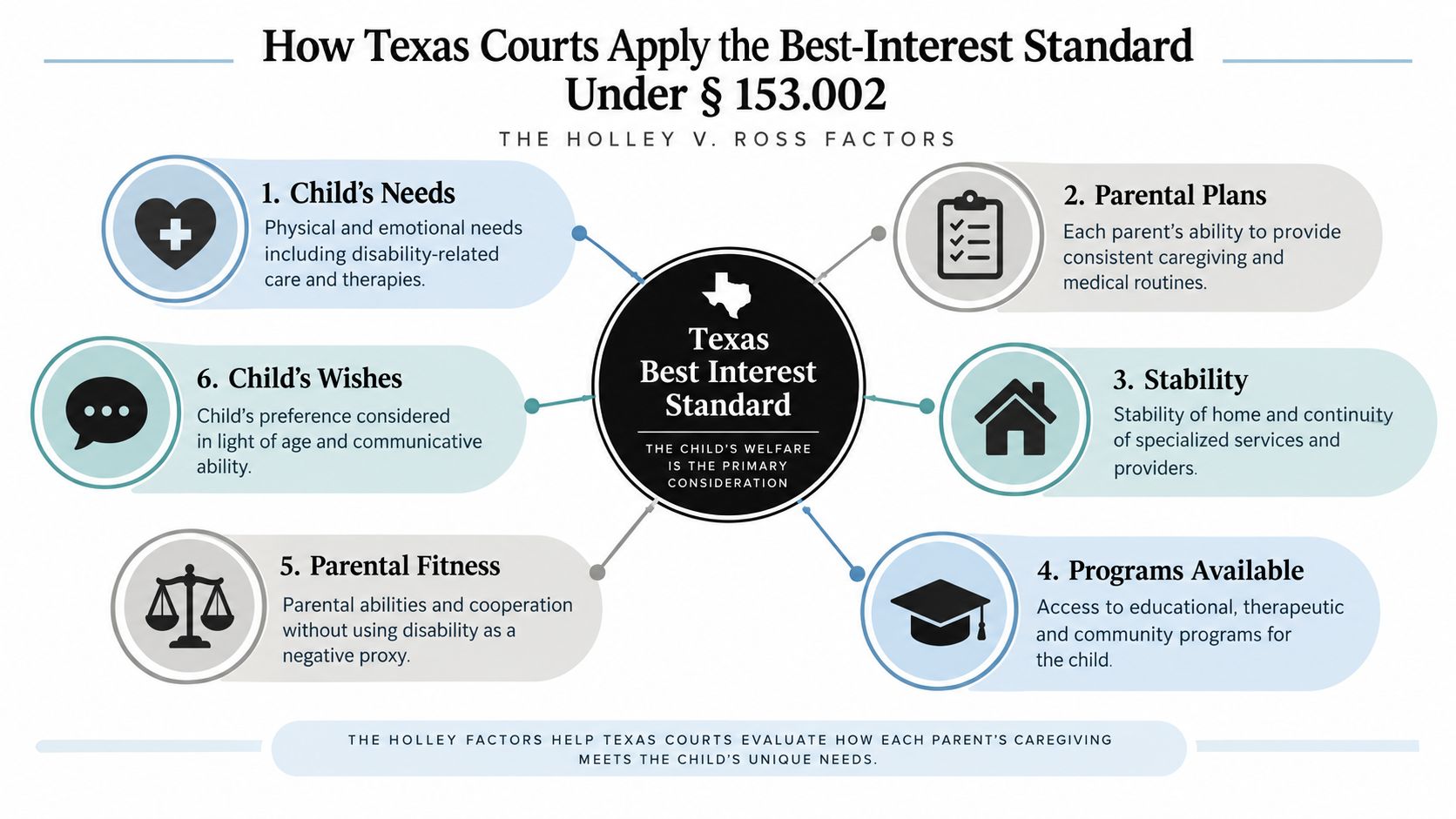
Texas Family Code § 153.002 makes the child's best interest the court's primary consideration in conservatorship and possession decisions. Courts commonly apply the factors from Holley v. Adams, often called the Holley factors, to organize the evidence.
Disability should inform the analysis, but it shouldn't become a shortcut for judging a parent. A child's diagnosis doesn't prove that one parent is safer, more loving, or more capable. The court must examine what each parent does and what arrangement serves the child.
Applying the factors to real caregiving
The child's emotional and physical needs, now and in the future, may include therapy, medication, communication support, mobility assistance, behavioral services, or a consistent sleep routine. The court may examine whether each parent understands those needs and follows the child's care plan.
The child's wishes can matter when the child can express a meaningful preference. Communication differences don't make the child's views irrelevant. The court considers the child's age, maturity, and ability to communicate in context.
Each parent's plans for the child also matter. A detailed plan for appointments, school transportation, therapy participation, emergencies, and transitions is stronger than a general promise to “handle it.”
The court may consider:
- Parental abilities, including cooperation and knowledge of the child's care.
- Available programs, such as school services, therapy, medical providers, and community support.
- Home stability, including continuity of caregivers, school, providers, and routines.
- Family relationships, including siblings and extended family who provide reliable support.
- Danger or harm, including family violence, neglect, unsafe supervision, or refusal to follow essential medical guidance.
- Acts or omissions, including conduct that damages the parent-child relationship, along with any legitimate explanation.
Practical rule: Bring evidence of caregiving, not just accusations. Appointment records, ARD notices, therapy communications, school records, and a calm parenting proposal help the judge compare actual performance.
Consider a father who repeatedly skips ARD meetings, refuses to communicate with the child's providers, and blocks recommended ABA therapy without a workable alternative. If the mother attends meetings, follows medical instructions, keeps records, and supports appropriate services, the court may give her exclusive educational authority. The point isn't that one parent has a disability-related opinion the judge dislikes. The point is that the child needs a reliable decision process.
For a focused explanation of the legal framework, see The Best-Interest Standard and the Holley Factors. Disability may affect the evidence under several factors, but it doesn't replace the best-interest test.
Disability-Specific Texas Statutes Families Should Understand
Texas law gives families several tools that ordinary custody explanations often miss. These provisions become especially important when a child's disability affects self-support, supervision, or ongoing dependence after adulthood.
Section 154.302 allows a court to order either or both parents to provide support for an indefinite period if the child requires substantial care and personal supervision because of a mental or physical disability, won't be capable of self-support, and the disability or its known cause existed on or before the child's 18th birthday. The court must identify who has physical custody or guardianship and receives the support. The statute doesn't guarantee a particular amount. The court must still determine the support obligation from the facts and the applicable order.
Section 154.309 addresses possession of or access to an adult disabled child. A court may order possession or access that is appropriate under the circumstances. That means the end of minority doesn't necessarily end every court-addressed parent-child access issue when the adult child remains dependent.
Parents should treat the order as a long-term planning document. If the pleadings and evidence never clearly establish the disability, care needs, and inability to self-support, later enforcement or post-majority support litigation may become harder. Benefits planning also requires careful language, particularly when payments may be directed through a special needs trust.
| Statute | What It Covers | Practical Impact |
|---|---|---|
| Texas Family Code § 153.002 | Best interest of the child | Guides conservatorship and possession decisions |
| Texas Family Code § 153.073 | Parental rights and duties | Helps define rights involving medical, educational, and psychological care |
| Texas Family Code § 154.302 | Indefinite support for certain disabled children | May preserve support beyond ordinary age limits when statutory findings are met |
| Texas Family Code § 154.309 | Possession or access to an adult disabled child | Allows a court to address continued access under appropriate circumstances |
A parent who is dealing with missed exchanges or ignored terms should review Enforcing a Texas Custody and Possession Order for the basic enforcement framework. Keep the disability findings, decision-making rights, support provisions, and access terms together in one carefully drafted order.
Connecting Custody Orders to IEP and 504 Rights
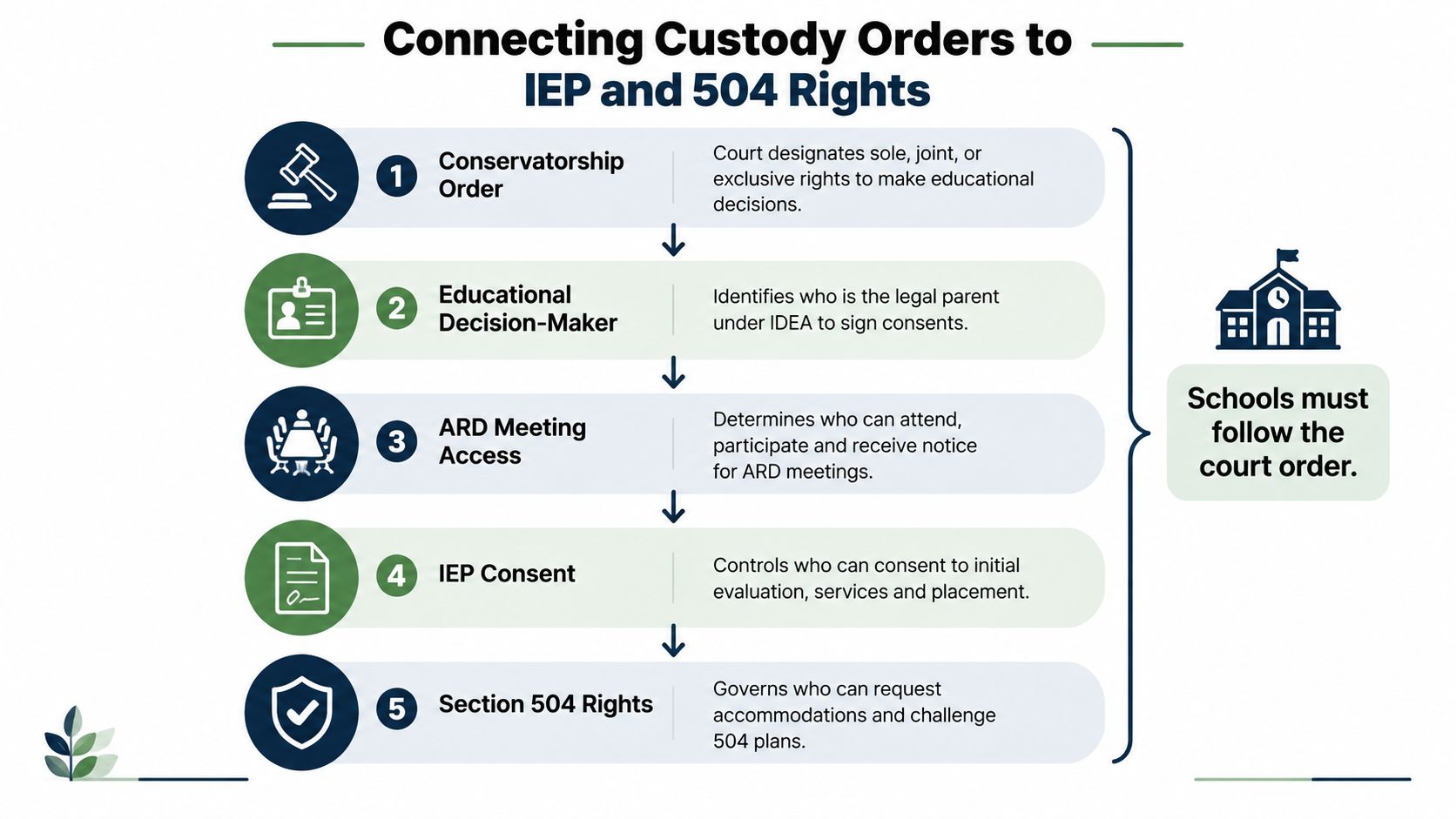
A custody order can determine who speaks for a child at school. It may control who receives notice of an ARD meeting, who signs consent for evaluations or placement, and who can make educational decisions when parents disagree.
Under an IEP, the school develops an individualized education program through the ARD process. A child may also receive protections and accommodations under Section 504. Federal education law and school procedures matter, but the school still needs to know which parent holds the relevant legal authority under the custody order.
Where parents get stuck
Joint managing conservatorship can work well when parents communicate. It can become unworkable when one parent refuses evaluations, disputes every accommodation, or treats ARD meetings as custody battles. The order should say whether educational decisions are joint, whether one parent has an exclusive right, and how disagreements will be handled.
A parent with exclusive educational authority may be able to sign school consents and direct placement decisions, but that doesn't necessarily eliminate the other parent's information rights or participation. The order should be shared with the school, and both the school and parents should understand its limits.
Parents should also address:
- ARD participation: Who receives notice and attends meetings?
- Records: Who can request educational and medical records?
- Evaluations: Who can consent to private evaluations or seek an independent evaluation?
- Technology: Who approves assistive technology and communicates with providers?
- Transportation: How will the child reach school, therapy, and medical appointments?
- Disputes: What happens when the parents disagree about services?
A custody finding may become relevant in a later TEA complaint or special education due process dispute, but the family court order doesn't automatically decide whether a school provided a free appropriate public education. Keep the legal issues distinct while making the documents consistent.
Before signing an order, send the proposed educational language to the IEP team and ask whether the school can implement it. Parents can also review custody and school enrollment in Texas when enrollment and decision-making overlap.
Public Benefits and How They Shape Custody Strategy
Custody planning can affect a disabled child's access to needs-based benefits. SSI, Medicaid, Medicaid waiver programs, and home and community-based services may apply financial and household rules that don't line up neatly with a parenting schedule.
The important distinction is authority. A conservator may hold parental decision-making rights, while a representative payee manages benefit payments for the beneficiary under the rules of the benefit program. Those roles aren't interchangeable. A support order also needs review before it sends money directly to the child or places assets in the child's name.
Parents should coordinate with a Texas family lawyer and a benefits-focused estate planning professional before finalizing support language. A special needs trust may allow support to be managed without treating every payment as a direct resource, but the trust must be drafted and administered correctly. Section 154.302 also permits a court to route support to a special needs trust in appropriate circumstances.
Benefits warning: Don't assume that a larger direct payment always helps. The wrong structure can create eligibility problems even when both parents are acting with good intentions.
Review whether the proposed order identifies the person managing support, preserves benefit eligibility, and avoids unnecessary transfers to the child. A stepparent adoption, a change in household, or a new support arrangement can create consequences that parents need to examine before agreeing.
Guardianship and Less Restrictive Alternatives
Turning 18 changes the legal relationship. A parent doesn't automatically retain the same authority to make medical, educational, or financial decisions for an adult child. That doesn't mean full guardianship is always the right answer.
Under Texas Estates Code Chapter 1101, a court considering guardianship must make required findings, including incapacity, whether less restrictive alternatives are available, and whether guardianship serves the proposed ward's best interest. Guardianship can provide broad authority, but it also removes or limits decision-making rights. The family should choose it because the adult needs that level of protection, not because the child has a diagnosis.
Alternatives may include a supported decision-making agreement, durable power of attorney where legally appropriate, representative payee status, and a special needs management trust. These tools can preserve more of the adult's control while assigning help with selected decisions.
A 17-year-old with Down syndrome may be able to communicate preferences and participate in health and financial decisions. The family might use supported decision-making and a pooled special needs trust rather than seek full guardianship. Another adult may need a court-appointed guardian because less restrictive tools can't protect the person from serious harm or manage essential decisions.
| Option | Court Involvement | Scope of Authority | Reversibility | Typical Use |
|---|---|---|---|---|
| Full guardianship | Court petition and findings | Broad authority defined by the court | Requires legal action to change | Adult needs substantial protection and alternatives aren't adequate |
| Supported decision-making | Agreement, generally without full guardianship | Support person assists while adult retains decision-making | More flexible than guardianship | Adult can make decisions with help |
| Durable power of attorney | Private legal document, subject to legal limits | Authority stated in the document | Can often be revoked or changed | Adult wants another person to assist with defined matters |
| Representative payee | Benefit-program process | Manages benefit payments | Program rules govern changes | Beneficiary needs help managing benefits |
| Special needs trust | Trust planning, with professional guidance | Manages assets under trust terms | Depends on trust structure | Protects resources and coordinates benefits planning |
Families looking for tailored support beyond guardianship may find it useful to compare decision-making supports rather than treating guardianship as automatic. A parent's former possessory conservator role may still help coordinate school, doctors, and benefits during the transition, but adult authority must be addressed separately. Texas families can also review custody and guardianship for the relationship between these legal systems.
Modifying Orders, Emergency Steps, and Your Next Move
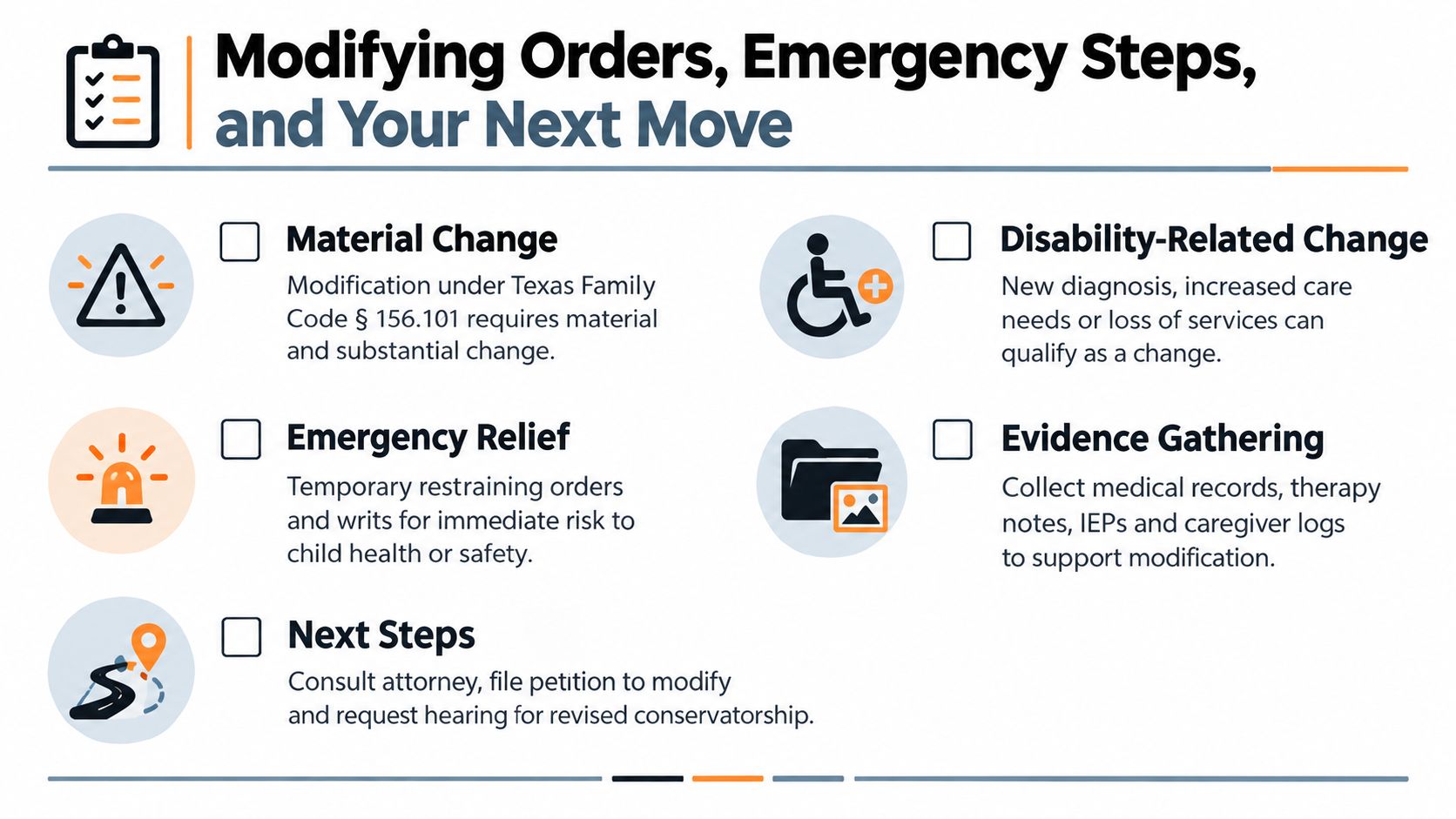
A custody order should change when the child's needs or circumstances materially change. Texas Family Code § 156.101 permits modification when the required material and substantial change is shown. A new diagnosis, increased supervision, loss of therapy, school placement change, or major transportation burden may support a modification when the facts meet the legal standard.
Enforcement is different from modification. If the other parent violates the existing order, a motion to enforce may seek court action. Texas Family Code § 157.002 addresses enforcement pleadings, and § 157.168 addresses additional possession in appropriate cases. Contempt may also be available, but the order must be clear enough for the court to identify the violation.
When the situation is urgent
If the child faces immediate danger, Texas law provides emergency tools. Section 262.101 concerns emergency proceedings involving immediate danger to a child's physical health or safety. Section 156.104 addresses urgent modification circumstances. DFPS may become involved when allegations concern abuse, neglect, or safety threats.
Don't use an emergency filing to resolve an ordinary scheduling dispute. Bring the court specific facts, dates, records, messages, medical information, and evidence explaining why ordinary notice and waiting would place the child at risk.
Military and relocating families need specialized planning. Texas Family Code § 153.007 and the Uniform Child Custody Jurisdiction and Enforcement Act can affect agreements, relocation, deployment, and interstate jurisdiction. A parent who expects to move or deploy should address the issue before the move or assignment creates a crisis.
Your checklist for this week
- Gather records: Collect diagnoses, medical records, therapy notes, IEPs, 504 documents, school messages, caregiver logs, and transportation information.
- Request an ARD meeting: Ask the school to schedule a meeting and preserve the written notices and responses.
- Review the order: Mark every provision concerning education, medical care, possession, exchanges, support, and dispute resolution.
- Calendar deadlines: Record hearing dates, mediation requirements, school deadlines, benefit reviews, and upcoming transitions.
- Document missed care: Keep factual notes about missed appointments, denied services, medication problems, or schedule failures.
- Get legal advice: Speak with a Texas family law attorney who understands disability-related custody, modification, enforcement, and emergency relief.
You don't have to solve the child's entire adult future in one afternoon. You do need an order that addresses the child's current needs and leaves room for responsible long-term planning.
The Law Office of Bryan Fagan, PLLC helps Texas parents, grandparents, and caregivers address conservatorship, possession, support, school decision-making, modifications, enforcement, and emergency custody concerns involving children with disabilities. Schedule a free consultation to discuss your current order, your child's care needs, and the legal steps that can protect stability now and into adulthood.
If you need help with a child custody or visitation case in Texas, our experienced attorneys can guide you every step of the way. Contact The Law Office of Bryan Fagan, PLLC today for a free consultation.