 Skip to content
When your child is racing out the door for school, the last thing you need is a custody schedule that only works on paper. A custody schedule for school age child Texas families can follow has to fit bus times, homework, sports, and the demands of two separate homes. If you're trying to match a court order to a real week, you're not alone, and you don't have to guess your way through it. For a broader overview of Texas custody issues, see our guide on custody in Texas.
The good news is that Texas law gives you a starting point, then leaves room to build a plan that works for your child. The hard part is turning legal language into a calendar that protects school nights, keeps exchanges calm, and avoids constant last-minute texting. A workable schedule starts with the law, then adds the details that everyday family life needs.
Understanding the Key Concepts
A school-age custody order in Texas starts with a few legal terms that sound formal at first, then become much easier once you connect them to daily life. Joint managing conservatorship means both parents may share decision-making rights, even if one parent has more parenting time. That matters because Texas does not treat joint conservatorship and equal possession time as the same thing. A court can give both parents rights and still set different schedules for each home, which is why custody and time-sharing are separate questions under Texas law. As one Texas family law overview explains, a judge may appoint both parents as joint managing conservators while still entering an unequal possession schedule based on the child's needs (Texas custody overview).
Practical rule: Shared decision-making does not automatically mean shared weekdays.
The default schedule many parents hear about is the Standard Possession Order, or SPO. The Texas Attorney General says Texas Family Code § 153.252 presumes the SPO is a reasonable minimum schedule in the child's best interest (parenting time overview). For school-age children living 100 miles or less apart, the SPO gives the possessory conservator time on the 1st, 3rd, and 5th Fridays from 6 p.m. Friday to 6 p.m. Sunday, plus a weekly Thursday visit from 6 p.m. to 8 p.m. during the regular school term unless that schedule is not in the child's best interest (Texas Family Code section 153.312). For many families, that becomes the starting point before anyone adds school logistics, travel time, or extracurriculars.

The baseline changes in practical ways. TexasAccess notes that when parents live more than 100 miles apart, the schedule shifts materially, including 42 days of summer possession, and older orders signed before September 1, 2005 used a Wednesday midweek visit from 6 p.m. to 8 p.m. instead of the newer Thursday pattern (TexasAccess SPO guide). For parents comparing school-year schedules, the primary question is not only how much parenting time appears on paper. It is how that time fits the school bell, bedtime, homework, and the drive between homes.
The Expanded Standard Possession Order (ESPO) in Texas gives the non-primary parent more time, which is why it comes up often in school-age cases. One legal guide also says that many Texas courts apply the ESPO by default for parents within 50 miles of each other, and that schedule can increase annual parenting time from roughly 20% to 24% under the traditional SPO to about 46% to 48% under the ESPO. Those figures matter only if the schedule works in daily life, because a plan still has to leave room for school nights, transportation, and activities that do not follow the court calendar.
School Age Considerations
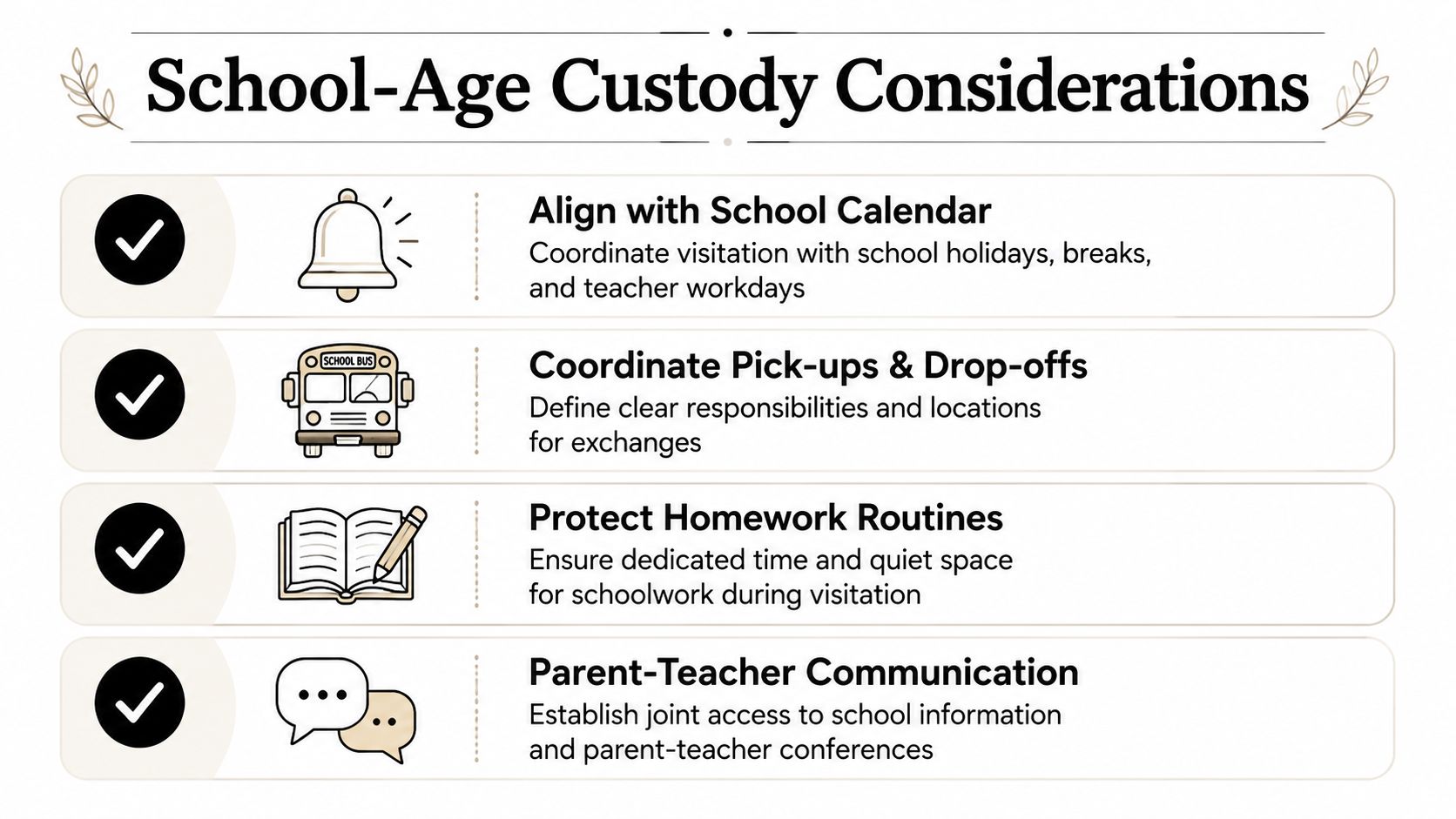
School-age children live by bells, buses, and deadlines. A custody plan that ignores the school calendar usually creates friction fast, even when both parents mean well. TexasLawHelp tells parents to get the school calendar and build a personal calendar that combines visitation weekends, holidays, and summer breaks, because the legal schedule alone doesn't solve the day-to-day problems (TexasLawHelp possession orders).
The details that matter most
A school-age plan works better when it answers four simple questions. Where does the child go after school? Who handles homework? Which parent drives on exchange day? What happens when a practice, recital, or exam lands on a parenting-time night? If those answers are missing, parents end up improvising, and children feel the stress of that uncertainty.
A custody order should work with the school week, not fight it.
Transportation matters more than many parents expect. A long drive can turn a short weekday visit into a rushed evening where dinner, reading, and bedtime all collide. Extracurriculars matter too, because a child who leaves one home for soccer, music lessons, or tutoring still needs access to school supplies and a quiet place to finish assignments. That's why school-based parenting plans usually work best when they name exchange locations, pickup times, and who handles the handoff after activities.
For parents trying to support both academics and activities, resources like managing school and youth sports can be helpful when sports schedules start crowding out homework time. The same is true for testing seasons. Families often ask how to protect study time during high-pressure weeks, and practical help like strategies for passing the STAAR test can complement a well-drafted order when school demands rise.
TexasLawHelp also points parents back to the school itself when decisions affect daily life, and that's a reminder that the school calendar isn't background noise. It's part of the parenting plan. For parents sorting out school enrollment and authority questions, our article on who decides where a child goes to school in Texas custody cases can help connect the dots.
Designing a Custody Schedule
A workable schedule starts with the child's weekly rhythm, not with a legal template. If your child wakes early for the bus, needs help with reading homework, and has practice two nights a week, the calendar should reflect that reality. The right plan reduces transitions, avoids duplicated chaos, and gives both parents enough structure to plan ahead.
A parent planning a custody schedule for school age child texas often has to fit legal language around ordinary life. School starts, ride times, after-school programs, and bedtime all have to fit together without constant reshuffling. That is why a good schedule should leave room for the small delays and surprises that come with real family routines.
Choosing the pattern that fits the child
For younger school-age children, 2-2-3 and 3-4-4-3 rotations often work well because they keep routines predictable and reduce transition stress. For older children, longer blocks can work better if both homes stay organized around bedtime, school materials, and activities. The point is not to chase a perfect formula. The point is to choose a pattern the child can follow.
Here's a simple sample chart you can use as a starting point:
| Schedule Type | Pattern | Parent A | Parent B |
|---|---|---|---|
| School-week focused | Weekday exchanges built around school nights | School nights and homework support | Alternating weekends and midweek time |
| Young child rotation | 2-2-3 | Two days, then two days, then alternate weekend block | The alternating days in the same cycle |
| Balanced shared time | 3-4-4-3 | Three-day block, then four-day block | Four-day block, then three-day block |
| Long-block option | Week-on/week-off | One full week at a time | One full week at a time |
The chart helps because children do better when they can predict what happens next. A calendar that feels simple to an adult can still feel confusing to a child if the handoffs change every week. If the order follows a familiar pattern, it is easier to explain, easier to pack for, and easier to keep on track.
If your child plays school sports, the schedule needs to protect both recovery time and attendance. A child should not miss practice every time the calendar flips, and neither parent should be left guessing who brings the cleats or permission slip. For that reason, school-age plans often work best when they name who keeps uniforms, school laptops, chargers, and activity calendars at each home. That kind of detail keeps the schedule from breaking down in the middle of a busy season. Parents who are working through that balance can also look at managing school and youth sports for help thinking through homework, practice, and travel time together.
The same logic applies to holidays and summer. A court order can be written to match school breaks, but only if the parents know the school calendar before the order is finalized. That is why a precise exchange schedule matters just as much as the number of overnights. If you want examples of how those schedules get written, see our guide to visitation schedule examples.
Making the plan court-ready
When parents negotiate, the strongest schedules are the ones that anticipate friction before it happens. That means naming exchange locations, deciding who picks up after late games, and setting a clear fallback when school gets canceled or a child gets sick. A parent who is driving across town after a game needs the order to say who waits, who carries the gear, and what happens if the child is not ready on time. It also means understanding that many Texas custody disputes settle before trial, so clear documentation can matter as much as courtroom strategy.
You do not need fancy language to make a schedule enforceable. You need clarity. A strong order tells both parents when the child moves, who drives, where the handoff happens, and what happens if the normal plan collides with a school event or activity. For parents who want to see how those pieces are often set out in writing, the visitation schedule examples guide can show what a practical draft looks like.
Negotiating and Drafting Your Order
A schedule works best when both parents treat it like a plan for school days, rides, and homework, not a tally sheet. If one parent wants Thursday evening time but the child is still in tutoring until 6:30, the order may need a later start time or a different exchange spot. Children do better when the written plan matches the rhythm of their week, so the adults spend less time repairing conflicts as they come up.
What to spell out in the order
A detailed order should cover more than the days on a calendar. It should name exchange locations, transportation responsibility, school-day drop-off times, and who makes sure homework gets finished before bedtime. It should also explain how parents handle vacation notice, holiday rotation, and changes when the school calendar shifts.
A useful draft often includes these points:
- Exchange location: Name the exact place, such as the school, a childcare center, or another agreed public location.
- Transportation duty: State who picks up and who returns the child for each type of visit.
- School-night routine: Explain who handles dinner, homework, and bedtime on nights that fall during possession time.
- Backup plan: Say what happens if a game runs late, a child is sick, or weather changes the exchange.
If mediation is on the table, parents usually do better when they focus on the child's routine instead of the legal labels. A mediator can help narrow the dispute to the key pressure points, like a Thursday visit that conflicts with band practice or a weekend exchange that creates too much driving. In many cases, one parent may want a Standard Possession Order baseline, while the other wants more flexibility. The best compromise is usually the one that keeps school days calmer, not the one that sounds strongest in argument.
Drafting tip: If a rule matters in real life, put it in writing.
A written order also needs to fit the family's daily logistics. A parent who lives across town may need extra time for traffic after school pickup, while a child with sports practice may need a handoff plan that works around the field, not just the clock. That is why school calendars and activity schedules should sit beside the possession schedule, the same way a map sits beside a route. One shows the destination, the other shows how to get there without confusion.
Law Office of Bryan Fagan, PLLC is one option parents use for help drafting and negotiating those details, especially when the case involves school routines, activity schedules, or a modification request. A careful order can prevent future fights, but only if it reflects how the family functions.
Filing Modification and Enforcement
A school-age child can outgrow a custody schedule faster than parents expect. A move to a different neighborhood, a new campus bell schedule, or a heavier load of practices and games can turn a once-workable order into a daily strain. Texas law starts with the SPO as a reasonable minimum under Family Code § 153.252, so a parent asking for a change usually needs to show why the new plan better serves the child's best interest. School calendars, transportation details, and activity schedules often become the clearest way to show that fit.
What to bring with you
If you are asking for a modification, bring records that show how the current order affects the child's routine. School calendars, practice schedules, commute distances, and notes about missed homework time help connect the legal request to real life. A judge will usually want more than disagreement between parents. The court wants to see how the child's day has changed and why the present schedule no longer works the way it once did.
A simple example helps. If a child has band practice on the same afternoon every week and the exchange time cuts into rehearsal, that conflict is not just inconvenient, it can reshape the whole evening. If a parent's drive now takes much longer because of a school change, that extra time can make after-school pickup and dinner feel rushed. Those are the kinds of facts that help a court see the difference between a paper schedule and a schedule that works on the ground.
Enforcement is different from modification. If the order works on paper but the other parent does not follow it, you may need mediation, an enforcement motion, or another court filing to make the order matter in daily life. The right remedy depends on what happened and how often it happened. If there is a safety issue, or if a child's stability is at risk, a lawyer can also help you look at emergency options.
For parents who are unsure which path fits, the practical question is simple. Has the child's life changed, or is the problem that the current order is being ignored? That answer usually points toward modification or enforcement.
Special Situations and Next Steps
Military families, relocation requests, and emergency situations often need special language in the custody order itself. A parent on active duty may need deployment clauses that protect continuity in school routines. A move can trigger a request under Section 153.002, and emergency custody scenarios may call for urgent temporary changes when a child's well-being is at risk.
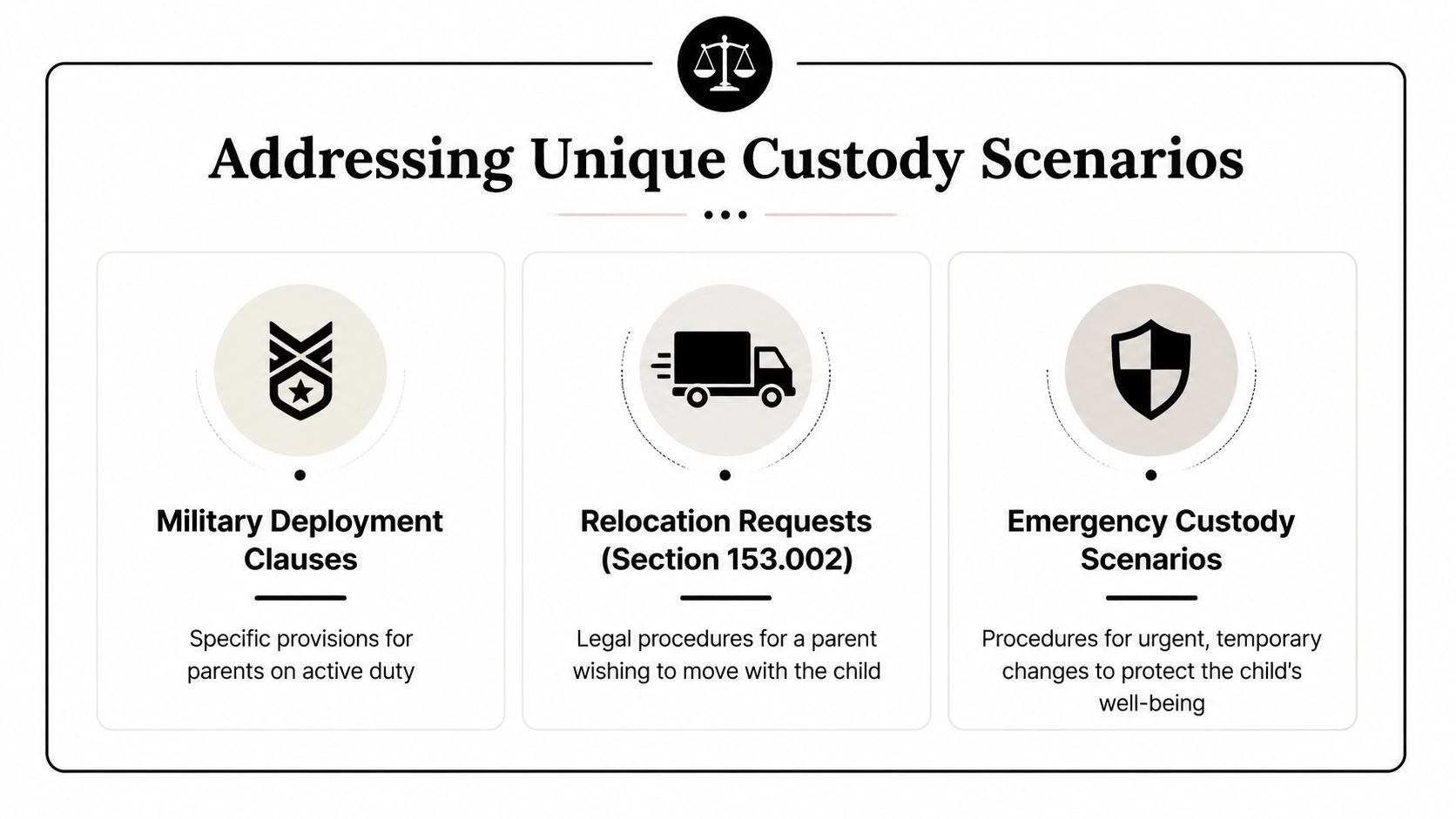
A school-age child needs stability even when adult circumstances change. That means the order should protect school enrollment, transportation, and routine care if one parent relocates or is temporarily unavailable. In a strong plan, the child's classroom life stays as steady as possible even when the family's logistics are shifting.
Key Takeaways
- Start with the legal baseline. Texas usually begins with the SPO or ESPO framework.
- Build around school life. Bus times, homework, and activities should shape the schedule.
- Write the logistics down. Exchanges, transportation, and backup plans should be in the order.
- Modify when life changes. A stale plan can work against the child's routine.
- Ask for help early. Clear legal guidance can prevent conflict before it grows.
If you need help with a child custody or visitation case in Texas, our experienced attorneys can guide you every step of the way. Contact The Law Office of Bryan Fagan, PLLC today for a free consultation.


