 Skip to content
Friday evening is when custody problems stop being abstract. One parent is late, the child is watching from the back seat, and both adults are trying to act calm while every word feels loaded. That handoff is where a custody X ray exchange Texas case either stays manageable or turns into the kind of conflict that ends up in front of a judge.
Why the Exchange Moment Matters More Than the Schedule
A lot of parents spend hours arguing about the calendar and then fall apart at the handoff. That is backwards. The schedule tells you when the child is supposed to move, but the exchange itself is where tempers rise, information gets missed, and the child sees whether the adults can follow the order.
Most custody trouble happens in parking lots, driveways, and pickup lines, not in court. A parent can have a solid possession order and still lose peace of mind, and sometimes legal standing, if every exchange turns into a scene. That is why a smart exchange plan is not paranoia. It is basic protection for the child and for your record if the other parent later claims you caused the problem.
Practical rule: Treat every exchange like it could be read by a judge later. That mindset changes how you speak, where you stand, and what you write down.
When parents hand off a child without a clear routine, small things get bigger fast. Who gets out of the car? Who opens the door? Is the child already buckled? Is the other parent standing close enough to argue? Those details matter because they shape the child's experience and the evidence trail if you ever need help enforcing an order. A clean exchange also helps when a judge is deciding the best interests of the child, which is the core standard in Texas family cases.
The best case is boring. The adults stay brief, the child moves safely, and the record is clear. If your exchanges are not boring, they need structure. If they still aren't safe, they need legal intervention.
Texas Custody Basics Every Parent Should Know
Texas family law uses words that sound colder than the work parents are doing. Conservatorship is the legal term for custody-related decision-making, and joint managing conservatorship usually means both parents share some level of that authority. A possession schedule is the calendar that tells you when the child is with each parent. Possession and access is the legal phrase for the time a parent spends with the child.
Under Texas Family Code § 153.312, the Standard Possession Order is the default schedule most parents hear about first. The Texas Standard Possession Order Explained gives a practical snapshot of how that default Texas visitation schedule works. Under the benchmark structure, a noncustodial parent typically has the child on the first, third, and fifth weekends, plus a school-year weeknight, alternating holidays, and summer possession rights. When parents live within 100 miles of each other, the noncustodial parent is generally entitled to 30 days of summer possession. When the parents live more than 100 miles apart, that summer possession increases to 42 days Texas standard possession order and parenting time.
That distance rule changes the exchange problem in a real way. More miles mean more drive time, more fatigue, and more chances for a missed pickup to turn into a fight. A parent who moves farther away without planning the handoff points is making the order harder to follow, and harder to prove when the other side starts blaming you for the breakdown.
Texas also gives parents a free resource that many people never touch until conflict is already high. The Texas Access and Visitation Hotline is the state-run hotline for parenting-time questions, and the Texas Office of the Attorney General says it offers free phone access to parenting-time specialists Monday through Friday from 1 to 5 p.m. at 866-292-4636, in English and Spanish Texas Access and Visitation Hotline. Use it before a bad exchange becomes a pattern.
For parents who want practical writing ideas for family-law content and client education, client intake growth tips can also help law firms explain custody tools in plain English.
Preparing for a Smooth and Safe Exchange
The 24 hours before an exchange should feel like logistics, not drama. Confirm the time and location in writing. Pack only what the child needs. Remove anything that invites an argument, especially money talk, accusations, or random side issues that have nothing to do with possession.
Build a routine you can repeat
Use the same channel every time, ideally email or a co-parenting app, so the record stays clean if a judge ever reviews it. If the child is young, make sure the car seat or booster is already installed correctly before the handoff. If the child is old enough to carry belongings, keep the bag simple and consistent so nobody ends up using a forgotten jacket as an excuse to prolong contact.
A short exchange log helps more than most parents realize. Write down the date, time, location, who showed up, the child's demeanor, and any deviation from the order. If the other parent is late, note how late. If the handoff changes locations, note that too. Memory gets fuzzy fast when conflict is involved, but a contemporaneous note looks much stronger later.
Keep your messages factual, brief, and boring. Judges trust the parent who sounds less invested in the fight.
One more thing. Your tone matters at pickup. A calm voice, short sentences, and no public argument can keep a small issue from becoming a child-centered crisis. That is not weakness. It is smart parenting.
| Step | What to Do | Why It Matters |
|---|---|---|
| Confirm in writing | Send the pickup time and location through one channel | Creates a clear record if there is a dispute |
| Pack basics only | Clothing, medication if ordered, school items, comfort item if appropriate | Cuts down on excuses and confusion |
| Check the car seat | Install it before the child arrives | Reduces delays and safety problems |
| Remove trigger items | Leave behind gifts, cash disputes, and adult conflict topics | Lowers the odds of a scene |
| Write the exchange log | Note time, place, people, and what happened | Helps if enforcement becomes necessary |
Choosing the Right Exchange Setting for Your Family
Not every family should use the same handoff setup. A private exchange at one parent's home works fine when people cooperate. It falls apart fast when there is intimidation, repeated conflict, or a child who gets caught in the middle every single time. The right setting depends on the actual risk, not on pride.
Compare the three realistic options
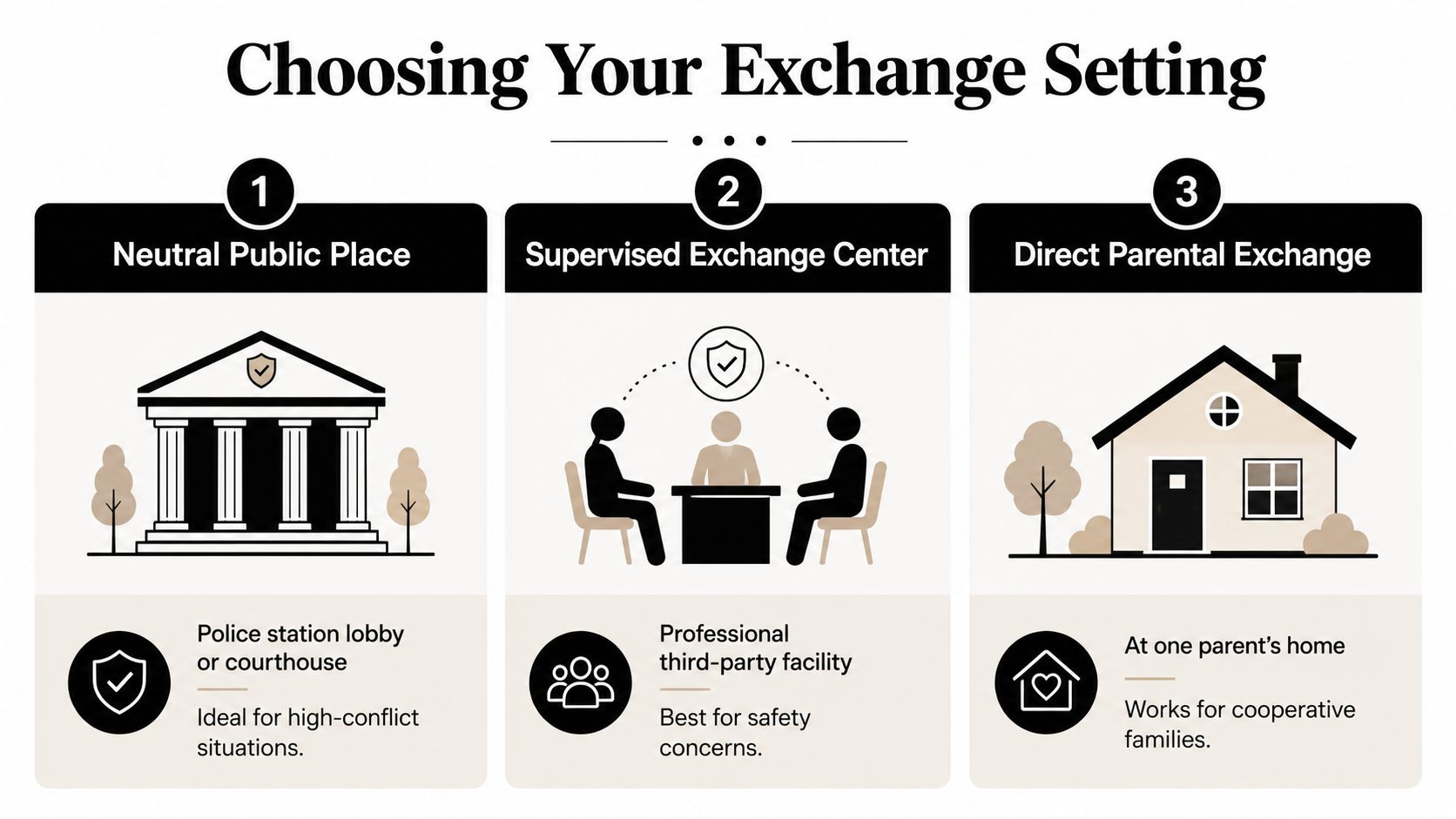
A neutral public place works when you want visibility and a low-drama setting. Think police station lobby, courthouse area, or a similar public spot where both adults are less likely to escalate. The upside is simplicity. The downside is that it still depends on both parents behaving reasonably.
A supervised exchange center is a better fit when the risk is higher but the child does not need fully supervised visitation. Travis County's Kids Exchange page shows that Texas counties do create dedicated exchange support, and many supervised visitation providers advertise structured exchange services Travis County Kids Exchange. A monitored site can reduce direct contact, improve documentation, and give the child a more orderly transition. For a deeper look at when families use these services, see supervised visitation in Texas.
A direct parental exchange is the least disruptive option, and for cooperative families it is often the easiest. It works when both parents can separate their conflict from the child's routine. It fails when one parent uses the exchange to vent, stall, or control the moment.
The trade-off is plain. Public places and monitored sites add structure and often reduce emotion, but they can also add travel time and awkwardness. Direct exchanges are quicker, but only if the adults are acting like adults. If safety is the main issue, you do not need a more convenient option. You need a more controlled one.
Handling Refusals, No-Shows, and Conflict at the Handoff
When the other parent refuses to release the child, does not show up, or arrives angry, do not improvise. Stay in the car if that is the safer place. Keep the child buckled if the child is already restrained and you are waiting for the other parent to arrive. Your first job is not winning the argument. Your first job is protecting the child from escalation.
If the situation feels dangerous, call the proper authority. Use a non-emergency line when the issue is a custody dispute without immediate danger. Call 911 only when there is a genuine safety threat. Speak plainly to the dispatcher. Say where you are, who is present, what is happening, and whether the child is in immediate danger. Do not turn the call into a legal lecture.
Document first, argue later
Write down the exact time, location, and what happened before details blur. Preserve photos or timestamps if they help show who was present or what the scene looked like. Then send a calm written follow-up that sticks to the order, not the emotion. If you know the specific paragraph or possession term being ignored, reference it directly.
A no-show or refusal is usually an enforcement problem, not a reason to rewrite the whole order. That distinction matters. If the existing order works on paper but one parent is stonewalling, a judge may need to compel compliance before anyone talks about changing the schedule. If the problem is repeated safety risk, the facts may point toward a broader legal fix.
Be careful with recordings. Texas consent rules can be an issue in some situations, so do not assume you can record every exchange and use it later without risk. If you are unsure, keep the focus on written documentation and legal advice instead of reaching for your phone first.
If you want a clear explanation of what to do when a parent blocks visitation, review what happens if a parent refuses visitation in Texas.
Modifying or Enforcing the Court Order After Repeated Problems
One bad exchange does not always justify a court filing. A pattern does. When the same problems keep happening, Texas parents usually have two paths, enforcement or modification. Enforcement says the current order should be followed. Modification says the current order no longer fits the child's situation and needs to change.
Texas custody-modification practice is procedural, and timing controls a lot of cases. Texas Law Help says modification generally starts with a Petition to Modify the Parent-Child Relationship, filed in the county where the current order was made, and Texas generally bars modification filings within one year of the prior order unless specific exceptions apply Texas Law Help custody modification guide. After filing, the other parent must be served and then has at least 20 days plus the next Monday at 10 a.m. to file an answer Texas Law Help modification guide. Those deadlines are not trivia. They decide whether the case keeps moving or sits still.
What to gather before you file
Keep the record tight. Save exchange logs, written refusals, photos, screenshots, and any court-order references that show exactly what was missed. If you are seeking enforcement, a judge may consider remedies like makeup possession time or contempt-type relief depending on the facts and the order. If you are seeking modification, you still need a child-focused reason, not just a parent's frustration.
The right tool depends on the problem. Repeated missed exchanges with a workable order often point toward enforcement. A relocation issue, safety concern, or long-running conflict may point toward modification. Parents who guess wrong lose time, and they usually make the next filing harder to manage.
Bottom line: Courts respond better to a clean paper trail than to a story told from memory after the fact.
If the pattern is ongoing, a family-law attorney can help you organize the evidence and decide whether to push enforcement, modification, or both. A case-management tool can help some firms sort messages and deadlines, and a Hyperleap AI chatbot for business can help firms sort messages and deadlines, though parents should still rely on attorney review, not automation, before taking legal action. For a practical walkthrough of the legal process, see how to enforce a custody order in Texas step by step. In some cases, the Law Office of Bryan Fagan, PLLC can review the order, the exchange history, and the county's local practice and help parents choose the next filing.
Key Takeaways and Your Next Legal Steps
A custody exchange is not just a handoff. It is a safety event and an evidence event. The place you choose, the way you document it, and the point where you bring in outside help all shape what happens next if the other parent refuses to cooperate.
What to remember
- Choose the setting wisely. A direct exchange, a neutral public place, a monitored site, or police involvement each fits a different level of conflict.
- Keep the record clean. Write down the time, place, who arrived, who did not, and what changed.
- Escalate the right way. Repeated problems usually point toward enforcement. Bigger structural problems, such as unsafe contact or a shaky possession plan, may point toward modification.
Texas parents also need to keep the baseline schedule in mind. As noted earlier, the standard possession order changes depending on how far apart the parents live, and distance affects both the exchange routine and the travel burden. Relocation, school nights, and handoff logistics should be planned with the order, not after the next dispute starts.
Keep the child out of the adult conflict, keep the paperwork current, and get help early if the exchange is no longer safe.
Frequently asked questions
Do text messages count as evidence? Yes, they can. Save the full thread, not just screenshots of one message, because context matters.
Can I record custody exchanges in Texas? Maybe, but do not assume every recording is safe or usable. If privacy rules might apply, ask a lawyer before using recordings as your main evidence.
Does moving 50 miles away require court approval? Not automatically in every case, but distance can affect the possession order, exchange logistics, and whether a modification makes sense. Talk to a lawyer before you move.
If you need help with a child custody or visitation case in Texas, our experienced attorneys can guide you every step of the way. Contact The Law Office of Bryan Fagan, PLLC today for a free consultation.
If your exchanges are tense, inconsistent, or unsafe, do not wait for the next argument to become the next court filing. The Law Office of Bryan Fagan, PLLC helps Texas parents, grandparents, and caregivers sort out possession schedules, enforcement issues, and custody modifications with a practical plan that fits the facts. Reach out today for a free consultation and get clear legal guidance for your next exchange, not just another guess.


