
When your child's future is on the line, a custody dispute can feel like it's turning into a character trial. One day you're trying to keep a normal schedule, and the next you're being accused of parental alienation, or of refusing to support your child's bond with the other parent. Those accusations can hit hard, especially when you've been trying to stay calm, follow the order, and put your child first.
Texas courts don't decide these cases by slogans or labels. They look for proof, context, and whether each parent has supported the child's best interests. That means you need a plan that does two things at once, it pushes back on a false accusation with clear records, and it also builds a court-ready case if real alienation is happening.
A good starting point is this practical guide on how to respond to false allegations, because the same discipline that protects you from a false label also helps you prove the truth when the other parent's conduct is the problem.
Facing Parental Alienation Claims
A parent usually doesn't see a parental-alienation claim coming. It often starts with small things, a missed pickup gets described as obstruction, a careful text about schedule changes gets called controlling, or a frustrated message is recast as proof that you're turning the child against the other parent. That's why these cases feel so personal, because the court is suddenly being asked to judge your intentions from fragments instead of your full history.
What the accusation usually misses
In Texas custody cases, the issue isn't a label. It's whether your conduct supports or undermines the child's relationship with the other parent, while still keeping the child safe and stable under the best interests of the child standard in Family Code §153.002 and the presumption favoring joint managing conservatorship in §153.131. Texas law also favors frequent and continuing contact with parents who act in the child's best interest, so the court wants to see whether the accusation is backed by a pattern, not a single ugly exchange. A practical overview of the custody framework is in The Best-Interest Standard and the Holley Factors, which describes the factors Texas courts use to decide custody.
Practical rule: A court is far more interested in repeated behavior than in one angry moment.
That matters because courts don't automatically reject abuse concerns in alienation cases. In the research base cited for these disputes, a 500-case Canadian review found only 10.9% of abuse allegations against alienated parents were founded or substantiated, and related federal research found courts credited only 23% of mothers' abuse claims in alienation cases (source). Those numbers don't mean abuse claims should be ignored. They do mean a judge will look for independent corroboration before treating either side's claim as reliable.
If you're accused, the safest move is to slow down and start building records immediately. If you're dealing with real alienation, the same discipline helps you prove it without sounding emotional or vague.
How Texas Courts Evaluate Alienation Allegations
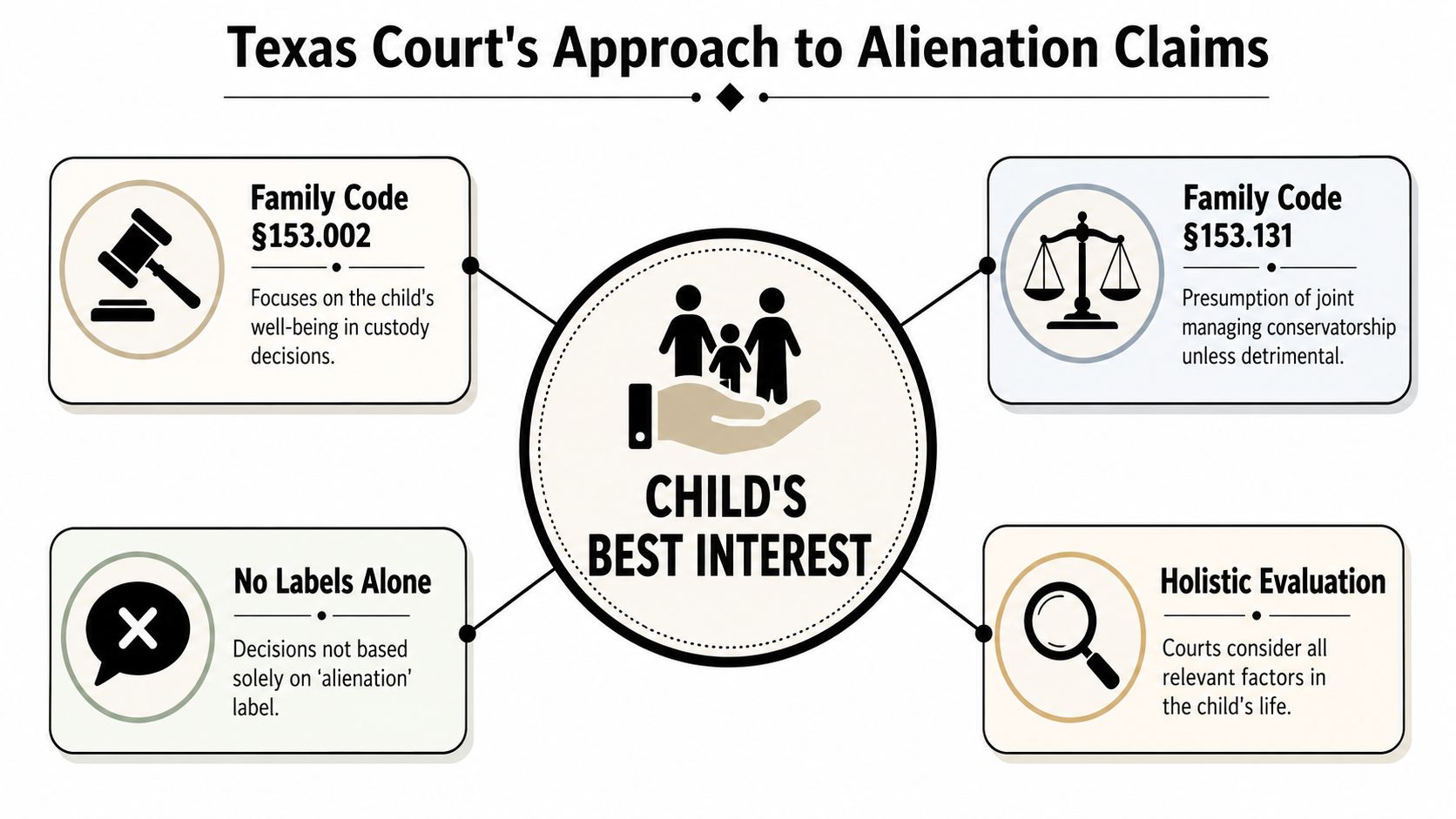
Texas judges start with the child's welfare, not with the word “alienation.” Under Family Code §153.002, the child's best interests control, and under §153.131, the court presumes joint managing conservatorship is appropriate unless there's a significant risk of harm to the child. In plain English, that means the judge is asking which arrangement protects the child's emotional and physical health, not which parent has the louder accusation.
The evidence also has to fit the broader custody picture. In appellate-level research on 963 cases, parents found to have alienated their children had an 81.62% greater probability of having a substantiated abuse claim against them, while alienated parents had an 86.05% greater likelihood of facing an unsubstantiated abuse claim than alienating parents (source). That tells Texas practitioners something important, judges aren't rubber-stamping either side. They're asking whether the abuse concern is independently proven and whether the alleged alienation is supported by a real record.
What judges expect to see
A parent who says, “The other side is alienating me,” usually needs more than frustration and suspicion. Courts respond better to consistent support for the other parent, proof of compliance with the possession schedule, and records showing that contact was encouraged instead of blocked. That lines up with the historical custody-outcome data showing that parental-alienation findings can sharply affect parenting time, including cases where about 40% of alienating parents lost 20% or more of their parenting time after trial and appeals (source).
The judge is usually looking for a pattern, not a label.
The practical takeaway is simple. If you're defending against a false claim, show cooperation. If you're proving real alienation, show the exact conduct, the time frame, and how the child's refusal ties to that conduct. Texas courts are built to evaluate context, and your evidence has to give them that context.
Building Your Defense Chronology and Corroboration Package
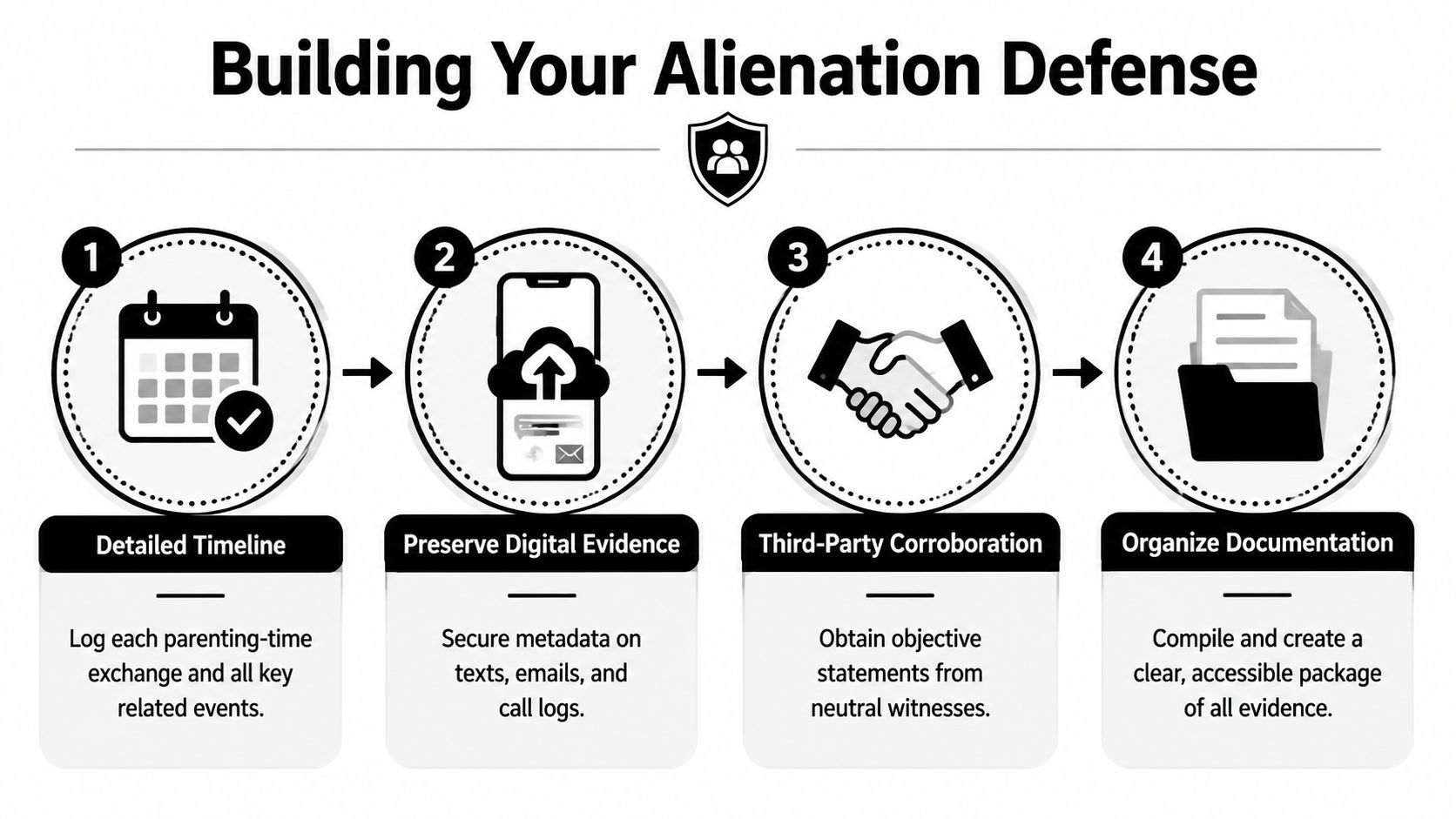
A strong defense starts with a clean timeline. Not a vague diary, not a long rant, but a chronology that ties each important event to a date, a message, and a source someone else can verify. That's the difference between “I always tried to cooperate” and “Here's the record showing I did.”
Build it in four layers
- Log every exchange. Write down pickup times, drop-off times, cancellations, late arrivals, and any refusal to follow the possession schedule. Include the exact wording when the other parent changes the arrangement.
- Preserve the digital trail. Save texts, emails, call logs, and screenshots with metadata whenever possible. A screenshot alone can help, but the better record is the full message thread or exported email chain.
- Collect neutral support. Teachers, coaches, therapists, pediatricians, and other third parties often see patterns before parents do. Their notes matter because they aren't part of the fight.
- Organize everything in one place. Keep the materials in a folder structure that matches your timeline, so your lawyer can find the right exhibit fast.
That last step matters more than people think. If your records are scattered across a phone, a notebook, and three email accounts, the strongest facts can still get buried. Tools with advanced document analysis features can help sort messages, dates, and recurring themes before a hearing, and that kind of organization can save real time when the facts are moving quickly.
For a Texas-focused resource on presentation, Texas custody evidence guidance can help you think through how records usually get packaged for court. If you need a broader framework for structuring your materials, document review tools like advanced document analysis features from Ivory Mind can make it easier to sort large message sets without losing the underlying chronology.
The point isn't to look perfect. The point is to look consistent, calm, and organized, because that's what judges trust.
Documenting Genuine Alienation with Concrete Evidence
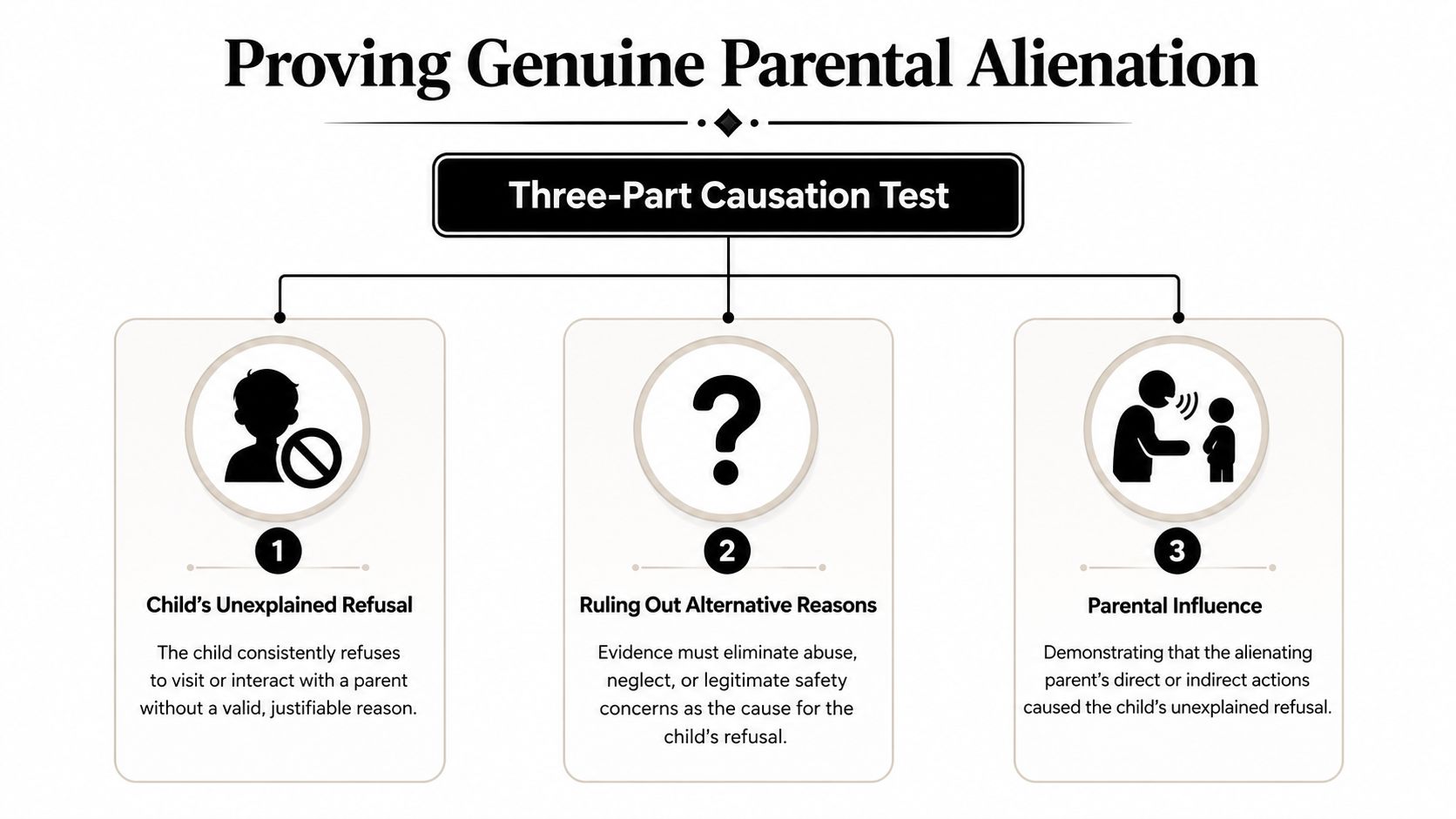
To prove real alienation, you need a causation story, not just a sad outcome. The three-part test used in formal guidance asks whether the child is refusing contact, whether that refusal is explained by something else, and whether the other parent's conduct caused the refusal (source). That structure matters because a court can't fairly label a parent as alienating unless it rules out justified fear, abuse, or another independent reason for the child's resistance.
Which proof carries the most weight
The strongest cases usually combine a psychological evaluation with corroborating records. School records, therapy notes, messages that show denigration, and witness statements that confirm the pattern often help more than raw accusations. Courts want to know what was said, when it was said, who heard it, and how the child responded over time.
A sealed evidence binder is useful because it keeps the materials in court order. Put the most important items first, the child's statements second, and the supporting records behind them. If a therapist or evaluator has already observed the child's rejection, that report should sit near the front of the packet, because it gives the court a professional lens before it sees the raw messages.
Courtroom rule of thumb: If the evidence doesn't show who influenced the child, when, and how, the claim stays weak.
Parents looking for a practical documentation model can also review Casewell on documenting parental alienation for ideas on turning scattered facts into a usable record. For Texas parents, a related overview on what a custody evaluation in Texas looks like can help set expectations for expert involvement.
Real alienation cases rise or fall on specificity. A child repeating a parent's language, a long pattern of blocked contact, and a timeline showing the full parenting history carry far more weight than a single emotional complaint.
Common Pitfalls and How to Avoid Them
The biggest mistake is reacting on the record. One angry text, one sarcastic email, or one social media post can get framed as coaching, denigration, or refusal to co-parent. If you're already under scrutiny, assume every written word may end up in front of a judge.
A second mistake is failing to timestamp the facts. If the missed exchange, the blocked call, or the school message doesn't have a date attached to it, the other side gets to define the story later. That's why calm documentation beats memory every time.
Watch these traps
- Emotional replies: Don't answer a provocation with a long message full of blame.
- Loose records: Keep the date, time, platform, and context with every important exchange.
- Selective logging: Small incidents matter because they build the narrative a judge sees.
- Missed deadlines: If you need temporary relief or enforcement, waiting too long can make the problem look less urgent.
Historical custody-outcome data shows why these mistakes matter. In the research cited above, 40% of cases with alienation allegations involved offending parents who lost 20% or more of their parenting time, which shows how seriously courts can treat a documented pattern of interference (source).
The practical fix is boring, and that's why it works. Use a neutral tone, preserve the full exchange, and keep a simple reminder system for hearings, exchanges, and school events. If you have to communicate about sensitive issues, use the least inflammatory channel available and keep the message short.
Keep the focus on the child, because judges do.
Collaborating with Experts and Legal Professionals

A custody fight gets harder when the child's refusal, the parent's conduct, and the family history all point in different directions. That's when a mental-health professional, a custody evaluator, and an experienced Texas family lawyer can keep the case grounded in evidence instead of emotion. In Texas, a custody evaluation can help explain the child's behavior in context, especially when the parties disagree about what's really driving the breakdown in contact.
When you're choosing an expert, ask direct questions. Does the evaluator understand the difference between a child who is afraid and a child who has been coached? Will the expert review school records, therapy notes, and message history before forming an opinion? The goal is not to find someone who already agrees with you, it's to find someone who can explain the facts clearly and credibly.
For a Texas-specific overview, what a custody evaluation in Texas looks like is a useful starting point. If you're weighing expert support tools, AI support for PI expert witnesses can be a helpful background resource for organizing expert-facing materials and case data.
What to bring to the first meeting
- A clean chronology: Bring the timeline, not just loose screenshots.
- School and therapy records: These often show whether the child's resistance is new or part of a longer pattern.
- Neutral witness names: Teachers, caregivers, coaches, and medical providers matter.
- A question list: Ask the expert what evidence they need before they can form a reliable opinion.
A good lawyer will also help you decide when to ask for interim relief. If daily contact is breaking down, waiting until final trial can let the damage harden. The right request, made at the right time, can protect the child while the court sorts out the evidence.
If you need help with a child custody or visitation case in Texas, our experienced attorneys can guide you every step of the way. Contact The Law Office of Bryan Fagan, PLLC today for a free consultation. If you're dealing with a false parental-alienation accusation or trying to prove real alienation with solid evidence, visit Law Office of Bryan Fagan, PLLC to get personalized help from a Texas family law team that handles custody, enforcement, and modification cases every day.