 Skip to content
When your child's future is on the line, understanding your rights matters most. You may be sitting in your car with packed bags, watching the scheduled exchange time pass while your calls go unanswered. The denial feels personal, but your next response should be deliberate. In Texas, a signed possession order is a court command, not a suggestion.
The practical answer to denied visitation what to do in Texas follows four moves: document the denial, file a motion to enforce, use the court's available remedies, and seek modification when the pattern continues. Your goal isn't to punish the other parent. It's to protect your relationship with your child and restore a dependable routine.
When Visitation Is Denied and You Feel Stuck
You arrive on time with your child's clothes packed and the car seat ready. The exchange window closes, your calls go unanswered, and your child stays inside the other parent's home. Treat that moment as the start of a legal record, not a confrontation.
Do not send threats, show up uninvited, or keep the child beyond your next court-ordered possession period. The other parent's violation does not give you permission to violate the order. Follow your own obligations, preserve the facts, and prepare a filing based on the order's exact language.
Practical rule: Record every denied exchange while the details are fresh. Continue complying with every part of your possession order.
Texas handles possession-and-access enforcement separately from child-support enforcement. A visitation dispute belongs in the district or county court that issued the custody order. Texas Law Help explains that a parent denied court-ordered visitation should generally file a motion to enforce, and the state's Access and Visitation Hotline, 866-292-4636, can provide basic guidance and local attorney resources (Texas Law Help's visitation enforcement guide).
Preserve texts, call records, location details, and witness memories immediately. If both parents can still coordinate exchanges, resources on coordinated routines for co-parents may reduce scheduling confusion. A planning tool cannot replace a court order or enforce it.
One missed visit may involve a misunderstanding or transportation problem. A deliberate pattern requires a stronger response. The judge will examine what the order required, what occurred, and what evidence supports your account.
Repeated denials also matter beyond the first enforcement filing. Texas's new 2025 three-strikes escalation framework makes continued violations a point where enforcement can develop into a custody-modification issue. Start documenting the first denial so you can show whether later violations form a pattern and whether the current arrangement still serves your child.
Document Each Denial the Right Way
Start your record the same week the denial occurs. Don't rely on memory, especially if several exchanges have gone wrong. A Texas enforcement pleading must be precise enough for contempt review, so the details you preserve now can become the structure of your case later.
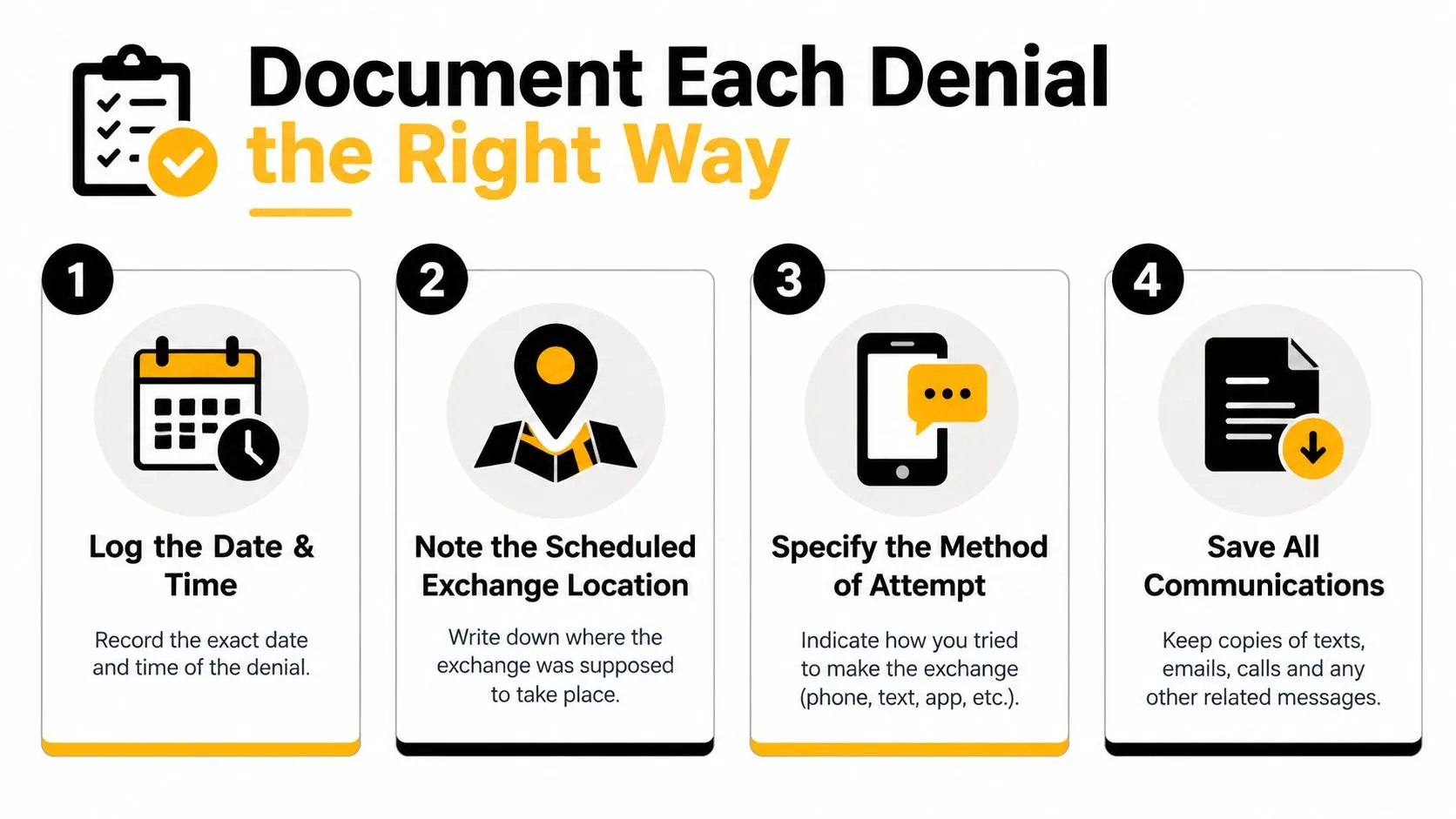
For every missed period, record:
- Date and time: Note when possession was supposed to begin and when you arrived or attempted contact.
- Exchange location: Identify the exact place listed in the order, including the home, school, daycare, or other designated location.
- Your compliance: State what you did to follow the order, such as arriving, calling, or sending a message.
- Refusal details: Write the other parent's exact words when possible. Don't turn “I'm not releasing the child today” into “the other parent acted crazy.”
- People present: List witnesses who saw the exchange, heard the conversation, or observed your attempts to comply.
- Supporting evidence: Preserve screenshots, emails, voicemail files, call histories, certified text-message exports, doorbell footage, and dashcam footage.
A simple chronological table works well:
| Date | Attempted compliance | Refusal details | Supporting exhibit |
|---|---|---|---|
| Date and time | Arrival, call, text, or other action | Exact response or lack of response | Texts, video, call log, witness declaration |
“Mom refused again” is a conclusion. “At 2:47 p.m., I called twice from the exchange location. At 2:52 p.m., I sent a text stating I was present. The message showed as read but received no response” gives a judge something usable.
Keep original files in a secure folder and avoid editing screenshots. If a third party witnessed the exchange, ask whether that person can provide a sworn declaration. For a broader explanation of organizing custody evidence, review this guide on how to present evidence in a custody case in Texas.
Your log should remain factual, professional, and chronological. It can also help you understand the schedule you have. For parents asking Is 50/50 Possession the Default in Texas?, the answer depends on the court's order and the child's best interests, not on a presumed equal-time rule.
Filing a Motion to Enforce in Texas
A motion to enforce asks the court to require compliance with an existing possession order and provide a remedy for violations. It does not change the parenting schedule. A motion to modify serves that purpose by requesting different conservatorship terms, possession periods, or other relief based on legally sufficient grounds.
Under Texas Family Code Chapter 309, identify the existing order, the court that signed it, and its date. List each violated provision separately, with the date and facts of every denial. State the relief you want, such as compliance, make-up possession, or sanctions. Specific pleading matters. The judge must be able to compare the order's exact language with the other parent's conduct.
Contempt enforcement for possession and access has a strict deadline. If the motion is not filed within six months after the child becomes an adult or the possession right ends by law or under the order, contempt relief may be limited, as explained in the Texas State Law Library guidance on visitation denial. Calendar the deadline for each alleged violation instead of waiting until the pattern becomes larger.
What the filing process usually involves
File the motion in the court with continuing jurisdiction over the custody case. Address the filing fee, or submit an affidavit of indigence if you cannot afford it. The other parent must receive proper legal service unless the court authorizes another method. The court will then set procedures for a hearing and any temporary relief.
Some counties encourage or require mediation before a final hearing. The court may address temporary make-up possession, then set a final enforcement hearing. Before contempt can be considered, the judge may examine whether the order is final, clear, specific, and properly served. Ambiguous language can defeat contempt even when the parents disagree about the schedule.
Use this guide to a motion to enforce in Texas to review the pleading and hearing process. Your first filing should focus on the existing order and provable violations. If denials continue, those same facts may support a later modification request, particularly under Texas's 2025 three-strikes escalation framework, where repeated violations can shift the case from enforcing the order to changing custody terms.
| Issue | Motion to Enforce | Motion to Modify |
|---|---|---|
| Main purpose | Enforce the current order | Change the current order |
| Primary question | Was a clear provision violated? | Has a legally important change occurred? |
| Typical proof | Order language, dates, communications, witnesses | Changed circumstances, best interests, stability, requested new terms |
| Possible result | Compliance, make-up possession, sanctions, fees | New conservatorship or possession terms |
An enforcement case can build the factual record for modification, but the two proceedings require different pleadings, proof, and requested relief.
The Enforcement Toolkit a Texas Court Can Use
A Texas judge has several options after finding that a parent violated a clear, enforceable possession order. The appropriate remedy depends on the proof, the seriousness of the conduct, and whether the parent can comply going forward.
Contempt is the most serious enforcement tool. Civil contempt can require compliance with the order, while criminal contempt can punish past disobedience. Contempt proceedings require clear and convincing proof, and the order must be specific enough that the accused parent could understand what compliance required. A vague schedule or disputed interpretation can weaken the case.
Make-up possession is often the most child-focused remedy. Texas courts may order additional periods to compensate for wrongfully denied access. Those periods must match the type and duration of the time denied, may include weekends, holidays, and summer possession, and must occur on or before the second anniversary of the finding of denial (Texas guidance on consequences of denying visitation).
Matching the remedy to the problem
| Remedy | Best For |
|---|---|
| Additional possession | Restoring time that was wrongfully denied |
| Contempt sanctions | Willful violations of a clear order |
| Fines or jail | Serious or repeated noncompliance established through contempt |
| Counseling or compliance measures | Conduct that may improve communication or parenting cooperation |
| Attorney's fees and travel costs | Expenses caused by the proven violation, when supported by the case |
| Money judgment | Financial compensation connected to missed possession or enforcement expenses |
A judge may also consider attorney's fees, travel costs, and other appropriate financial relief. The requesting parent must support those requests with evidence and connect them to the enforcement dispute.
Courts generally prefer remedies that protect the child's schedule and encourage future compliance before imposing the harshest sanction. Jail is not an automatic result of missed visitation. The court must find a legally enforceable violation and apply a remedy proportionate to the conduct. Repeated, willful violations are treated differently from a single confusion about an exchange time.
When Repeated Denial Becomes a Custody Case
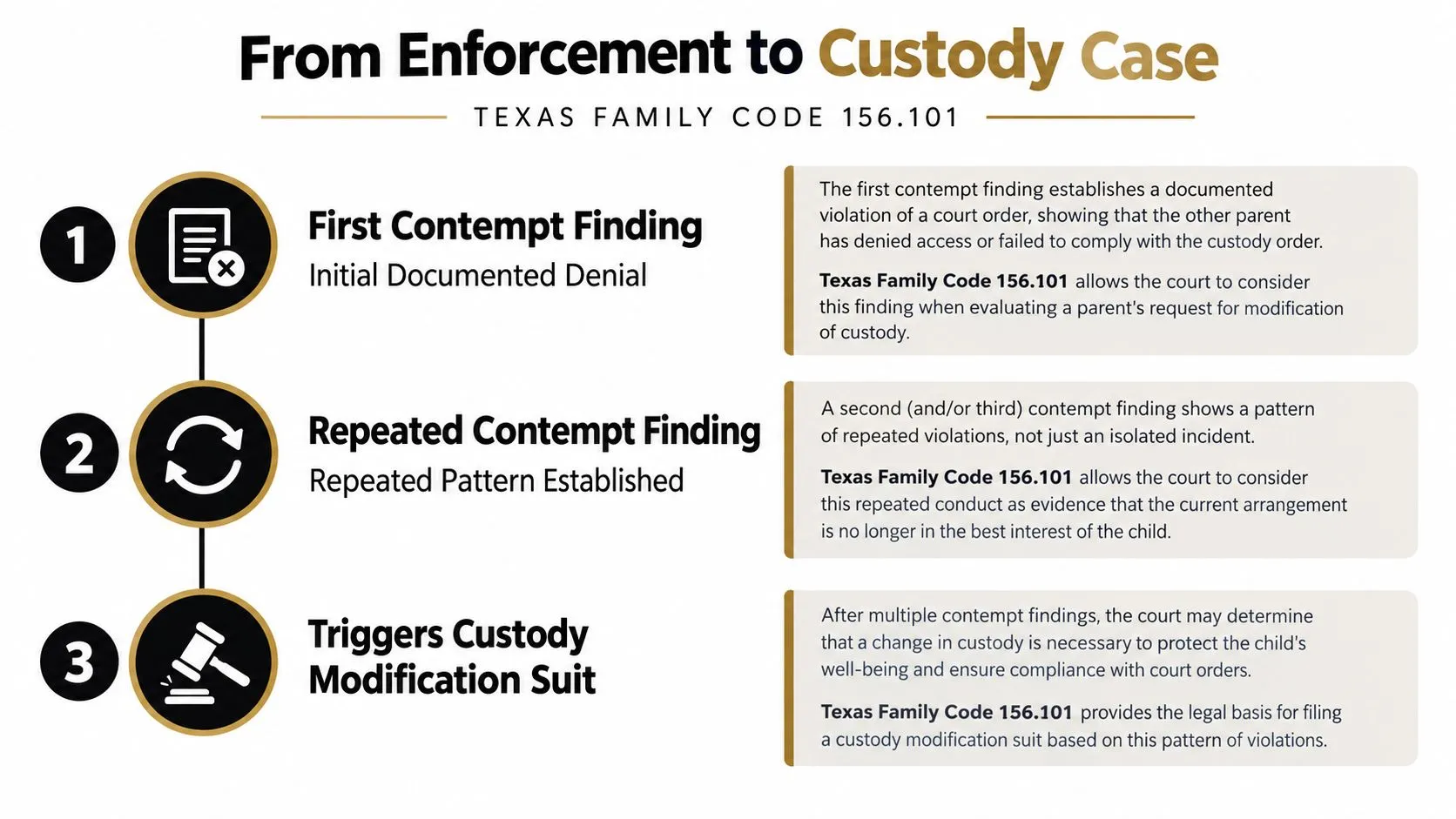
A first denied visit is usually an enforcement problem. A pattern of formal contempt findings can become evidence in a custody-modification case, especially after Texas changed the escalation path in 2025.
House Bill 3181 was signed on June 20, 2025, and took effect on September 1, 2025. Under the framework, a third contempt finding for denying court-ordered possession or access can be treated as a material and substantial change of circumstances, allowing the court to modify conservatorship. The law also limits community supervision options and makes compensatory possession mandatory for repeat violators (Texas three-strikes custody framework).
That doesn't mean three complaints automatically change custody. The important point is that formal contempt findings matter. Informal complaints, angry messages, and missed visits that were never proven in court won't carry the same weight under this escalation framework.
What a modification case still requires
A parent seeking modification under Texas Family Code Section 156.101 still needs a legally supported request. The case generally must address:
- Changed circumstances: Explain what has changed since the existing order.
- Best interests: Show why the requested change serves the child.
- Stability: Explain how the new arrangement will provide dependable care and continuity.
- Requested relief: State exactly what conservatorship or possession change you want.
Texas law generally presumes that appointing parents as joint managing conservators is in the child's best interest, but that presumption can be overcome if the arrangement would significantly impair the child's physical health or emotional development. A history of family violence removes the presumption (Texas Family Code Section 153.131).
The denial log from your enforcement case may later become a central exhibit. It can show missed exchanges, failed communication, and the other parent's response to court orders. Contempt findings don't automatically transfer conservatorship, but they can materially change settlement discussions and trial strategy.
Emergency Relief and Grandparent Options
Emergency court action is reserved for situations involving immediate danger, not ordinary frustration over a missed weekend. A parent may need to ask for emergency relief when the denial is connected to imminent harm, a risk that the child will be taken away, or a serious medical crisis. The judge will expect focused evidence, often including recent messages, witness statements, medical information, law-enforcement records, or other reliable proof showing why waiting for an ordinary hearing could endanger the child.
A temporary restraining order or emergency motion must describe the specific threat and the relief requested. Do not use emergency language just to gain an advantage in a routine possession dispute. Courts take emergency filings seriously, and unsupported accusations can damage your credibility.
Grandparents need a separate legal analysis
Grandparents don't automatically receive possession because they have a close relationship with a grandchild. Texas law gives parents strong authority to decide who has access to their children, and grandparents face a higher threshold under the constitutional principles associated with Troxel v. Granville. Texas law also recognizes a rebuttable presumption that a fit parent acts in the child's best interest.
A grandparent seeking court-ordered access must evaluate standing, the child's welfare, the relationship with the grandparent, and the circumstances behind the denial. Possession may be available in qualifying circumstances, but managing conservatorship is much harder. A grandparent petition may be handled with the underlying SAPCR, which is a lawsuit affecting the parent-child relationship, when the cases and facts overlap.
For a plain-language discussion of this issue, review grandparent visitation rights in Texas.
Keep emergency communications in writing. Don't attempt to recover a child through confrontation or self-help. Preserve messages, call records, videos, and witness information, then present the facts through the proper court process.
Your Next Steps and When to Call an Attorney
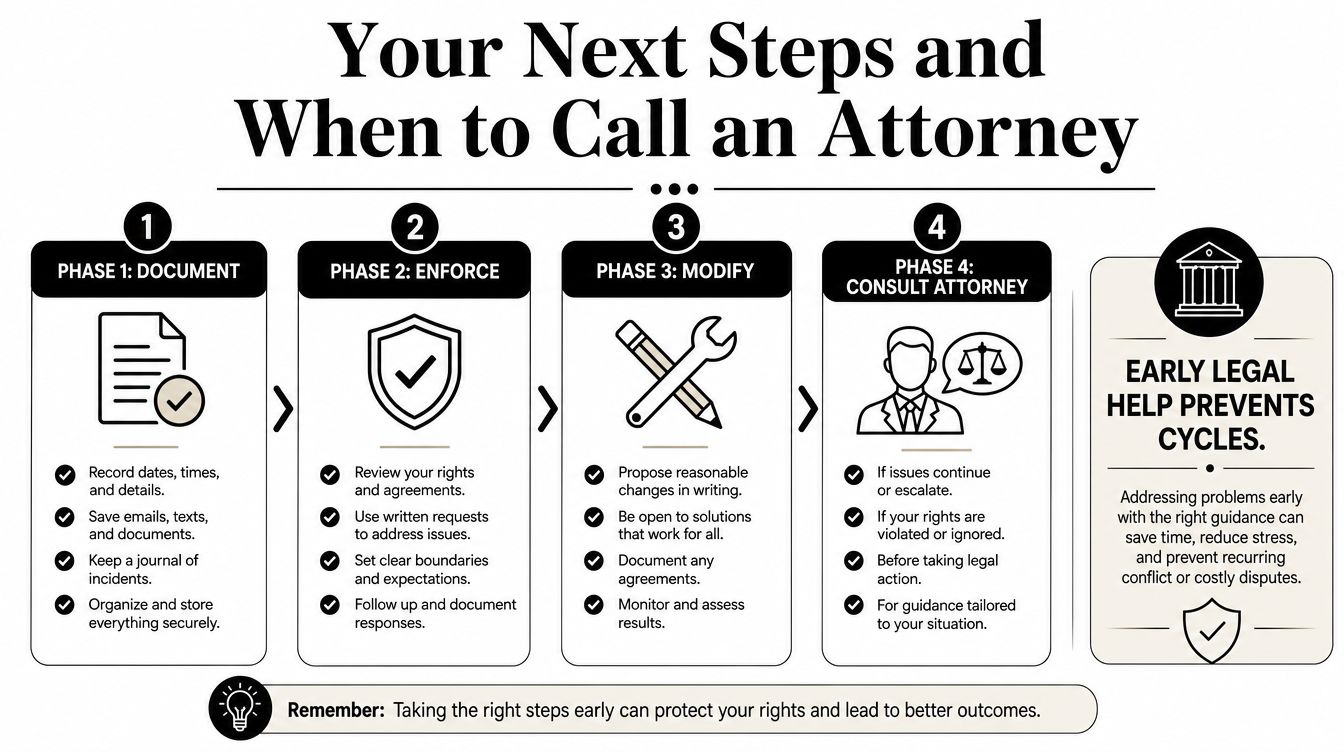
Waiting through another denial cycle rarely improves the record. The stronger approach is to document, enforce, escalate, and modify when the facts support it. Mothers and fathers both benefit from the same discipline, and neither parent should assume that gender changes the court's focus. Judges examine the order, the evidence, the child's needs, and each parent's willingness to support a healthy parent-child relationship.
A practical checklist for this week
- Preserve communications: Save texts, emails, voicemails, call logs, and relevant video without altering the original files.
- Finish the denial log: List every date, time, location, attempted compliance, refusal, witness, and exhibit.
- Review the order: Mark the exact possession provisions and identify any unclear language.
- Calendar the deadline: Track the six-month enforcement limitation tied to the end of the possession right or the child's adulthood, as explained by the Texas State Law Library (visitation and custody denial guidance).
- Prepare for resolution: Request a family case conference or mediation if available.
- Gather financial records: Keep documents supporting any request for attorney's fees or travel-related expenses.
Call a Texas family law attorney promptly after a second denied possession weekend, an abuse allegation used as a reason to block access, a relocation notice, or a counter-filing for modification. Those events can change the strategy quickly. If you're unsure whether you need an enforcement lawyer, a custody lawyer, or another family-law professional, a guide to finding the right legal specialty can help you identify the type of advice to seek.
Key takeaway
A denied visit should trigger organized action, not retaliation. Preserve the facts, file a precise enforcement motion, pursue a remedy that restores stability, and treat repeated contempt findings as potential evidence for custody modification under Texas's newer escalation framework.
If you need help with a child custody or visitation case in Texas, our experienced attorneys can guide you every step of the way. Contact The Law Office of Bryan Fagan, PLLC today for a free consultation.
The Law Office of Bryan Fagan, PLLC can review your possession order, organize evidence of denied visitation, and develop an enforcement or modification strategy focused on your child's best interests. Visit Law Office of Bryan Fagan, PLLC to request a free consultation and discuss your Texas custody case.


