
When your child's future is on the line, understanding your rights matters most.
If you're asking Does Texas favor mothers in custody?, you're probably not asking a legal theory question. You're asking something more personal. You may be a father worried the court won't listen to you. You may be a mother afraid your caregiving role will be minimized. You may be a grandparent or caregiver trying to make sense of what happens if the adults around a child can't agree.
The short answer is this: Texas law does not give mothers an automatic advantage in custody cases. But many parents still experience the system as if mothers have a head start. That confusion usually comes from two things. First, courts are very concerned with which parent has handled the child's day-to-day life. Second, unmarried fathers face a real procedural hurdle at the beginning that many people don't understand until they are already behind.
The Legal Truth Behind Texas Custody Decisions
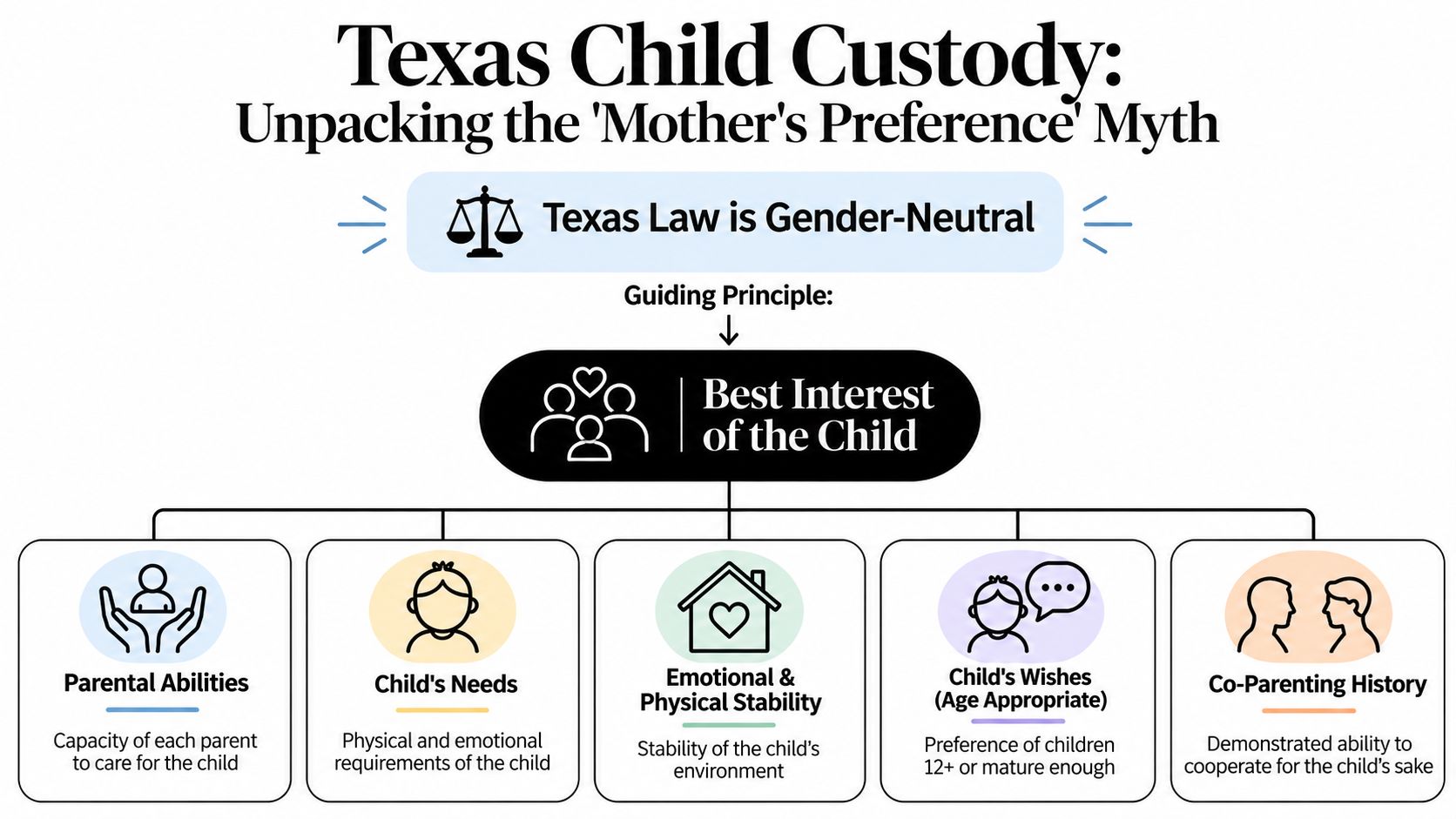
Texas law answers the core question more clearly than most rumors ever will. Texas Family Code § 153.003 requires courts to stay gender-neutral in custody decisions. The statute says judges must evaluate parents “WITHOUT regard to their marital status or to the sex of the party or the child,” as discussed in this explanation of Texas Family Code § 153.003 and gender-neutral custody law.
That means a judge can't lawfully decide custody because one parent is the mother and the other is the father.
The legal standard is found in Texas Family Code § 153.002, which says the court's main concern is the best interest of the child, as stated in Texas Family Code § 153.002. In plain English, that means the court asks one central question: What arrangement gives this child the healthiest, safest, most stable life?
What best interest means in daily life
“Best interest of the child” sounds broad because it is. Judges use it to look at real parenting, not labels.
They often focus on things like:
- Stability at home: Which parent can provide a steady routine, safe housing, and consistency?
- Meeting daily needs: Who handles school, meals, bedtime, medical care, and emotional support?
- Co-parenting behavior: Which parent is more willing to support the child's relationship with the other parent?
- Safety concerns: Violence, neglect, or substance abuse can change a case quickly.
Practical rule: Courts decide custody based on parenting facts, not parenting titles.
Why this matters to worried parents
A lot of people walk into a custody dispute believing the answer is already set. It isn't. Texas courts are supposed to start from a neutral legal position and then examine the child's actual life.
That should reassure both mothers and fathers. It should also push both parents to focus on evidence, routines, and child-centered decisions instead of assumptions about bias.
Why Mothers Often Receive Primary Custody in Reality
If the law is neutral, why do so many people still believe mothers usually win?
Part of the answer is history. Texas used to live under the shadow of the tender years doctrine, an old idea dating back to 1881 that favored mothers of young children. That doctrine has been abolished, but its influence still lingers in how people talk about custody and, at times, how cases are framed in practice, as discussed in this overview of the lingering tender years doctrine in Texas custody cases.
The more important answer is simpler. Courts often give weight to the primary caregiver.
The primary caregiver issue
A judge may not care whether the primary caregiver is mom or dad. But the judge does care who has been doing the daily work.
That includes the parent who:
- Gets the child to school
- Schedules doctor visits
- Helps with homework
- Knows the child's routines
- Handles behavior, meals, and bedtime
- Shows up consistently
When mothers have done more of that before separation, they often enter the case with stronger facts. That isn't the same thing as a legal preference. It's a practical advantage based on history and proof.
Mothers often receive more parenting time because they were already doing more of the caregiving before the case began.
Why custody and parenting time get confused
Texas also separates legal authority from parenting time. That's where many parents get lost. A parent can share important decision-making rights and still have less time in the child's schedule.
A helpful explanation appears in Conservatorship vs. Possession and Access in Texas, which explains why Texas separates decision-making authority from parenting time. If you've ever heard someone say, “She got custody,” they may mean she received the right to decide the child's primary residence, not that the other parent lost all rights.
For more context on how older assumptions still shape modern custody conversations, see this discussion of the tender years doctrine in Texas.
What this means for fathers and mothers
For fathers, this is important because it shows where to focus. The question is not, “How do I overcome being a dad?” The question is, “How do I prove my real involvement and stability?”
For mothers, it explains why caregiving history matters without promising any automatic result. If you've carried most of the child's daily needs, that work matters. But you still need to present it clearly and stay focused on the child, not on assumptions that the court will take your side without question.
Understanding Texas Custody Terms Conservatorship and Possession
A parent leaves court hearing the words “joint managing conservators” and feels relieved, then panics after reading the schedule and realizing the child will live primarily with the other parent. That reaction is common because Texas uses technical terms that do not match the way families usually talk about custody.
If you understand the vocabulary, the order starts to make sense. More importantly, you can see what the judge actually decided.
Conservatorship means legal rights and duties
In Texas, conservatorship refers to authority over major parts of a child's life. That can include educational decisions, medical choices, and the right to determine the child's primary residence.
Texas courts often use these terms:
| Term | Plain-English meaning |
|---|---|
| Joint Managing Conservatorship | Both parents share major rights and duties involving the child |
| Sole Managing Conservatorship | One parent receives the main legal decision-making authority |
| Possessory Conservator | A parent has possession and access rights, but not the full set of major decision-making rights |
A good way to read this is to separate “who makes decisions” from “where the child sleeps on most nights.” Those are related questions, but they are not the same question.
That distinction matters because many parents hear that Texas favors mothers and assume judges are handing mothers all parental rights. In many cases, the outcome is narrower. Both parents may keep substantial legal rights, while one parent receives the right to choose the child's primary home. If you want a clearer explanation of how courts divide those rights, this guide to conservatorship in Texas breaks down the terms in plain English.
Possession means the parenting schedule
Possession is the time each parent has with the child. Access is the right to visit and communicate.
Possession works like a calendar. Conservatorship works like a set of decision-making rules. A parent can share legal authority and still have fewer overnights. That is one reason parents can walk away from the same order with very different impressions of what happened.
For parents trying to understand the mechanics, The Texas Standard Possession Order Explained gives a factual overview of how the default Texas visitation schedule works.
If your order says “joint managing conservators,” it still may not answer two of the biggest practical questions. Who decides the child's primary residence, and what does the weekly schedule actually look like?
What a possession schedule usually covers
Many parents will see the phrase Standard Possession Order, or SPO. This is the default schedule Texas courts often use when it fits the child's best interest.
A typical order addresses:
- School-year time: weekends, weekday periods, or both
- Holiday time: how major holidays are divided
- Summer time: longer blocks with the non-primary parent
Courts can adjust that framework. Younger children, long driving distances, school needs, and a parent's work schedule can all affect the final calendar.
Why these terms matter so much
This vocabulary shapes how parents interpret the result of a case. A father may believe the court favored the mother, when the actual issue is that she was awarded the right to designate the primary residence because the evidence showed she had been handling more of the daily care. A mother may assume her role as primary caregiver guarantees final control over every issue, then learn that major rights will still be shared.
The label “custody” hides those details. Texas court orders do not.
If you are trying to evaluate whether a case reflects gender bias or a child-focused decision, start by asking specific questions. Who has decision-making rights? Who sets the primary residence? What possession schedule was ordered? Once you break the order into those parts, the result usually becomes much easier to understand.
The Critical Exception for Unmarried Parents
Many fathers feel blindsided.
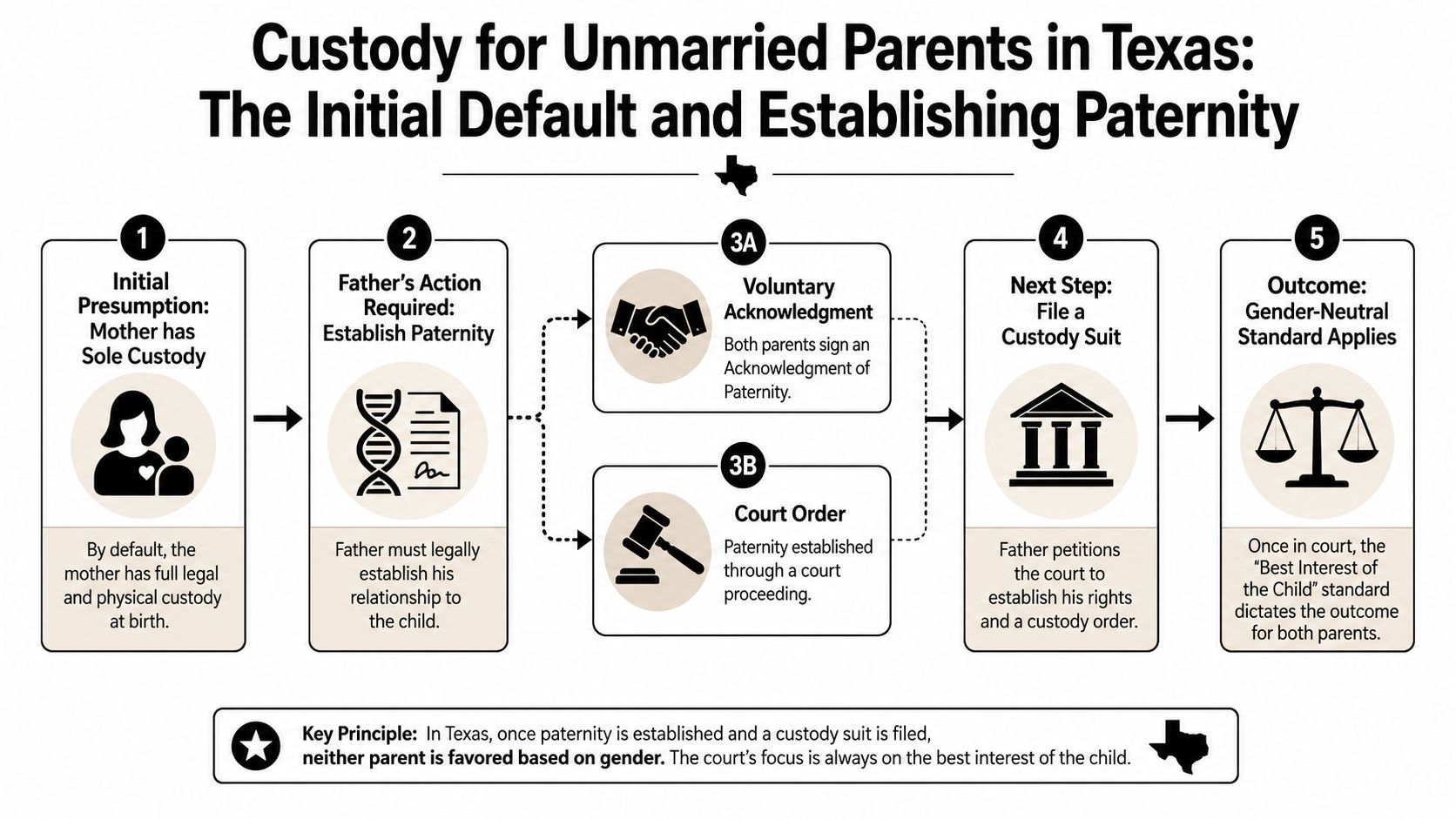
If the parents are unmarried when a child is born, Texas law gives the mother an immediate legal position the father does not automatically receive. Under Texas Family Code § 151.001(a) and § 160.201, the biological mother of an unmarried child is automatically the sole managing conservator at birth, while the unmarried father has no automatic parental rights until he legally establishes paternity, as explained in this discussion of Texas child custody laws for unmarried parents.
That is one of the biggest reasons people think Texas favors mothers in custody.
The real issue is legal standing
For married parents, both usually begin the case on equal legal footing. For unmarried parents, the father must first clear a threshold step before the court can treat him as a legal parent with enforceable rights.
That doesn't mean the final custody decision is based on gender. It means the father has to take legal action to get into the position where the court can make that decision.
This creates a practical first-mover advantage for the mother. Until paternity is established, she holds the authority to make major choices about the child's healthcare, education, and living arrangements.
How unmarried fathers gain equal footing
An unmarried father usually needs to do one of two things:
Sign an Acknowledgment of Paternity
This is often called an AOP. If properly signed and filed, it legally recognizes paternity.Ask the court to adjudicate parentage
If there is disagreement or no AOP, the father may need a court order establishing paternity.
After that, the father can ask the court for conservatorship, possession, and access orders.
A practical resource for that process is this article on Texas child custody laws for unmarried parents.
An unmarried father's biggest mistake is waiting too long to establish paternity and then trying to undo a status quo that formed without him.
Why timing matters so much
Courts often look at the child's established routine. If a father delays taking legal steps, the mother may become the undisputed decision-maker by default, and that pattern can become the child's normal.
That doesn't mean the father can't build a strong case later. It does mean early action matters. If you're an unmarried father, don't assume that being the biological parent alone gives you enforceable custody or visitation rights in Texas. If you're an unmarried mother, understand that the father may still establish paternity and ask the court to create a formal order that defines both parents' rights.
How to Build a Strong Custody Case as a Mother or Father
A parent walks into court convinced the judge will favor the other side. The core question is usually much simpler. Who can show, with records and steady behavior, that they are meeting this child's day-to-day needs and will keep doing so?
That is why custody cases often feel unfair from the outside. A judge is not grading which parent loves the child more. A judge is looking for proof of stability, follow-through, sound judgment, and a plan that fits the child's actual life. In many cases, the parent who has already been handling school mornings, doctor visits, homework, meals, and bedtime has an easier time proving that role. That often explains the outcome people describe as bias.
Texas courts use a best-interest analysis, and one well-known guide is the Holley factors. Those factors look at issues such as the child's needs, each parent's abilities, the stability of each home, and any concerns about safety, violence, or substance abuse, as explained in this summary of Holley v. Adams and Texas best-interest guidelines.
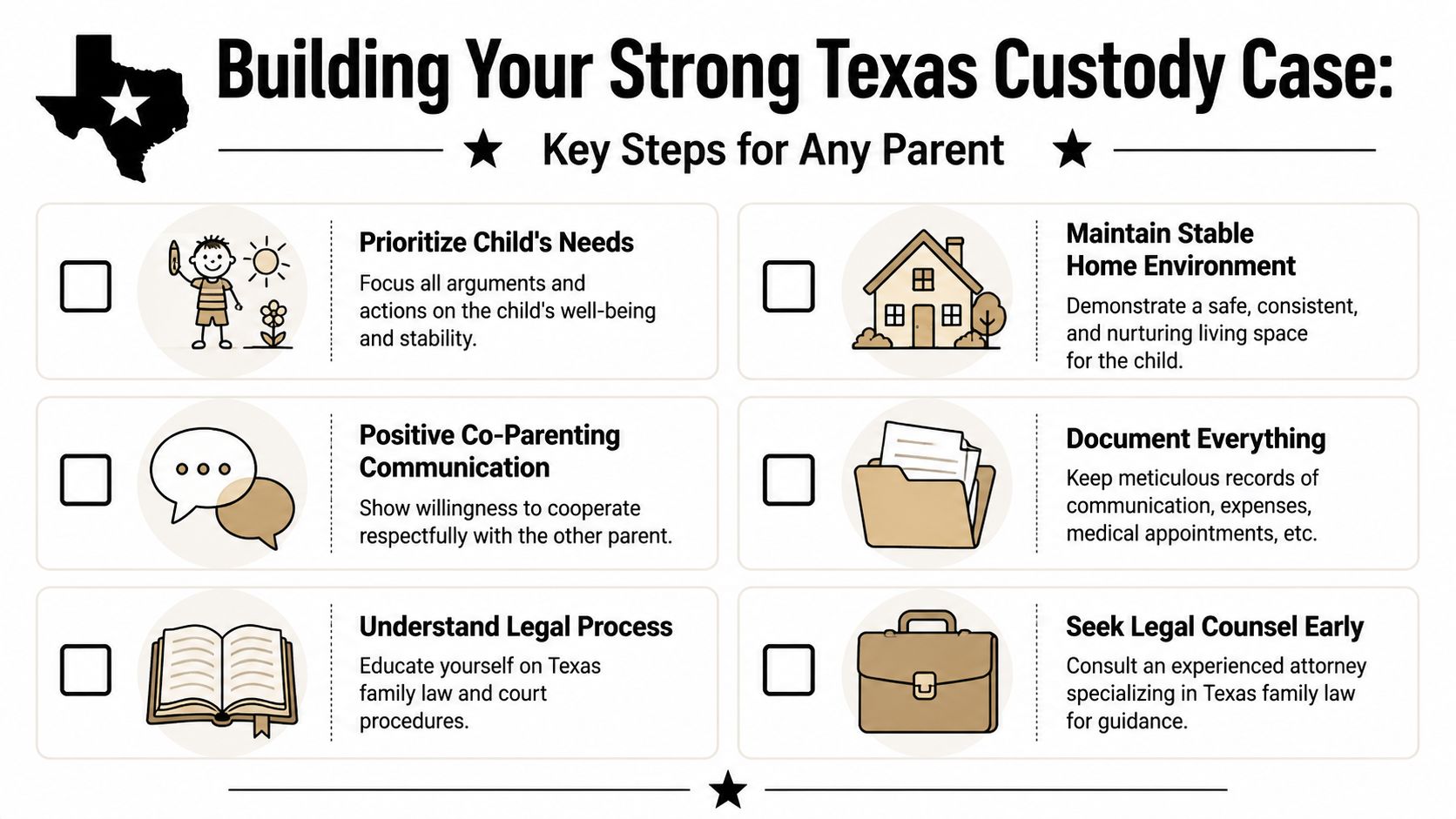
A strong custody case is built the same way you would build a convincing timeline for work or school. Memory helps, but records carry more weight.
What judges usually want to see
Judges often respond best to organized, child-focused evidence that shows what you do, not what you say you intend to do later.
Useful proof can include:
- School involvement: Report cards, attendance records, teacher emails, and notes showing you attend conferences, performances, or school meetings.
- Medical participation: Records showing you schedule appointments, attend visits, track medications, and communicate with providers.
- Daily parenting routines: Calendars, journals, and messages showing who handles wake-ups, meals, transportation, homework, baths, and bedtime.
- Stable home life: Evidence that your housing, work schedule, transportation, and childcare arrangements support the child's routine.
- Healthy co-parent communication: Texts or emails showing respectful communication and a willingness to support the child's relationship with the other parent.
If you are an unmarried father, this section matters in a specific way. Once legal standing is established, the case usually turns on the same proof any parent needs. The challenge is often not gender. It is showing the court your consistent parenting role early enough and clearly enough.
What hurts a case
Parents under stress sometimes make choices that feel protective in the moment but look harmful in court.
These actions often create problems:
- Using the child as a messenger or bargaining tool
- Blocking reasonable communication
- Missing exchanges, school events, or medical appointments
- Making accusations you cannot support with evidence
- Speaking badly about the other parent in front of the child
- Asking for a schedule that does not match your real availability
Judges notice tone, but they care even more about patterns. A parent who shows up prepared, calm, and focused on solutions usually presents a stronger case than a parent focused on blame.
To hear more about these issues in context, watch this discussion:
A workable checklist you can start today
Start small and stay consistent. Courts are often persuaded by the ordinary details of parenting because those details show who is reliably carrying the load.
- Keep a parenting log: Track overnights, pickups, homework help, meals, activities, and appointments.
- Save important communications: Keep messages with teachers, doctors, counselors, coaches, and the other parent.
- Match your request to real life: Ask for a schedule you can realistically follow based on work, distance, school, and childcare.
- Show your plan, not just your complaint: If you want more time, explain how you will handle mornings, transportation, after-school care, and medical needs.
- Protect your credibility: Be accurate, be civil, and do not exaggerate.
- Get legal guidance early: If you need help with custody, paternity, support, or modification issues, Law Office of Bryan Fagan, PLLC handles those family law matters in Texas.
The goal is not to look perfect. The goal is to show the court that your child can rely on you.
Handling Special Custody Situations
Some custody questions don't start from scratch. They begin when life changes after an order is already in place.
Modification after a major change
A mother may receive a new work schedule that makes the current exchange plan unworkable. A father may become more available and want a schedule that reflects his increased involvement. In those situations, a parent may ask the court to modify the existing order.
The court still focuses on the child's best interest. It does not reopen the case just because one parent is unhappy. It looks at whether the child's needs or the family's circumstances have changed enough to justify a new arrangement.
Relocation and long-distance parenting
Relocation cases are emotionally hard because there often isn't a perfect answer. One parent may need to move for family support, work, or remarriage. The other parent may fear losing meaningful time with the child.
In those cases, courts often examine how the move would affect school, stability, travel, and the child's ongoing relationship with both parents. A parent considering a move should get legal advice before relocating, not after.
A related question many parents ask is whether a child can choose where to live. The answer is more nuanced than is commonly understood. This article on whether a child gets to choose which parent in Texas helps explain that issue in plain language.
Military family issues
Military parents face another layer of stress. Deployment, training, and sudden transfers can disrupt even a well-made parenting plan.
A court may need to address temporary caregiving, communication during deployment, and how parenting time will work when the service member returns. The key is planning early and documenting how the child will stay connected and supported during service-related absences.
When special situations need quick action
Parents often wait until the problem becomes urgent. That can make things harder.
If any of these situations apply, it helps to gather:
- Current court orders
- A proposed new schedule
- School and medical information
- Travel or work documentation
- Communication records with the other parent
Your Next Steps to Protect Your Parental Rights
A father learns that the mother has already been making school and medical decisions, and he worries the case is over before it starts. A mother who has handled nearly every bedtime, doctor visit, and parent meeting worries a judge will ignore that work and split time down the middle. Both fears are common. Both deserve a clear answer.
Texas custody cases usually turn on two practical questions. Who has legal standing to ask the court for relief, and what arrangement best serves the child's daily life? That is why many parents experience what feels like bias. In many cases, a significant gap appears at the starting line, especially for unmarried fathers who have not yet established paternity. After that hurdle is cleared, judges usually focus on caregiving history, stability, judgment, and each parent's ability to support the child's relationship with the other parent.
The primary caregiver factor often explains the result people see from the outside. A parent who has been doing the steady work of raising the child often looks stronger on paper because the facts are stronger, not because the parent is the mother. Courts pay close attention to routines. Who gets the child ready for school, attends appointments, communicates with teachers, and handles the ordinary needs that make a child's life feel safe and predictable? Those details matter.
What to keep in focus
If you remember only a few points, keep these in front of you:
- Texas law does not give mothers an automatic custody advantage.
- Many outcomes follow the child's established routine and caregiver history.
- Unmarried fathers may need to establish paternity before they can fully assert parental rights.
- Judges look for calm, consistent, child-centered conduct backed by evidence.
A custody case works like a record of the child's life. The court is not judging which parent loves the child more. The court is deciding which legal arrangement best protects the child's well-being.
Practical steps you can take now
- Confirm your legal position. If you are an unmarried father, find out immediately whether paternity has been legally established and whether any court orders already exist.
- Build your timeline. Gather calendars, school records, medical records, message threads, and other documents that show your day-to-day involvement.
- Follow current orders carefully. Judges notice reliability. Missed exchanges, unpaid support, or unilateral decisions can hurt your credibility.
- Keep communication child-focused. Write as if a judge may read every message later, because that sometimes happens.
- Get legal advice early. Early advice can prevent mistakes that are hard to fix after a case is filed.
If you are feeling overwhelmed, start with paper, not panic. Make a folder. Put in the current order, your notes about the child's routine, names of teachers and doctors, and copies of important communications. Small, organized steps often do more for a case than emotional arguments.
For a plain-English overview of Texas custody and support procedures, the Texas State Law Library has a child custody and support guide that many parents find helpful.
If you need help with a child custody or visitation case in Texas, our attorneys can guide you through the process. Contact The Law Office of Bryan Fagan, PLLC today for a free consultation.