
When your child's world feels split between two homes, every missed call can hurt more than words can say. If you're working late, living in another city, or dealing with a co-parent who makes phone contact difficult, it can feel like your relationship is slipping through the cracks.
Texas law gives parents a way to protect that bond. An electronic communication order can create clear, court-recognized contact through calls, video chats, email, and messaging, while still respecting the child's regular routine and physical time with each parent.
If you're trying to hold on to connection during divorce or after a custody order is signed, this guide will help you understand what Texas courts look for, how these orders work, and how to protect your child's best interests without losing your voice in the process. For families facing long-distance parenting, a long-distance parenting plan often starts with the same basic question, how do we stay present when we can't be there in person?
When Distance Threatens Your Relationship With Your Child
A father who works offshore misses bedtime stories for weeks at a time. A mother moves to another Texas city after a job change and still wants to hear her child's voice after school. A grandparent or caregiver may have the child during the week, but the other parent keeps asking for calls that never seem to happen at the same time twice.
Those situations are common, and they're exactly where an electronic communication order can help. Texas law recognizes electronic contact as a legal way for a parent to stay connected with a child, and it can become part of a custody order or a modification case when the current arrangement no longer works well for the family (Texas LawHelp on electronic communication with your child).
Practical rule: electronic communication is meant to preserve a parent-child relationship, not to replace regular possession time.
For many families, the hardest part isn't the law itself. It's the uncertainty. Parents wonder whether they can ask for scheduled video calls, whether the other side can block them, and whether a judge will see the request as reasonable. Texas courts can address those concerns through orders designed to fit the child's needs, the family's equipment, and the realities of daily life.
That's why careful drafting matters. A vague promise to “stay in touch” often leads to conflict, while a clear order can reduce arguments before they start. Parents often need help turning fear and frustration into a plan a court can enforce.
What Texas Law Says About Electronic Communication
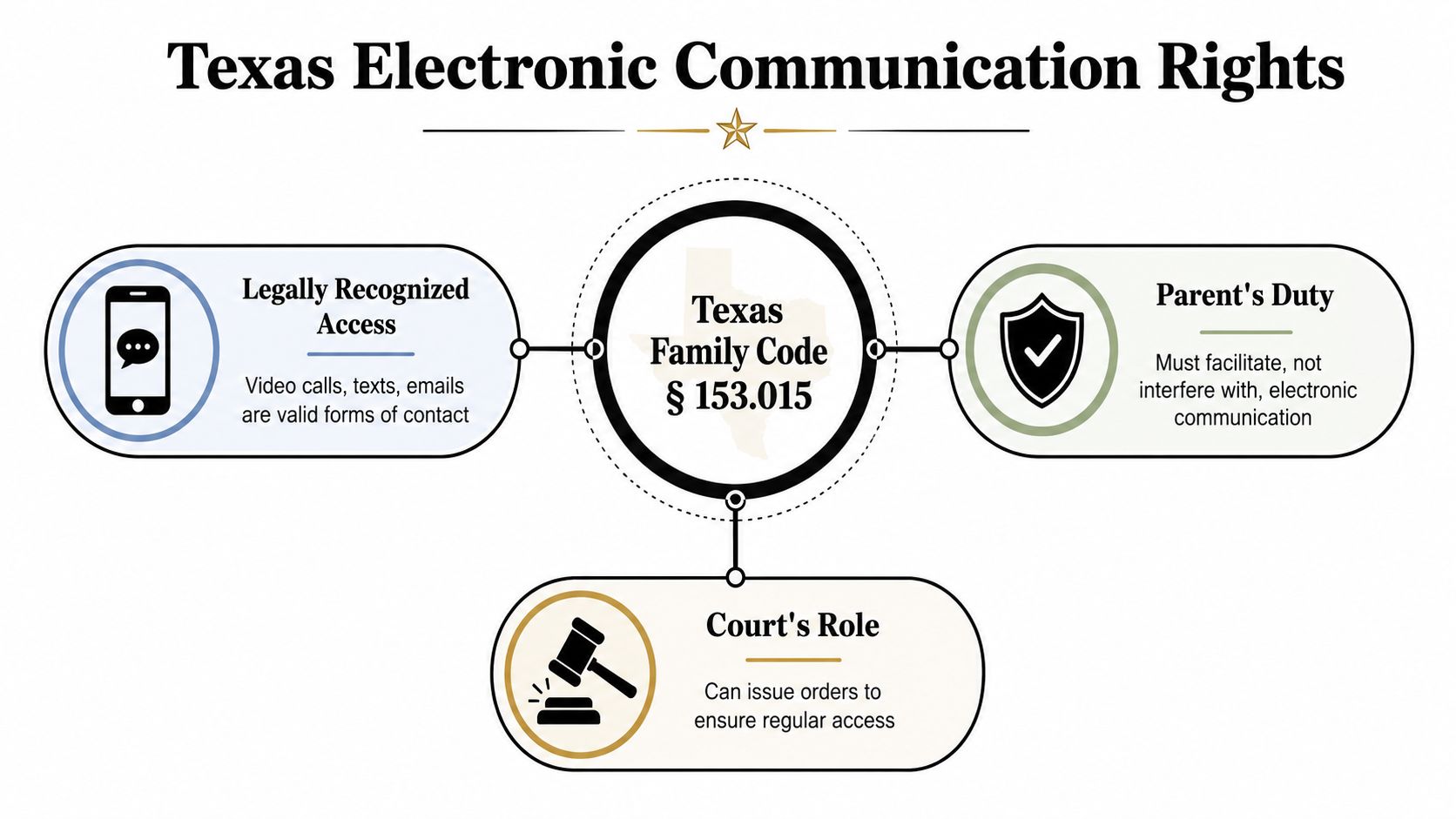
Texas Family Code § 153.015 treats electronic communication as a legally recognized form of access to a child. In plain English, a court can order contact by telephone, email, instant messaging, videoconferencing, or webcam when the arrangement fits the child's best interest (Texas Family Code § 153.015).
What the law covers
The statute uses broad language. It includes communication through wired or wireless technology over the internet or other electronic media, and it specifically names telephone, email, instant messaging, videoconferencing, and webcam contact. That matters because parents sometimes assume only one method counts. In reality, the court can shape the method to match the child's age and the family's circumstances.
The key limit is just as important. Electronic communication supplements physical possession, but it does not replace it. It works like a bridge between parenting periods, not a substitute for being there in person.
When a parent can request it
A conservator can ask for reasonable periods of electronic communication in an original custody suit or in a modification suit (Texas Family Code § 153.015). That gives parents flexibility. If the child is very young, if the parents now live farther apart, or if the prior order was silent on virtual contact, the request can be brought before the court.
Courts also look at practical details, not just legal labels. They consider the child's best interest, whether the needed equipment is reasonably available to everyone involved, and whether the requested schedule makes sense for the child's life.
For parents trying to understand how judges read statutory language, a plain explanation of the process of interpreting statutes can help make sense of why one phrase in an order carries so much weight. If the other parent refuses to follow a signed order, Enforcing a Texas Custody and Possession Order is the kind of remedy families often look at next.
How Texas Courts Decide What Is Reasonable
Texas judges do not ask whether a parent wants more contact. They ask whether the request fits the child's best interest, whether the tools are available, and whether the schedule is realistic (Texas Family Code § 153.015). That sounds simple, but the details matter a lot in the courtroom.
Best interest comes first
The best interests of the child standard is the lens for the entire request. A court may approve contact that helps a child stay connected to a parent, but it can also narrow the request if constant calls would interrupt school, sleep, or emotional stability. A young child may need shorter, more predictable contact, while an older child may do better with longer video conversations at set times.
Equipment availability matters
The court also looks at whether the necessary equipment is reasonably available to all parties (Texas Family Code § 153.015). That can include a working phone, reliable internet access, or a device that supports video calling. If one household has no dependable connection, a judge may narrow the request, choose a different platform, or build in flexibility instead of forcing an order that will fail on day one.
The schedule has to be workable
Reasonableness is where many disputes get resolved. A court may see daily late-night calls as disruptive, but a short call after dinner or a video visit on a weekend evening may look much more sensible. The judge is balancing contact with normal childhood routines.
A good order protects connection without turning every evening into a conflict.
Parents help themselves when they bring concrete facts. School schedules, bedtime routines, internet access, device ownership, and prior attempts to communicate all matter. The other side may argue that the child is too busy, that the schedule is too open-ended, or that the requested platform is too hard to manage safely.
For a broader view of how a custody agreement gets built, Modifying a Texas Custody Order is a useful companion topic when your current plan no longer fits real life. The same logic applies when you're comparing a child's need for routine with a parent's need for regular contact.
Steps to Request or Oppose an Electronic Communication Order
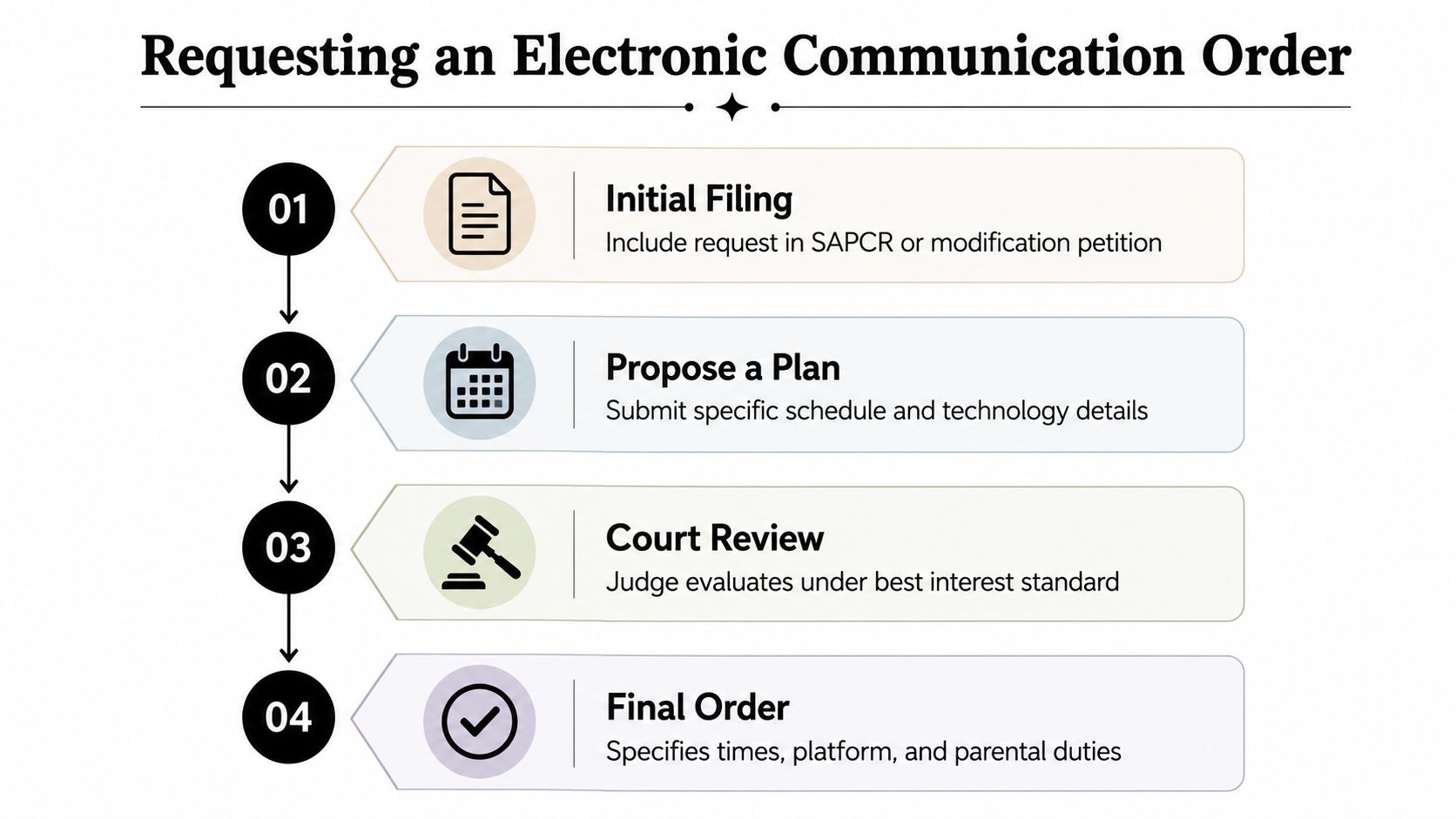
The request can be made in an original SAPCR, which is the lawsuit Texas uses to decide custody and related parenting issues, or in a later modification case if the existing order needs to change. The safest path is usually to ask for specific language early, before confusion turns into a pattern.
What to file and when
If you're asking for electronic communication, the request should be included in the petition or motion so the court has clear notice. If both sides agree, the terms may also be written into a Rule 11 agreement, which is a signed agreement between attorneys or parties that can shape the final order. If the other parent has already refused contact, your lawyer may frame the issue so the judge can see the pattern, not just the isolated incident.
The most useful requests are precise. They name the platform, the time of day, the frequency, and who starts the call. They also say what happens if a call is missed, because that is where many arguments begin.
How to oppose an unreasonable request
Parents can object when the proposal is unsafe, unworkable, or too disruptive for the child. A valid objection might be that the child has no reliable device, the request would interrupt bedtime or schoolwork, or the proposed frequency would pull the child into parental conflict. Safety concerns matter too, especially when a court needs to protect a child from harmful contact.
Bulletproof your position with records, not emotion alone.
- Save failed contact attempts: Keep texts, emails, and call logs that show when communication was requested or denied.
- Note the child's routine: Write down school hours, bedtime, sports, and therapy appointments if they affect scheduling.
- Use consistent language: Ask for a clear schedule that a judge can understand and enforce.
If you need a reference point for what happens when the other side ignores an order, how to enforce a custody order in Texas step by step is the type of practical enforcement issue families often face after the first violation.
Sample Order Language and Parenting Plan Clauses
Vague language creates fights. Specific language gives both parents a roadmap, and that helps the child most of all. A court order that says “reasonable contact” sounds flexible, but it often leaves too much room for disagreement about timing, length, and platform.
| Weak Language | Strong Language |
|---|---|
| Reasonable phone contact | The child shall have a phone or video call with the non-possessory conservator every Tuesday and Thursday from 7:00 p.m. to 7:30 p.m. using FaceTime or another agreed platform |
| The parents will cooperate | Each parent will make the child available at the scheduled time and will not interfere with the call |
| As often as needed | Calls will occur at the set times unless the parents agree in writing to another time |
| The parties will work it out | If the child is unavailable due to school, illness, or an extracurricular activity, the missed call will be made up within 48 hours |
This kind of language matters because it cuts down on interpretation problems. A parent doesn't have to guess whether “reasonable” means tonight, tomorrow, or only on weekends. The child also benefits because routines stay predictable.
If you're reviewing your own order or preparing one for court, a parenting plan template can help you spot the places where details should be added. The goal is not to micromanage family life. The goal is to prevent the kind of conflict that starts when a simple call turns into a dispute.
Clear orders protect children from being caught in the middle.
Ask your attorney to include duration, frequency, the exact platform, backup contact methods, and what happens if equipment fails. Those small details often decide whether the order works in real life or sits on a shelf.
Enforcement and Modification Options
A written order has legal force, and a parent who refuses to follow a signed electronic communication order or a Rule 11 agreement can face an enforcement case. That path can seek compliance and consequences for ignoring the terms, so a parent is not limited to repeated reminders or hoping the other side will cooperate.
What enforcement can address
If one parent blocks scheduled calls, ignores the written terms, or keeps adding new barriers, the court can review enforcement. The request can ask for make-up communication time, and clear violations can support contempt findings when the order is specific and the proof is solid. The court will want to see the exact language in the order and the exact way it was not followed.
For a business-law comparison, when people need to amend your LLC operating agreement, the written terms stay in place until they are formally changed. Custody orders work the same way. They control until a court changes them, and that is why precise wording matters so much.
When modification makes sense
Sometimes the issue is not refusal. The order no longer fits the child's life. A child gets older, a parent moves farther away, or technology changes what is realistic. In those situations, a modification suit may be the right way to update the schedule and the contact method.
To support modification, a parent should be ready to show why the current order no longer works and why a new version better serves the child. Helpful evidence can include school routines, changes in distance, new device access, or a pattern showing that the old schedule has not worked in practice.
If the conflict has become a pattern, it may be time to use a formal enforcement process and review how to enforce a custody order in Texas step by step. If the order itself is outdated, a modification request may be the cleaner solution.
Special Considerations for Military and Relocation Cases
Some families need more than a standard schedule. Military deployment, relocation, and protective orders can all change how a child stays connected to a parent, grandparent, or caregiver. Texas courts can account for those realities by shaping electronic contact around safety, distance, and practical access.
Deployed service members often rely on video calls, messages, and scheduled check-ins to stay present in a child's life. In long-distance cases, electronic communication can become the glue that holds the relationship together between in-person visits. That does not erase the need for possession time, but it does help the child maintain a steady connection when travel is hard.
Relocation cases often need tighter scheduling because time zones, school demands, and travel costs make last-minute calls harder to manage. Courts may use more structured communication to reduce confusion and keep the child from feeling torn between households.
Protective order situations require extra care. A court may limit or supervise communication when safety is an issue, and that concern always comes before convenience. Grandparents and other caregivers may also ask about contact rights, especially when they've been part of the child's daily life and want a safe, predictable way to stay connected.
Parents dealing with deployment or criminal defense issues sometimes need coordinated legal help. In those situations, families may also look to find military defense attorneys for broader service-related support while still addressing custody concerns at home.
Protect Your Relationship With Your Child Today
If you're worried that distance, conflict, or confusion is wearing down your bond with your child, you still have options. Texas law recognizes electronic communication as a real part of custody and possession, and courts look at the child's best interest, equipment availability, and whether the schedule is reasonable before entering an order (Texas Family Code § 153.015).
A strong order can protect your right to stay connected, and it can be enforced if the other parent refuses to comply. You do not have to guess your way through it alone.
If you need help with a child custody or visitation case in Texas, our experienced attorneys can guide you every step of the way. Contact The Law Office of Bryan Fagan, PLLC today for a free consultation.
The Law Office of Bryan Fagan, PLLC helps Texas parents, grandparents, and caregivers understand custody, possession, enforcement, and modification issues with clear legal guidance. If you're dealing with an electronic communication order Texas custody issue, visit Law Office of Bryan Fagan, PLLC to get the information and support you need for your family's next step.