
When your child's schedule starts falling apart, it doesn't feel like a paperwork problem. It feels like your family's routine is coming apart in real time, right in the middle of school drop-off, holidays, and bedtime calls.
That's why enforcement vs. clarification: which motion fixes a broken custody order is the right question to ask. A custody order can fail in two very different ways, it can be unclear, or it can be clear but ignored. Texas Family Code Chapter 153 puts the child's best interests at the center of every possession schedule, joint managing conservatorship, and visitation dispute, but the court still needs the right motion before it can help.
| Criterion | Motion to Clarify | Motion to Enforce |
|---|---|---|
| Purpose | Fixes ambiguous language | Responds to violations of a clear order |
| What the court can do | Make the order more specific | Address noncompliance and request relief |
| Required proof | The order is contradictory or too vague | The exact violation, the noncompliance, and the requested relief |
| Visitation detail | Helps make unclear terms easier to follow | Must list the date, place, and time of each missed or denied visit |
| Best use | The schedule cannot be followed as written | The schedule is being disobeyed as written |
A parent who understands that difference saves time, money, and a lot of frustration. A parent who guesses often files the wrong motion first, and the court can only fix the problem that is in front of it.
When a Custody Order Stops Working in Real Life
The first sign that a custody order is failing is usually not a dramatic courtroom fight. It's a school-night handoff that goes sideways, or a holiday exchange nobody can agree on because the order sounds clear until someone has to use it.
A Texas parent might read a possession schedule and think, “We can work with this.” Then the first Thanksgiving arrives, the pickup time is never written down, and the other parent interprets the order one way while you read it another. That is the moment the order starts to feel broken, even though the page itself hasn't changed.
The hard part is that “broken” can mean two different things. The order may be too vague to follow consistently, which means you need clarification. Or it may be specific enough already, and one parent is just refusing to follow it, which means you need enforcement.
Practical rule: if the fight is about what the order means, ask for clarification. If the fight is about someone refusing to follow what the order already says, ask for enforcement.
Parents often spend too long arguing about fairness when they should be diagnosing the problem. Mothers, fathers, grandparents, and caregivers all face the same question: is this a wording problem or a compliance problem? Once you answer that, the next step becomes much clearer.
If you're comparing your order to real life and still can't tell where it broke, start with a plain reading of the language and a record of what happened. A neutral translation service can also help when an order or supporting document needs to be understood across languages, especially for families dealing with immigration paperwork, such as document translation for immigration paperwork. If the order itself is still unclear after that, review this discussion of a custody order violation in Texas and focus on whether the problem is wording or disobedience.
What a Motion to Clarify Actually Does
A motion to clarify is not a do-over. It doesn't let a parent rewrite custody, change visitation, or relitigate what the court already decided.
Under Texas law, clarification is limited to fixing ambiguity. Texas Law Help explains that the motion is appropriate when an order is contradictory or too vague to follow, and the court may grant it when the ambiguity is nonsubstantive and the clarified provision would be enforceable by contempt. The same resource says the request generally must be filed no later than six months after the visitation order expires. That deadline matters because parents miss it when they wait too long hoping the other side will “figure it out.”
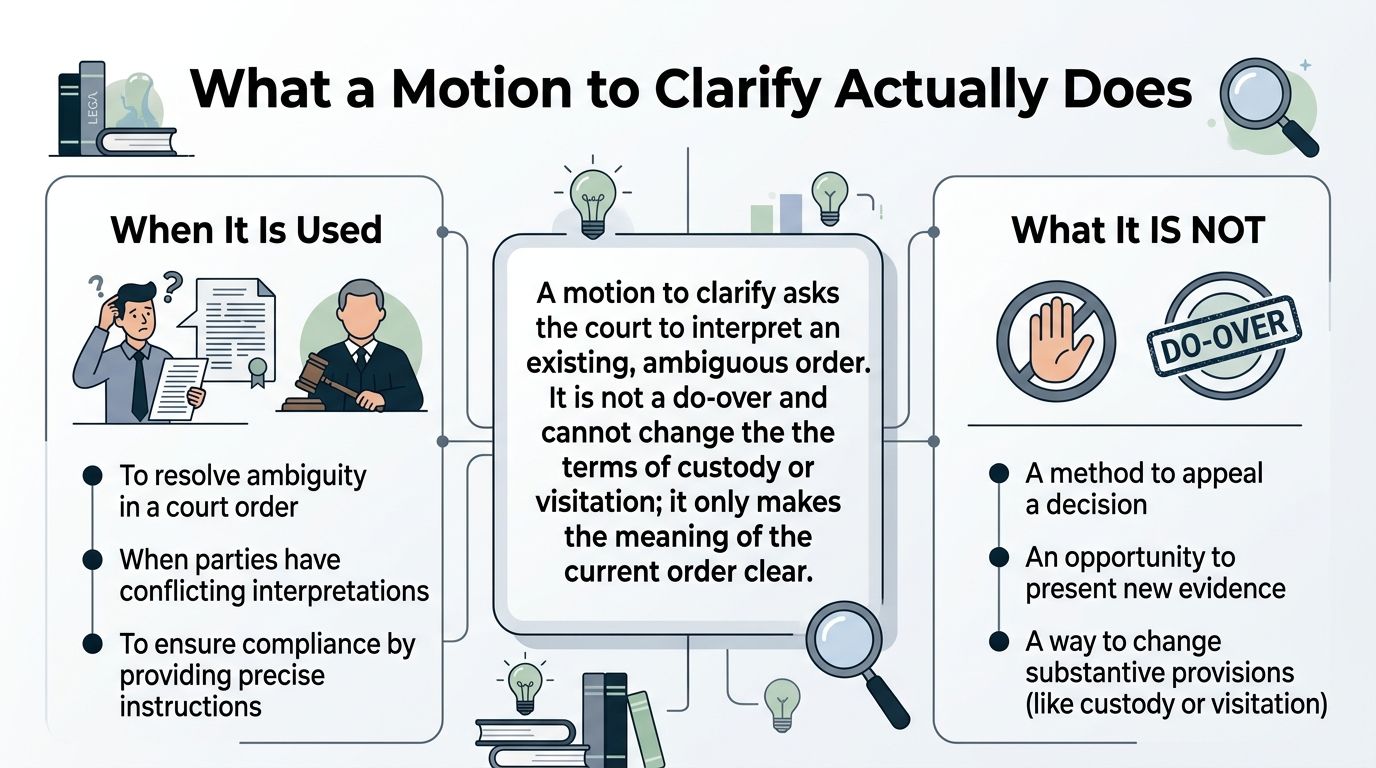
A simple example makes the point. If an order says alternate holidays but never gives a pickup time, the court may need to specify what that means in practice. The goal is not to create new rights, it's to make the existing possession schedule understandable enough to follow.
Read the order the way a judge would
Texas courts care about precision because contempt only works when the rule is clear enough that someone can tell whether it was violated. That's why clarification matters when the wording itself creates the confusion. In Chapter 153 cases, that often comes up in possession and access language that sounded fine during the hearing but falls apart in the car line, at exchange time, or during a school break.
If the clarified language becomes definite, that provision can then be enforced later if someone still refuses to comply. That bridge between clarity and enforcement is where many custody disputes finally become manageable.
For parents working through conservatorship, possession, and access issues under Chapter 153, Texas Child Custody Lawyer is one resource that addresses those matters in plain terms. It's useful when you need to understand whether your order needs interpretation or a stronger enforcement step.
What a Motion to Enforce Does
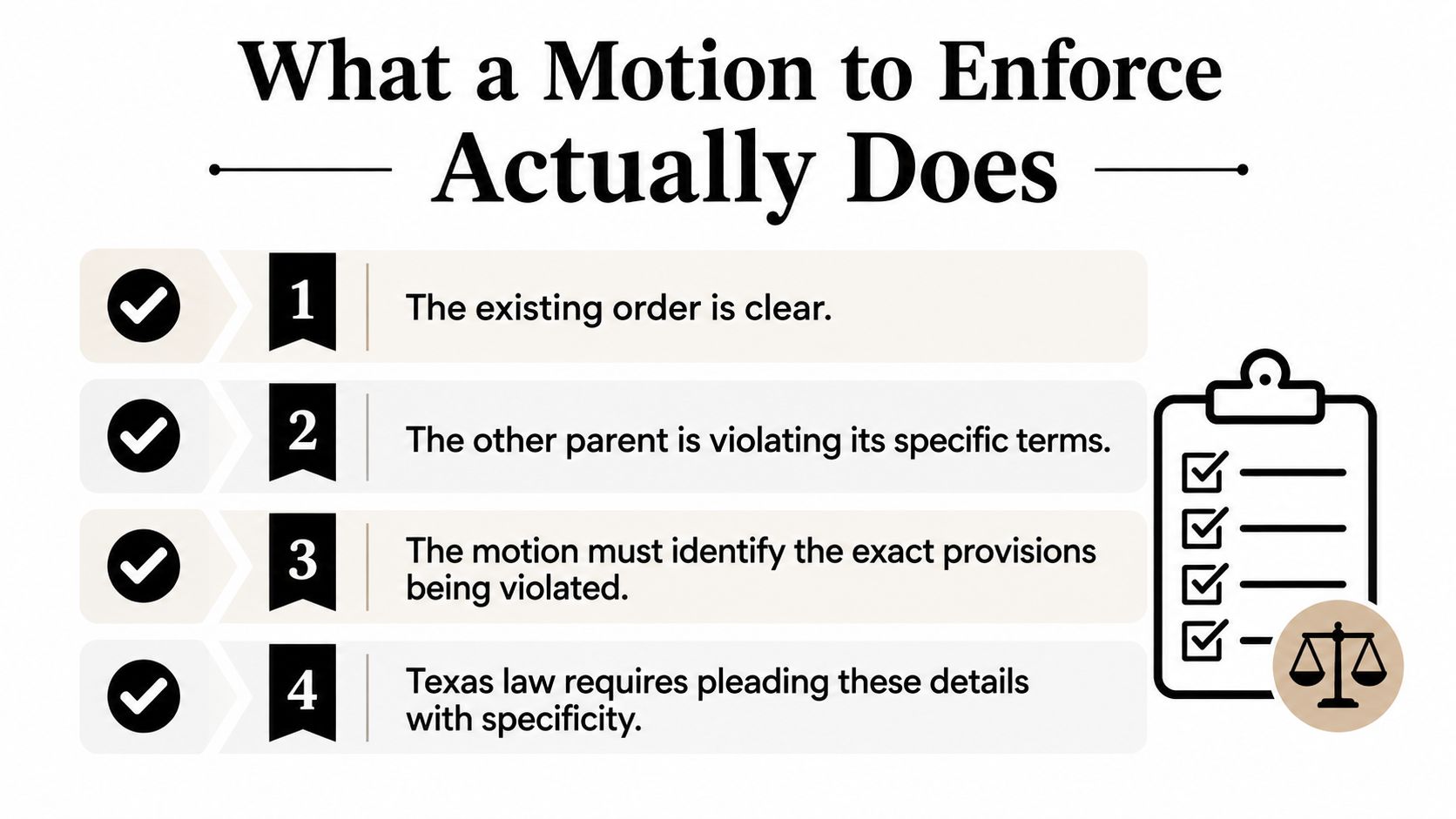
A motion to enforce is the right tool when the order is already clear and the other parent is not following it. Texas Law Help requires the moving parent to identify the exact violated provisions, the specific noncompliance, and the requested relief. For visitation enforcement, it also has to list the date, place, and time of each missed or denied exchange.
That level of detail is the point. Enforcement is not about asking the court to guess what happened. It is about showing, with specifics, that the existing order was ignored.
The order must already be clear
If the wording is fuzzy, enforcement can fail before the court even gets to the facts. A parent cannot prove a violation of a term nobody can define with confidence.
Texas courts expect a visitation order to spell out the exchange details. If the schedule is definite, the court can decide whether someone missed it. If you need a practical walkthrough of how those pleadings are built, review this motion to enforce guide.
Ask for the specific relief you need
Enforcement can seek make-up visitation, contempt findings, and other relief tied to the violation. If you do not ask for a specific remedy, the court cannot just invent one because it seems fair.
Careful pleading matters more than emotion. The court needs a motion that matches the conduct, not a story that only says the other parent has been “difficult.”
For related document standards and proof issues, the guide to enforceable agreements is a useful lens when you are deciding whether a written term is specific enough to enforce.
Enforcement vs Clarification at a Glance
Here's the cleanest way to read the problem. Clarification fixes meaning. Enforcement fixes disobedience. If you keep that sentence in mind, you'll make better choices before you file.
| Criterion | Motion to Clarify | Motion to Enforce |
|---|---|---|
| Core problem | The language is unclear | The language is clear but not being followed |
| Court's task | Interpret and specify | Decide whether the order was violated |
| Evidence focus | The wording itself | Dates, times, places, and conduct |
| Likely result | A clearer order | Relief tied to the violation |
| Bad fit risk | Trying to change custody or visitation terms | Trying to enforce an order that still needs interpretation |
Bottom line: if the court needs to understand what the order means, clarify it. If the court already knows what it means and a parent still won't follow it, enforce it.
A parent should never treat these motions as interchangeable. A clarification motion can't be used to sneak in a custody change, and an enforcement motion won't work well if the order is too vague to measure.
Three real-world ways the choice changes
If the dispute is about what counts as the child's school district for a move or exchange point, that sounds like an interpretation problem. If the dispute is about a parent refusing weekend visits that are already written into the order, that's enforcement.
A partially clear order is trickier. Some terms may be specific, while one key piece, like pickup timing or holiday exchange location, is too loose. In that situation, a parent may need clarification first, then enforcement later if the other side still refuses to comply.
The right motion tracks the symptom. Don't ask the court to punish confusion, and don't ask it to rewrite a schedule when the issue is simple refusal.
Three Scenarios That Show Which Motion Fits
A mother calls because the order says the child will attend school in “the district where the child resides,” but the parents now disagree on which district that means after a recent move. That is not a disobedience problem. It's a wording problem, so clarification is the cleaner fix.
A father brings texts, missed exchanges, and a weekend schedule that has been ignored for months. The possession schedule is already specific, but the other parent keeps withholding the child anyway. That is enforcement territory.
A grandparent or caregiver may face a mixed order, one part is precise, another part leaves room for argument. For example, the weekday exchange rule may be definite, while holiday pickup language is incomplete. In that case, the safest path is often to clarify the vague piece and preserve enforcement for the parts that are already definite.
Pattern match before you file
Use this test before paying a filing fee or preparing pleadings.
- If the words are unclear: ask for clarification.
- If the order is clear and ignored: ask for enforcement.
- If both problems exist: tackle the ambiguity first, then enforce the clear terms if the violations continue.
That approach protects both mothers and fathers from wasting time on the wrong remedy. It also gives grandparents and other caregivers a cleaner record if the dispute later becomes more serious.
The key is not how upset you feel. It's whether the order itself can be followed as written. That answer drives everything else.
Filing Steps and Evidence You Will Need
Start with a motion that does one job and does it clearly. The judge should be able to read your filing and tell which words in the custody order you are challenging, what happened in real life, and exactly what relief you want.
Then match your proof to the remedy. For enforcement, gather texts, emails, a visitation log, and any documents showing you appeared at the right place and time. For clarification, focus on the exact phrases in the order that conflict with each other or leave too much room for argument. If you need a practical way to organize those exhibits, use this custody evidence presentation guide in Texas as a model for how to present the record clearly.
Practical rule: if your evidence does not fit the motion, the court may refuse the relief you asked for.
Service comes next, and it has to be done correctly. Then prepare for the hearing with a clean timeline and organized exhibits. Texas procedure is strict about notice, especially when contempt is on the table, because the court must know the other side had a fair chance to respond.
Your paperwork should also be specific enough to show whether the problem is an unclear order or a clear order that is being ignored. For that reason, a guide to enforceable agreements is a useful reference point for the level of precision courts expect.
Evidence checklist by motion type
- Clarification: a copy of the order, the exact confusing language, and a short explanation of why the wording cannot be followed consistently.
- Enforcement: the order, detailed records of each violation, messages showing the dispute, and proof that you complied with your own obligations.
- Both: the order, the vague language, the violation records, and a timeline that separates interpretation problems from refusal problems.
Your evidence needs to tell a clean story. If you are asking for clarification, show the court where the language breaks down. If you are asking for enforcement, show the court repeated noncompliance with terms that are already definite.
Costs and hearing outcomes vary by court, and attorney fees may be part of the discussion depending on the case. If you want a family-law team that handles conservatorship, possession, and access disputes under Chapter 153, the Law Office of Bryan Fagan, PLLC is one option families use when they want direct guidance on post-judgment custody problems.
Timelines, Outcomes, and Risks of Choosing Wrong
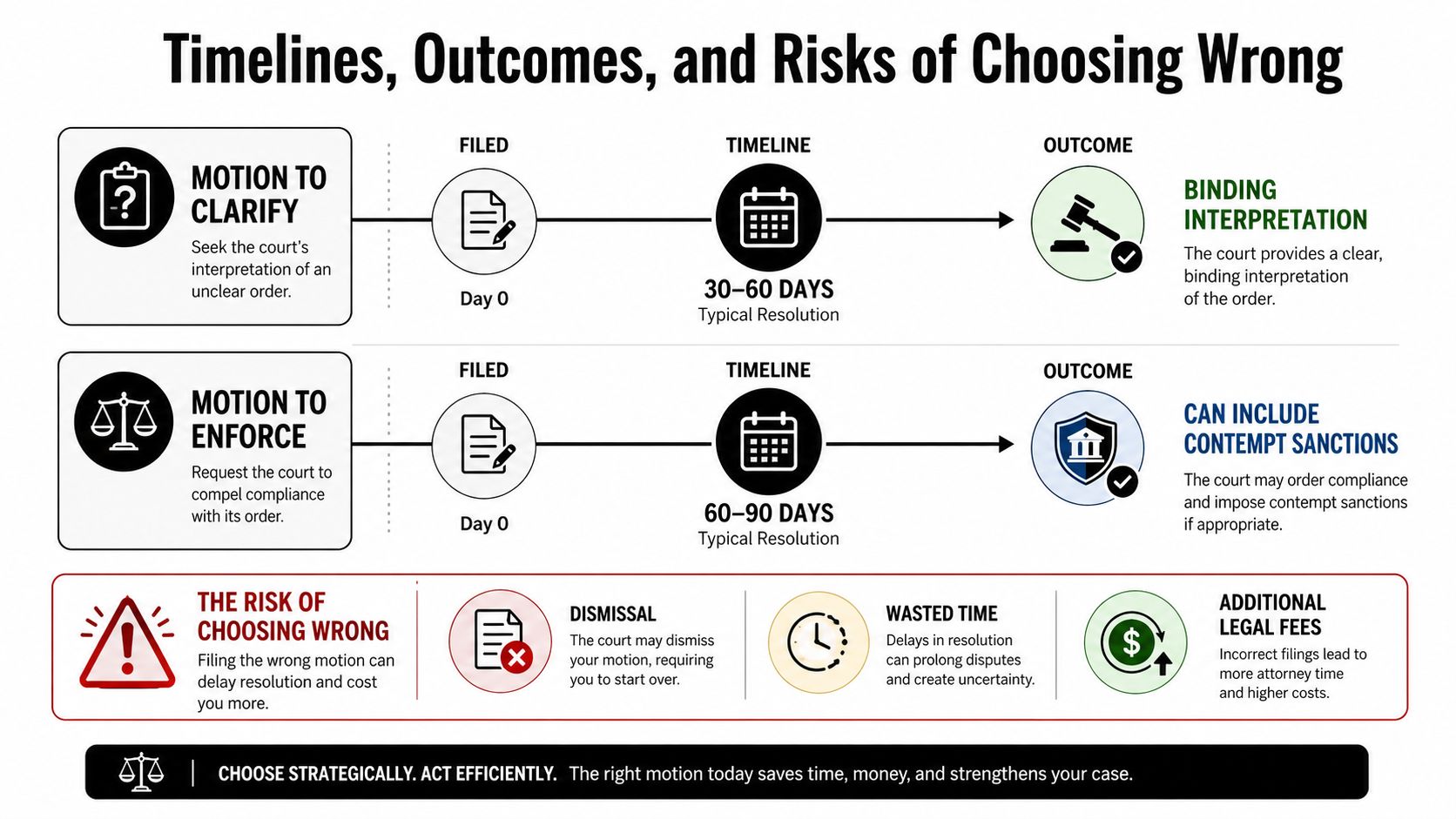
A clarification motion and an enforcement motion solve different problems, so they end differently too. A successful clarification gives you a binding interpretation of an unclear term. A successful enforcement can lead to make-up time, sanctions, or contempt-related relief, depending on what you asked for and what the court finds.
The timing risk is real. If you file a clarification motion but try to use it to change custody or visitation, the court can deny it because that is outside the motion's narrow purpose. If you file enforcement against a vague order, the court may not find a violation because the order is too uncertain to measure.
The broad pattern from England and Wales shows that these disputes don't usually disappear on their own. In that system, 59% of enforcement applications were brought within 52 weeks of the original order, 18% within the first three months, and 22% were filed two to eight years after the order, showing that enforcement problems arise both immediately and long after judgment. That doesn't tell Texas parents what their case will do, but it does reinforce a simple truth, timing matters, and delay rarely improves a broken schedule. Parliamentary evidence on enforcement applications
Choose the motion that fits the symptom
If the order is unclear, don't rush into punishment. Fix the wording first.
If the order is clear and the other parent keeps violating it, don't waste time asking for interpretation. Go straight to enforcement with specific proof.
If both issues exist, separate them and deal with each one directly. That's the cleanest path for the court and the strongest path for your child's stability.
Choosing the Right Motion and Taking the Next Step
The best interests of the child standard under Texas Family Code Chapter 153 should guide every decision here. A possession schedule works only when it can be followed, and a joint managing conservatorship works only when the parents and the court can tell what each term means.
So use this decision rule. If the order is unclear, seek clarification first and enforce later if needed. If the order is clear and being disobeyed, go straight to enforcement. If both problems are present, a lawyer can help you decide whether to file together or in sequence so the case stays focused.
That's the practical answer for mothers, fathers, grandparents, and caregivers who are tired of guessing. The court cannot fix the wrong problem, and your child needs a stable schedule more than a dramatic argument.
If you need help with a child custody or visitation case in Texas, our experienced attorneys can guide you every step of the way. Contact The Law Office of Bryan Fagan, PLLC today for a free consultation.
If your custody order no longer works in real life, The Law Office of Bryan Fagan, PLLC can help you figure out whether clarification, enforcement, or both makes sense for your family. Visit Law Office of Bryan Fagan, PLLC to get personalized guidance on Texas custody and visitation disputes, and take the next step with a team that handles these cases every day.