
Under Texas Family Code § 153.0071, a mediated settlement agreement in a SAPCR becomes binding when it contains a prominently displayed non-revocation statement and is signed by both parties, along with any attorney present at signing. Once those requirements are met, each party is entitled to judgment on the agreement.
When your child's future is on the line, understanding your rights matters most. You may be sitting with a proposed parenting plan, wondering whether you can still change your mind, whether the other parent can back out, or what happens when the agreement reaches the judge.
Those questions are especially important in a Suit Affecting the Parent-Child Relationship, commonly called a SAPCR. A SAPCR can address conservatorship, possession and access, decision-making authority, and child support. The terms may guide your family for years, so the signing process deserves careful attention.
This guide explains how a Family Code 153.0071 mediated settlement agreement in a SAPCR works at the mediation table, in the courtroom, and after the order is entered. It also explains the safety exceptions that protect children and vulnerable parents when enforcement would create serious danger.
When Mediation Becomes the Moment That Decides Your Case
Two parents sit across from a neutral mediator in a Texas conference room. A draft agreement lies between them. One parent has questions about school-week possession. The other wants clearer holiday terms. Both know that the next signature could bring an exhausting custody dispute to a close.
Mediation often feels less formal than a trial, but the legal effect of the document can be much more serious than parents expect. Under Texas Family Code § 153.0071, a compliant mediated settlement agreement, or MSA, is binding when the required notice and signatures are present. The statute also gives a party the right to obtain judgment on the agreement despite Texas Rule of Civil Procedure 11 or another rule of law.
Before signing, parents commonly ask:
- Is this binding now? It can be, if the statutory requirements are satisfied.
- Can I change my mind later? A compliant MSA contains a statement that it isn't subject to revocation.
- What if the other parent refuses to cooperate? The agreement can still support a request for judgment.
- Does signing create the final custody order? The MSA becomes binding at signing, but the court still must render the judgment that turns the agreed terms into the operative SAPCR order.
Practical rule: Treat the mediation signing as a major legal decision, not as a preliminary promise.
A parent may agree to joint managing conservatorship, which means both parents share certain legal rights and duties. That arrangement doesn't necessarily mean equal time. The agreement may name one parent as the person with the exclusive right to designate the child's primary residence and establish a detailed possession schedule for the other parent.
Parents who want a clearer picture of the mediation process can review what happens during custody mediation in Texas. The most important protection is preparation. Read every page, ask what each clause means, and raise safety concerns before anyone signs.
What Texas Family Code § 153.0071 Actually Says
The statute applies to mediated settlement agreements in a SAPCR. In plain language, that can include a new custody case, a request to modify an existing order, or a dispute involving conservatorship, possession and access, or support.
The writing controls the legal effect
The document must contain a prominently displayed statement saying that the agreement isn't subject to revocation. The statute identifies presentation methods such as boldfaced type, capital letters, or underlining. A warning hidden in ordinary text may not provide the same protection as the clearly visible language the statute requires. The exact wording should be reviewed carefully rather than assumed to be sufficient.
Each party must sign. If an attorney is present when a party signs, that attorney must also sign the MSA. The mediator helps the parents negotiate and records the agreement, but the mediator doesn't replace the parties' signatures or the attorney signatures required by the statute.
Once those requirements are met, the agreement is binding and a party is entitled to judgment on it. That's why the agreement may become much more than a list of proposals. It can become a near-final resolution mechanism for custody and visitation disputes.
The agreement may resolve all or part of the case
Some MSAs settle every disputed issue. Others resolve only possession, while leaving support, medical expenses, or another issue for the court. Parents should identify exactly what the document resolves and what remains open.
For example, an MSA might provide that the parents will be joint managing conservators, name one parent as primary, and establish a holiday schedule. If child support terms remain unresolved, the case may still require additional court action on that issue.
The statute strongly favors finality, but it doesn't eliminate the court's responsibility to protect children. Parents dealing with safety concerns may also need to understand Custody When There Is a History of Family Violence, including how abuse or violence changes custody presumptions.
The Three Requirements That Make an MSA Binding
Parents should use the signing process as a final review. The document's form matters because the statute ties enforceability to specific formalities.
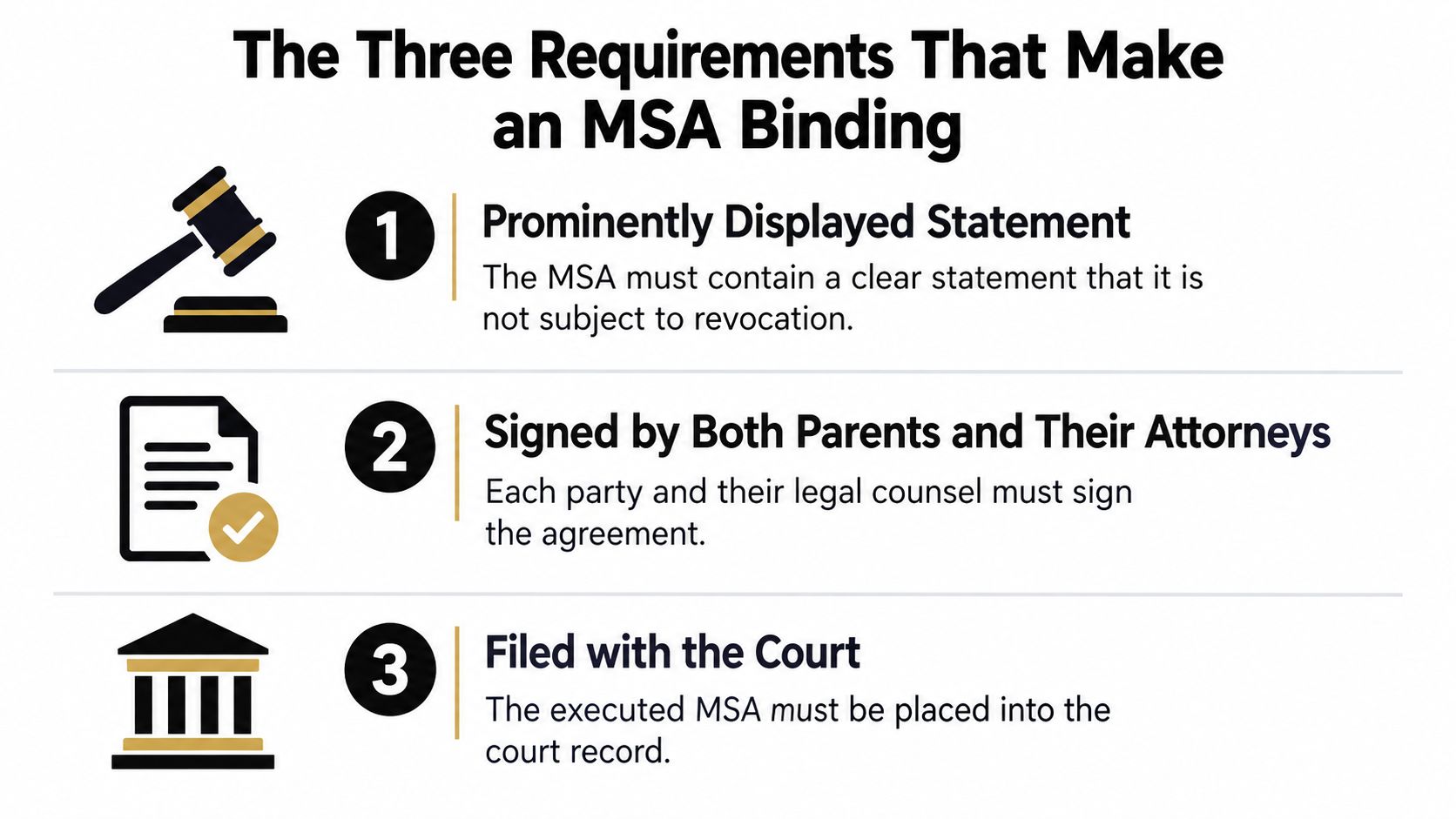
Requirement one is visible non-revocation language
Look for a clearly displayed statement that the agreement is not subject to revocation. The notice may appear in boldfaced type, capital letters, or underlined text. It shouldn't be buried in a dense paragraph or placed where a signer could easily overlook it.
A parent might recognize language stating that the agreement is not subject to revocation under Texas Family Code § 153.0071. The precise wording may vary, so an attorney should confirm that the clause satisfies the statute.
Requirement two is the required signatures
Both parties must sign the agreement. Any attorney present at execution must also sign. Check that the signature pages identify the correct parties and that no page or signature block is missing.
Use this quick review before leaving mediation:
- Read the notice: Confirm that the non-revocation statement stands out.
- Check party signatures: Make sure each parent signs the final version.
- Check attorney signatures: Confirm that every attorney present at signing signs as required.
A missing signature or changed page can create a serious enforcement dispute. Parents should keep a complete copy of the signed MSA, including every exhibit and signature page.
Filing puts the agreement before the court
The signed MSA must be presented in the SAPCR so the judge can render judgment. Filing and court adoption are part of the path to a final order, even though the agreement's binding force begins when the statutory execution requirements are met. The parties and their attorneys should confirm that the correct version reaches the court handling the case.
From Signed Agreement to Court-Approved SAPCR Order
After mediation, the signed MSA moves from the conference room into the court record. The paperwork commonly includes the executed agreement, a proposed final SAPCR order, and the petition or counterpetition already filed in the case. Child support issues may also require supporting financial worksheets or related documentation.
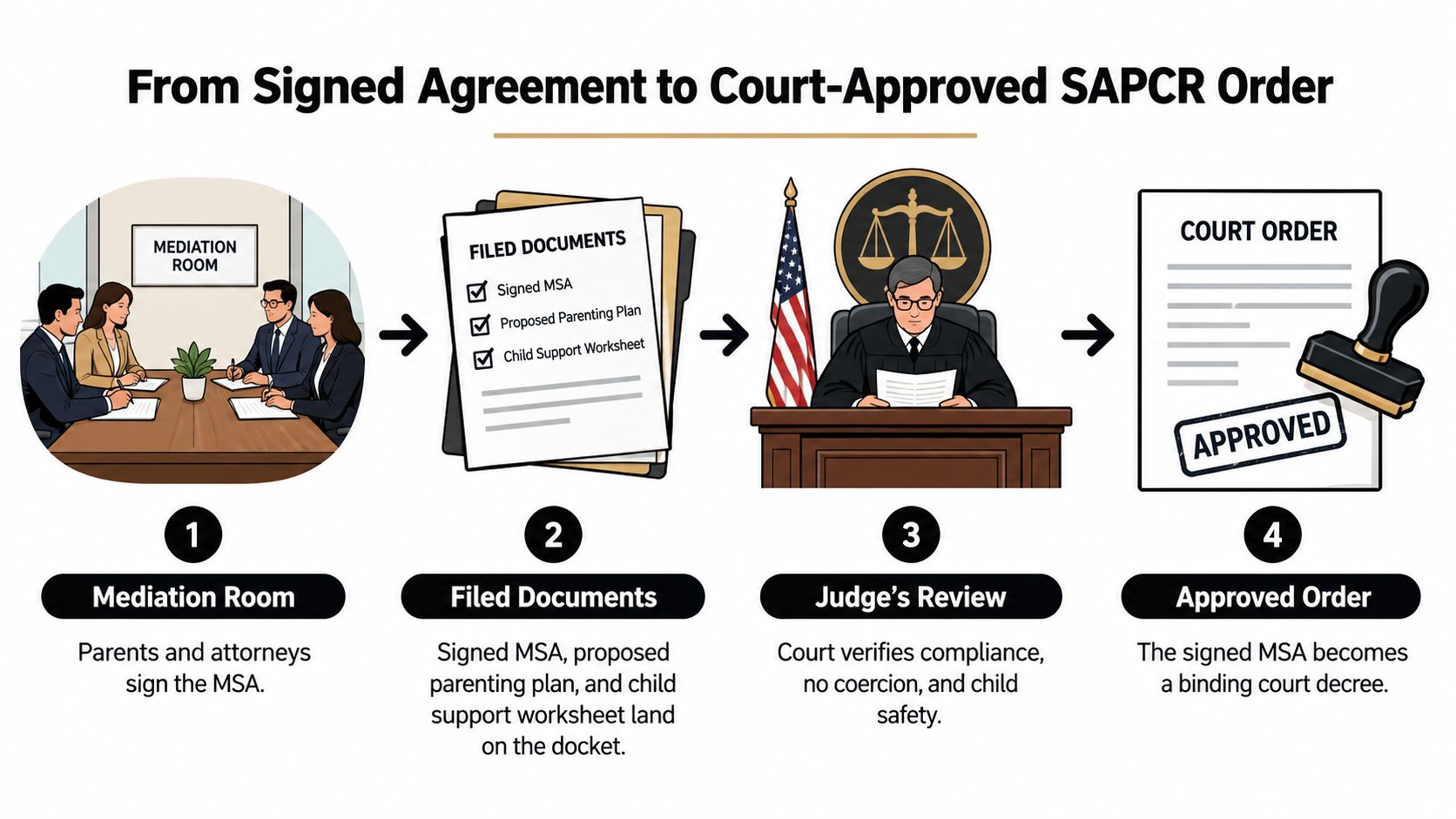
The proposed order should accurately reflect what the parents signed. If the MSA says the parents will share decision-making but the proposed order gives one parent exclusive authority over every issue, the inconsistency must be addressed before the judge signs.
Parents may also need to review the SAPCR form in Texas so they understand how the underlying case documents fit together.
What happens at the prove-up
A court appearance after an agreement is often a short prove-up rather than a contested trial. The judge may confirm the parties' identities, ask whether they understand the agreement, and review whether the proposed order matches the signed terms. Testimony is generally limited compared with a fully contested custody hearing, but both parents may still attend.
The MSA itself isn't the court order. The judge must adopt its terms and sign the final decree or order. Once signed, that order becomes the document parents use to determine possession, exchange times, decision-making authority, and support obligations.
The distinction matters. The agreement is binding when it satisfies § 153.0071's requirements, while the court's signed order becomes the operative decree for enforcement and day-to-day compliance.
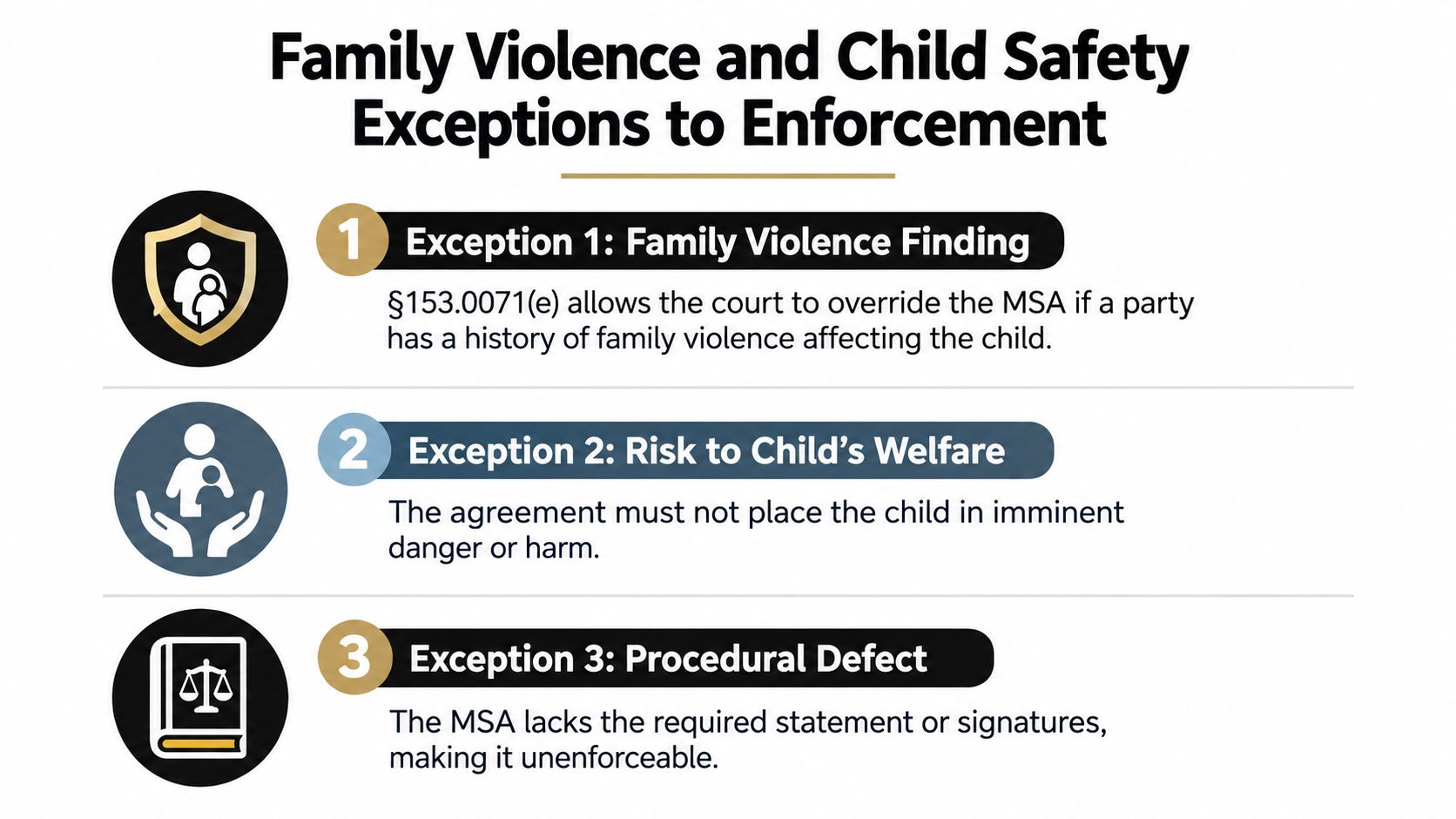
Family Violence and Child Safety Exceptions to Enforcement
Texas law strongly supports finality in properly executed mediated settlements, but finality isn't absolute in every high-risk situation. The statutory exceptions act as protective guardrails, not as a general opportunity to withdraw from a difficult bargain.
Family violence can change the analysis
Texas Supreme Court materials discussing subsection (e-1) recognize an exception when a party was a victim of family violence and the violence affected decision-making during mediation. In that situation, the court may decline to render judgment on the agreement.
The question isn't whether the parties argued or whether one parent later regrets the terms. The concern is whether family violence interfered with a person's ability to make a free and informed decision. Evidence may include protective orders, reports, messages, witness accounts, or other facts showing coercion or danger.
Child safety receives separate protection
Texas child-protection materials identify another exception involving a registered sex offender or a person with a history or pattern of physical or sexual abuse. A court may refuse enforcement if the agreement would allow that person to reside with the child or have unsupervised access, and the court must still determine that the arrangement isn't in the child's best interest.
Best interests of the child means the court's central focus is the child's safety, stability, emotional needs, physical needs, and relationships, rather than a parent's preference alone. A settlement that places a child at serious risk can't be treated as an ordinary compromise.
Safety comes first: Tell your attorney and the mediator about violence, coercion, protective orders, or child-endangerment concerns before signing.
Pending child-protection concerns, active protective orders, or credible evidence of abuse may require careful court review. Parents should explain the facts directly and promptly. These exceptions are narrow and fact-driven, but they exist so an agreement can't be used as a weapon against a vulnerable parent or child.
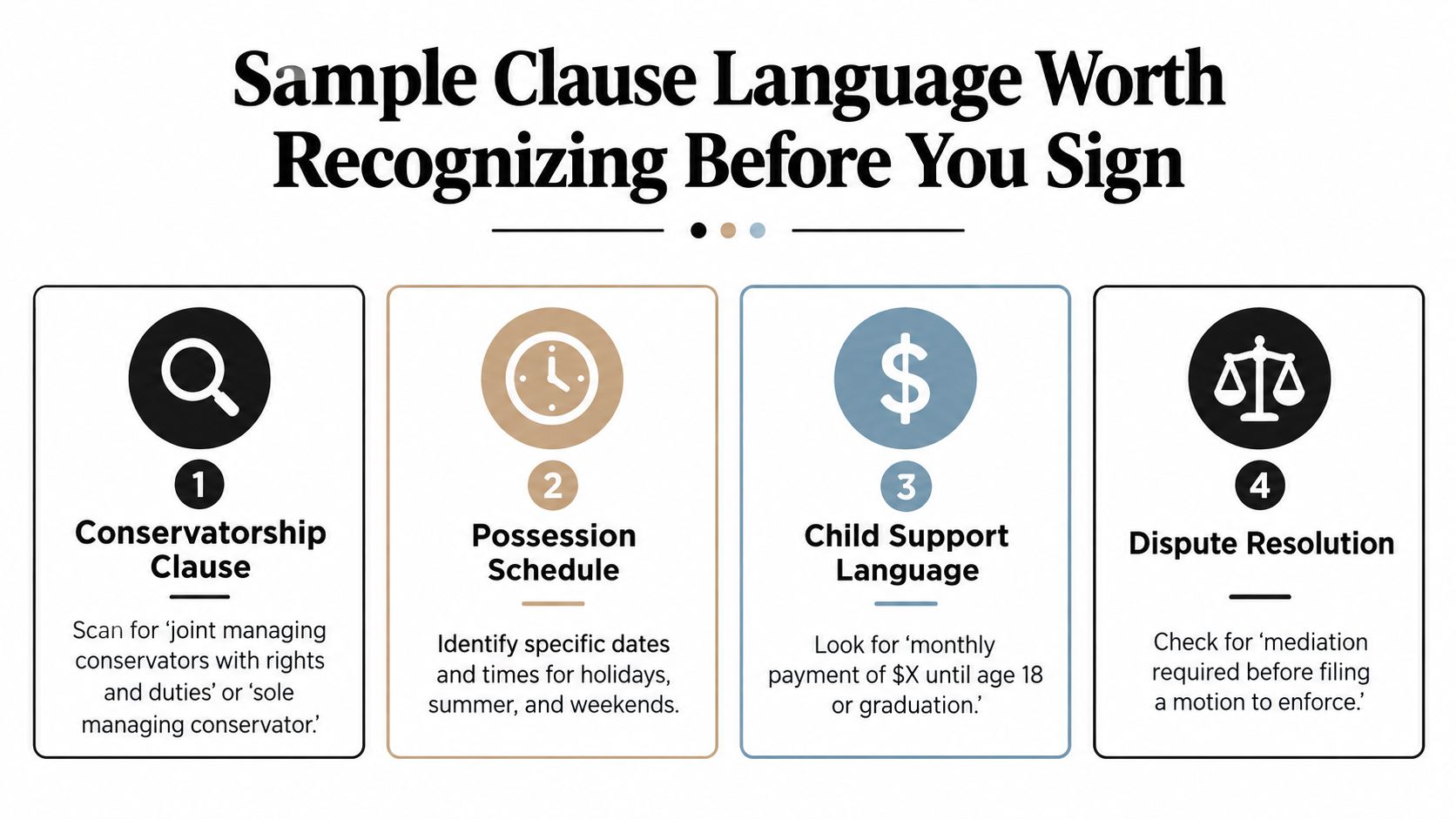
Sample Clause Language Worth Recognizing Before You Sign
A custody MSA can sound friendly and still create firm legal duties. Read the document by topic. Ask what each clause requires on a normal school week, a holiday, an emergency, and a future disagreement.
Conservatorship and possession terms
A conservatorship clause may say that the parents are joint managing conservators and identify which parent has the exclusive right to designate the child's primary residence. That doesn't automatically mean equal possession. The agreement should identify decision-making rights, access to records, school communication, and medical authority.
A possession clause should answer practical questions:
- School weeks: Who picks up the child, and where does the child sleep?
- Holidays: Which parent has each holiday, and when does the exchange occur?
- Summer and travel: How is extended possession selected and communicated?
- Transportation: Who drives, and where do exchanges happen?
A vague phrase such as “reasonable visitation” may leave too much room for conflict. A detailed schedule gives parents a shared calendar instead of a recurring argument.
Support and protective provisions
Child support language should identify the payment obligation, due date, and method of payment. Medical and dental support provisions should identify who provides coverage and how uninsured expenses are allocated. If the document includes a waiver, release, indemnification clause, relocation restriction, or non-disparagement provision, ask an attorney to explain its effect before you initial the page.
The most important statutory language is the visible non-revocation statement. Also check for signature blocks for both parties and any attorney present. Waivers of discovery or trial can affect what information you receive and how the case proceeds.
Before signing, ask:
- What exactly am I agreeing to?
- Which rights are shared, and which belong exclusively to one parent?
- What happens if school, work, or travel disrupts the schedule?
- Can this term be modified later, and under what legal standard?
- Does the final order match every material term in the MSA?
How to Enforce or Modify an MSA After the Ink Is Dry
A parent who stops following the agreement may create an enforcement problem. Start by gathering the signed MSA, the final court order, relevant messages, exchange records, payment records, and a clear timeline of what happened.
Enforcement follows the written terms
A parent may file a motion to enforce and attach the signed MSA and the court order. The request can ask the court to enforce possession, decision-making, support, or another specific obligation. Parents can review how a motion to enforce works in Texas before deciding how to proceed.
The court will focus on the language of the order and the alleged violation. A vague complaint that the other parent is being difficult is less useful than a specific record showing the date, required action, missed exchange, or unpaid obligation.
Keep communications calm and child-focused. Don't retaliate by withholding possession unless a lawyer advises you that an emergency legal basis exists. A parent who wants enforcement should preserve evidence rather than create a second dispute.
Modification addresses changed circumstances
Enforcement asks the court to make the other parent follow the existing order. Modification asks the court to change it. Texas courts generally require a material and substantial change in circumstances and a determination that the requested change serves the child's best interests.
A parent relocating for work may need a new geographic restriction or a redesigned possession schedule. A teenager's school, activities, or changing developmental needs may make a prior schedule unworkable. The parent seeking modification should explain what changed, connect the change to the child, and propose a workable replacement.
A compliant MSA receives substantial respect even years later, but it doesn't freeze family life forever. Document exchanges, preserve the original MSA, and consider mediation for practical adjustments before turning a manageable disagreement into a courtroom fight.
Key Takeaways and Your Next Steps in Texas Custody
A parent considering a Family Code 153.0071 mediated settlement agreement in a SAPCR should remember five essentials:
- The trigger is formal: A prominently displayed non-revocation statement and the required signatures give the agreement its binding effect.
- The agreement is powerful: A party can seek judgment on a compliant MSA despite Rule 11 or another rule of law.
- Safety remains central: Family violence and child-safety exceptions can prevent enforcement in carefully defined circumstances.
- The MSA and order differ: The MSA binds the parties, but the judge's signed order becomes the operative custody decree.
- Later changes require a legal basis: A parent generally needs a material and substantial change and proof that modification serves the child's best interests.
If mediation is coming, gather school, medical, childcare, work, and transportation information before the session. If you have a draft, review the non-revocation language, signature blocks, possession schedule, conservatorship rights, support terms, and relocation provisions. If the other parent isn't following the order, preserve evidence and obtain legal advice before responding in a way that could worsen the dispute.
A Texas family law attorney can review the MSA before you sign and explain how it may affect mothers, fathers, grandparents, and caregivers. The Law Office of Bryan Fagan, PLLC handles custody, visitation, support, enforcement, modification, relocation, and emergency family law matters for Texas families.
If you need help with a child custody or visitation case in Texas, our experienced attorneys can guide you every step of the way. Contact The Law Office of Bryan Fagan, PLLC today for a free consultation.
The Law Office of Bryan Fagan, PLLC can review your proposed MSA, explain the non-revocation and signature requirements, and help you address custody, visitation, support, safety, or relocation concerns. Visit Law Office of Bryan Fagan, PLLC to request a free consultation about your Texas family law case.