 Skip to content
When your baby is still waking at night, adjusting to daycare, or learning to handle longer separations, a custody schedule can feel overwhelming. One parent may worry about losing precious bonding time. The other may worry that short visits won't let a real relationship grow. Both fears are real.
Texas law recognizes that toddlers and infants aren't just “small older kids.” Their routines, sleep, feeding, and attachment needs can shape what a court sees as a workable possession schedule. Parents who are already dealing with nap struggles and things like help for two-year-old night waking often need a plan that protects the child's stability while also protecting each parent's role.
When Your Child Is Under Three Understanding Your Rights Matters Most
Looking for answers about family code 153.256 possession of a child under three in Texas, you're probably in the middle of a hard season. Maybe you're a mother trying to keep your toddler's routine steady. Maybe you're a father who wants more time and doesn't want to be treated like a visitor in your child's life. Maybe you're a grandparent or caregiver trying to understand what the parents are facing.
What makes this age group different is simple. Texas doesn't treat possession for a child under three the same way it treats possession for an older child. The usual schedule that many parents have heard about doesn't automatically fit an infant or toddler. At this stage, courts focus more closely on development, caregiving patterns, and what kind of contact helps the child stay secure.
Why this issue creates so much confusion
Many parents hear terms like custody, visitation, conservatorship, and standard possession order and assume there must be one default answer. For very young children, there usually isn't. That can feel unsettling, but it also means the court has room to build a schedule around your child's actual needs.
A judge may look at questions like these:
- Who has handled daily care: feeding, naps, bedtime, doctor visits, and soothing?
- How does the child respond to separation: does the child transition easily, or does longer time away create distress?
- What can each parent realistically do: work hours, transportation, and ability to follow the child's routine all matter.
Practical rule: Under-three possession cases often turn on details of daily parenting, not broad arguments about fairness.
This area of Texas law matters because the schedule entered now can shape the child's bond with each parent for years to come. It can also set up the transition to a different schedule later. When parents understand that early, they can ask for orders that are clearer, more realistic, and easier to enforce.
What Texas Family Code Section 153.256 Means in Plain English
Texas custody law uses words that sound formal, but the basic ideas are easier to understand once you translate them.
Conservatorship means legal rights and duties regarding a child. A joint managing conservatorship usually means both parents share major decision-making rights, even if the child lives primarily with one parent. A possessory conservator is a parent who has possession and access according to the court's order. Possession and access is the Texas phrase for the parenting schedule, or what many people casually call visitation.
The court's guiding rule is the best interests of the child. In plain English, that means the judge looks for the arrangement that best supports the child's well-being, stability, and healthy relationship with both parents.
The age-three line matters
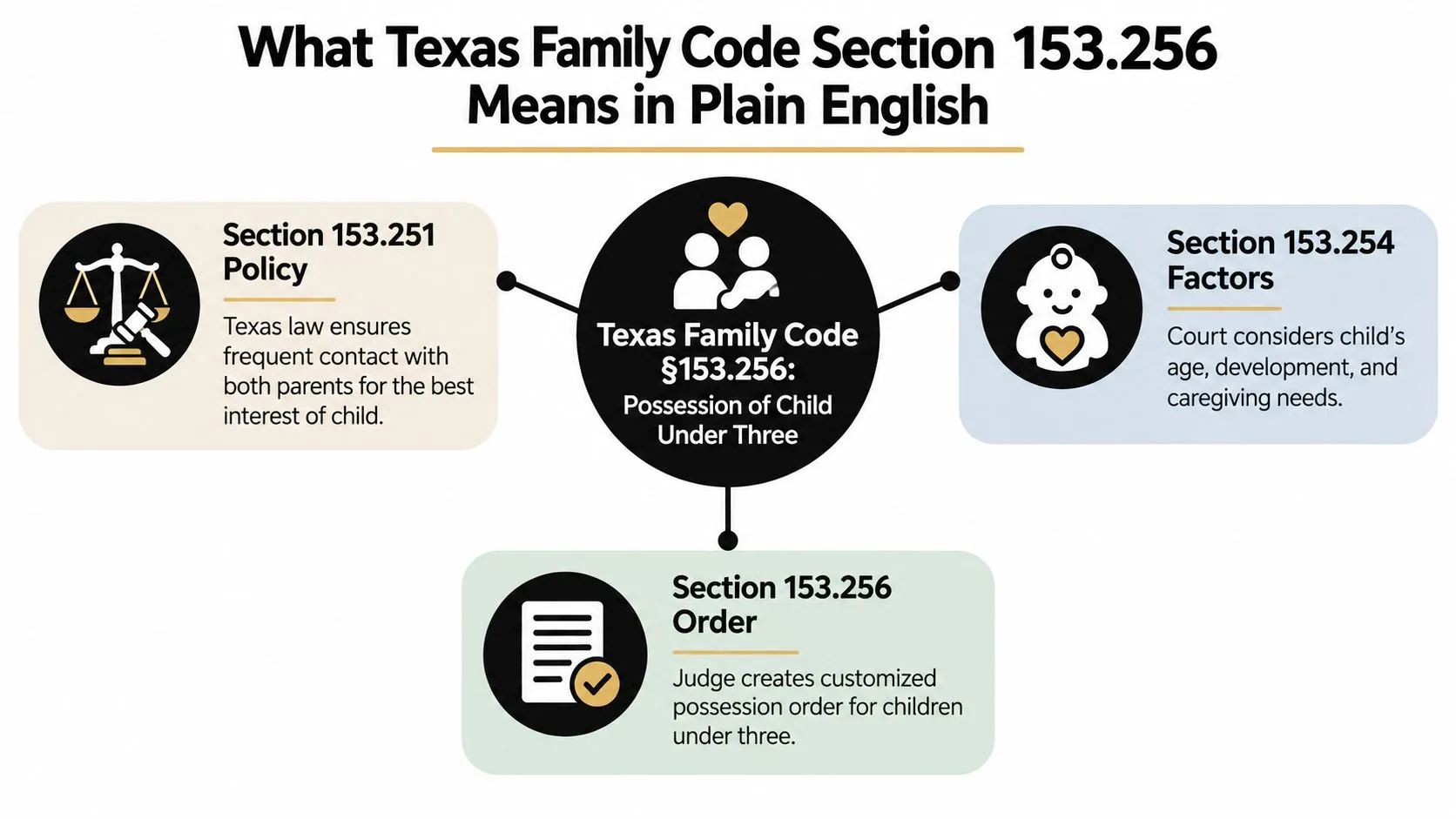
Texas draws a clear line based on age. Section 153.251 states that the standard possession order is designed for children three years of age or older, while Section 153.254 requires the court to render an order appropriate under the circumstances for a child less than three years old and to create a prospective order that takes effect on the child's third birthday (Texas Family Code Section 153.254).
That means two things happen in an under-three case:
- The court creates a schedule that fits the child now.
- The court also plans for what happens when the child turns three.
What Section 153.256 tells judges to do
Section 153.256 explains that the court is not using a fixed toddler schedule. Instead, when the court orders possession under something other than the standard possession order, it must be guided by standard possession guidelines and may consider the child's age, developmental status, circumstances, needs, best interest, each parent's circumstances, and any other relevant factor (Texas Family Code Section 153.256).
That flexibility is why parents shouldn't assume under-three cases start from equal time or from one rigid pattern. If you've wondered whether equal parenting time is automatic, Is 50/50 Possession the Default in Texas? addresses that specific question.
A toddler case isn't about plugging your family into a formula. It's about matching the schedule to the child's stage of development.
Why Texas treats toddlers differently
A baby or young toddler may need frequent contact with a parent, but not necessarily long stretches away from the main routine right away. A different child may already handle transitions well and be ready for longer blocks of time. Texas law leaves room for that difference.
That's why family code 153.256 possession of a child under three in Texas is so important. It gives judges a framework, but it also gives parents the chance to present the facts that make their child's situation unique.
How Texas Judges Decide Possession for Children Under Three
Parents often want a simple answer to one question. What does a judge look for? Section 153.256 gives the legal framework, but courtroom decisions usually come down to how well each parent shows the child's real needs.

The factors judges weigh
Texas law says the court may consider the child's age, developmental status, circumstances, needs, and best interest, the circumstances of both parents, and any other relevant factor when building an under-three schedule (FindLaw's text of Section 153.256).
In practice, that usually means the judge studies the daily realities of the child's life.
- Age and development: A very young infant has different needs than a toddler who can handle longer transitions.
- Caregiving history: Courts often pay attention to who handled feeding, bedtime, bathing, doctor visits, and comfort during distress.
- Parental availability: A parent asking for more time should be ready to show work flexibility, childcare plans, and transportation reliability.
- Adjustment and routine: Judges care about sleep, daycare, medical needs, and whether the child adapts calmly to exchanges.
- Other relevant concerns: Safety issues, conflict during exchanges, or a parent's refusal to support the child's bond with the other parent can matter too.
Why equal-time arguments often miss the point
For older children, parents often focus on whether time should be split evenly. For infants and toddlers, courts usually start somewhere else. They ask what pattern gives the child meaningful contact with both parents while protecting stability.
That can be hard for fathers to hear if they feel shut out. It can also be hard for mothers to hear if they assume the early caregiving role will control the case forever. Neither assumption is safe. The better question is whether the requested schedule fits the child's current stage and supports a stronger parent-child relationship over time.
What judges often reward: a parent who brings a child-focused plan, keeps records, and shows flexibility usually presents a stronger case than a parent who argues only from entitlement.
Evidence matters more than labels
Calling yourself the “primary parent” or “more involved parent” isn't enough by itself. Judges tend to focus on proof. Helpful proof may include calendars, daycare records, medical appointment history, text messages about routines, photos of involvement, and testimony from people who have seen each parent care for the child.
A parent asking for overnights may need to show more than desire. The court may want to know whether the child has slept there before, how bedtime works there, and whether the home setup supports the child's routine. Parents thinking through these issues often benefit from guidance on overnight visitation for an infant in Texas.
What a phased schedule often looks like in principle
Texas public guidance notes that evidence about caregiving history, the noncustodial parent's availability, and the child's adjustment can affect the court's design of a phased-in schedule, and phased schedules are commonly used to gradually expand contact as the child matures (Texas Law Help on child visitation and possession orders).
That doesn't mean every case gets the same step-up plan. It means the judge may build a progression instead of a one-step jump. For some families, that protects attachment. For others, it gives the less-involved parent a clear path to more time if things go well.
How Under Three Orders Compare to the Standard Possession Order
The biggest mistake parents make is assuming a toddler order is just a smaller version of the regular Texas schedule. It isn't. These are different legal frameworks.
For a child under three, the court has broad discretion to create an order that fits the circumstances. For a child who is three or older, the law moves toward the standard possession order, which serves as the usual framework. If you want a fuller look at that schedule, this guide on the Texas standard possession order is a useful companion.
Under Three Order vs Standard Possession Order at Age Three
| Feature | Possession Under Three | Standard Possession Order Age Three Plus |
|---|---|---|
| Starting point | Tailored to the child's circumstances | Presumptive standard framework |
| Main focus | Development, routine, caregiving history, gradual adjustment | Formula-based schedule for older children |
| Default schedule | No fixed default toddler schedule | Standard possession order is designed for children three and older |
| Court approach | Guided by standard possession principles but individualized | Uses the regular possession structure unless changed |
| Transition planning | Often includes phased or stepped-up terms | Already operating under the older-child structure |
| Third birthday effect | Court must include a prospective order that takes effect then | Standard framework presumptively applies |
Why the third birthday matters strategically
Texas law requires more than a short-term answer. For a child under three, the court must create a future order that takes effect on the child's third birthday, and that future order is presumptively the standard possession order (Texas Family Code Section 153.254).
That built-in transition matters in real cases. Parents may ask for:
- A gradual step-up plan: more time added in stages before the third birthday.
- A clear birthday trigger: automatic changes when the child turns three.
- A review point: language that allows the court or parties to revisit concerns if the child isn't ready for the next phase.
The order you ask for now can shape the pace of change later. That's why details matter.
Sample Possession Schedules for Infants and Toddlers
No sample schedule is guaranteed. These examples show how judges and parents often think through gradual expansion. The point isn't to copy a template word for word. The point is to see how a child-focused plan can grow with the child.
A visual example can help:

Example one with a very young infant
A court may favor frequent shorter visits when a baby is still tied closely to feeding, naps, and a narrow routine. That can help the nonprimary parent build familiarity without stretching the child too far beyond what the child can handle.
A parent in that situation might propose:
- Several shorter weekly periods: enough repetition for bonding and recognition.
- Consistent exchange times: because predictability helps caregivers and child alike.
- Video or phone contact when appropriate: especially if the child is very young and in-person transitions are still being built carefully.
Example two with an older infant
As a child gets older and handles transitions better, a judge may consider expanding visit length. The focus often shifts from simple contact to building ordinary parenting experiences, including meals, outings, and bedtime routines.
This kind of progression may include daytime periods first, then longer weekend blocks, then carefully introduced overnights if the facts support them. Parents comparing possibilities often look at examples of a possession schedule for infants in Texas to prepare for discussions with counsel.
Here's a video that helps many parents think through these issues in practical terms.
Example three with a toddler approaching age three
For a toddler closer to the statutory transition point, a court may build a step-up schedule that starts under the under-three framework and gradually moves toward the future age-three order. This can reduce the shock of a sudden schedule change.
That plan may account for:
- The child's existing bond with each parent
- How well overnights have gone
- Whether both parents can follow routines across homes
- How close the parents live to one another
Some of the strongest proposals don't ask for everything at once. They show the court a workable path from today's schedule to tomorrow's.
Why these examples matter for both parents
For mothers, these examples can show how to protect stability without appearing to block the other parent's relationship. For fathers, they can show how to request more time in a way that matches the court's concern for development and attachment.
Grandparents and other caregivers also benefit from understanding this pattern. Even when they aren't the direct parties seeking possession, they often help support transitions, routines, and communication.
Requesting Modifying and Enforcing Possession Orders for Young Children
Knowing the law is helpful. Taking the right step is what protects your relationship with your child.
Requesting the first order
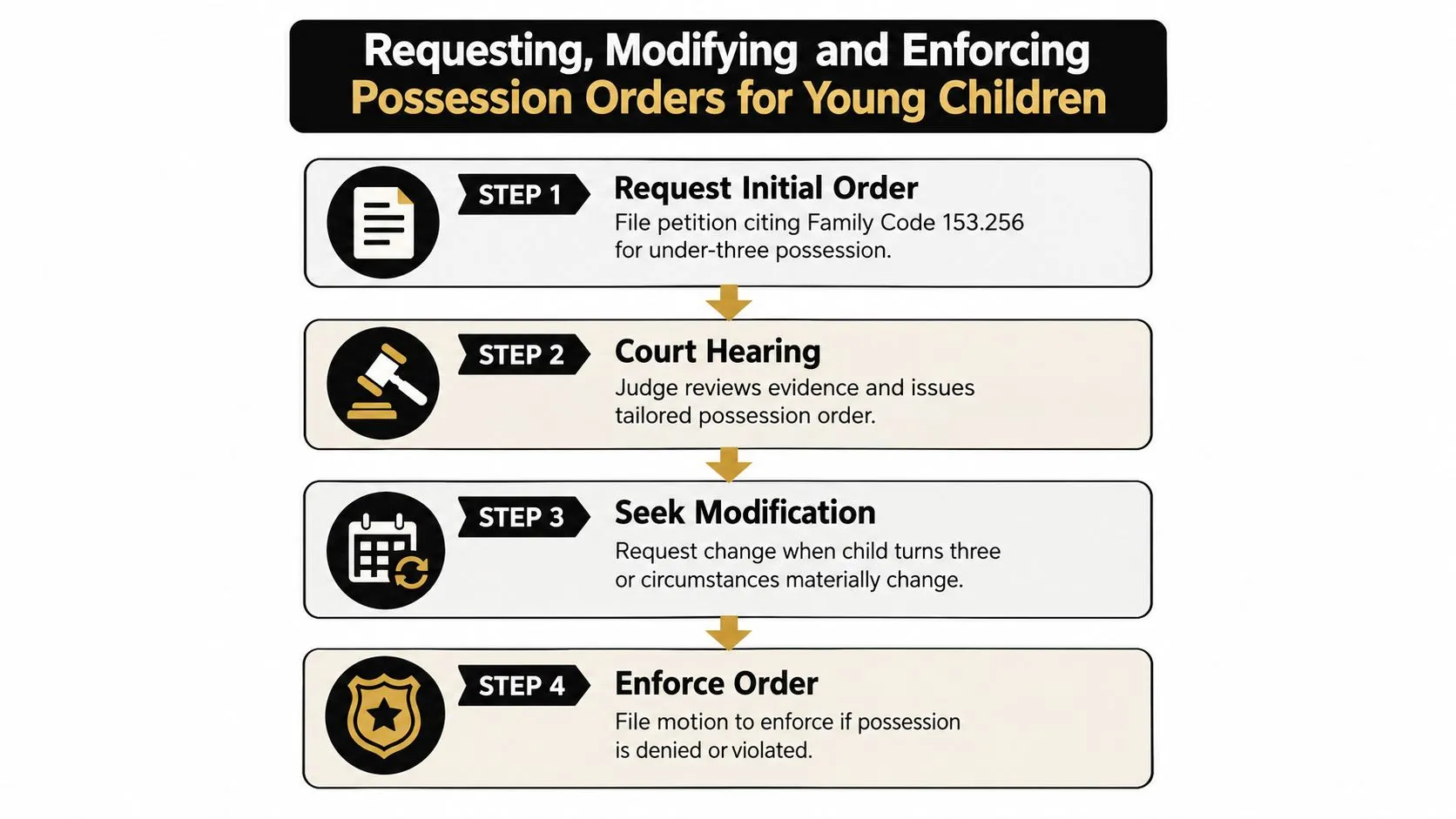
When there isn't already a final possession order, parents usually need to present a specific proposed schedule instead of asking the judge to “figure something out.” A stronger request often includes the child's routine, each parent's availability, transportation details, and a realistic plan for transitions.
If safety is an issue, the court may also hear requests involving supervised possession, temporary restrictions, or emergency relief. In some situations, parents may need to ask quickly for temporary orders or other immediate protections.
Modifying the order as the child grows
Under-three orders often stop fitting the child after a period of growth, especially when the child starts daycare, becomes more adaptable to exchanges, or is nearing the third birthday transition. A modification request usually works best when the parent can point to a meaningful change in the child's needs or family circumstances.
Helpful preparation often includes:
- Updated routine records: sleep, daycare, and medical needs may look different now.
- Exchange history: smooth transitions can support expansion. Repeated problems may support caution.
- Parenting proof: notes, calendars, and communications can show what has or hasn't worked.
Enforcing the order if the other parent won't comply
A possession order only works if both parents follow it. If a parent refuses exchanges, shortens visits, or repeatedly interferes, documentation becomes very important. Save messages, keep a possession log, and write down missed exchanges while the details are still fresh.
Some parents also choose structured legal support. The Law Office of Bryan Fagan, PLLC handles Texas matters involving child custody, visitation, possession rights, enforcement, modification, child support, paternity, and emergency custody orders.
Keep your records factual. Dates, times, locations, and exact communications usually help more than emotional summaries.
Cooperative communication still matters
Not every disagreement needs immediate courtroom escalation. Sometimes a toddler's illness, travel issue, or daycare change creates a real scheduling conflict. When both parents communicate clearly and stay child-focused, they may solve the issue faster and with less stress on the child.
Still, cooperation shouldn't mean giving up enforceable rights. If the pattern shows repeated denial or instability, legal action may be necessary.
Next Steps to Protect Your Relationship With Your Child
If your child is under three, the law gives the court room to build a plan around real life instead of forcing your family into a one-size-fits-all schedule. That can be frustrating when you want certainty, but it can also be a real advantage when your child's developmental needs, caregiving history, or transition struggles need careful attention.
The biggest point to remember is this. A toddler possession case is rarely won by broad claims about fairness alone. Courts want to see the child behind the case file. They want to understand routines, bonding, separation, flexibility, and how the schedule will work in practice.
Key takeaway
- Under-three orders are individualized: the court looks at the child's age, needs, development, and each parent's circumstances.
- The third birthday matters: the order should account for the legal transition that follows.
- Evidence helps: daily caregiving details, communication records, and practical planning often shape the result.
- Both mothers and fathers have options: the strongest approach is usually a child-centered proposal, not a reactive one.
If you're worried about losing time, being pushed out, or managing a schedule that doesn't fit your child's stage of life, act early. Clear legal advice can help you ask for a plan that protects both stability and connection.
If you need help with a child custody or visitation case in Texas, our experienced attorneys can guide you every step of the way. Contact The Law Office of Bryan Fagan, PLLC today for a free consultation.
If you're dealing with an under-three possession dispute, a step-up schedule, or a transition tied to your child's third birthday, Law Office of Bryan Fagan, PLLC can help you evaluate your options and prepare a child-focused plan. Our team works with Texas parents on custody, visitation, modifications, and enforcement, and we invite you to schedule a free consultation for guidance that fits your family.


