 Skip to content
When your child's future is on the line, understanding your rights matters most.
You may be reading this after a long mediation day, staring at a signed agreement that suddenly feels wrong. Maybe you said yes because you were scared of what would happen if you didn't. Maybe the other parent never raised a hand in the room, but years of threats, control, or intimidation followed you into every decision. If that sounds familiar, you are not overreacting, and you are not without options.
In Texas custody cases, a mediated settlement agreement, often called an MSA, usually carries serious weight. But Texas law also recognizes that family violence can distort a parent's ability to make real, free choices. That is where the family violence exception to an MSA in Texas custody becomes so important. For mothers, fathers, grandparents, and other caregivers, the hard part is often not knowing that the exception exists. It's understanding what it requires, what evidence matters, and how it affects custody, visitation, and parental rights under Chapter 153.
When the Family Violence Exception to an MSA in Texas Custody Matters
A parent walks out of mediation with a signed agreement that gives both parents joint decision-making and a broad possession schedule. On paper, it looks cooperative. In real life, it may reflect fear.
Maybe that parent agreed because the other parent had a history of controlling money, isolating them from family, sending threatening messages, or exploding when challenged. Maybe the children had already seen frightening behavior. After the mediation ends, the parent starts asking the question many people ask too late. “Did I really agree to this freely?”
A common point of confusion
Many parents think signing an MSA means the custody terms are untouchable. That's usually close to true, which is why mediation must be taken seriously. But in custody cases, Texas law allows a narrow path for the court to refuse to enter judgment on an agreement when family violence affected the decision-making and the result would not serve the child's best interest.
That matters because custody is never just about what two adults signed. Texas courts still focus on the best interests of the child, which means the arrangement must protect the child's safety, stability, and emotional well-being. If violence shaped the deal, the court may need to look past the paper and look at what was happening inside the family.
Practical rule: Regret alone usually won't undo a custody agreement. Fear, coercion, and safety risks may.
Why this issue shows up after mediation
Parents often expect abuse to look obvious. Sometimes it does. Sometimes it shows up as pressure that outsiders miss. A parent may freeze, agree too quickly, stop asking for safety terms, or avoid raising concerns because they're trying to prevent retaliation later.
Plain-English custody terms can help here:
- Joint managing conservatorship means shared legal decision-making authority, such as choices about school, medical care, and other major issues.
- Possession schedules are the calendar rules for when each parent has time with the child.
- Best interests of the child is the guiding standard Texas courts use to decide what arrangement protects and supports the child.
For both mothers and fathers, the key question is not only whether abuse happened. The question is whether that abuse affected the agreement and whether enforcing it would put the child in a harmful situation.
How Texas Family Code Section 153.0071 Creates the Exception
A parent can walk into mediation wanting peace, sign an agreement, and still leave with terms that do not reflect a free, reasoned choice. Section 153.0071 is the part of Texas law that gives a court limited room to stop that result in custody cases.
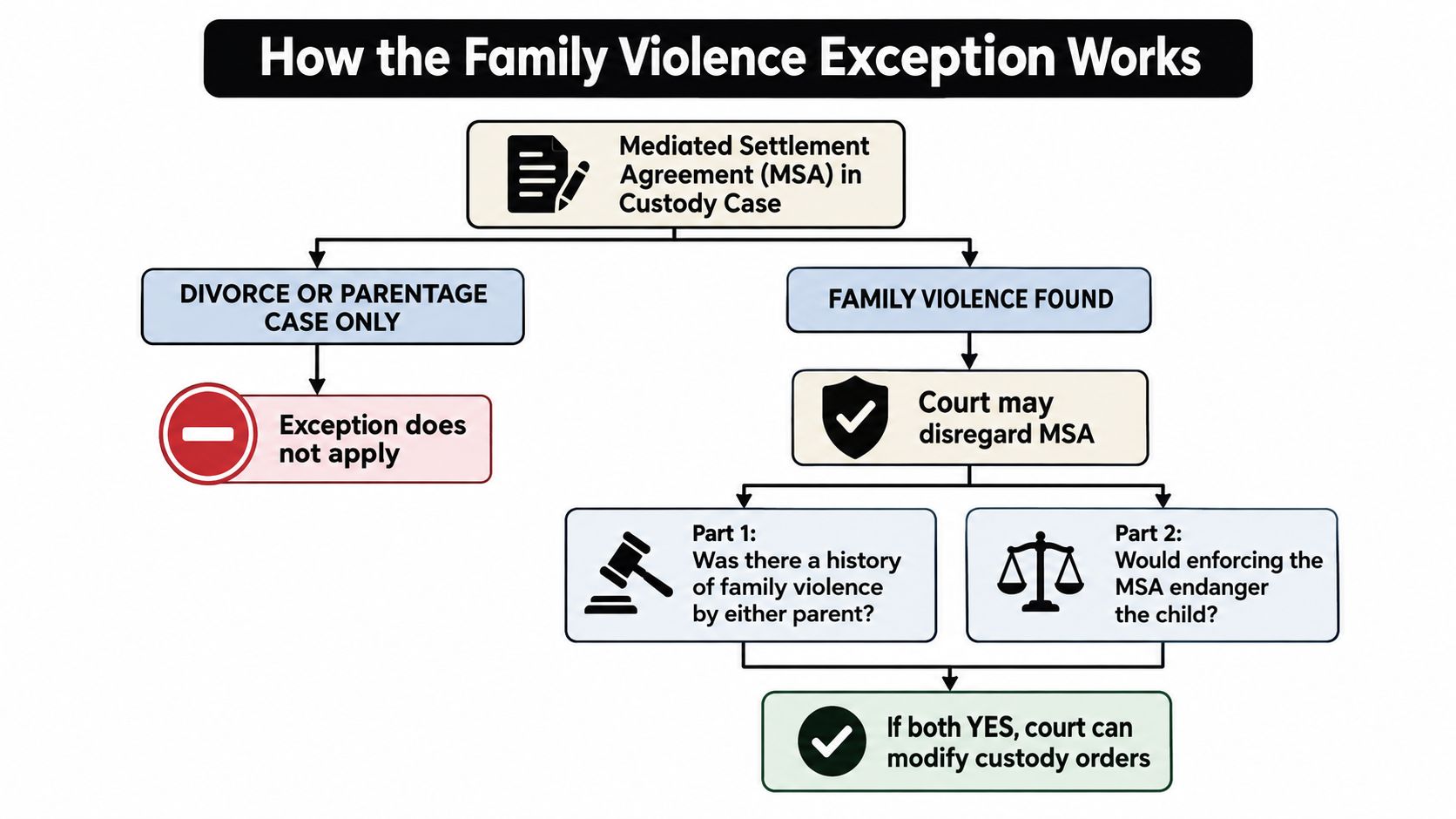
Texas Family Code Section 153.0071 makes mediated settlement agreements in SAPCR cases generally binding, but it also carves out a narrow exception. A court may refuse to enter judgment on the MSA only if it finds both that a party was a victim of family violence that impaired the party's ability to make decisions, and that the agreement is not in the child's best interest, as described in Texas Family Code Section 153.0071.
The court needs two findings, not one
This is the part many parents do not hear clearly enough. An abuse allegation by itself does not automatically defeat an MSA. The judge is not deciding only whether violence occurred. The judge is deciding whether the violence affected the parent's ability to make custody decisions during the agreement process, and whether enforcing that deal would hurt the child's best interest.
Those are separate questions.
A simple way to understand it is to compare the statute to a locked door with two keys. One key is proof that family violence impaired decision-making. The second key is proof that the actual agreement is not in the child's best interest. If either key is missing, the court will usually enforce the MSA.
Texas courts have described this as a narrow exception. The reason is practical. Mediation is supposed to produce final agreements people can rely on. Section 153.0071 protects that finality, while still giving judges a way to reject a deal shaped by coercion or fear.
What “impaired decision-making” usually means
This phrase matters more than many articles explain.
“Impaired decision-making” is not the same as second thoughts, regret, or feeling that the bargain was unfair. It points to a damaged ability to make a voluntary, thoughtful choice at the time of mediation. In plain English, the question is whether the parent was deciding, or whether fear was doing the deciding for them.
That can show up in several ways:
- agreeing to unsafe terms because the parent expects retaliation after mediation
- staying silent about guns, threats, stalking, or prior assaults because raising them feels dangerous
- accepting joint decision-making on paper even though the other parent has used violence or intimidation to control every major choice
- shutting down emotionally, freezing, or complying quickly after a long pattern of coercive control
A judge will usually want a connection between the violence and the agreement itself. For example, did the parent ask for exchanges at a police station earlier, then suddenly drop that request after threats? Did text messages before mediation show intimidation tied to custody demands? Did the parent report being afraid to disagree because of what would happen later at pickup, at home, or through the child?
That is different from a general claim that the other parent is abusive. A general allegation asks, “Did something bad happen in this family?” Section 153.0071 asks a narrower question: “Did family violence interfere with this parent's ability to make this custody agreement?”
Why Section 153.0071 matters beyond the signature page
This statute also fits into the larger Chapter 153 custody rules. It deals with whether the MSA should be enforced. Other sections, including the conservatorship rules discussed elsewhere in this article, address who should make decisions for the child and under what limits. Those are related issues, but they are not identical.
That distinction matters. A parent might have evidence strong enough to raise serious conservatorship concerns under Chapter 153, yet still need separate proof that the violence impaired decision-making during mediation. The reverse can also happen. The same facts may support both arguments, but the court still analyzes them through different legal lenses.
If you want a fuller explanation of how Texas Family Code 153.0071 applies to mediated settlement agreements in a SAPCR, that resource can help. Families also often need to understand how abuse shifts custody presumptions more broadly, which is why Custody When There Is a History of Family Violence is relevant in these cases.
How Family Violence Affects Conservatorship Decisions in Texas
The family violence issue does not stop with whether an MSA can be enforced. It also reaches the structure of custody itself.
Under Texas Family Code Section 153.004(b), a court may not appoint parents as joint managing conservators if there is credible evidence of a history or pattern of family violence during the two years before filing or while the suit is pending, according to Texas Family Code Section 153.004. Under Section 153.005(c), the court must consider whether a party had a history or pattern of family violence, child abuse, or child neglect, and whether a final protective order was entered against that party, as stated in Texas Family Code Section 153.005.
What that means in plain English
Conservatorship is Texas's word for custody rights and duties. It covers who makes major decisions for a child. Those decisions can include education, medical care, counseling, and other important parts of daily life.
If family violence is established, the court may move away from shared decision-making and give one parent more authority. In some cases, one parent may become the primary decision-maker while the other parent's role is limited.
| Issue | Without Family Violence Finding | With Family Violence Finding |
|---|---|---|
| Joint managing conservatorship | Shared legal decision-making may remain possible | Court is barred from appointing joint managing conservators if the required violence finding is made |
| Major child decisions | Parents may share authority over school, medical care, and similar issues | Court may shift those rights away from the parent with the violence history |
| Effect of protective orders | May be one factor among many | A final protective order can weigh heavily in conservatorship analysis |
| Role of prior abuse evidence | May be disputed as part of general best-interest analysis | A history or pattern of violence can directly change the custody structure |
Why this matters for mothers and fathers
This applies whether you are a mother seeking protection, a father trying to prevent unsafe joint custody, or a parent defending against allegations and needing to respond with evidence. The legal label matters because a parent can seem cooperative on paper while still posing a safety risk in decision-making.
Texas courts and related court materials also recognize that family violence can affect the conservatorship framework itself, not just the best-interest analysis. If you want a practical discussion of that connection, see how domestic violence affects child custody in Texas.
Evidence Standards for Proving the Family Violence Exception
A parent can leave mediation with a signed MSA and still feel a knot in their stomach. On paper, the deal looks finished. In real life, the question is whether the agreement was shaped by fear, control, or intimidation in a way that puts the child at risk.
That is why evidence matters so much here.
The hard part for many parents is understanding what the court is looking for. A general claim that the other parent was abusive may matter in the case overall, but this exception usually calls for something more focused. The judge is looking for proof that family violence affected the parent's ability to make free, considered decisions in mediation, and separate proof that enforcing this particular agreement would not serve the child's best interest.

Evidence that usually carries more weight
Judges often give more weight to evidence that is specific, dated, and tied to real events rather than broad descriptions. In plain terms, details help the court see whether fear was part of the decision-making process.
Stronger proof may include:
- Police reports, 911 logs, or final protective orders that show a documented history of threats, assault, stalking, or harassment
- Text messages, emails, voicemails, or recordings showing coercion, pressure, monitoring, or threats tied to the custody dispute or mediation process
- Medical, therapy, or counseling records reflecting injury, trauma symptoms, fear, or safety planning
- School or daycare records showing the child's fear, behavior changes, disclosures, or attendance problems connected to violence at home
- Testimony from neutral witnesses such as teachers, counselors, doctors, neighbors, law enforcement officers, or supervised exchange personnel
- Evidence about the mediation itself such as threats before mediation, intimidation during negotiations, or pressure to sign quickly without meaningful input
A simple way to view it is this: a judge needs more than proof that conflict existed. The judge needs proof that violence or coercion affected judgment.
Why impaired decision-making is different from a general abuse allegation
This is the part many articles skip.
A general abuse allegation asks, "Did something harmful happen?" Impaired decision-making asks a narrower question. "Did the violence or fear interfere with this parent's ability to make voluntary custody decisions?"
That difference matters. A parent may have evidence of ugly arguments, insults, or even prior bad conduct, but the court still wants a clear link between the family violence and the parent's decision-making at the time of mediation. For example, evidence that a parent agreed to unfavorable terms after repeated threats, surveillance, prior assaults, or fear of retaliation usually speaks more directly to impairment than evidence of ordinary co-parenting conflict.
Evidence judges may treat more cautiously
Some proof is still relevant, but it often needs support from other records or testimony.
- Vague allegations with no dates, incidents, or examples
- Secondhand statements from relatives who only know what someone told them
- Delayed reporting with no context about fear, isolation, financial dependence, or other reasons for the delay
- Messages showing hostility alone without threats, coercion, or control
- Claims that label every argument as abuse when the facts describe conflict but not family violence
Parents often worry that a delay in reporting will ruin their case. It does not automatically do that. Many people stay quiet because they are scared, dependent, ashamed, or trying to keep the peace. But it helps to explain the delay with facts the court can understand.
The child-best-interest prong needs its own evidence
As noted earlier, Section 153.0071 requires more than proof of violence alone. The court also has to decide whether enforcing the MSA would be against the child's best interest.
That second part needs its own factual support. Useful evidence may include unsafe exchanges, the child witnessing assaults or threats, trauma symptoms, fear of a parent, instability caused by the proposed schedule, or a custody structure that gives significant decision-making power to a parent whose violence creates ongoing safety concerns. Texas Family Code Section 153.0071 sets the legal framework, but the courtroom question is practical: what about this agreement puts this child at risk?
A helpful analogy is a cracked car seat. Proof that the seat was damaged explains part of the problem. Proof that a child is expected to ride in it explains why the court cannot ignore it.
How a Violence Finding Changes Possession and Access
Even when a court allows some contact, family violence can change the parenting schedule in very practical ways.
Texas Family Code Section 153.004(d-1) says a court may still allow access after a family-violence finding, but only if the court first finds that access will not endanger the child's physical health or emotional welfare and is in the child's best interest. The court must also issue a possession order designed to protect safety, as set out in Texas Family Code Section 153.004(d-1).

What safety-focused possession orders can include
Texas law becomes very concrete here. A protective possession order can require:
- Continuously supervised visits
- Exchanges in a protective setting
- No alcohol or controlled-substance use within 12 hours before or during access
- Completion of a battering intervention and prevention program
These are not abstract ideas. They directly shape where visits happen, who must be present, and what conditions apply before a parent sees the child.
How this changes a standard possession schedule
A standard possession order often follows a regular pattern for weekends, holidays, and school breaks. But Chapter 153 is structured so that family violence can alter both conservatorship and possession analysis, including movement away from a standard schedule when safety concerns exist, as reflected in the Texas Legislature's Chapter 153 materials.
That may mean no unsupervised pickups, no direct contact between parents during exchanges, or visits at a supervised facility rather than a home. If you need a plain-language overview of that option, this explanation of supervised visitation in Texas is useful.
A court is not required to choose between full access and no access. It can build a safer middle ground.
For parents and grandparents, this is often the part of the case that most affects daily life. School handoffs, holiday visits, and transportation all become part of the safety plan.
Modifying or Challenging an MSA After Family Violence
Once family violence is raised, the next question is usually procedural. What do you file, and when?
That answer depends on where the case stands. If no final order has been entered, a parent may object to the MSA's custody terms under the narrow statutory pathway discussed earlier. If there is already an order in place, the issue often becomes a modification case, enforcement issue, or emergency request tied to child safety.
Common legal paths parents use
A parent may need to:
- File within the existing cause number to challenge enforcement of custody terms or request relief tied to the pending case
- Seek temporary restraining orders or temporary injunctions if immediate safety concerns exist
- Request a modification when circumstances have changed and the current order no longer protects the child
Texas parents also often ask whether a violence finding can support a later custody change. In many cases, safety-related developments can become part of the changed-circumstances argument in a modification suit. Families who are already under final orders often need practical information on modifying a Texas custody order.
Preparation matters more than panic
Parents sometimes want to file something immediately, even if they do not yet have organized proof. Speed matters in emergencies, but so does clarity. Judges often need a focused explanation of what happened, when it happened, how it affected the MSA or current order, and what immediate relief is needed.
Confidential communication also matters when you are gathering evidence and talking with counsel. If you are trying to understand how private attorney communications generally work while navigating a sensitive legal problem, this practical advice from Ciphar may help you think through information-sharing and confidentiality concerns.
What to expect from the court process
A challenge like this may involve temporary hearings, affidavits, testimony, and sometimes court-appointed professionals in high-conflict custody cases. The court may also weigh whether mediation itself should continue with safeguards, or whether safety concerns call for a more direct judicial decision.
If you are a father worried that abuse allegations are being raised against you, evidence and legal strategy still matter. If you are a mother, grandparent, or caregiver trying to protect a child from escalating behavior, waiting too long can make the case harder. The goal is not to inflame conflict. The goal is to put reliable facts in front of the court.
Practical Steps to Protect Children and Parental Rights
When fear is high, it helps to focus on actions you can take today. Start with documentation, safety planning, and legal advice that fits your situation.
A judge usually needs more than a broad story. The judge needs a record. That record can show patterns, timing, escalation, and the effect on the child.

A practical checklist you can start now
- Keep a dated incident journal. Write down what happened, where it happened, who saw it, and how the child was affected.
- Save messages carefully. Preserve texts, emails, voicemails, and social media messages in their original form when possible.
- Collect official records. Ask for police reports, medical records, counseling records, school notes, and protective-order paperwork.
- Track parenting-time problems. Log missed exchanges, late arrivals, unsafe behavior, and any statements the child makes that need follow-up.
- Store copies in a safe place. Keep digital backups and, if needed, a secure physical folder outside the home.
Safety planning at home and during exchanges
Documentation is only part of protection. Daily safety planning matters too.
Consider practical steps such as changing locks if appropriate, updating school pickup instructions, using a code word with children or trusted adults, and arranging exchanges in a public or supervised setting. If immediate danger exists, contacting law enforcement may be necessary. Parents may also need to pursue a protective order or request temporary court relief connected to the custody case.
Keep your notes factual. Dates, times, words used, visible injuries, missed visits, and witnesses help more than angry commentary.
What to bring to a lawyer consultation
Bring the custody order or draft MSA, any protective orders, your incident log, screenshots, medical records, school communications, and a simple timeline. If you are considering legal help, the Law Office of Bryan Fagan, PLLC handles child custody, visitation, modifications, and emergency custody orders in Texas. That makes it one factual option for families who need case-specific advice on Chapter 153 issues.
Parents often feel pressure to “have everything perfect” before calling a lawyer. You don't. But the more organized your information is, the easier it becomes to identify whether the problem involves an MSA challenge, a modification, an enforcement issue, or emergency relief.
Key Takeaways and Next Steps for Texas Families
The family violence exception to an MSA in Texas custody is real, but it is narrow. A court may refuse to enter a custody MSA only when it finds both that family violence impaired a parent's decision-making and that enforcing the agreement is not in the child's best interest. That is a high standard, which is why strong, specific proof matters.
This issue also reaches beyond the MSA itself. Under Chapter 153, family violence can affect conservatorship, meaning who makes major decisions for the child, and possession and access, meaning when and how a parent spends time with the child. In some cases, that leads to restricted exchanges, supervised visitation, or other court-ordered protections.
For worried parents, grandparents, and caregivers, the biggest practical lesson is simple. General accusations usually aren't enough. Courts want documentation, dates, records, and facts that show both what happened and why the child needs a safer arrangement. Mothers and fathers both need to understand this. Whether you are seeking protection or responding to serious allegations, careful preparation often shapes the outcome.
If you believe abuse affected a custody agreement, or if a current order no longer protects your child, don't assume you have to live with it. Get your documents together. Write down the timeline. Ask for legal advice focused on your specific facts and your child's immediate needs.
If you need help with a child custody or visitation case in Texas, our experienced attorneys can guide you every step of the way. Contact The Law Office of Bryan Fagan, PLLC today for a free consultation.
If you're facing questions about mediation, family violence, conservatorship, or safe possession terms, Law Office of Bryan Fagan, PLLC offers guidance on Texas child custody, visitation, modification, and emergency orders. A free consultation can help you understand whether the facts in your case may support challenging an agreement, seeking protective relief, or pursuing a safer custody arrangement for your child.


