 Skip to content
When you're sitting at the kitchen table the night before a custody hearing, the weight hits hard. You're not just thinking about paperwork. You're thinking about pickup times, school routines, who answers the phone when your child needs you, and whether the court will really understand your side of the story.
Texas custody law can feel cold when you're living it, but it gives parents real tools. If you know your rights, document what matters, and stay focused on the facts, you can protect your relationship with your child without making a bad situation worse. From the parent's side, that means learning how Texas courts look at conservatorship, possession, access, modifications, and emergency orders, then using that knowledge in a calm, practical way.
When Your Child's Future Feels Uncertain
A lot of parents come into this process feeling like they're already behind. One day you're handling bedtime and soccer practice, and the next day you're staring at an email from the other side that makes everything feel uncertain. That fear is real, and it's exactly why you need a clear plan instead of reacting out of panic.
Texas family courts do not start from the idea that one parent automatically wins. They start from the child's best interests, and they look at the family's actual circumstances, not just the loudest argument in the room. That gives you room to make your case, whether you're the mother, father, or grandparent trying to stay involved.
A modern custody case can involve divorce, separation, blended families, or a parent who does not live in the same home as the child. The U.S. Census Bureau reported that parents living with children under 18 fell from about 66.1 million in 2010 to 63.1 million in 2020, and that 78% of parents living with children were married in 2020 while 15% were parents living without a partner, showing how far family structure has moved from the old one-household model. The same reporting also showed that nearly 20 million children under 18 lived with one parent in 2017, which is why issues like parenting time, paternity, and enforcement matter so much in everyday life (Census Bureau family structure release, Census Bureau living arrangements release).
Practical rule: if you're feeling overwhelmed, start with what you can prove and control, not with what you fear.
This guide stays on the parent's side. It focuses on what you need to do, how Texas judges think, how to prepare for a hearing, what to document, when relocation or military service changes the picture, and when emergency help is appropriate.
How Texas Custody Law Works From the Parent's Side
Texas uses words that sound technical, but the structure is simple once you strip away the jargon. Conservatorship is about who has the legal rights and duties. Possession and access are about when the child is physically with each parent and how that contact works in real life.
Two co-pilots on the same flight plan. One parent may have more say over where the child lives, but both parents can still hold important rights and duties. That's the core idea behind joint managing conservatorship, or JMC, which is Texas's way of saying both parents remain legally involved even if they do not share time equally.
In a JMC order, parents commonly have rights like receiving information from schools and doctors, conferring on major decisions, and consenting to certain activities. A sole managing conservatorship order gives one parent most of those decision-making rights, while the other parent may still have possession and access. A possessory conservator is the parent whose time with the child is scheduled, even though that parent still has legally protected contact.
Texas Family Code Chapter 153 centers everything on the best interests of the child. That means the court is supposed to look at what supports stability, safety, and healthy parenting, not just who speaks the strongest in court. For parents, the question is usually, “What arrangement lets me stay meaningfully involved without disrupting the child's life?”
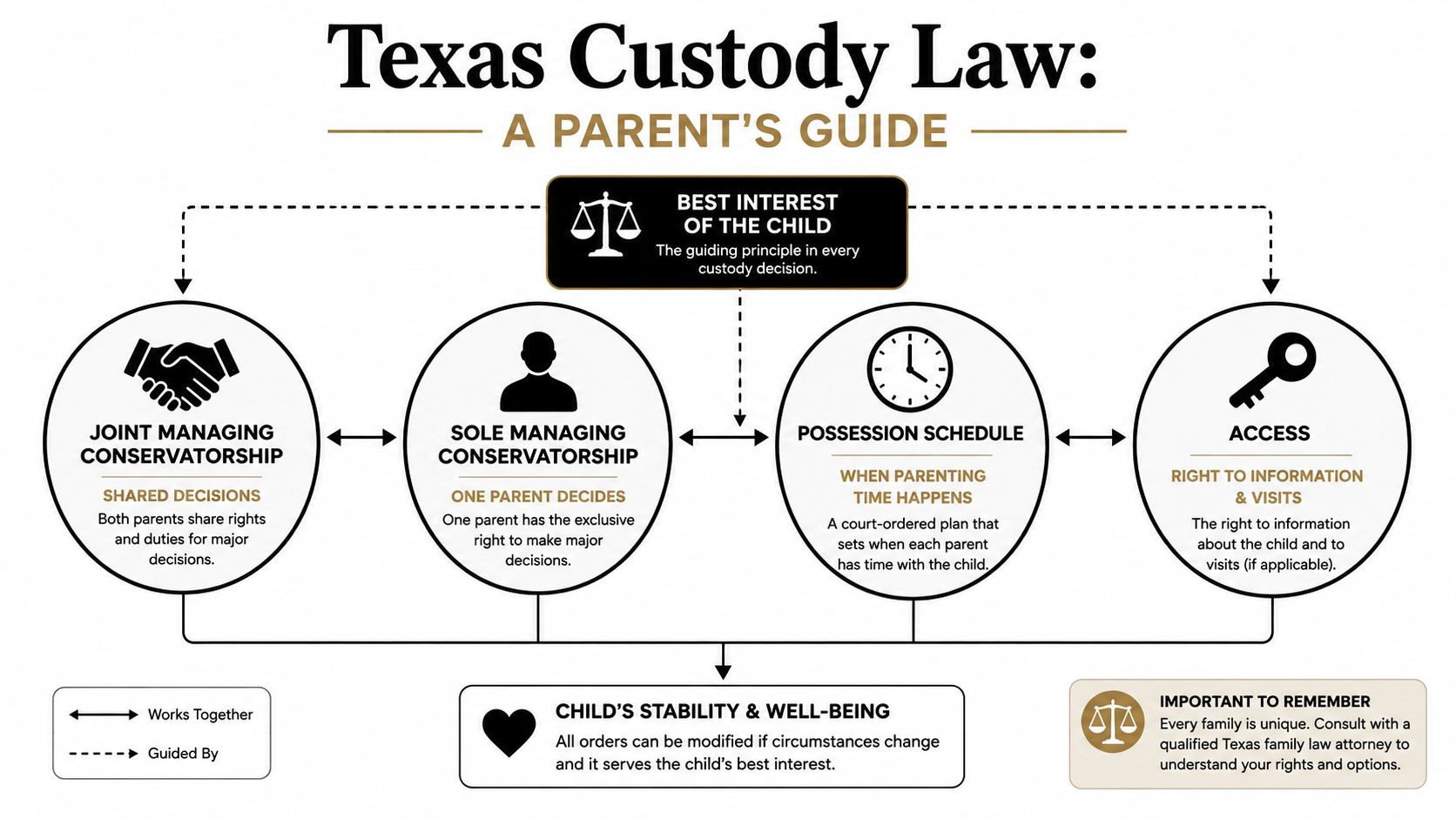
If you want a fuller breakdown of the difference between decision-making and parenting time, the resource on Conservatorship vs. Possession and Access in Texas explains why Texas separates those two ideas.
How Courts Actually View Parental Behavior
Texas judges pay close attention to patterns, not one-off moments. A parent who shows up consistently, communicates respectfully, and keeps the child's routine stable usually looks stronger than a parent who only becomes involved when there's a hearing coming up. That's true for mothers and fathers alike.
What helps a parent's case
Courts notice when you stay involved in school, medical appointments, and everyday care. They also notice whether you support the child's relationship with the other parent instead of trying to control it. A calm message, a timely pickup, and a consistent home routine matter more than dramatic arguments.
What hurts a parent's case
Alienating behavior can backfire fast. So can substance abuse, untreated mental health issues that affect parenting, and domestic violence. If your actions suggest that you are trying to punish the other parent through the child, a judge is likely to see that as a problem, not a strength.
Your credibility is built in small moments. Text messages, school involvement, and the way you handle exchanges tell the court more than a single emotional outburst ever will.
Texas courts also expect both parents to act like adults when possible. That does not mean you have to agree with the other parent on everything. It does mean you should not sabotage schedules, withhold information, or turn every disagreement into a power struggle. If you want a judge's trust, act like someone who can put the child's routine ahead of the conflict.
For a deeper look at how judges weigh those facts, see How Does a Judge Decide Custody in Texas?
Building Your Evidence and Documentation
The best custody evidence is boring in the best possible way. It shows a pattern. It shows you were there, you communicated, and you handled your responsibilities without turning every exchange into a war. That is far more persuasive than a stack of angry screenshots with no context.
Start with a simple record. Keep a parenting time log with dates, exchanges, appointments, school events, and activities. Save texts and emails that show cooperation, conflict, missed pickups, or ignored requests. Hold on to school records, medical records, and receipts for child-related expenses. Notes from teachers, coaches, and caregivers can help show who handles the child's day-to-day life.
The goal is not to build a file that screams, “Look how awful the other side is.” The goal is to show that you are steady, present, and willing to parent. That's the kind of documentation that helps a court see the pattern.
A few cautions matter here. Don't violate court orders to gather evidence. Don't post emotional updates on social media hoping the other parent will react. And don't assume one recording or one ugly text will win the case for you. Judges care more about the full picture than a single heated exchange.
If the stress is getting to you, a neutral support resource can help you stay grounded while you document carefully. Some parents also find it useful to talk with a counselor while custody tensions are high, and Interactive Counselling therapy for parents is an example of the kind of outside support that can help you think clearly when emotions run hot.
The article on What Evidence Matters Most in a Texas Custody Case? is a good companion if you want to organize your proof before a hearing.
Preparing for Hearings and Possession Schedules
Texas custody cases usually move through temporary orders, mediation, and then a final hearing if the parents can't resolve things sooner. Temporary orders set the short-term rules. Mediation gives both sides a chance to work out a plan with help from a neutral third party. The final hearing is where the judge makes the lasting call if no agreement is reached.
Your best courtroom advantage is simple discipline. Dress like you're meeting an employer, not a neighbor. Answer the question that was asked, not the question you wish had been asked. Stay steady when the other side pushes your buttons, because the court notices composure.
Possession schedules are not one-size-fits-all
Texas often uses the Standard Possession Order as the default schedule for many parents who live within 100 miles of each other. The law also gives different possession options when parents live more than 100 miles apart, including different weekend, holiday, and summer arrangements. The schedule changes because real parenting logistics change, too.
If you're the parent who sees the child less often, that does not mean your role is minor. It means your time has to be protected with precision. If you're the parent managing most of the daily routine, you still need a schedule that supports consistency instead of constant conflict.
Practical rule: organize your exhibits before the hearing, and know exactly which one proves each point you want the judge to understand.
If you want more detail on how Texas handles the default schedule, review The Texas Standard Possession Order. You can also use the firm's video resource below to get a clearer sense of the hearing flow.
Relocation and Military Service Cases
Some custody problems show up the moment a parent talks about moving. Others start when military orders change the family's life overnight. Those two situations are different, but they both force Texas courts to ask the same hard question, how do you protect the parent-child relationship when geography changes?
Relocation puts the burden on the moving parent
If a parent wants to move the child, the court usually wants a reason tied to the child's best interests. If the other parent objects, a move can require court approval. The practical issue is not just whether the move makes sense for the adult. It is whether the child can still maintain a real relationship with both parents after the move.
Military service changes the schedule, not the relationship
Military families deal with deployment, temporary duty, and permanent change of station. Those events can affect possession schedules, and the family-care plan becomes important because it shows how care will be handled if a parent is unavailable. Texas courts understand that service members do not always control where they are sent, but the parenting plan still has to work on paper and in real life.
If you are facing a move-away issue, it helps to think ahead instead of hoping the other side will agree later. That's especially true if you're balancing a job change, a new spouse, or service-related orders. Planning gives you a better shot at preserving time with your child than scrambling after the fact.
For a deeper discussion of move-away cases, the firm's resource on parental relocation can help you see how Texas courts approach those disputes. The point is simple. Thoughtful planning protects the relationship. Avoidance usually makes the fight worse.
Emergency Custody and Common Misconceptions
Emergency custody is for real danger, not ordinary frustration. Texas courts may step in quickly when there is credible evidence of immediate harm, abandonment, or serious neglect. If that is the situation, document what happened, when it happened, who saw it, and why waiting for a normal hearing would put the child at risk.
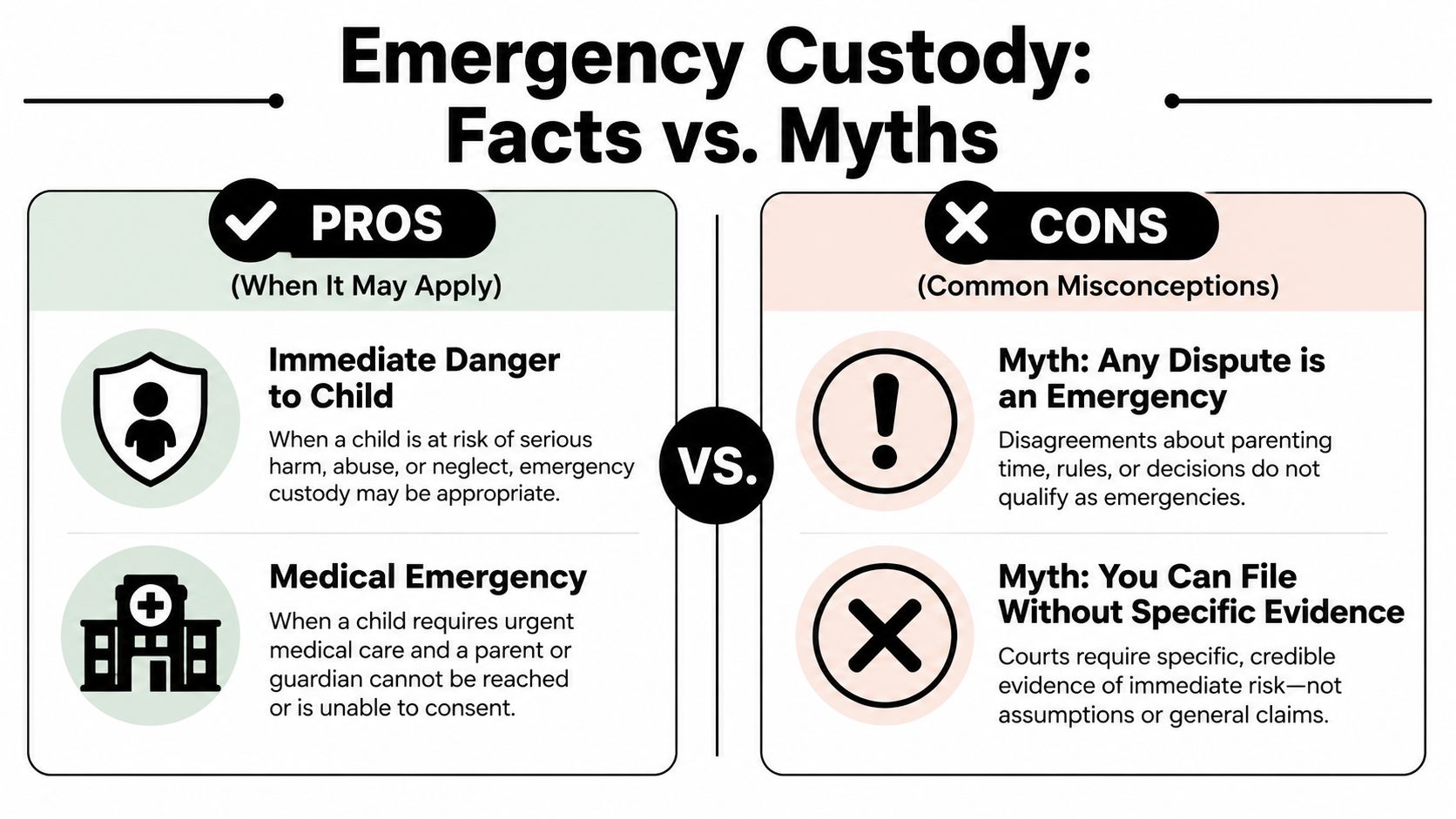
A lot of parents hurt their own case by leaning on myths. Mothers do not automatically win custody. Fathers do not lose rights just because they were never married. Dating is not a custody crime. And refusing to cooperate rarely impresses a judge.
Texas courts are required to focus on the child's best interests, not on rewarding one parent or punishing the other.
That's the rule that should guide your choices. If you need emergency relief, bring facts, not accusations. If you don't have specific proof, don't turn every disagreement into an emergency petition. Courts can tell the difference, and so can opposing counsel.
Key Takeaways and Your Next Steps
Texas custody law gives parents real rights, but those rights work best when your behavior matches your goals. Best interests of the child control the case, both parents usually keep meaningful rights, and your evidence matters more than your anger. Relocation, military service, and emergency orders each have their own legal path, so don't guess in these critical situations.
The strongest case is usually the calmest one. Keep your records, protect your routine, and get advice before you make a move that could complicate your rights.
If you need help with a child custody or visitation case in Texas, our experienced attorneys can guide you every step of the way. Contact The Law Office of Bryan Fagan, PLLC today for a free consultation.
If you need help sorting out custody, visitation, paternity, or a modification in Texas, The Law Office of Bryan Fagan, PLLC can help you understand your options and build a plan that fits your family. Visit Law Office of Bryan Fagan, PLLC to schedule a free consultation and get personalized guidance for your situation.


