
When your grandchild's future suddenly rests on your shoulders, love may tell you to act, but Texas law determines which actions you can take. You may be providing meals, arranging doctor visits, helping with school, and offering the stable home your grandchild needs. Yet being the everyday caregiver doesn't automatically give you custody, visitation, or authority to make major decisions.
Texas grandparent kinship custody cases require careful attention to the child's current circumstances, the parents' legal rights, and the correct court process. The difference between visitation, managing conservatorship, guardianship, and informal kinship care can determine whether you can file a case and what evidence you'll need.
When Grandparents Step In to Raise a Grandchild
Your grandchild may arrive at your door after a parent's substance-use crisis, incarceration, hospitalization, or sudden inability to provide a safe home. The child may carry only a backpack, while you begin handling meals, school, appointments, and bedtime. You step in because the child needs a safe adult, not because you expected to become a full-time parent again.
That responsibility can bring affection and pride alongside serious uncertainty. You may ask whether you can enroll the child in school, consent to medical care, speak with teachers, or stop another adult from taking the child without warning. These are practical legal questions, especially when your daily role has grown larger than the authority recognized on paper.

Kinship care can be informal or court-ordered
Kinship care describes a child being raised by relatives, including grandparents. It does not, by itself, tell you whether you have managing conservatorship, visitation rights, or authority to make major decisions. Those legal paths are separate, much like staying in a child's home, having a key to the house, and owning the house are different arrangements.
A Texas-focused report estimated that 263,013 children lived in kinship households in 2023, with about 40% living with a grandparent. It also identified 6,088 children formally placed through state-supervised kinship care, compared with 11,175 children in paid foster care. These figures show that much caregiving occurs outside a formal child-welfare placement. (Kinship Care in Texas report)
Earlier Texas GrandFacts information reported 314,137 grandparents were householders responsible for their grandchildren. Of those households, 98,001, or 31.2%, did not have the child's parents present. It also described 24 children raised by kin outside foster care for every 1 child raised by kin in foster care. (Texas GrandFacts data on grandparent-headed households)
Informal care may function while the parents cooperate. Trouble often begins when a parent withdraws permission, a school requests legal documentation, a hospital needs consent, or CPS becomes involved. A court order can establish decision-making authority and possession, but being the grandparent does not automatically create those rights.
The updated 2025 standing rules make the first question especially important: are you seeking visitation, asking to become a managing conservator, or continuing an informal kinship arrangement? The facts about the parents, the child's living situation, and any existing case help determine which legal route may fit.
Practical rule: Caring for a grandchild and having legal authority to act for that child are separate issues. Identify both from the beginning.
For a closer explanation of the access path, read this guide to grandparent visitation rights in Texas. Visitation may address contact with the child, while managing conservatorship concerns broader authority and responsibility.
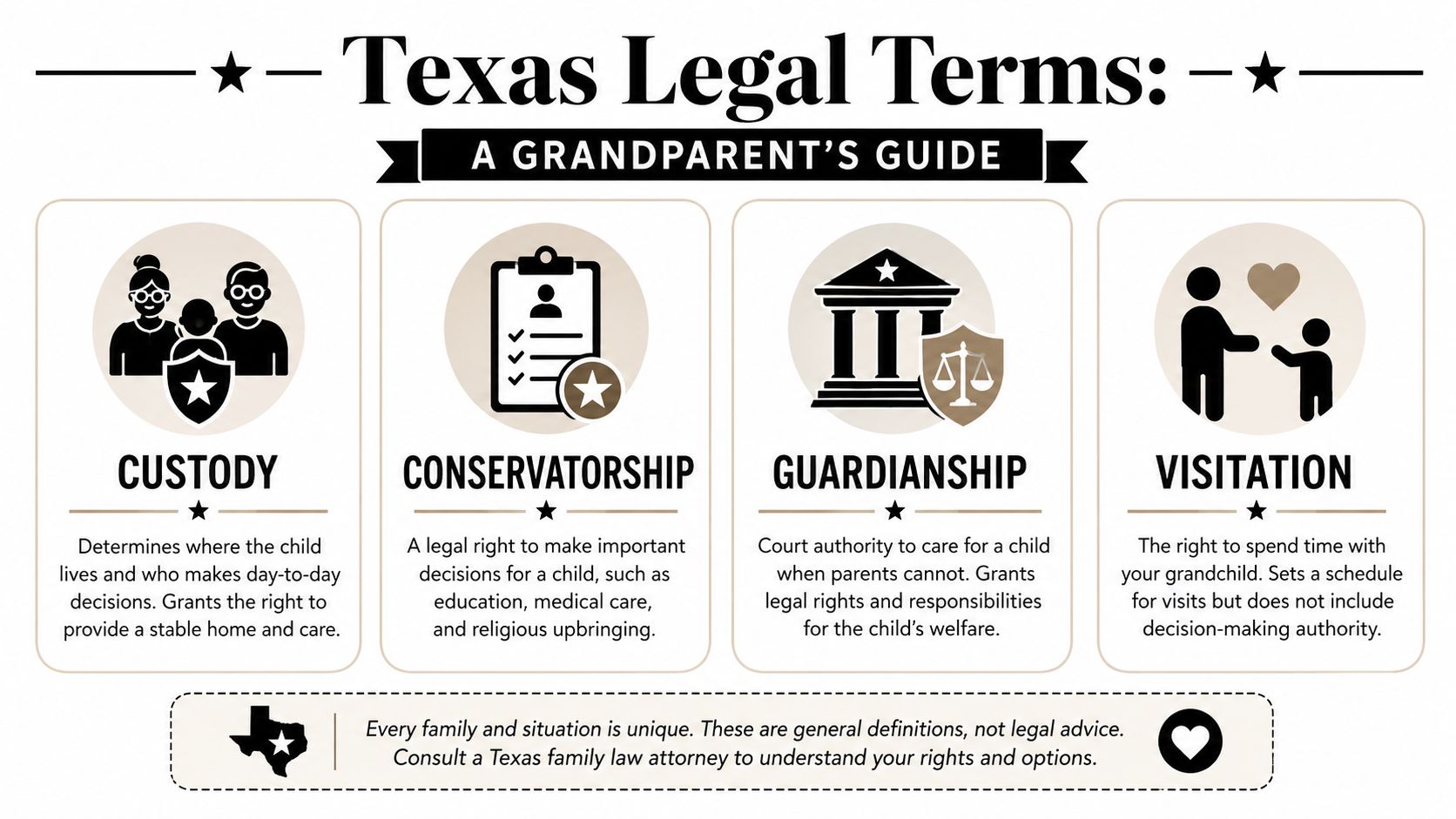
Understanding Custody, Conservatorship, Guardianship, and Visitation
People often use “custody” as a general word, but Texas family courts usually use conservatorship. The terms overlap in everyday conversation, yet they don't provide the same authority.
Conservatorship is the family-law version of custody
A managing conservator has decision-making authority for the child. Depending on the order, that authority may include decisions about education, medical care, psychological treatment, and other major needs. A sole managing conservator generally has the exclusive right to make certain decisions, while joint managing conservators share rights and duties as the court orders.
Think of managing conservatorship as serving as the child's legal captain. The court order determines whether one person makes a particular decision, whether the adults must consult each other, or whether they must follow a specific process when they disagree.
A possessory conservator has court-ordered time with the child. That time may follow a standard or customized possession schedule, and it can include conditions designed to protect the child. Possession is about when the child is physically with someone. Managing conservatorship is about legal decisions and authority. One person can have substantial possession without holding exclusive decision-making power.
Texas Family Code §153.002 says the best interest of the child is the primary consideration in conservatorship, possession, and access decisions. In plain English, the judge focuses on the child's safety, emotional health, development, stability, and relationships rather than rewarding the adult who feels most deserving. (Texas Family Code §153.002)
Visitation means possession and access
Texas often calls visitation possession and access. It gives a person time or communication with a child, but it doesn't automatically give that person power to choose the child's school, approve non-emergency medical care, or control the child's residence.
A grandparent seeking visitation usually asks for reasonable possession or access. That request is narrower than asking to become a managing conservator. The court applies separate statutory requirements, including proof that denying access would significantly impair the child's physical health or emotional well-being.
Guardianship is a different legal relationship
Guardianship generally concerns responsibility for a person or property and may arise in a probate or protective proceeding. It isn't another name for a Texas custody order. A grandparent may need conservatorship, guardianship, or both, depending on the child's circumstances and the authority the grandparent needs.
If a parent remains involved and a family-law case controls possession and decisions, conservatorship may be the more direct issue. A lawyer can help identify which court and legal proceeding fit the facts.
For families considering how parental decision-making is divided, Joint Managing Conservatorship in Texas explains the presumption favoring joint conservatorship and what that arrangement means. It doesn't mean parents split every decision equally in every situation. The order controls the specific rights and duties.
Legal Standing and Eligibility Under the Texas Family Code
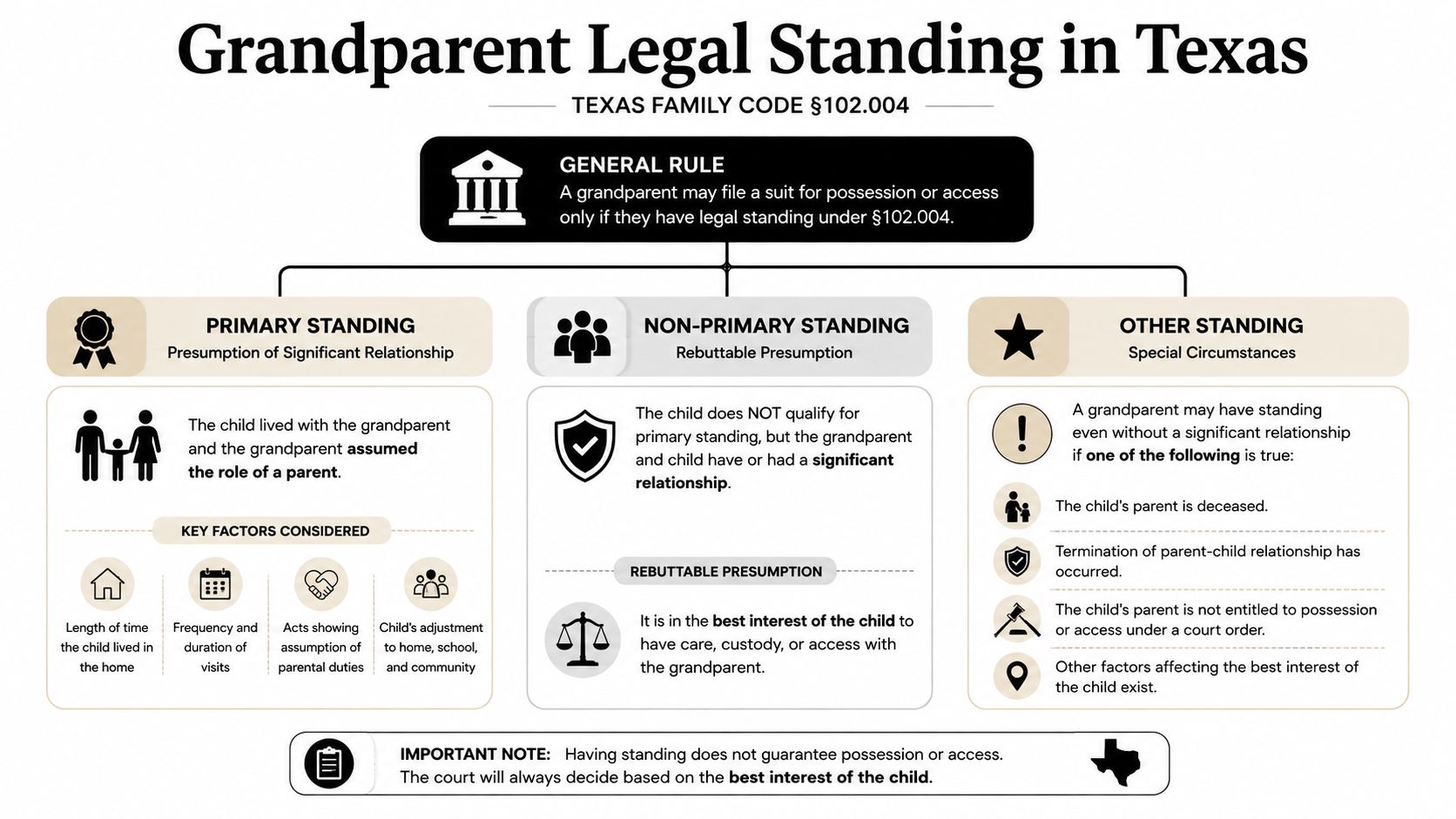
Before a judge considers whether a grandparent should receive custody or access, the grandparent must usually establish standing. Standing means you have the legal right to bring the case. Without it, the court may dismiss the filing before reaching the larger question of what arrangement serves the child.
Texas Family Code §102.004 provides a limited route for a grandparent seeking managing conservatorship. The grandparent must provide satisfactory proof that the child's present circumstances would significantly impair the child's physical health or emotional development. Another route exists when both parents, a surviving parent, or a managing conservator consents to the suit. (Texas Family Code §102.004 standing rules)
That standard asks for more than family tension, poor communication, or a grandparent's belief that the parent could do better. Evidence should connect the child's current environment to a concrete risk of physical or emotional harm. A parent's unsafe conduct, serious instability, neglect, or inability to meet essential needs may matter. General disagreement about discipline or lifestyle may not be enough.
Visitation has its own gatekeeping rules
For access-only claims, Texas Family Code §153.432 requires a biological or adoptive grandparent to file an original or modification suit with a sworn affidavit. The affidavit must allege specific supporting facts showing that denial of visitation would significantly impair the child's physical health or emotional well-being. If the facts would not support relief even if true, the court must dismiss the case. (Texas Family Code §153.432)
Section 153.433 also requires the grandparent to overcome the presumption that a parent acts in the child's best interest. The grandparent must prove by a preponderance of the evidence, meaning more likely than not, that denial of access would significantly impair the child's physical health or emotional well-being. At least one biological or adoptive parent must still have parental rights. (Texas Family Code §153.433)
The law narrows some cases based on parental circumstances, including incarceration, incompetence, death, or lack of court-ordered access. Section 153.434 also bars certain requests involving adoption or termination of parental rights. If both parents have died, Section 153.431 allows the court to consider a parent, sister, or brother of a deceased parent as managing conservator, but the court still retains discretion and must apply the broader child-centered rules. (Texas Family Code §153.431)
The 2025 standing change matters for informal caregivers
A major issue arose after September 1, 2025, when multiple legal sources described a stricter “exclusive care, control, and possession” threshold for some custody-related claims. That language replaced the earlier “actual care, control, and possession” wording. (Discussion of the Texas 2025 standing change)
This distinction matters if you cared for the child while sharing responsibilities with a parent, helping during a CPS matter, or providing informal care without a written order. Being heavily involved may not answer the legal standing question. The court may need to examine whether your role was exclusive and whether it fits the specific statutory route.
Evidence matters early: Keep school records, medical information, caregiver communications, court papers, and a dated record of the child's living arrangements. Your goal is to show what happened, when it happened, and how it affected the child.
Parents also have rights in these cases. Texas Family Code §153.131 creates a strong presumption favoring a parent as sole managing conservator, or both parents as joint managing conservators, unless that arrangement would not be in the child's best interest because it would significantly impair the child's physical health or emotional development. A mother or father facing a grandparent petition should respond carefully, preserve relevant records, and seek advice before treating the case as a private family argument.
A grandparent who needs help evaluating a third-party custody route can review information about a third-party custody suit in Texas. The details of the child's current placement and your caregiving role should be assessed under the current statute, not an outdated online summary.
Filing a Petition and Navigating the Court Process
A grandparent's filing must match the relief requested. A request for visitation is not the same as an original suit seeking managing conservatorship. If a case already exists, intervention or modification may be more appropriate than starting a separate proceeding.
Start with the correct court filing
A common starting point is a Suit Affecting the Parent-Child Relationship, known as a SAPCR. A SAPCR asks the court to enter orders concerning conservatorship, possession, access, and other parent-child issues. A modification petition asks the court to change an existing order when the legal requirements for modification are met.
The petition should identify the child, the parents and caregivers, the requested relief, and the facts supporting standing. A grandparent seeking access under Section 153.432 should prepare the required sworn affidavit with specific facts. Avoid conclusions such as “the child is better with me.” Explain the actual events, the child's condition, the parent's conduct, and the connection between denied contact and the alleged impairment.
For forms and filing concepts, you can review this resource on the SAPCR form in Texas. A form cannot replace legal analysis, particularly after the 2025 standing change.
Prepare evidence that answers the legal question
Courts need reliable evidence, not only heartfelt testimony. Organize materials that show the child's present situation and your role in the child's life.
- Daily-care records: Track school transportation, meals, appointments, medications, and overnight care.
- School information: Preserve attendance records, teacher communications, progress reports, and notices about changes in behavior or performance.
- Medical documentation: Keep appointment records and provider communications that relate to missed care, injuries, treatment, or emotional needs.
- Written communications: Save texts, emails, and messages that show parental consent, refusal of access, threats, instability, or requests for your help.
- Witness accounts: Identify teachers, relatives, counselors, medical professionals, or others who personally observed relevant events.
Don't alter messages or create a record designed to provoke a parent. Courts often respond better to calm, dated documentation than to exaggerated accusations.
Temporary orders and emergency concerns
Temporary orders can establish short-term authority or a possession schedule while the case continues. If the child faces immediate danger, ask an attorney about emergency relief and the evidence required. A serious safety concern should be described with concrete facts, dates, and supporting records.
After filing, the parents and other required parties generally must receive legal notice. The case may involve temporary-orders hearings, discovery, mediation, and a final hearing. Discovery allows parties to request information and documents. Mediation gives the adults an opportunity to reach a written agreement, but no one should sign an agreement without understanding what rights it grants or gives up.
At a final hearing, the judge evaluates admissible evidence and testimony. The order may address who makes decisions, where the child lives, and the possession schedule. The final result can differ from what a grandparent initially requested, particularly if the court finds that limited access, conditions, or another arrangement better protects the child.
Timelines, Costs, and Common Hurdles Grandparents Face
A grandparent may have cared for a child for months, yet still lack legal authority to enroll the child in school or consent to medical care. That gap explains why timing and cost depend on the legal path. Visitation, managing conservatorship, and informal kinship care are different tracks. Informal care may begin immediately, while a court case can take months or longer.
A cooperative access agreement usually moves faster than a contested request. CPS involvement, emergency allegations, multiple parties, or a trial can add hearings and delay. No attorney can responsibly promise a fixed schedule or result.
Costs depend on the facts and the work required. Expenses may include filing and service fees, attorney time, mediation, records, home studies, and expert assistance. Ask at the first consultation how billing works, which tasks you can handle, and what expenses may arise beyond legal fees.
| Case Type | Typical Timeline | Estimated Costs |
|---|---|---|
| Uncontested access agreement | Often shorter when the parents cooperate and court approval is required | Filing fees may be about $300-$400, plus attorney fees for document preparation and any service or mediation |
| Contested visitation request | Often takes longer while the court reviews standing, evidence, and the child's circumstances | Attorney fees, filing and service fees, and litigation expenses vary with the dispute |
| Managing conservatorship case | May take months or longer when hearings, evidence, and multiple parties are involved | Court costs and legal fees may be joined by investigation, records, home-study, or expert expenses |
| CPS-related kinship matter | Depends on the agency case, hearings, and placement questions | Costs vary. Ask about legal-aid options and available public benefits |
These are planning categories, not promises or market quotations. A lawyer can give a more useful estimate after learning whether there is an existing order, parental consent, CPS involvement, or an emergency.
Financial help may be limited
Texas DFPS kinship policy identifies a one-time TANF Grandparent Grant of up to $1,000 for eligible grandparents. The child must qualify for TANF, the grandparent must be at least 45, household income must be at or below 200% of the federal poverty limit, and resources must remain within TANF limits. (Texas DFPS kinship assistance information)
Benefits and custody rights are separate. Grant eligibility does not give a grandparent visitation, managing conservatorship, or decision-making authority. A grandparent can seek financial assistance while pursuing the legal filing that matches the child's living arrangement.
Common hurdles include the parental presumption, unclear informal caregiving, incomplete records, and relying on outdated explanations of standing. CPS cases add another layer. The agency's case, the parents' rights, and relative placement may proceed together while remaining legally distinct.
Next Steps and How We Can Help Protect Your Grandchild
Start by writing down the child's living history in plain language. Include when the child began staying with you, who provided daily care, whether a parent shared that care, and what has changed recently. Gather school and medical records, court orders, CPS papers, communications, and names of people who personally observed the child's circumstances.
Then identify the outcome you need. Do you need authority to make medical and school decisions? Are you seeking a predictable possession schedule? Are you asking the court to place the child with you because the current environment creates a serious risk? Those answers point toward different legal strategies.
Protect the relationship while protecting the record
Keep communication with the parents focused on the child. Avoid threats, public arguments, or promises you can't keep. If contact is denied, record the request and response without repeatedly escalating the conflict. If you believe the child is in immediate danger, seek prompt legal guidance rather than waiting for the situation to become harder to document.
Mothers and fathers should also take these cases seriously without assuming a grandparent's involvement means they'll automatically lose custody. A parent who provides a safe, stable home should gather records showing consistent care, school involvement, medical attention, and compliance with court orders. A parent facing genuine safety concerns should address them openly and obtain advice about temporary orders or protective remedies.
The Law Office of Bryan Fagan, PLLC handles Texas family-law matters involving custody, visitation, conservatorship, modifications, emergency orders, and related support issues. An attorney can help evaluate standing under the current law, select the proper filing, organize evidence, negotiate a possession schedule, and represent your position in court.
Key takeaway: Your love and caregiving already matter to your grandchild. A legal consultation helps determine how Texas law can recognize, protect, or properly address that role.
If you need help with a child custody or visitation case in Texas, our experienced attorneys can guide you every step of the way. Contact The Law Office of Bryan Fagan, PLLC today for a free consultation.
The Law Office of Bryan Fagan, PLLC can evaluate whether visitation, managing conservatorship, modification, or another kinship-care option fits your family's facts. Visit Law Office of Bryan Fagan, PLLC to schedule a free consultation and discuss how to protect your grandchild's stability and your legal position.