 Skip to content
When your child's future is on the line, understanding your rights matters most. You may be standing at the exchange location, watching the scheduled return time pass while your calls go unanswered. The panic is real, but the next legal step should be based on the correct Texas statute, the exact wording of your order, and organized evidence.
When Your Child Isn't Returned in Texas
At 6 p.m. on Sunday, a mother waits in her front yard for her child's return. The possession order sets a clear time. The other parent does not arrive, ignores her messages, and leaves her wondering whether to call the police.
That fear affects fathers, grandparents, and caregivers too. The phrase “habitually failing to return a child Texas 153.501” points to the wrong provision, and the distinction matters before you file anything. Section 153.501 is not the statute for a parent who repeatedly fails to bring a child home. It belongs to Texas's framework for preventing international parental child abduction when credible evidence suggests a child may be taken or kept outside the country. Texas Family Code Section 153.501 requires courts to consider the child's best interests, abduction risk factors, obstacles to recovery, and possible physical or psychological harm.
A repeated failure to return a child generally calls for enforcement of the possession order. Depending on the facts, that may involve habeas corpus, contempt, or a modification of custody terms. Section 153.501 becomes relevant when the conduct also indicates a risk of international concealment or nonreturn. It does not give a parent permission to recover a child without court process.
Why the distinction matters
Suppose the other parent keeps your child after a weekend visit and threatens to leave the country. You may need an immediate remedy to enforce your possession rights. You may also need preventive protections, such as travel restrictions or other safeguards, as described in our guide to an abduction prevention order under Texas Family Code 153.503.
International travel can make recovery far more difficult. Do not wait for a border crossing. Gather the order, preserve messages and call records, document the missed return, and speak with a Texas family lawyer promptly.
Practical rule: Match the legal tool to the danger. A missed exchange, a repeated withholding pattern, and an international abduction risk can occur together, but each requires a different response.
The sections that follow explain which remedies apply, what evidence supports them, and how Texas courts evaluate these disputes.
What Texas Family Code Section 153.501 Actually Says
Section 153.501 belongs to Texas's international parental child abduction prevention framework. It applies when a court has credible evidence that a parent may abduct a child internationally. The court must consider the child's best interests under Sections 153.001 and 153.002, the risk factors in Section 153.502, the difficulty of locating and returning the child from another country, and the possible physical or psychological harm to the child. The statutory text and related provisions explain why the court looks beyond a simple disagreement over visitation.
Once the evidence reaches the required threshold, the court can consider protective measures under Section 153.503. Those measures may include supervised visitation, restrictions on travel, and, in some cases, a bond intended to offset recovery costs if an abduction occurs. The statute therefore works primarily as a prevention and protection tool, not as a replacement for every enforcement filing after a missed return.
Match the problem to the tool
A parent dealing with an ordinary possession violation usually needs a court process designed to enforce an existing order. Texas law provides habeas corpus procedures when a parent with a superior right to possession seeks the child's return. Courts may also use contempt, fines, fees, jail, and a writ of attachment when the child is hidden or likely to be moved. The Texas State Law Library's guidance on denied visitation and custody describes this enforcement structure in practical terms.
| Statute / Tool | What It Covers | Typical Remedy |
|---|---|---|
| Section 153.501 | Credible risk of international parental child abduction | Preventive protections under Section 153.503, including possible travel restrictions, supervised visitation, or a bond |
| Habeas corpus | A child held in violation of a valid possession right | An order requiring return when the legal requirements are met |
| Writ of attachment | A child who may be hidden, moved, or withheld despite a return order | Law-enforcement-assisted recovery |
| Possession enforcement | Violation of specific terms in a custody or possession order | Contempt, fines, fees, jail, and other enforcement relief |
| SAPCR modification | A custody or support order that should change because circumstances changed | A revised order serving the child's best interests |
Section 153.501 also shouldn't be confused with the provision addressing habitual failure to return a child. The practical question is not which phrase appears in a search result. It's whether your facts call for prevention, immediate recovery, punishment for disobedience, or a long-term change to the order.
That distinction can save time during an emergency. A lawyer reviewing your decree can identify the controlling possession language and determine whether the facts support a habeas petition, enforcement action, abduction-prevention request, or several proceedings at once.
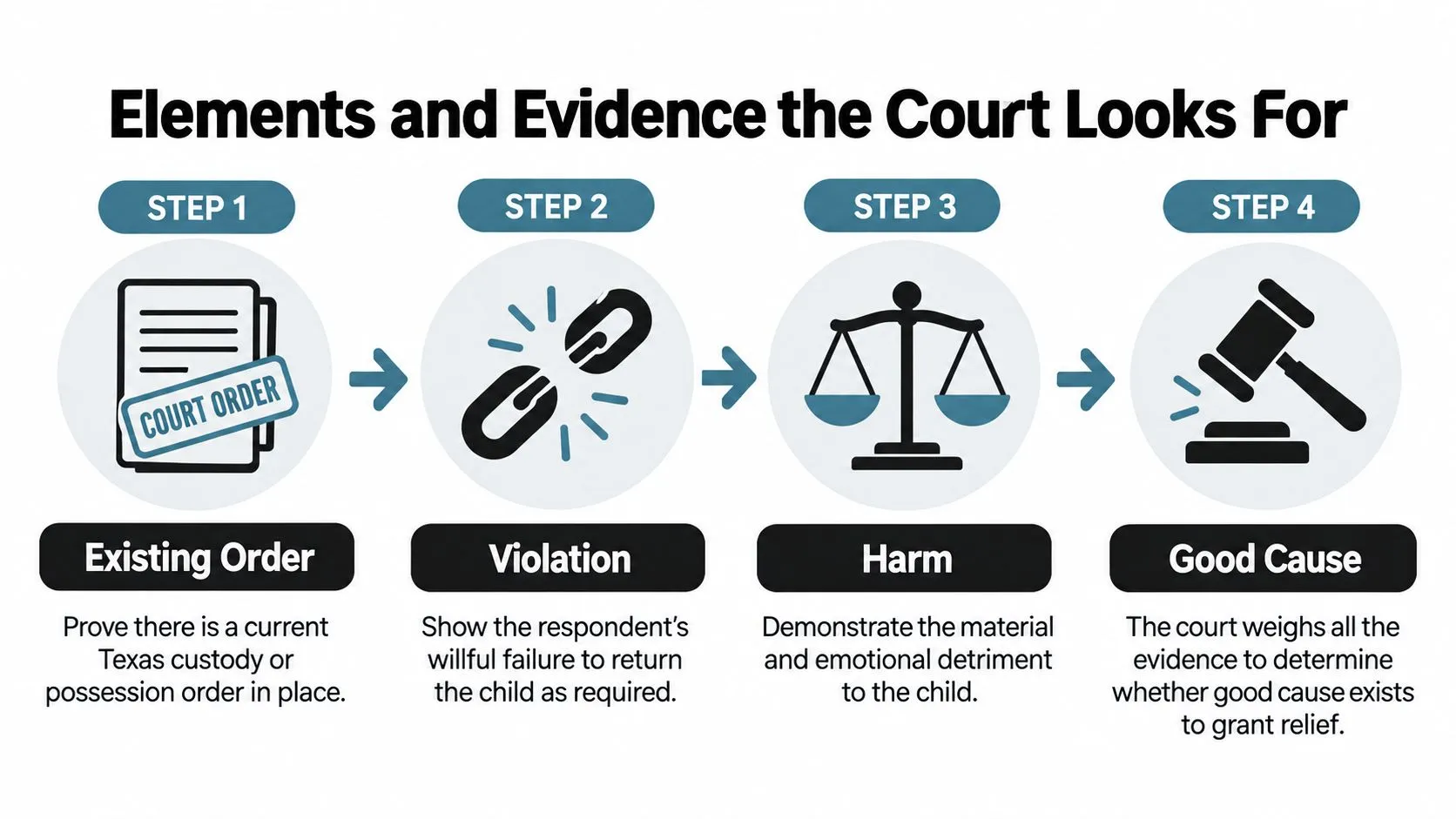
Elements and Evidence the Court Looks For
A strong case starts with the order, not with the argument. Whether you pursue an abduction-prevention remedy or a related enforcement action, the court needs a clear connection between the written possession terms, the other parent's knowledge, the missed return, and the relief you're requesting.
Four questions organize the case
First, is there a current Texas custody or possession order? Bring the final decree, temporary orders, or modification order. A judge needs to see the exact exchange date, time, location, transportation responsibility, and any conditions attached to the possession period.
Second, did the other parent know the terms? Service of the order, participation in the case, signed agreements, messages discussing the schedule, and prior compliance can help establish knowledge. A parent who claims confusion about a plainly written exchange term faces a weaker position when the communication history shows repeated discussion of it.
Third, was the conduct knowing or intentional? A delayed return caused by a documented emergency differs from a parent who turns off the phone, changes locations, and refuses to disclose where the child is. Intent is often shown through the pattern surrounding the missed return, not through one angry message.
Fourth, did the act violate a specific possession period? Judges need dates and provisions. “He never follows the schedule” is less useful than a dated entry showing the child was due back under a named paragraph and wasn't returned.
Use the evidence that matters most in a Texas custody case as a practical guide while organizing your file.
Evidence that helps and evidence that hurts
Strong evidence is usually ordinary, time-stamped, and easy to verify:
- The written order: Highlight the precise possession and return provisions.
- Contemporaneous messages: Preserve texts, emails, parenting-app messages, and call records.
- Exchange witnesses: Identify people who saw you arrive, wait, or attempt the handoff.
- School or daycare records: These may help establish where the child was and who handled pickup.
- Calendar entries: Record each missed return, the scheduled time, the response, and the steps you took afterward.
Vague recollections, social-media posts without context, and testimony about an isolated argument carry less weight. Don't edit screenshots, delete unfavorable messages, or exaggerate the number of missed exchanges. Credibility is evidence.
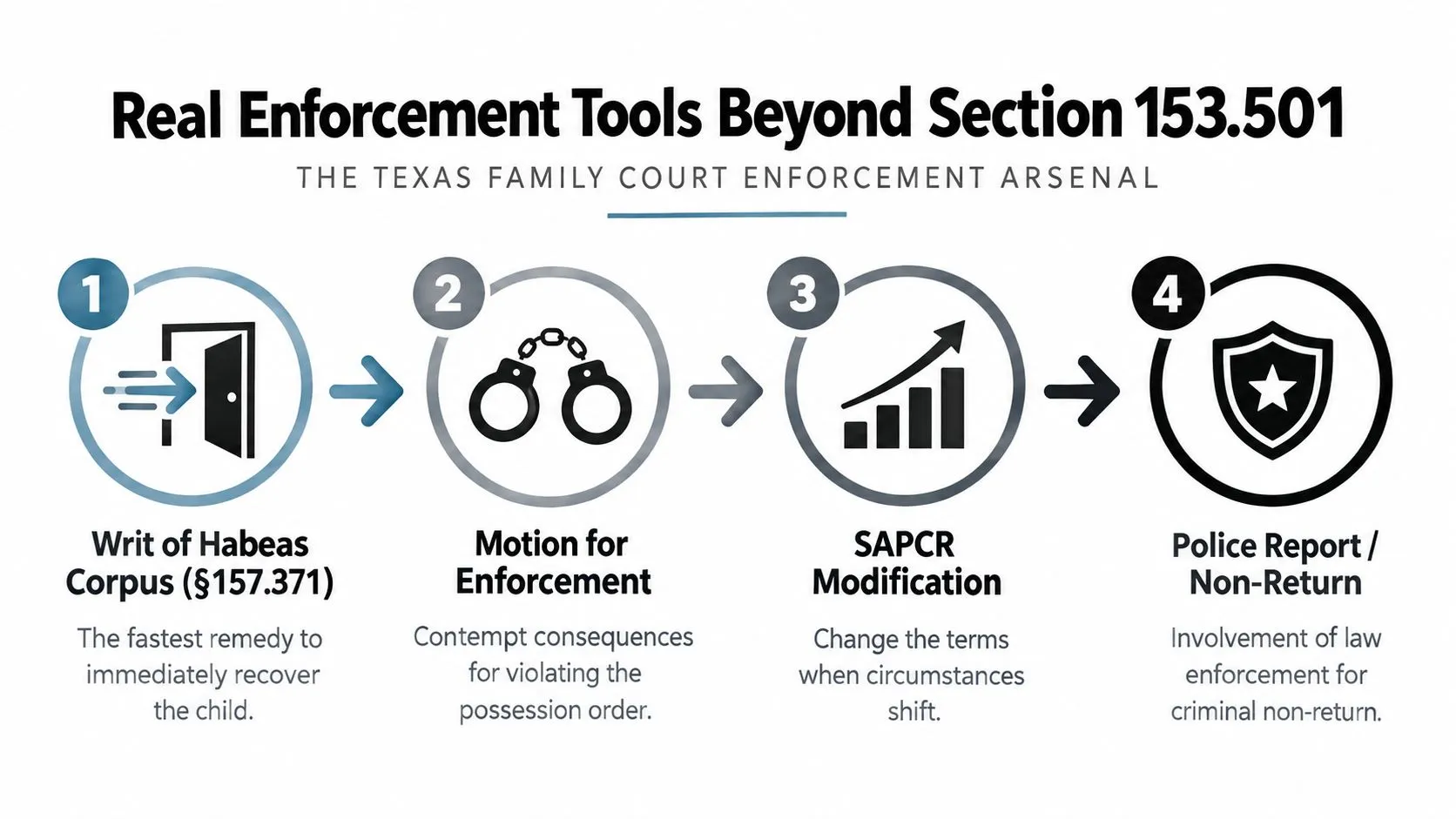
Real Enforcement Tools Beyond Section 153.501
When a child isn't returned, Texas parents often need a remedy that produces action, not merely a finding that the other parent acted improperly. The available response depends on the urgency, the wording of the existing order, the child's location, and the risk that the child will be hidden or moved.
Immediate recovery
A writ of habeas corpus can be used when a parent has a superior right to possession and the other party is illegally keeping the child. Texas Law Help explains that the court must order return in the applicable circumstances unless a serious, immediate welfare issue exists or the petitioner previously relinquished possession for at least six months before filing. Texas Law Help's explanation of a refused return also describes a writ of attachment when the child may be moved or hidden and a simple return order may not be enough.
A writ of attachment is more forceful than a paper instruction. It can direct law enforcement to assist with locating and recovering the child or, depending on the order and circumstances, apprehending a withholding party. This is why delay can matter. If you believe the child is being concealed or transported, tell your attorney immediately rather than treating the matter as a routine schedule dispute.
Accountability and long-term change
A motion for enforcement can ask the court to find contempt for violating specific, enforceable terms. Contempt may lead to fines, fees, or jail, and the court may also address makeup possession. Your filing should identify each violation separately instead of relying on broad accusations.
Repeated interference may also justify a custody modification. Texas modification law requires both a finding that the change serves the child's best interests and a threshold ground, such as a material and substantial change in circumstances. A request to change the primary residence or possession schedule needs more than frustration with the current order.
Recent Texas coverage describes House Bill 3181 as creating stronger consequences after three contempt findings for denying possession, including mandatory doubled makeup time, no probationary workaround, and treatment of the conduct as a material change for modification. Coverage of the 2026 Texas family law update should be reviewed carefully with counsel because procedural details and implementation can affect strategy.
For a practical overview of filing and preparing an enforcement case, see how to enforce a custody order in Texas step by step. If the problem is no longer a single violation and the existing order no longer protects the child's stability, Modifying a Texas Custody Order explains when and how an existing custody order can be changed.
Common Defenses in Texas Possession Disputes
Not every missed return supports contempt, and not every safety concern excuses withholding a child. Texas judges examine the specific facts, the order's language, and the parent's conduct before and after the missed exchange.
| Defense Claimed | Strength | Why Courts Accept or Reject It |
|---|---|---|
| Reasonable belief of immediate danger | Potentially strong | A narrow, evidence-heavy defense may matter when the parent can show a serious and immediate welfare concern, not a general fear |
| Confusion about time or location | Limited to moderate | A genuine misunderstanding may reduce blame when the order is unclear and the parent communicated promptly |
| Child didn't want to go | Usually limited | A child's preference can be considered, but it rarely cancels a clear possession right |
| General safety concerns | Usually weak | Broad allegations without records, witnesses, or specific facts don't justify unilateral withholding |
| Repeated late exchanges or schedule changes | Weak | A pattern suggests intentional interference rather than an isolated mistake |
A parent who claims immediate danger should preserve the facts supporting that belief. Medical records, messages, school information, witness accounts, and timely reports are more useful than a later statement that the parent "felt unsafe." If the concern was real, explain what happened and seek an emergency court order instead of unilaterally creating a new custody schedule.
The child's preference
Texas courts may interview a child in chambers when the statutory requirements are met, including the child being at least 12 and expressing a preference. That conversation isn't an automatic veto. A child's wishes can inform the judge's decision, but the existing order remains enforceable unless the court changes it.
Good-faith mistakes should be handled differently from a pattern of unilateral decisions. A parent who immediately communicates, offers a replacement exchange, and follows the order going forward presents a different credibility picture from a parent who repeatedly changes return times, refuses contact, and expects the other parent to accept the new arrangement.
Evidence and Documents to Start Collecting Now
Start with the controlling order. Find the signed final decree, divorce decree, temporary orders, or SAPCR order, and include any Standard or Modified Possession Order attached to it. Don't rely on memory or a prior lawyer's summary. The exact paragraph may control the exchange time, location, holiday schedule, transportation duty, and notice requirements.
Build a clean chronology
Create one document with a separate entry for every incident. Include the scheduled possession period, the required return time, where the exchange was supposed to happen, when you arrived or contacted the other parent, what response you received, and where the child was ultimately located.
Preserve original communications rather than forwarding only selected lines. Export parenting-app records when possible, save emails as complete messages, retain voicemail files, and keep screenshots that show dates and participants.
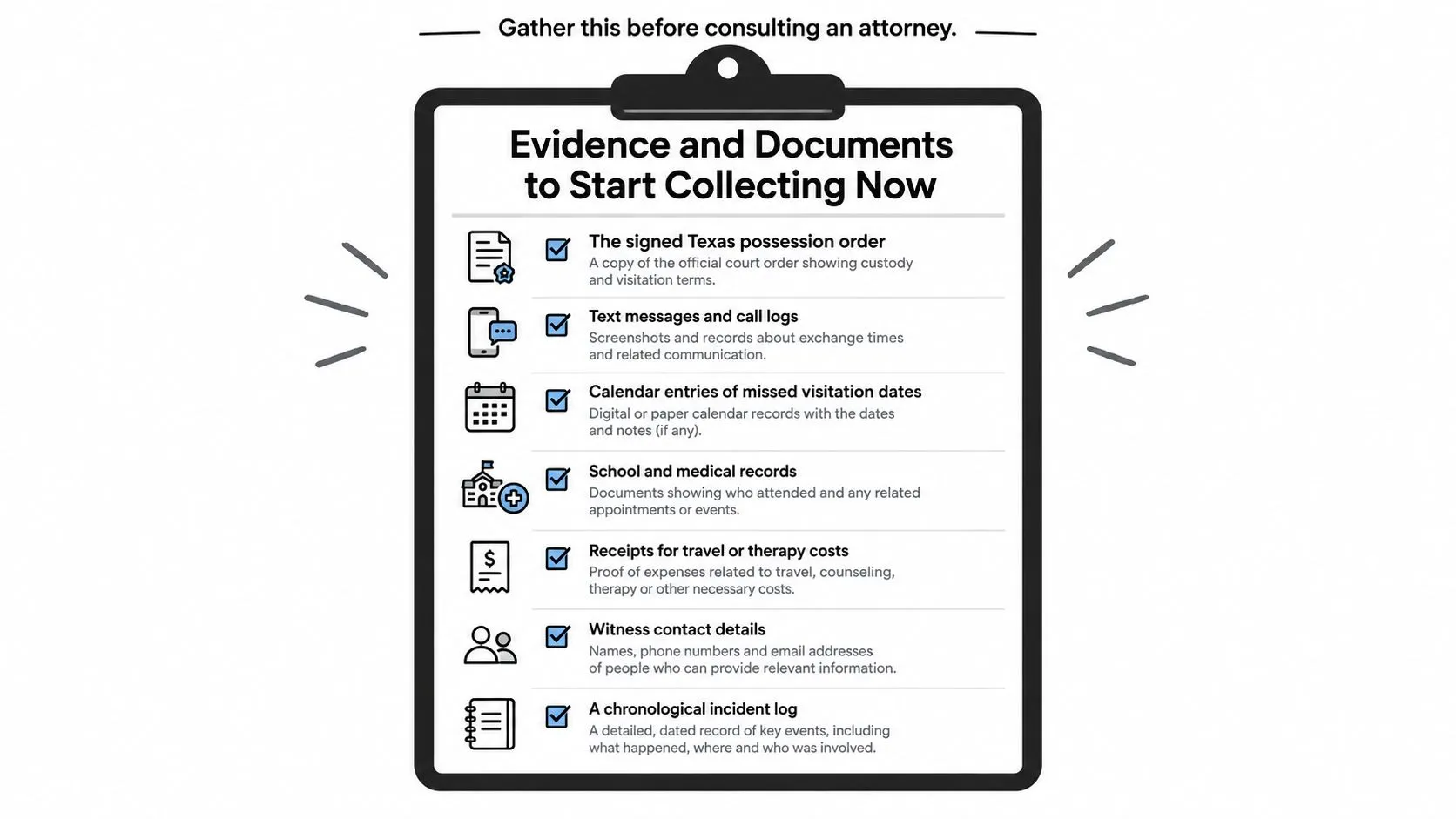
Your working file should include:
- The signed possession order: Mark the provisions the other parent allegedly violated.
- Communication records: Gather texts, emails, parenting-app messages, call logs, and voicemail.
- Missed-visit calendars: Note every scheduled and missed exchange in date order.
- School and medical records: Preserve documents showing attendance, pickup, and routine care.
- Receipts and travel records: Keep materials connected to transportation, therapy, or other disputed events.
- Witness information: Record names, phone numbers, and what each person personally observed.
- Incident reports: Save 911 information, police incident numbers, and relevant CPS records.
Photographs or videos of the child's room and belongings can help show routine and readiness for possession, but don't use them to provoke the other parent or expose the child online. Keep the file private, factual, and easy for an attorney or judge to follow.
Your Practical Path Forward in a Texas Custody Case
Choose the filing based on the immediate problem. A private demand letter may be appropriate for a minor delay or a genuine misunderstanding, especially when the child is safe, the other parent is communicating, and the order's terms are unclear. The letter should identify the violated provision, request a specific return, preserve your right to seek relief, and avoid threats you don't intend to carry out.
Escalate quickly when the child is hidden, the other parent threatens travel, communication stops, or the refusal is deliberate. A habeas corpus request focuses on recovery. A motion for enforcement focuses on proving violations and seeking contempt or makeup possession. A request under the abduction-prevention framework focuses on credible international risk and protective conditions.
Decide whether enforcement or modification fits
Enforcement addresses the past. Modification addresses the future.
Texas custody modification law requires the requested change to serve the child's best interests and requires a qualifying trigger, including a material and substantial change in circumstances, a child's qualifying preference, or a voluntary surrender of primary care and possession for the required statutory period. Texas Law Help's explanation of modification standards explains why best interests alone isn't enough.
A SAPCR is the case type used to establish or modify custody and support orders. The Texas State Law Library explains that a parent seeking to change an order from a SAPCR must file for modification in court, even when both parents agree that the schedule should change. The State Law Library's SAPCR modification guide provides useful procedural context.
House Bill 3181's reported changes may affect how repeated possession denials are documented and argued, especially after contempt findings. Don't assume a new rule replaces the need for a precise order, proper service, and admissible evidence. A lawyer can also evaluate whether conduct should be referred for possible criminal interference under Penal Code Section 25.03.
Protect the record on your timetable
In the immediate days, preserve the order, document the incident, make a safety-based decision about police contact, and speak with counsel. Over the following weeks, maintain the chronology, follow your own possession terms exactly, and avoid retaliatory withholding. Over the longer term, assess whether enforcement is correcting the problem or whether the child needs a different schedule, residence arrangement, or protective order.
Parents who use digital tools to organize signed parenting terms may also find resources that help them manage personal legal agreements, but a private agreement doesn't replace a court-approved modification when enforceable custody rights must change.
Choose an attorney who regularly handles Texas possession enforcement, emergency custody matters, contempt, and modification. Ask how the lawyer would classify your facts, what evidence is missing, and whether the immediate goal is return, protection, accountability, or a revised order. Retainer amounts vary by attorney and case, so request the fee agreement in writing rather than relying on a verbal estimate.
Frequently Asked Questions About Section 153.501
Is Section 153.001 or Section 153.501 the enforcement statute?
Neither is the ordinary possession-enforcement provision. Section 153.001 states Texas's public policy favoring frequent contact when consistent with the child's best interests, while Section 153.501 addresses credible international abduction risk. A parent seeking return or contempt usually needs the possession-enforcement and habeas corpus procedures discussed earlier.
Does Section 153.501 remove the other parent's custody rights?
Not automatically. It can support protective measures under Section 153.503, including supervised visitation, travel restrictions, or a bond, but the court still evaluates the child's best interests and the evidence of risk. The provision may affect how possession occurs without automatically terminating conservatorship.
How does Texas calculate “habitual” failure?
Don't assume the phrase creates a simple universal formula. The applicable enforcement claim depends on the statute, the order, and the facts showing repeated or intentional violations. Section 153.501 itself is focused on credible international abduction risk, not a fixed count or automatic time window.
Can a parent recover attorney fees after successful enforcement?
Texas Family Code Section 157.167 may support attorney-fee recovery in an enforcement action when the statutory requirements are met. Fees aren't automatic in every dispute, and the court still considers the findings, pleadings, proof, and relief granted. Reported HB 3181 changes may also affect the consequences of repeated possession denials, so counsel should review the current law before filing.
If you need help with a child custody or visitation case in Texas, our experienced attorneys can guide you every step of the way. Contact The Law Office of Bryan Fagan, PLLC today for a free consultation. For personalized help with a child not returned, emergency recovery, contempt, or custody modification, visit Law Office of Bryan Fagan, PLLC.


