 Skip to content
When you're trying to get kids out the door, make a school pickup, answer work emails, and still fit in a civic duty, voting can feel like one more moving part in an already crowded day. That's why hour by hour: election periods & schedules matters for Texas families, because the calendar is really a family logistics problem. The good news is that once you break the process into a few clear checkpoints, the whole thing gets much easier to manage.
What Election Periods Really Mean for Texas Families
A lot of parents hear “election period” and picture one Tuesday marked on the calendar. In practice, it stretches across several checkpoints, more like a family schedule than a single appointment. If you have ever lined up school drop-off, a pediatric visit, and a late work shift, the rhythm is familiar, some tasks happen early, some happen later, and some need a backup plan.
A voting calendar, not a voting day
The election period covers the steps that lead up to voting, the days when you can vote before Election Day, the day itself, and the administrative work after the polls close. That matters for Texas parents because custody exchanges, daycare pickups, and work schedules do not wait for a neat ballot window. A parent who cannot leave work at noon may still be able to vote before school pickup, after a shift, or during a planned early-voting slot.
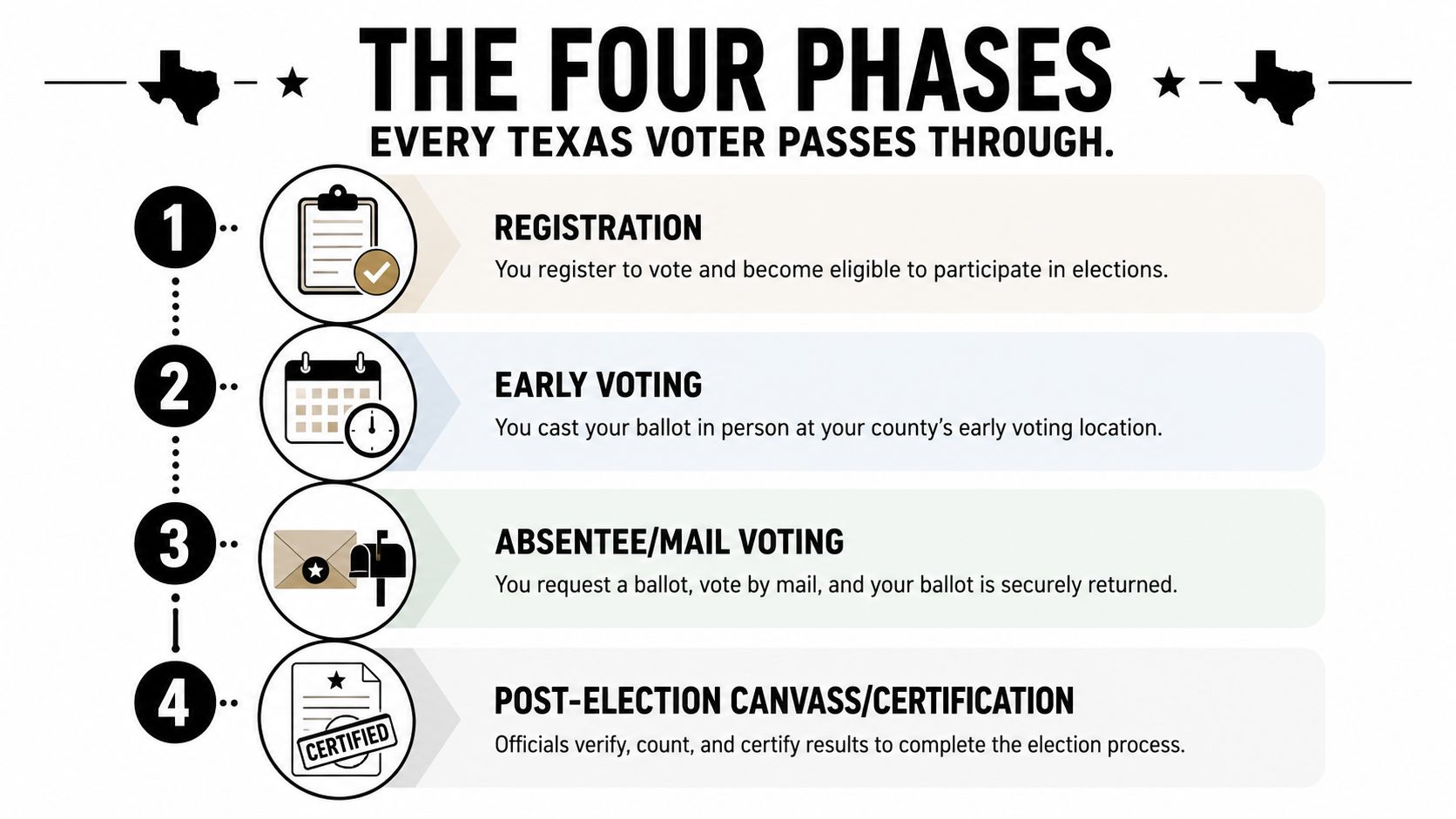
The process has four practical phases. First comes registration, then early voting, then any mail ballot process that applies, and finally the counting and certification stage after Election Day. Each phase has its own deadline, and each one can shape when a busy family can act.
Practical rule: Do not treat voting like a one-hour errand. Treat it like a short family project with checkpoints, and the stress drops fast.
For Texas parents who also deal with custody schedules, the same planning mindset helps with voting deadlines. If you want another example of how timing and legal planning can overlap in family life, this custody and military-orders example shows how families often have to plan ahead around fixed dates and changing routines.
The Four Phases Every Texas Voter Passes Through
The cleanest way to understand election timing is to break it into the same kind of sequence you'd use for a school year. There's enrollment, there's the open window when things happen, there are special access options, and then there's the final recordkeeping at the end. Voting works the same way, just with more legal deadlines attached.
Registration comes first
Registration is the step that makes you eligible to vote in the place where you live. For a parent, that can be as simple as updating an address after a move or after a custody-related housing change. If your home base changed, the first question is whether your registration still matches where you live.
Early voting gives families more room
Early voting is the flexibility valve in the system. Instead of squeezing everything into one election day, it gives parents more than one chance to fit voting around work, childcare, and transportation. In family terms, it's the difference between trying to make one exact bedtime routine work forever and having a few evening options when life gets messy.
Mail voting serves specific situations
Mail ballots are usually for voters who qualify under state rules, and they come with their own request and return timeline. The important thing for parents is that a ballot request deadline is not the same thing as Election Day itself. If you miss the request window, you may lose the mail option even though you're still allowed to vote in person.
Canvass and certification finish the process
The last phase is the formal accounting of results. That's the part most voters never see, but it matters because it's where election officials review the totals and finalize the outcome. In a school analogy, it's the report card after the semester ends, not the class period itself.
If you like seeing how a child-related legal issue can turn on a narrow timing question, Does a Child Get to Choose Which Parent in Texas? is a straightforward resource on how a child's wishes factor into a Texas custody decision.
Texas Polling Hours and Deadlines at a Glance
Texas families often need the voting calendar in plain view, because school drop-off, work shifts, and custody exchanges do not leave much room for guesswork. A quick reference helps parents treat voting like any other fixed appointment, something to fit around lunch, pickup, or the drive home. Texas Election Day polls open at 7:00 a.m. and close at 7:00 p.m., and early voting gives families a wider practical window than Election Day alone.
| Phase | Typical Window | Notes for Parents |
|---|---|---|
| Registration | Varies by election calendar | Update your address early if a move changed where you live. |
| Early voting | Before Election Day | Best option when your workday, pickup schedule, or caregiving duties are tight. |
| Election Day voting | 7:00 a.m. to 7:00 p.m. in Texas | A before-work or after-school option if you cannot vote earlier. |
| Mail ballot requests and returns | Set by election rules | Good for eligible voters who need more flexibility, but deadlines matter. |
The simplest way to use this chart is to treat voting like a family logistics task. If the week is already full, do not wait for Election Day to be your first plan. Put voting on the same mental calendar you use for soccer practice, doctor visits, and custody exchanges.
Parents also run into timing questions outside elections, especially during divorce or modification cases. In that setting, how a child's wishes factor into a Texas custody decision can matter when families are already working around tight schedules and changing homes. The legal issue is different from voting, but the planning habit is the same, know the date, know the deadline, and do not assume you can fix it later.
Family-friendly takeaway: When your week is crowded, the best voting plan is the one you can actually keep, not the one that looks easiest on paper.
An Hour by Hour Look at Texas Election Day
Election Day in Texas runs on a fixed legal clock. Under Texas polling rules, polls open at 7:00 a.m. and close at 7:00 p.m., which gives parents a full day to work voting into real life, whether that means a quick stop before work or a stop after pickup and dinner. The key is to pick the part of the day that creates the least disruption at home.
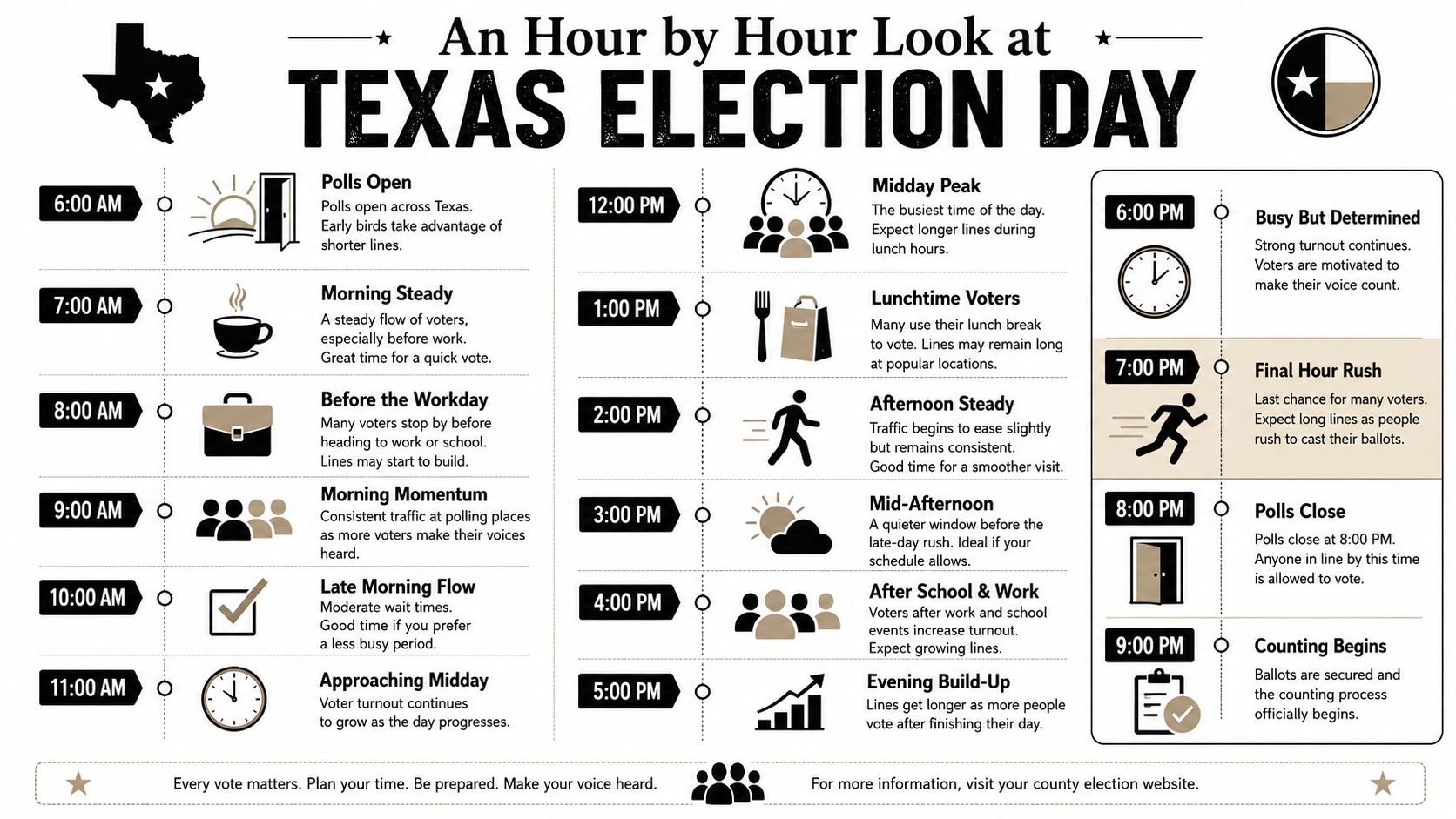
The morning is usually the easiest fit for parents who can move before the day gets away from them. If your house is calm before school drop-off, that can be a good time to vote and then get on with the rest of the day. A lunch break can work too, but only if your polling place is close enough that the round trip doesn't turn into a panic.
By late afternoon, the question changes. For many families, that's the window between work and evening activities, so it can be the hardest time to leave the house. Parents often do better if they vote either early in the morning or right after the workday ends, before dinner and homework start stacking up.
Texas also has a simple but important protection at closing time. If you're already in line when the polls close, you're supposed to be allowed to vote. That rule matters because life doesn't always line up with the clock, and a caregiver who arrives at 6:58 p.m. shouldn't be turned away just because the line moved slowly.
The after-hours part of Election Day is mostly about election officials handling the process, not voters making last-minute choices. Once the polls close, officials move into the counting and review stages. For families, that means the day's voting window is over, but the election process itself is still moving forward behind the scenes.
A good rule for busy parents is to treat the 7 a.m. opening like the first school bell and the 7 p.m. closing like the hard stop before bedtime. If you know your household's natural rhythm, you can usually spot the least stressful slot without overthinking it.
Why Weekend, Time Zone, and Closing Rules Matter
A family's voting plan can fall apart over small timing details. A parent may have the right address, the right day, and a clear intention to vote, yet still run into trouble if weekend hours are limited or if the local rules treat closing time differently than expected. Weekend early voting is not handled the same way everywhere, and a schedule that looks simple on paper can become harder to use once school pickup, work shifts, and dinner prep enter the picture. A research review on weekend voting access in 2024 found uneven access across states, which helps explain why a general “polls are open” message does not always tell the whole story.
Closing time is not always the whole story
If a polling place closes at a set hour, the important detail is whether you made it inside the line before that cutoff. In some places, being in line when the polls close still protects your right to vote, so the printed end time is not the only rule that matters. That distinction matters for parents who are coming from work, school pickup, or a commute that does not leave much room to spare.
A closing bell at school ends the day for students, but voting rules can give people already waiting their turn a little more room. That is why a parent who arrives right before the deadline should know the local line rules instead of assuming the doors shut the moment the clock flips.
Time zones can change the effective window
Texas does not use the same time-zone structure as Canada, but Canada offers a clear example of how election hours can be set across a large geography without treating every voter the same. Under Canadian federal law, election-day hours vary by time zone, from 8:30 a.m. to 8:30 p.m. in the Newfoundland, Atlantic, and Central zones, 9:30 a.m. to 9:30 p.m. in the Eastern zone, 7:30 a.m. to 7:30 p.m. in the Mountain zone, and 7:00 a.m. to 7:00 p.m. in the Pacific zone. That kind of structure shows why the same clock time can mean something different depending on where the voter is standing.
A family that lives near a time-zone line can feel this difference in practical terms, even when the voting rule itself is straightforward. If one parent is trying to leave work early and another is handling after-school pickup, the usable window may feel shorter than the posted hours suggest.
The key question isn't just, “What time do polls close?” It's, “What rules apply if I'm still in line when the clock hits closing?”
For Texas families, the better habit is to look past the headline hours and ask how the local rule works in practice. That matters if you are coordinating with a co-parent, traveling for work, or trying to fit voting into a day that already has too many moving parts, including moving pets during a PCS and checking whether a child relocation plan may affect your address, as explained in this guide on moving out of state with a child in Texas.
Practical Tips for Parents, Military Families, and Movers
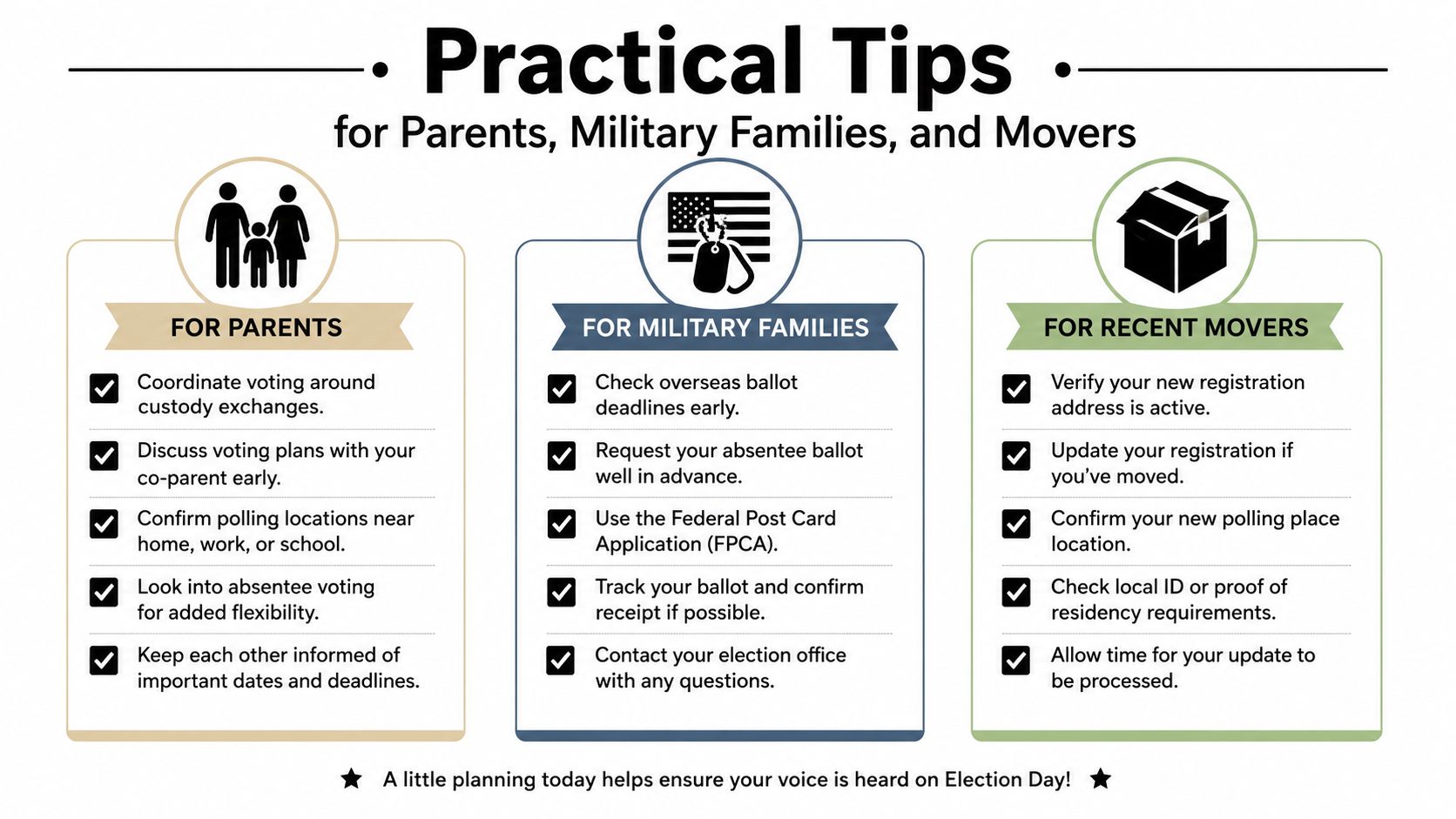
Families don't all move through election season the same way. A parent handling custody exchanges, a grandparent helping with school pickup, and a military family managing orders all face different timing problems, but the solution starts the same way, make the calendar concrete and check the address rules early. If you're juggling a lot, voting needs to sit on the same list as appointments, practice schedules, and pickup times.
For parents
- Use early voting around custody exchanges: If your child swap happens after school or on weekends, vote during the quieter part of the week.
- Keep your polling place in mind when planning childcare: A short trip is easier than a cross-town errand with a toddler in the car.
- Check your schedule before Election Day: The earlier you vote, the less likely a work or parenting conflict will push you past closing time.
For military families
- Start the ballot process early: Deployment, training, and relocation can compress the time you have to act.
- Track your mailing address carefully: A Texas family can lose time if paperwork goes to an old residence.
- Use trusted moving resources: If your family is dealing with PCS logistics and even needs help with the practical side of relocation, a guide like moving pets during a PCS can be one more reminder that every moving piece needs a plan.
For recent movers
- Verify your registration after a move: Even a move within the same county can change what you should update.
- Match the address you use with where you live: That keeps you from showing up at the wrong place on Election Day.
- If custody issues overlap with relocation, get the legal side right too: Moving Out of State With a Child in Texas is relevant when a move affects where a child lives and how a family coordinates schedules.
Good planning beats last-minute scrambling. The families who feel most settled on Election Day usually aren't the ones with the most free time, they're the ones who check details early.
If your move, military orders, or custody arrangement changes where and when you can vote, the same kind of careful timing applies to legal relocation questions as well. The request to move with a child is not the same as updating a voter address, but both can affect where your day begins and ends, which is why how to request permission to relocate with a child in Texas can be useful background for parents managing both family and logistics at once.
Common Pitfalls That Catch Texas Parents Off Guard
A busy parent can do everything else right and still get tripped up by one small voting detail. The usual problems are familiar. A move changes the precinct, but the address on file never gets updated. A work schedule shifts, and the registration deadline has already passed. A mail ballot is filled out, then set aside with a missing signature on the outer envelope.
Those mistakes are frustrating because they are easy to avoid once you know what to check.
- Wrong precinct after a move: Confirm where you are registered before you leave home, especially if a custody-related move changed where your family now lives.
- Missing the registration cutoff: Do not assume an address change updates your record automatically. If you moved recently, check whether your voter registration needs to be revised.
- Unsigned mail ballot envelope: Read the return instructions all the way through before sealing the packet.
- Waiting too long to vote: If your week is packed with school pickup, overtime, or childcare, early voting gives you more room than relying on Election Day timing.
Another common mistake is assuming a poll worker can fix everything at the door. Poll workers can answer questions and follow the rules that apply at the polling place, but they cannot change deadlines or ignore paperwork requirements. That makes a quick pre-check the safest habit, especially for parents who are already juggling a full family calendar.
A move can raise the same kind of timing questions in family law too. Voting logistics, custody schedules, school routines, and relocation decisions often overlap, and that overlap can make a parent's day feel tight before it even starts. For families sorting through those issues, the guidance in how to request permission to relocate with a child in Texas can help put the voting calendar in a wider family context.
Key Takeaways and Next Steps for Your Family
The biggest lesson is simple. Election timing is a family calendar issue, not just a government schedule. If you know the registration rules, use early voting when your week is crowded, and keep an eye on closing-time protections, you can usually fit voting into real life instead of trying to build life around one narrow hour.
If custody, relocation, or military logistics are making the schedule harder to manage, you don't have to sort it out alone. A family law attorney can help you understand how timing, residence, and parental responsibilities affect your options.
The Law Office of Bryan Fagan, PLLC helps Texas families with custody, visitation, relocation, and other legal timing issues that affect daily life. If your voting plans are getting tangled up with a custody schedule or a move, visit Law Office of Bryan Fagan, PLLC to learn more and schedule a free consultation for personalized guidance.


