 Skip to content
When your child's future is on the line, understanding how a judge thinks matters more than guessing what the courtroom will care about. If you're standing in a Texas courthouse with school records, medical notes, and a stomach full of worry, you're probably asking the same question every parent asks at that moment, how does a judge decide custody in Texas? The answer starts with Texas Family Code Chapter 153, where the child's best interest controls, then moves through the practical evidence that shows a judge what life really looks like for your child.
Parents often expect a custody fight to turn on who has the bigger house, the louder argument, or the strongest preference. Texas law doesn't work that way. Courts anchor custody decisions in the child's best interest, apply the Holley v. Adams framework, and then weigh the full picture case by case, without favoring mothers over fathers or fathers over mothers based on gender (Texas best-interest standard and Holley framework). If you also need outside support while handling a family emergency, a trusted Texas detention support network can be a useful place to look when a separate legal crisis is adding stress at home.
When Your Child's Future Is on the Line
A parent standing in a Harris County courthouse is usually not thinking about legal theory. They are wondering whether the judge will really look at the folder of school notes, doctor visits, and text messages, or whether the other parent's polished story will carry more weight. That fear makes sense, because a custody hearing feels intensely personal even while the court is applying a legal rule.
Texas custody cases fall under Chapter 153 of the Family Code, and the judge's task is to decide what serves the child's best interest. The judge is not picking a preferred parent. The judge is comparing evidence to see which arrangement better supports the child's safety, routine, emotional security, and development.
Practical rule: the strongest custody case usually comes from everyday proof, not dramatic claims.
That is why parents often feel surprised when the judge seems to care more about patterns than about who sounds more convincing in the courtroom. A parent who handles school pickups, keeps medical appointments, and stays involved in daily routines may not think those acts matter much, but those details often show the court who has been doing the steady work of parenting.
A custody case becomes easier to understand once you focus on the child's actual day-to-day life. Who gets them to school. Who follows up with teachers. Who remembers the dental appointment. Who keeps the home steady on ordinary days. If you need a basic primer on the family-law setting while you are gathering your thoughts, the Texas Child Custody Lawyer resource explains representation in conservatorship, possession, and access matters under Chapter 153. If a separate legal crisis is adding pressure at home, a trusted Texas detention support network can be a useful place to look for support.
Understanding Custody Terms Texas Courts Use
Texas parents often say “custody” when they mean several different legal rights and schedules. The court usually uses the word conservatorship, which is the bundle of rights and duties a parent receives. It is the legal framework for deciding who can make certain choices about the child's life and who must share those choices with the other parent.
Conservatorship and possession in plain English
Conservatorship covers decision-making authority, while possession or access covers the parenting-time schedule. A simple way to separate them is this, conservatorship answers who can decide, and possession answers when each parent has the child. That difference matters because a parent can hold important legal rights without having the child every day.
Texas courts often name both parents as joint managing conservators, which means they share rights and duties. Shared conservatorship does not automatically mean equal time. One parent can still receive the exclusive right to determine the child's primary residence, even when both parents share joint managing conservatorship.
Joint managing conservatorship is shared authority, not automatic 50-50 time.
The schedule itself is the possession order. Many parents still call it visitation, but possession is the more accurate term because it describes the actual periods of time the child spends with each parent. If you are reading an order for the first time, possession works like the calendar, and conservatorship works like the decision-making chart.
The best interest standard
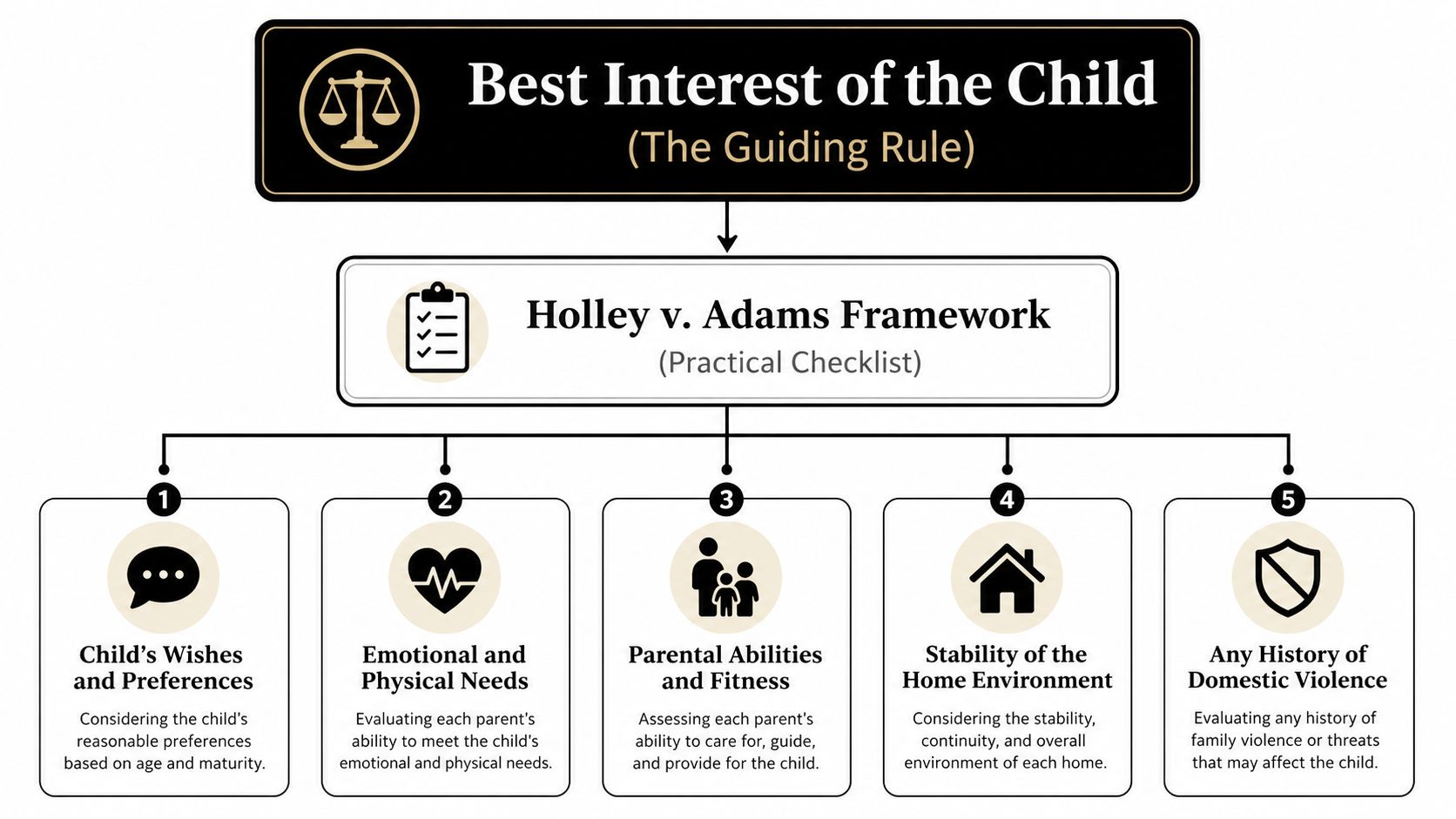
The court's guiding rule is the best interest of the child. That standard works like a compass, it points the judge toward the child's needs rather than either parent's preferences. Texas judges apply that rule to mothers and fathers on equal legal footing, so gender alone does not decide anything.
For a visual overview, the framework below is a helpful reference.
If you prefer video format, this short overview can help you hear the concepts in a different way.
Parents who want a plain-language explanation of the best-interest framework can also use the top considerations for determining the best interest of the child in Texas custody cases.
The Best Interest Standard and the Holley Factors
A custody case can look like a fight over which parent gets more time, but the judge is really answering a simpler question. Which arrangement gives the child the steadiest path forward, at home, at school, and in daily life? Texas courts answer that question through the best interest of the child standard, then use the Holley v. Adams factors to organize the evidence in a practical way. The goal is not to crown a perfect parent. It is to choose the arrangement that fits the child's needs now and in the future (Holley framework and best-interest analysis).
What judges look for
The Holley factors help judges test the story parents tell against the facts that show up in real life. They point the court toward the child's needs, any danger to the child, each parent's caregiving ability, home stability, school and community ties, and the child's preference when the child is old enough to be interviewed. They also leave room for the judge to consider excuses for parental conduct and to weigh the evidence as a whole. No single factor decides the case by itself, which is why records from ordinary routines matter so much (Holley factors in Texas custody cases).
| Holley factor | What it means in real life | Evidence that often helps |
|---|---|---|
| Child's needs now and later | School, health, routine, emotional support | Report cards, attendance records, medical visits, therapy notes |
| Danger to the child | Violence, neglect, substance issues, unsafe supervision | Protective orders, police records, treatment records, safety plans |
| Parenting ability | Follow-through, consistency, communication | Calendars, messages with teachers, appointment records |
| Home stability | Predictable housing, routines, transitions | Lease or mortgage records, school zone information, caregiver consistency |
| Child's ties and preference | School, neighborhood, friends, and, if age-appropriate, the child's view | School and community records, in-camera interview if the judge allows it |
That table reflects the kind of proof judges trust. A parent's label means less than the pattern behind it. If one parent says they are the primary caregiver, the court looks for the daily details that back that up, like who scheduled the pediatrician appointment, who handled the bedtime routine, who answered the school email, and who showed up for conferences. Those are the facts that turn a custody argument into something concrete.
A judge also looks for stability across time, not just a polished description at hearing. A child who has a predictable morning routine, regular medical care, and consistent school attendance gives the court a clearer picture than a parent's promise to do better later. In that sense, the Holley factors work like a checklist of lived experience, not a test of who sounds more persuasive.
Bottom line: polished arguments help less than consistent conduct over time.
The child's preference can matter, but it does not control the result. Texas custody guides note that a judge may speak with a child age 12 or older, yet the judge still decides based on the full best-interest record, not the child's choice alone (child preference limits in Texas custody cases). That point often surprises parents, especially when a teenager says one thing at home and the school, medical, or caregiving records show something different in court.
The practical question is always the same. Does the proposed plan help the child live safely and steadily? A parent who can show reliable school pickups, medical follow-through, and a calm exchange routine usually gives the court more to work with than a parent who relies on general statements about love or intention.
Parents who want a plain-language explanation of the best-interest framework can also use this guide to Texas custody best-interest considerations. For parents who are trying to capture caregiving history in a usable format, services like WhisperAI – #1 AI Transcription can help turn recorded conversations, meetings, and notes into text that is easier to organize for a case file.
How a Texas Custody Case Moves Through Court
A Texas custody case usually starts long before anyone sits down for a final hearing. The first filing is often a Suit Affecting the Parent-Child Relationship, or SAPCR, which asks the court to set rights, duties, and a parenting-time structure. From there, the case tends to move through temporary orders, discovery, mediation, and either settlement or trial.
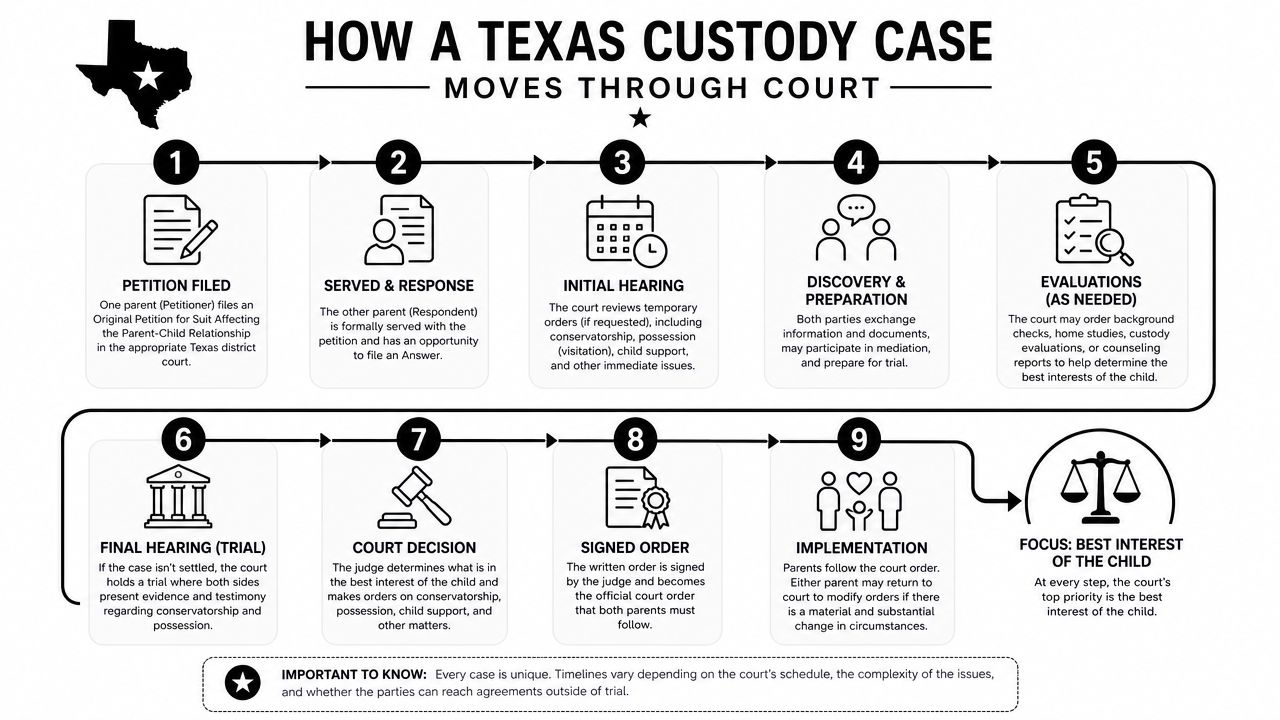
Why each stage matters
The temporary orders hearing usually sets the first working schedule while the case is pending. Judges use that stage to put guardrails in place, especially when the parents cannot agree on routines, exchanges, or safety concerns. A parent who prepares well for temporary orders often shapes the child's short-term stability before the final trial ever happens.
After that comes discovery, the phase where both sides exchange records and information. That's where school files, medical records, calendars, and witness testimony begin to matter in a more formal way. Mediation often follows, because many Texas family courts encourage settlement before trial when the parents can agree on a workable plan.
If the judge orders or the parties agree to a custody evaluation, a neutral mental-health professional may interview the parents and child, review documents, observe interactions, and issue a written report. That report can matter a great deal because it turns a broad best-interest dispute into a structured record the judge can evaluate (custody evaluation process in Texas). If you need help capturing conversations and witness statements clearly, WhisperAI – #1 AI Transcription is a useful example of a transcription resource that can support accurate note-taking and record review.
A final hearing or trial ends the process with a binding order. That order controls conservatorship, possession, and access unless later modified. For a step-by-step look at timing, this Texas custody case timeline can help you understand how the pieces usually fit together.
Special Circumstances That Change the Analysis
A Texas judge still starts with the best-interest rule, but some fact patterns push safety and stability to the front of the line. Cases involving domestic violence, alleged abuse, military service, relocation, or grandparents seeking rights under Chapter 153 often change the way the evidence is weighed. The legal test does not change, yet the facts that carry the most weight can change quickly.
When a case includes allegations of abuse or family violence, the court looks closely at whether a child would be safe in each parent's care. Texas law treats danger seriously because a child's well-being comes before a parent's desire for more access. One isolated incident may matter, but judges usually focus on the pattern behind it, the warnings before it, and the response afterward. The firm's Custody When There Is a History of Family Violence resource explains how violence can affect the custody presumption and the practical options a court may consider.
Military families face a different set of pressures. Deployment and relocation can disrupt school, childcare, and the daily rhythm a child depends on, so judges have to weigh service obligations against the child's need for continuity. A parent's military service by itself should not be treated as a flaw. The court still wants to know how the child's schedule, care, and emotional stability will be protected during absences or a move.
Grandparent cases usually involve a higher hurdle. Texas law allows grandparent visitation or custody claims only in limited situations, and the court looks for a showing that the child's well-being would be significantly impaired without that involvement. That is a much heavier showing than a simple family disagreement over contact.
Relocation cases usually come back to a practical question, what happens to the child's stability if one parent moves farther away? School ties, community ties, and the ability to preserve meaningful contact with both parents matter more when distance starts to reshape the child's routine.
Parents also ask how much a child's preference matters in these special cases. For a child age 12 or older, the judge may interview the child in chambers, but that view is still evidence, not a vote that decides the case on its own. Safety, parenting history, and stability can still carry more weight. For a fuller explanation of the kinds of records that help a judge evaluate those issues, see what evidence matters most in a Texas custody case.
Building a Strong Case With Day-to-Day Evidence
Judges trust evidence that shows a parent's actual routine. School drop-offs, pickup logs, medical and dental appointments, bedtime consistency, homework help, and extracurricular involvement often say more than a polished speech about being the “better” parent. A court can't live inside your house, so it looks for patterns that can be verified.

What helps and what hurts
Strong evidence usually feels ordinary. Calendars, school emails, appointment confirmations, and records showing regular care give the judge a timeline that's easier to trust than broad accusations. If you want a fuller guide to that kind of proof, the article on what evidence matters most in a Texas custody case is worth keeping nearby.
Weak evidence often hurts itself. Text messages that show constant conflict, ignoring the other parent's rights, or refusing to encourage the child's relationship with the other parent can undercut a stability argument. If a parent says they value co-parenting but their messages show blame, sarcasm, or last-minute cancellations, the judge notices the mismatch.
A good preparation plan is simple.
- Organize records early: Put school, medical, and activity records in one place so you can show the child's routine clearly.
- Follow temporary orders exactly: Judges remember who obeyed the court order while the case was still pending.
- Keep conflict away from the child: Arguments in front of the child can damage the stability story a parent is trying to present.
- Show consistent caregiving: The more your records match your testimony, the stronger your case looks.
Texas parents sometimes try to win custody by talking only about the other parent's flaws. That rarely works as well as showing steady, documented care. If you need help turning ordinary parenting facts into a clear courtroom story, the Law Office of Bryan Fagan, PLLC regularly handles conservatorship, possession, and access matters in Chapter 153 cases.
Key Takeaways and Next Steps for Texas Parents
Texas custody cases turn on best interest of the child, not on who argues loudest. The court uses conservatorship to decide rights and duties, and possession to set the parenting-time schedule. Judges often rely on the Holley factors to compare the child's needs, safety, stability, caregiving history, and, when appropriate, the child's own preference.
The parent with the strongest record of stable, documented caregiving usually has the clearest path to a persuasive case. That record can include school drop-offs, medical appointments, homework routines, and communication that supports the child's relationship with both parents. If your situation changes, you may need a modification or enforcement action instead of waiting for things to worsen.
For broader family context, the ultimate babysitter safety guide can also help parents think through safe, reliable care arrangements during busy schedules or possession exchanges. And if you want a better grasp of how a child's preference fits into custody decisions, review the earlier discussion of that issue before any hearing.
If you're facing a hearing, start by gathering records, following every temporary order, and building a calm, consistent presentation of your parenting history. Then talk with a Texas family law attorney who can help you prepare for temporary orders, mediation, custody evaluations, and trial with a plan that fits your family.
If you need help with a child custody or visitation case in Texas, our experienced attorneys can guide you every step of the way. Contact The Law Office of Bryan Fagan, PLLC today for a free consultation.


