
When your child's future is on the line, understanding your rights matters most.
If you're sharing time with your child equally, it's completely normal to think child support should also be equal, or maybe not owed at all. Many Texas parents come into a divorce, modification, or paternity case believing that 50/50 custody means 50/50 financial responsibility. That sounds fair on the surface. Texas law just doesn't treat it as a straightforward matter.
If you're asking how does child support work with 50 50 custody in Texas, the short answer is this. Equal parenting time does not automatically cancel child support. Courts look closely at income, expenses, and what arrangement serves the best interests of the child, which means the outcome that best supports the child's safety, stability, and overall well-being. The goal isn't to reward one parent or punish the other. The goal is to help a child live in two homes without carrying the financial burden of the adults' differences.
The Common Myth About 50/50 Custody and Child Support
Parents often say, “If we each have the child half the time, why would either of us pay support?” That question makes sense. It feels logical.
But Texas family courts separate parenting time from financial support. A parent can spend equal time with a child and still be ordered to pay support. That usually happens when one parent earns more or pays fewer child-related expenses.
Why the myth feels so believable
A 50/50 possession schedule looks equal from the outside. In Texas, a possession schedule is the calendar that says when each parent has the child. A joint managing conservatorship usually means both parents share important rights and duties involving the child, such as education or medical decisions.
Many parents assume those labels mean every part of parenting becomes equal. They don't.
Equal time and equal legal rights don't automatically create equal financial ability.
Texas courts focus on the child's real life in both homes. If one parent has much more income, the court may decide that parent should contribute more financially so the child has more stability across both households.
The child's needs come first
Texas courts make custody and support decisions based on the best interests of the child. That phrase appears often in family law because it drives nearly every major decision under Texas Family Code Chapter 153. In plain English, it asks: what arrangement best supports this child's emotional, physical, educational, and financial needs?
That matters for mothers and fathers alike. Texas law also doesn't allow judges to treat a parent differently based on gender in child support decisions under Tex. Fam. Code § 154.010, as discussed by Our Easy Divorce's overview of 50/50 custody and support in Texas.
Here's the practical takeaway:
- Equal time isn't the end of the analysis. The court still looks at money.
- Higher income often matters more than the calendar. Especially in true 50/50 cases.
- Support is for the child. It isn't a prize, and it isn't a penalty.
That shift in thinking helps parents make better choices in negotiation, mediation, and court.
Understanding Guideline Child Support in Texas
Before a parent can understand a 50/50 case, it helps to know the standard formula Texas starts with.
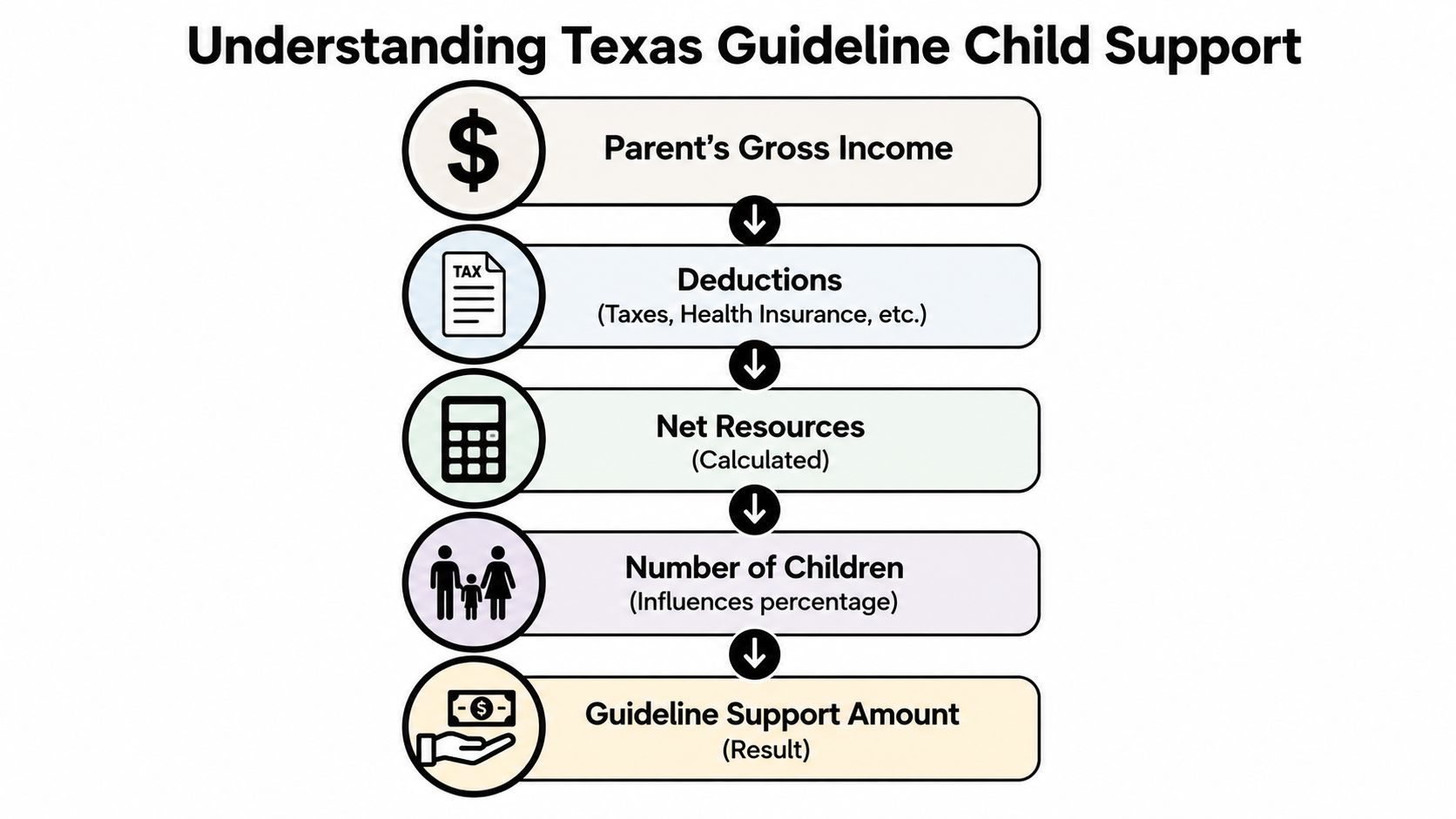
Texas uses guideline child support. That means the law gives courts a baseline method for calculating support. Under Tex. Fam. Code § 154.125, child support is generally calculated as a percentage of the obligor's net monthly resources. The guideline percentages are 20% for one child, 25% for two children, 30% for three children, 35% for four children, and 40% for five or more children, applied to net income up to $11,700 per month, according to TexasLawHelp's explanation of child support in Texas.
How the basic formula works
The process usually starts with the paying parent's income, then moves through deductions, then applies the guideline percentage for the number of children.
A simple way to think about it is:
- Start with gross income
- Subtract allowed deductions
- Find net monthly resources
- Apply the guideline percentage
If you want a broader walkthrough of the mechanics, this article on how to calculate child support adds useful context.
What confuses many parents
Parents often focus first on custody days. Texas usually starts with the support formula instead. The possession schedule matters, but it doesn't erase the formula.
That's why support and custody questions often overlap with other family law issues. For example, a child's wishes may matter in some custody disputes, but they don't control support. If you're also sorting through that question, Does a Child Get to Choose Which Parent in Texas? explains how a child's wishes factor into a Texas custody decision.
Practical rule: In Texas, child support usually begins with the statutory guideline formula. A 50/50 schedule changes how courts may apply it, but it doesn't make the formula disappear.
That foundation matters because many 50/50 cases still begin with those same guideline percentages before the court considers a different final result.
Why Equal Possession Does Not Mean Equal Financial Duty
Texas law says this directly. Texas Family Code Section 153.138 explicitly states that appointing joint managing conservators does not limit the court's authority to order one joint managing conservator to pay child support to the other, as explained in Bryan Fagan's discussion of 50/50 custody and support.
That sentence answers a question many parents wrestle with after they agree to equal parenting time. Joint managing conservatorship does not block support. A 50/50 possession schedule does not block support either.

The court is trying to protect stability
Think about two parents who both love their child and both spend equal time with that child. One parent can comfortably pay for school supplies, shoes, groceries, and activity fees. The other struggles to cover basics every month.
A judge may decide the child shouldn't experience a sharp financial swing from one home to the other if support can reduce that gap. The law recognizes that equal possession doesn't create equal earning power.
This doesn't mean one parent is “winning.” It means the court is trying to support a child in both homes.
A plain-English way to see it
A useful comparison is this. If two people share responsibility for a project, but one has much greater financial capacity, that person may be expected to contribute more money even if both put in the same amount of time.
Family court works similarly. Time matters. But the child's financial stability matters too.
Here are the ideas that usually drive the court's thinking:
- Income difference matters. If one parent earns much more, support often follows.
- Actual child-related costs matter. Some parents pay insurance, school costs, or daycare.
- The child's day-to-day life matters. Courts try to reduce harmful imbalance between homes.
What this means for mothers, fathers, and caregivers
Fathers sometimes worry that 50/50 support rules are stacked against them. Mothers sometimes worry equal custody will sharply reduce support even when incomes are far apart. Grandparents and other caregivers may also struggle to understand why support survives an equal-time plan.
The legal answer is the same across the board. The court looks at the child's needs and each parent's financial reality. It is not supposed to make the decision based on whether the paying parent is the mother or the father.
If you're trying to understand how does child support work with 50 50 custody Texas cases, this is the key shift. The question isn't only who has the child more. The question is what financial arrangement best supports the child across both homes.
The Offset Method How Courts Calculate 50/50 Support
This is where many online articles stop too early. They say “the higher earner pays” and leave parents guessing. In real life, many courts use an offset method in true 50/50 cases.
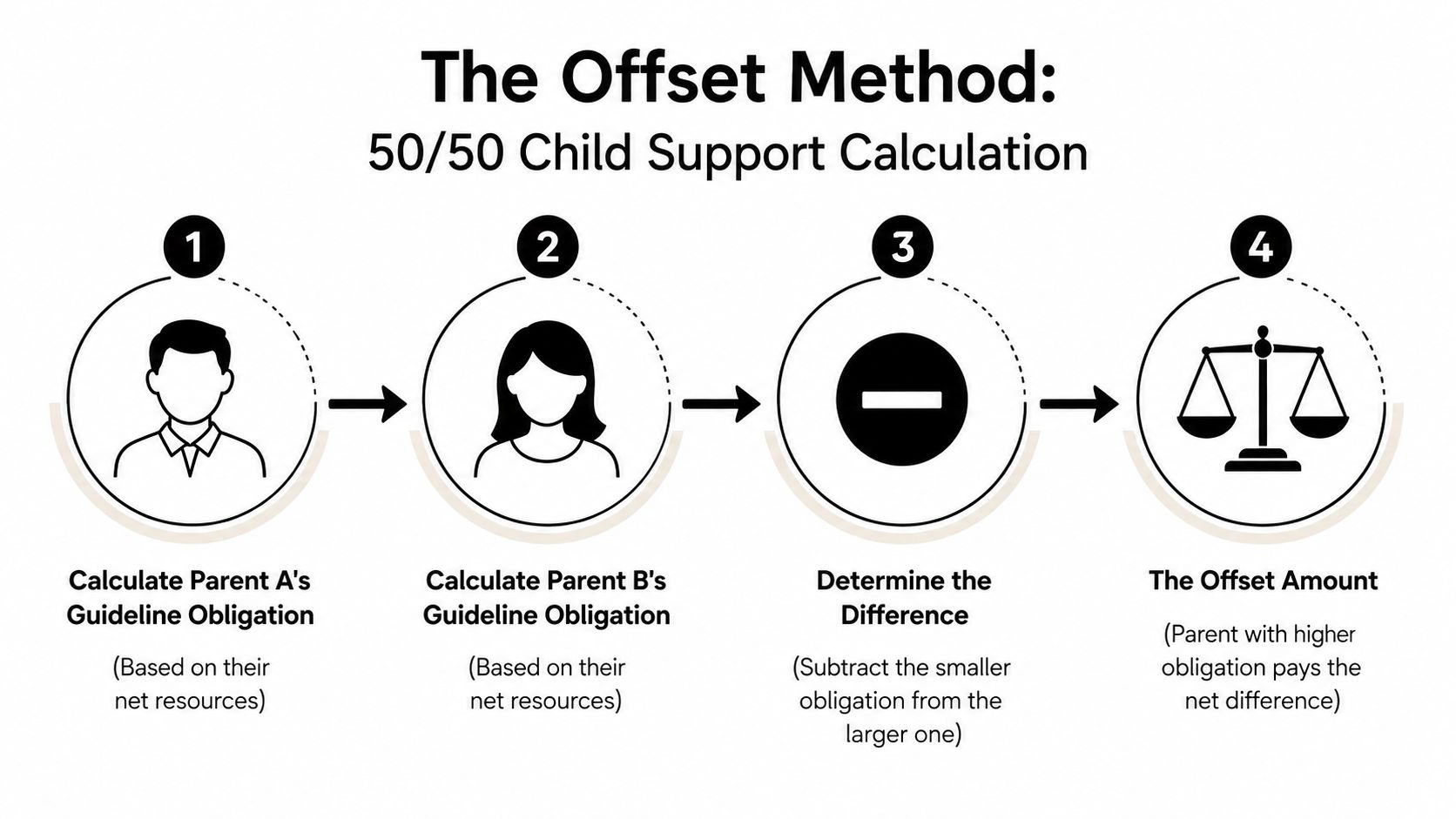
A common explanation is that courts often calculate each parent's guideline amount, then subtract the smaller obligation from the larger one, so the higher earner pays the difference. One example given is that if Parent A's obligation is $2,000 and Parent B's is $1,000, the final payment is $1,000, according to Divorce.law's guide to 50/50 child support in Texas.
A step-by-step example
Use this as a teaching example, not a guarantee. Judges can vary, and facts matter.
Suppose there is one child. Parent A has $10,000 in monthly net resources. Parent B has $5,000 in monthly net resources. The standard guideline for one child is 20%.
The calculation would often look like this:
| Step | Parent A | Parent B |
|---|---|---|
| Net monthly resources | $10,000 | $5,000 |
| Guideline percentage for one child | 20% | 20% |
| Guideline obligation | $2,000 | $1,000 |
Then the court may subtract the smaller amount from the larger amount:
- Parent A obligation: $2,000
- Parent B obligation: $1,000
- Offset difference: $1,000
Under that approach, Parent A would pay Parent B $1,000 per month.
This is the math many parents are trying to find.
Why the offset method makes sense
If both parents have the child equally, each home already carries direct day-to-day costs during that parent's time. The offset method tries to account for that by recognizing that both parents have some baseline support responsibility.
The payment then focuses on the difference in financial capacity, not just on a label like “custodial” or “noncustodial.”
For another practical discussion of this overlap, this article on how custody affects child support in Texas can help parents compare custody structure with financial outcomes.
A video explanation can also help if you're more of a visual learner.
One more issue parents miss
The guideline cap can matter in higher-income cases. As of September 1, 2025, Texas caps the net monthly resources used for guideline calculations at $11,700. That means the maximum guideline support is $2,340 per month for one child and $2,925 per month for two children, as described in Kirker Davis's Texas child support calculator discussion.
So even when one parent earns above that cap, the court may still use the capped amount as the baseline in the offset analysis, then compare it to the other parent's obligation.
If your numbers are close, the offset may be small. If your incomes are far apart, the offset can still be substantial even with equal time.
Factors That Can Change the Final Support Amount
The offset method is often a starting point, not the last word. Judges in true 50/50 cases may adjust the final number based on facts that don't show up in a simple income comparison.
According to Huckaby Hicks's discussion of 50/50 custody and support in Texas, judges may deviate from standard calculations by considering each parent's financial resources, health insurance costs, work-related daycare expenses, and special needs or circumstances affecting the child.
Common reasons a judge may adjust support
Some factors tend to come up again and again:
- Health insurance and dental coverage: If one parent carries the child's coverage, that cost may support a credit or adjustment.
- Work-related daycare: A parent who pays daycare so they can work may have a stronger argument for sharing that burden.
- Special needs or unusual expenses: A child with ongoing medical, educational, or therapeutic needs may require a support structure that goes beyond a simple offset.
- Broader financial resources: Courts can consider more than paycheck income alone when deciding what is fair for the child.
Why details matter in real cases
Two 50/50 families can have the same schedule and very different support outcomes. One family may split most costs informally and evenly. Another may have one parent paying insurance, after-school care, and nearly all activity fees.
That's one reason informal assumptions can cause trouble. Parents say they're “sharing everything,” but they mean very different things. A written list of recurring expenses can help. If you're trying to organize that part of the conversation, this guide to splitting expenses offers a practical framework for identifying shared costs.
A support order should reflect the real cost of raising the child, not just a rough sense of fairness.
Cooperation still matters
Even when parents disagree on dollars, a cooperative approach can help. Mediation often gives parents room to discuss insurance credits, reimbursement language, extracurricular costs, and who pays what directly. That can reduce future conflict.
One option some parents use when they need legal help with support, possession, or modification issues is Law Office of Bryan Fagan, PLLC, which handles Texas family law matters involving custody, visitation, and support.
How to Establish or Modify Your Support Order
A verbal agreement isn't enough. If you have a 50/50 schedule, your support arrangement should be clearly stated in a court order. That protects both parents and gives the child more financial predictability.
If you're setting support for the first time
Parents usually reach a support order in one of three ways:
Agreement between the parents
If both parents understand the finances and agree on a fair amount, they can present that agreement to the court for approval.Mediation
A mediator helps the parents negotiate unresolved issues. This often works well when the dispute is about credits, reimbursement, or how to apply a 50/50 arrangement.Court decision
If no agreement is reached, the judge decides support based on the evidence.
If you already have an order
A parent who moves into a true 50/50 schedule should not assume the old support amount changes automatically. It doesn't. The existing order stays in place until the court signs a new one.
That matters for both mothers and fathers. A parent paying under an old order can build arrears if they stop paying without a modification. A parent receiving support can also face problems if the current arrangement no longer matches reality.
If your parenting schedule or finances have changed, this guide on how to modify child support in Texas explains the modification process in more detail.
What to gather before you file
Bring order to the process early. Helpful records often include:
- Income documents: Pay stubs, tax records, and proof of other resources
- Child expense records: Insurance premiums, daycare bills, and recurring costs
- Parenting schedule proof: Calendars, prior orders, and any written agreements
- Communication records: Messages showing what each parent has agreed to or disputed
Parents who prepare carefully usually make better decisions in negotiation and present clearer evidence in court.
Next Steps and When to Contact an Attorney
By now, the core rule should be clearer. In Texas, equal possession does not automatically erase child support. Courts care about the child's stability, each parent's financial ability, and the actual expenses attached to raising that child.
Key takeaway
Keep these points in mind:
- A 50/50 schedule doesn't guarantee zero support
- Income disparity often drives the final result
- Courts may use an offset method in true equal-time cases
- Insurance, daycare, and special needs can change the final number
- A written court order matters more than an informal understanding
There is one narrow point many parents want to know about. Texas courts may order zero base support only when parents have “substantially equal incomes, equal work hours, and equal out-of-pocket child expenses,” a high threshold that makes support common in many 50/50 cases where incomes differ, as discussed in Jamie Graham's article on 50/50 custody and child support in Texas.
When legal advice can help most
You should strongly consider talking with an attorney if:
- Your income and your co-parent's income are far apart
- You're paying major child-related expenses directly
- You're moving from a traditional schedule to 50/50
- Your current order no longer matches your actual parenting plan
- You're trying to negotiate support without creating future conflict
Support questions also connect to the bigger financial picture after divorce. For example, life insurance obligations sometimes appear in decrees or settlement terms, and this Coveredly's life insurance divorce guide can help you think through that issue alongside support planning.
The legal framework gives structure, but no article can replace case-specific advice. A small detail in your order, your income records, or your expense history can change the outcome in a meaningful way.
If you need help with a child custody or visitation case in Texas, our experienced attorneys can guide you every step of the way. Contact The Law Office of Bryan Fagan, PLLC today for a free consultation.