
When your child's future is on the line, understanding your rights matters most.
If you're reading this, you may be losing sleep over what happens when your child is with the other parent. Maybe you've seen drug use, unsafe people in the home, missed school, untreated medical needs, or behavior that feels unstable and frightening. Many parents come in saying, “I need to prove the other parent is unfit.” In Texas, the better question is often: How do I show the court what my child needs to be safe?
That shift matters. Texas judges focus on protecting children, not handing out labels. If you're trying to learn how to prove a parent unfit in Texas, the strongest path is to build a clear, fact-based case around your child's safety, stability, and well-being.
Understanding the Best Interest of the Child Standard
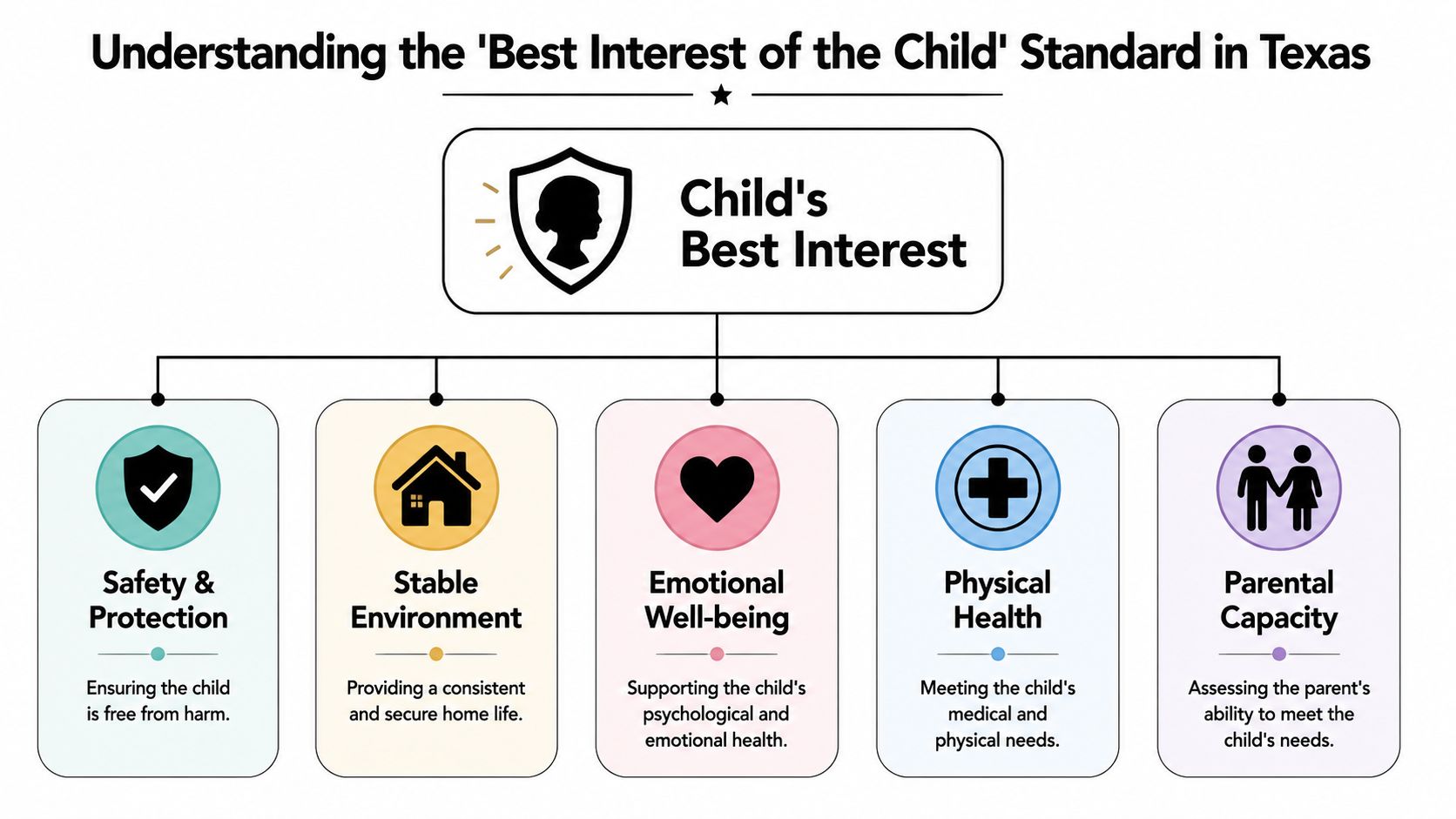
Texas custody law starts with one central idea: the best interest of the child. That phrase sounds broad, and for worried parents, it can feel frustratingly vague. But in practice, it gives the court a framework for looking at whether a child is safe, supported, and living in a stable environment.
Texas law does not provide a specific legal definition of an “unfit parent.” Courts don't decide custody by applying that label by itself. Instead, they look to the child's best interests under Texas Family Code standards, and a parent is effectively treated as unfit when they cannot provide a safe, stable, and nurturing environment because of concrete proof of abuse, neglect, addiction, or serious violations of court orders, as explained in this Texas unfit parent overview.
What best interest means in plain English
A judge is usually asking practical questions like these:
- Is the child safe there
- Is the home stable and appropriate
- Are the child's physical needs being met
- Are the child's emotional needs being met
- Can this parent make sound decisions for the child
Those questions affect major custody issues under Texas Family Code Chapter 153, including who will be a joint managing conservator. That's the Texas legal term for parents who share important rights and duties for a child, such as making decisions about education, medical care, and other major issues. The court also looks at possession schedules, which is the Texas term for the parenting time calendar.
For a closer look at the factors Texas courts weigh, this guide on Texas custody and the Holley factors can help connect the legal language to real life.
Practical rule: A judge is not deciding who is more frustrated, more persuasive, or more offended. A judge is deciding what arrangement protects the child.
Normal conflict versus true danger
Not every co-parenting problem proves unfitness. Parents often disagree about bedtime, discipline, new relationships, school choices, or communication style. Those disputes can be stressful, but they aren't automatically enough to change custody.
A stronger case usually involves a pattern that puts the child at risk. That can include abuse, neglect, addiction, unsafe supervision, repeated disregard of court orders, or exposing the child to dangerous situations. The court wants facts that show actual harm or a real threat of harm.
Why the burden can feel so high
Many parents are shocked by how much proof the court expects. That's because Texas starts from the idea that a parent should usually remain involved in the child's life unless there's a real reason to limit that involvement. For grandparents and other non-parents, the legal hurdle is even steeper. The court usually presumes a biological parent is the proper caregiver unless strong evidence shows the child faces physical or emotional danger.
That doesn't mean your concerns won't matter. It means your case needs to stay focused, organized, and grounded in proof.
Gathering Compelling Evidence to Protect Your Child
Fear is real. So is anger. But in court, those feelings need support from documents, records, and credible witnesses. Judges tend to give more weight to concrete proof than to emotional accusations. As noted in this discussion of Texas unfitness evidence, success rates drop significantly when cases rely on unverified statements from children or witnesses without corroborating physical evidence such as home inspection reports or electronic correspondence, because courts prioritize concrete facts over emotional testimony in proving a parent unfit.
What strong evidence usually looks like
The most useful evidence usually comes from neutral sources or preserved records. Think of evidence as building blocks. One text message may not prove much. A pattern of texts, school records, police reports, photos, and medical records can tell a very different story.
Consider this practical perspective:
| Evidence Type | What It Proves | How to Obtain |
|---|---|---|
| Police reports | A documented incident involving violence, threats, intoxication, or unsafe conduct | Request records from the responding agency |
| Medical or mental health records | Treatment related to injuries, substance abuse, or conditions affecting parenting ability | Work with your attorney and proper legal process |
| DUI records or criminal records | Conduct that may show impaired judgment or danger to the child | Obtain through court records or official record requests |
| Text messages and emails | Threats, admissions, missed exchanges, instability, or refusal to meet the child's needs | Save screenshots, export messages, preserve originals |
| Social media posts | Substance use, dangerous companions, unstable behavior, or contradictory statements | Capture posts with dates and identifying details |
| School records | Absences, tardiness, behavior changes, or lack of parental involvement | Request records from the school if you have authority |
| Counselor or therapist records | Behavioral concerns or statements tied to the child's well-being | Use lawful channels and court procedures |
| Photos and videos | Unsafe home conditions, injuries, or environmental hazards | Keep originals with dates and context |
| Witness testimony | Firsthand observations of conduct, conditions, or neglect | Use people who directly saw or heard events |
| Home inspection or evaluation materials | Living conditions and supervision concerns | Request through the court when available |
If you're preparing documents and exhibits, this resource on how to present evidence in a Texas custody case can help you avoid common presentation mistakes.
How to preserve evidence without hurting your case
Parents sometimes damage a good case by collecting evidence the wrong way. A few habits can protect you:
- Save original files: Keep full screenshots, emails, and messages with dates, names, and context.
- Write a timeline: Record incidents soon after they happen while details are fresh.
- Stick to firsthand facts: Note what you personally saw, heard, or received.
- Follow the law: Don't hack accounts, impersonate anyone, or record communications unlawfully.
- Keep it child-focused: Document missed medication, unsafe supervision, or school problems, not just rude behavior.
Children shouldn't carry the burden of building your case. Courts want adults to bring proof.
What weak evidence looks like
Weak evidence usually sounds like this:
- “My friend thinks the other parent is unstable.”
- “My child said something happened, but there's no follow-up report or corroboration.”
- “I know something is wrong, but I don't have dates or records.”
That doesn't mean your concern is false. It means your concern still needs support. If school staff, doctors, counselors, law enforcement, or other neutral parties have seen warning signs, their records can help confirm what you've observed.
Key Grounds for Finding a Parent Unfit
Courts look for conduct that threatens a child's safety or well-being. The issue isn't whether a parent is imperfect. The issue is whether the child is being exposed to harm, neglect, or a home that isn't stable enough to meet basic needs.
Abuse and family violence
Physical abuse, emotional abuse, sexual abuse, and family violence are among the most serious concerns in a custody case. If there's a recent pattern of violence, the court may place restrictions on conservatorship, possession, or access. In plain terms, that can affect decision-making rights, the parenting schedule, and whether visits must be supervised.
If your case involves dangerous conduct toward the child or another family member, this article on child endangerment and custody in Texas may help you understand how courts view those facts.
Substance abuse and neglectful supervision
Drug or alcohol abuse becomes a custody issue when it affects supervision, decision-making, transportation, or the child's daily care. A parent who uses substances around a child, drives impaired, leaves the child unsupervised, or repeatedly fails to meet basic needs creates concerns the court takes seriously.
The same is true when the home itself becomes unsafe. A judge may look at who is around the child, whether the child has proper food and clothing, whether the home is sanitary, and whether the child is being left with inappropriate caregivers.
Mental health and the legal nuance many parents miss
Mental health concerns often create the most confusion. A diagnosis by itself usually isn't enough.
Texas courts often treat a potentially dangerous psychological condition as relevant only when it directly impairs the parent's ability to provide a safe, stable, and nurturing environment. Mental health alone is rarely sufficient to override the presumption of parental fitness without verifiable abuse or neglect, as discussed in this Texas mental health and unfitness analysis.
That distinction matters. A parent can have anxiety, depression, PTSD, or another diagnosis and still be a safe, loving, consistent parent. On the other hand, untreated symptoms that lead to dangerous behavior, severe instability, abandonment, or inability to meet the child's needs may become highly relevant.
A court usually cares less about the label and more about the impact on the child.
Dangerous lifestyle and lack of parental involvement
Judges may also consider criminal activity, repeated violations of court orders, exposing a child to unsafe people, or failing to maintain a meaningful presence in the child's life. If a parent repeatedly disappears, ignores medical needs, refuses schooling, or leaves the child in harmful settings, those facts can shape custody decisions.
In these disputes, a Texas Child Custody Lawyer handles representation in conservatorship, possession, and access matters under Chapter 153. That kind of representation can help organize facts into a legally usable case instead of a collection of understandable but unfocused complaints.
Navigating the Texas Court Process
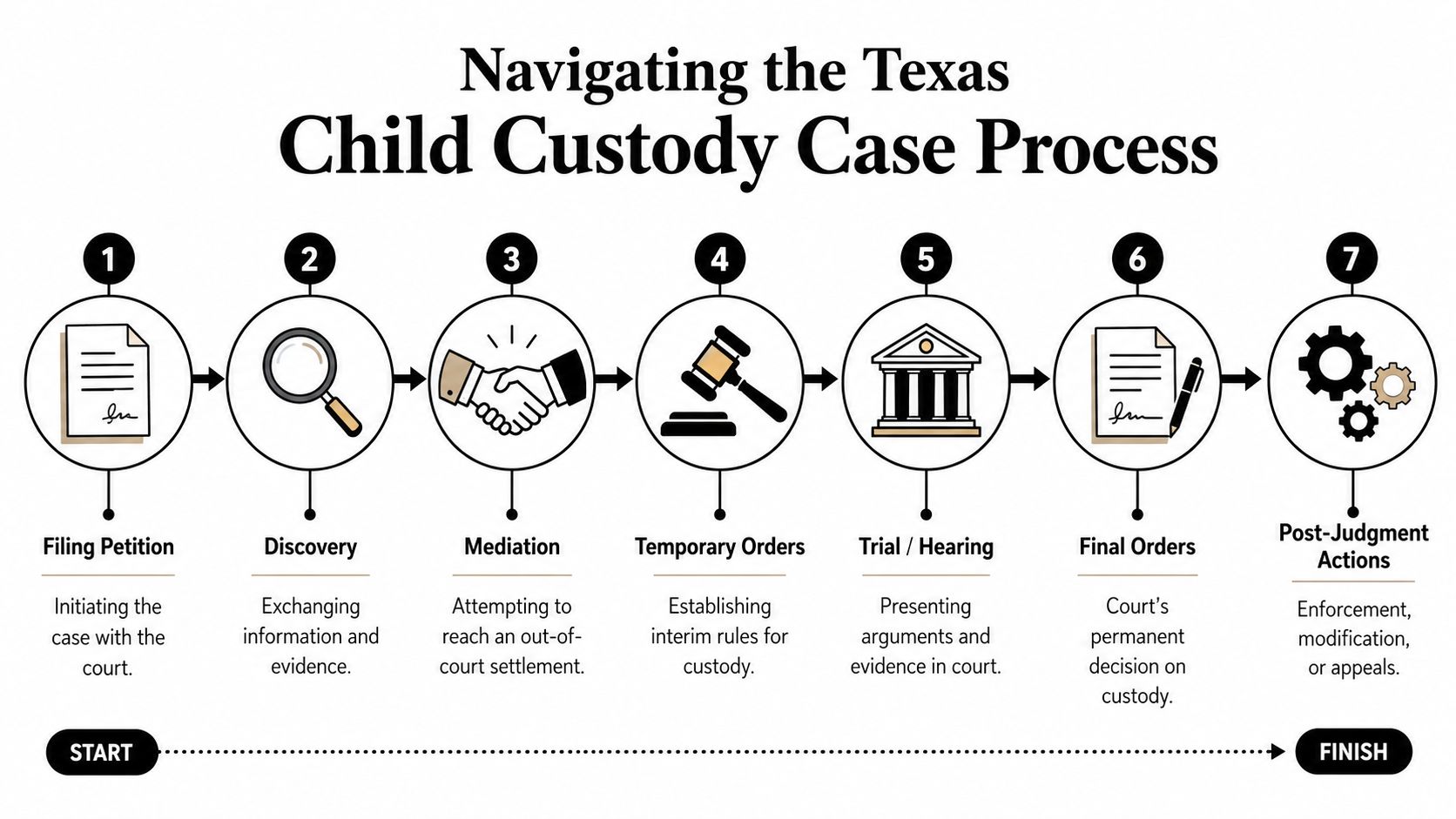
A custody case feels less overwhelming when you know the sequence. The legal path usually has a beginning, a middle, and a final decision point. Your job is to move carefully through each one.
Filing the right case
If no custody order exists, a parent may file a Suit Affecting the Parent-Child Relationship, often called a SAPCR. If there's already a court order in place, the case is usually a modification.
That distinction matters. In modification cases, the court generally considers events that occurred since the most recent custody order rather than retrying old issues, as explained in this discussion of how Texas courts decide if a parent is unfit. If a judge previously entered orders, you'll usually need new evidence showing a material concern for the child.
Temporary relief and urgent protection
If your child is in immediate danger, your attorney may ask for temporary orders or emergency relief. Temporary orders create rules while the case is pending. They can address possession, exchanges, communication, school issues, or temporary decision-making rights.
Later in the process, many courts require mediation before trial. Mediation is a structured settlement meeting where the parties try to resolve issues with a neutral mediator. Even in tense cases, it can narrow the dispute.
A practical challenge for solo and small family law practices is client communication during fast-moving custody disputes. Some attorneys look at tools for managing calls for solo legal teams when intake volume rises, especially during emergency filing periods.
Discovery, hearing, and final orders
Discovery is the formal information-gathering stage. That may include requests for documents, written questions, subpoenas, and records from third parties. This phase often produces the records that support or undermine allegations.
The court may also hear arguments about each parent's rights under conservatorship law. If you're a father trying to understand how courts evaluate your role, Fathers' Rights in Texas Custody Cases discusses how Texas law treats fathers in conservatorship decisions.
Some families also find it helpful to hear the process explained out loud before a hearing. This short video gives that kind of practical overview.
If settlement doesn't happen, the judge decides the contested issues at a final hearing or trial. That's where organized documents, witness preparation, and a child-focused presentation make the biggest difference.
Using Legal Strategies to Strengthen Your Case
Sometimes the strongest move isn't more argument. It's bringing in a neutral professional who can investigate and give the court an objective view.
Ask for independent eyes on the case
In the right situation, a court may appoint a Guardian Ad Litem or an Amicus Attorney. These roles are different, but both can help the court evaluate what arrangement serves the child's best interests. Their involvement can reduce the force of a simple he-said, she-said dispute because they investigate facts instead of just repeating accusations.
Another major tool is a formal custody evaluation. A court can order a custody evaluation under Texas Family Code § 107.101, and that process may include home inspections, psychological assessments, and personal interviews to determine fitness objectively. These evaluations often become some of the most important evidence in the case, as noted in the earlier discussion of the Texas court process.
Offer practical solutions, not just criticism
Judges notice when a parent comes to court with a safety plan instead of a punishment mindset. Depending on the facts, that might include:
- Supervised visitation: Useful when a child needs contact with a parent, but the setting must be controlled.
- Drug or alcohol testing: Helpful when substance concerns are central and facts need confirmation.
- Therapy or parenting classes: Sometimes appropriate when the issue is instability, communication, or coping skills.
- Neutral exchange locations: A smart option when direct handoffs have become unsafe or hostile.
A strong strategy is often simple: show the court that you're protecting the child while still respecting the importance of the parent-child relationship when it can be done safely.
Legal guidance matters here because strategy should match the facts. In custody and support disputes, one option for legal help is the Law Office of Bryan Fagan, PLLC, which handles child custody, visitation, possession rights, paternity, child support establishment and enforcement, custody modifications, and emergency custody orders in Texas.
Common Pitfalls and Your Next Steps
Parents often weaken solid concerns by acting too quickly or too emotionally. The biggest mistakes include making broad accusations without records, coaching a child to report information, violating existing court orders out of frustration, or flooding the court with irrelevant grievances that don't connect to the child's safety.
Grandparents and other caregivers face another challenge. Texas law makes it difficult for a nonparent to prove that a parent is unfit in modification cases because the court has already presumed the biological parent is fit, and the nonparent must present significant evidence of physical or emotional danger that happened since the most recent order, as explained in this Texas Law Help guide on parent and nonparent custody modifications.
Key takeaway
If you're trying to prove a parent unfit in Texas, don't build your case around anger. Build it around specific harm, credible proof, and a clear plan for your child's safety.
Before meeting with a lawyer, it may help to organize records, timelines, and court paperwork. Some people also use tools like a Comprehensive legal research AI solution to sort documents and legal materials before discussing strategy with counsel. That kind of preparation can make your consultation more productive.
Your next steps are usually straightforward:
- Document carefully: Keep records, dates, messages, and reports.
- Protect the child lawfully: Follow current court orders unless emergency legal relief changes them.
- Get legal advice early: Small mistakes at the beginning can make a hard case harder.
If you need help with a child custody or visitation case in Texas, our experienced attorneys can guide you every step of the way. Contact The Law Office of Bryan Fagan, PLLC today for a free consultation.