 Skip to content
When your child's future is on the line, understanding your rights matters most. If you've just opened a court letter at the kitchen table, or you're trying to make sense of a co-parent's demands after a breakup, the words can feel cold and confusing. Texas family law has its own language, but once you translate it into everyday English, the path forward gets clearer.
Texas usually does not use the word custody the way most parents do. The law talks about conservatorship, possession, and access, and those words matter because they decide who makes decisions, where the child lives, and how parenting time works. That's why Chapter 153 of the Texas Family Code sits at the center of most cases, from the first filing to later changes.
This guide is for mothers, fathers, grandparents, and caregivers who want straight answers without legal fluff. It also points parents toward helpful family resources, like stability tips for divorcing families, because children often need steady routines while the adults sort out the legal side.
What Texas Custody Really Means
A parent sitting at the kitchen table usually wants one simple answer. Who gets the child, who signs for school, and who decides what happens next? In Texas, those questions usually start with a Suit Affecting the Parent-Child Relationship, often shortened to SAPCR, which is the court case used to decide conservatorship, possession, support, and related issues.
Why Texas uses different words
Most parents say custody and visitation. Texas law uses different terms, but the concerns are the same. A mother may want to know whether she can approve a doctor visit. A father may want to know when he gets weekends. A grandparent may want to know whether the court can give access at all.
That's why Chapter 153 matters so much. It gives the structure the judge uses when deciding how parenting rights and time will work. Families often feel better once they realize the case is not about labels, it's about daily life, school pickups, medical decisions, and bedtime routines.
Practical rule: If you can explain the issue in plain words at the kitchen table, a judge can usually understand it too.
A parent reading a summons may also worry about the emotional side. That's normal. Children feel the shift even when adults try to keep things calm, which is one reason many families look for support while the legal process unfolds.
Conservatorship and Possession in Plain English
Texas custody cases usually turn on three ideas. Conservatorship means the legal right to make decisions for a child. Possession means the time the child spends in your home. Access usually means contact or parenting time for someone who is not a parent, often a grandparent or another person seeking time with the child.
The three roles parents hear about most
| Conservatorship Types at a Glance | Type | Who Decides | Who Has the Child |
|---|---|---|---|
| Joint managing conservatorship | Both parents share decision-making, often with some decisions divided or one parent given final authority in certain areas | Both parents have parenting time under an order | |
| Sole managing conservatorship | One parent makes major decisions | The other parent may still have possession and access if the court orders it | |
| Possessory conservatorship | Usually limited decision-making | The child spends time with that parent under the schedule ordered by the court |
Texas Family Code Chapter 153 makes joint managing conservatorship the default framework, allowing the court to appoint both parents as conservators unless that would not be in the child's best interest. A parent can still be named sole managing conservator if joint appointment would significantly impair the child's physical health or emotional development. That best-interest standard is the court's north star in every decision.
In everyday terms, joint managing conservatorship does not always mean equal time or equal power over every decision. One parent may handle school enrollment while the other handles medical consent. Another family may split holidays but keep one parent in charge of the child's primary residence.
If you want a deeper dive into how the role works, Joint Managing Conservatorship in Texas explains the presumption and what it means. For a broader overview of the legal setup, this guide on conservatorship in Texas is a helpful companion.
A good order does not just name roles, it tells parents how to live with them on a school night, a sick day, and a holiday.
How the Standard Possession Order Works
Most Texas families hear about the Standard Possession Order, often called the SPO. That is the court's default parenting schedule in many cases, and it usually spells out weekday time, weekend time, holidays, and summer periods. The idea is simple. The schedule should give both parents predictable time so the child's life stays steady.
Reading the calendar without getting lost
For a child under three, the order may look more limited at first, with shorter and more age-appropriate overnights. For an older child, the schedule often expands into regular weekends, holiday rotation, and longer summer time. The exact calendar can change based on the child's age, school schedule, distance between homes, and any safety concerns.
If you're trying to picture it visually, this infographic gives a useful snapshot of the schedule framework for younger children in Texas.
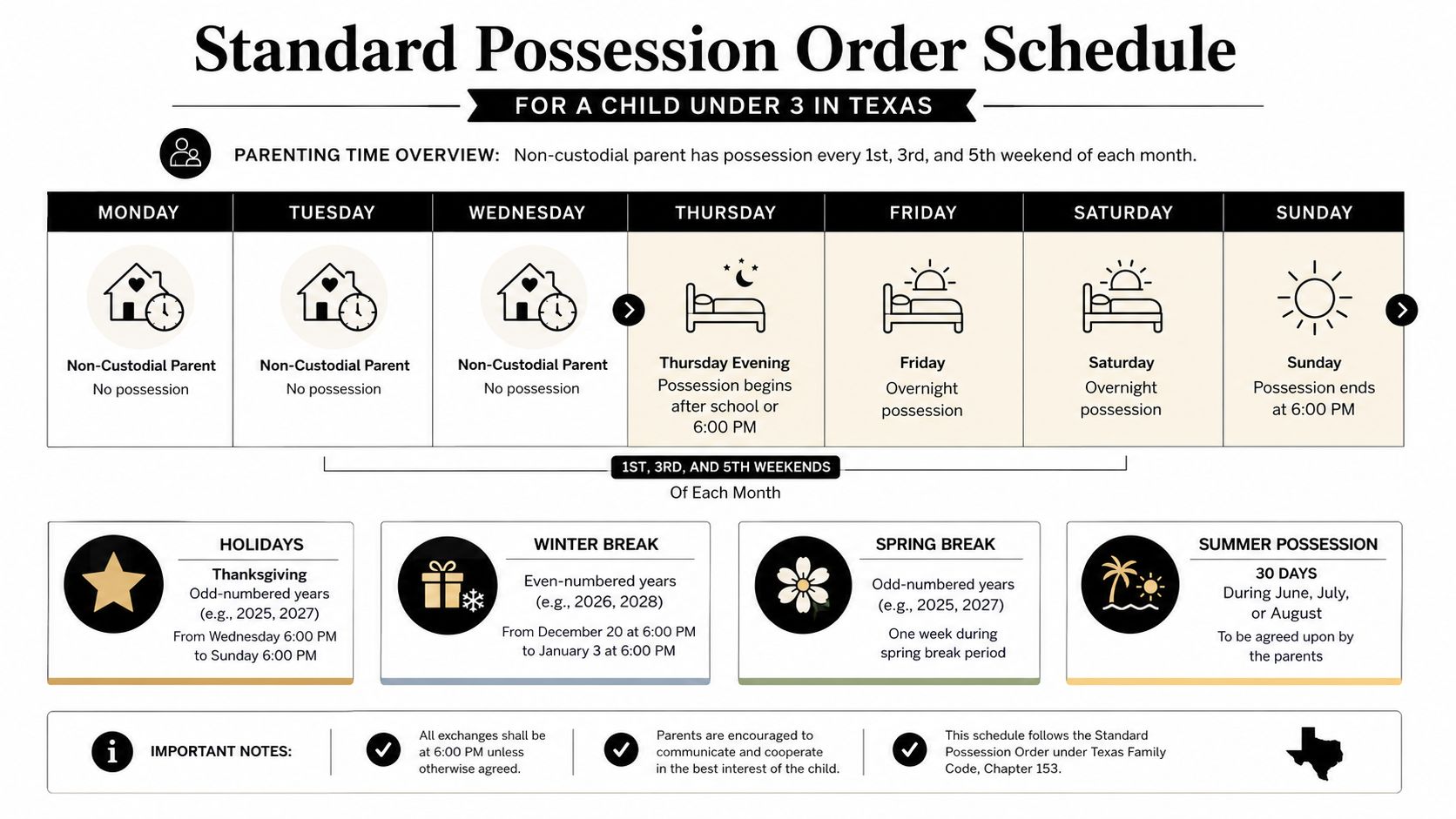
Parents can also agree to a custom possession schedule if they both think a different setup works better. That can help with school travel, work shifts, or a child who does better with a different routine. Courts may order something different when the child is an infant, when school schedules matter, or when a parent lives more than 100 miles away.
For a more detailed breakdown of the default schedule, the Texas Standard Possession Order can help parents compare the court's usual setup with their own family's reality.
Steps in a Texas Custody Case
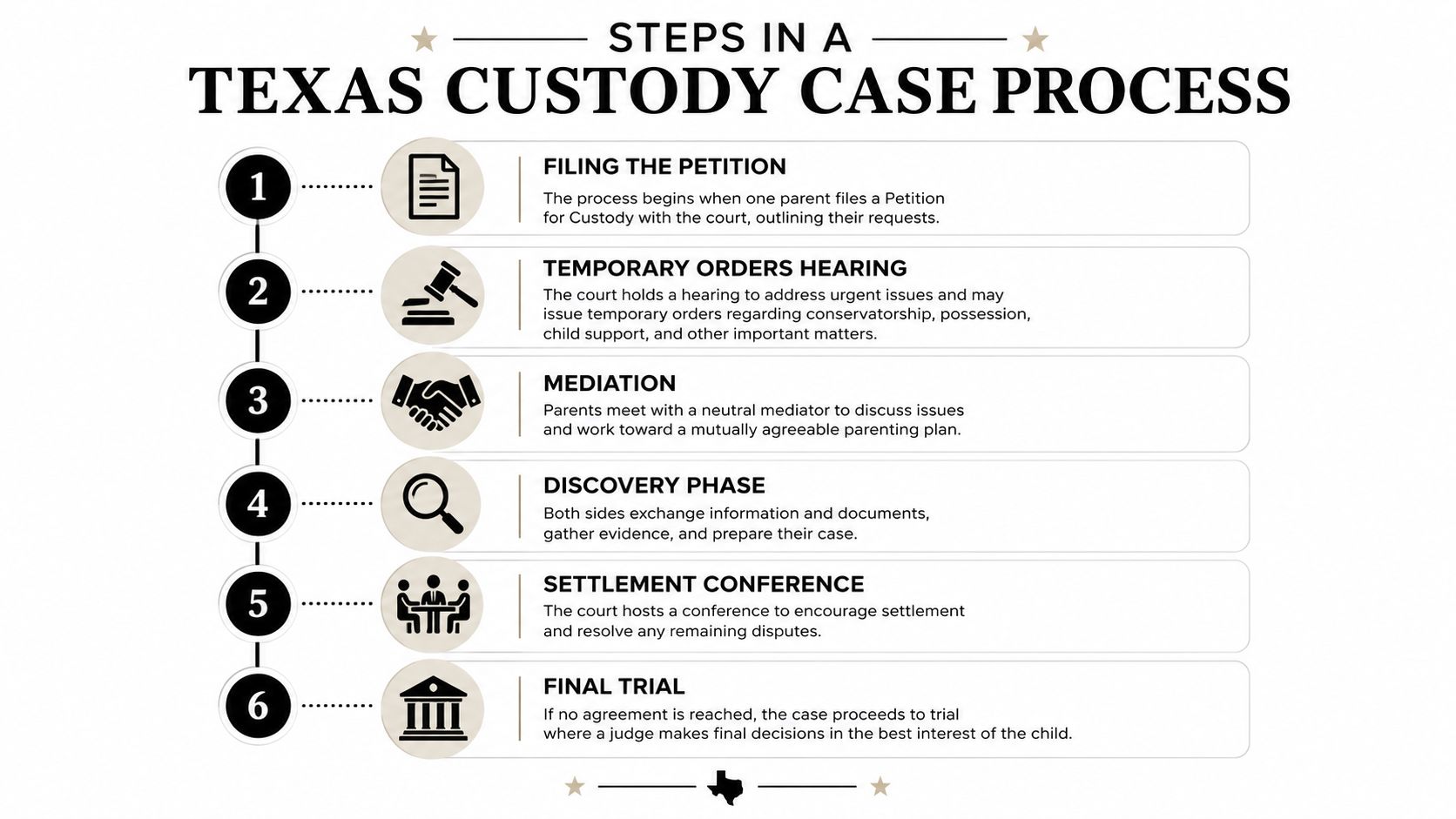
A custody case usually starts with a filing, not a fight in court. One parent files the SAPCR, the other parent gets served, and then the case begins moving through temporary orders, mediation, discovery, and sometimes trial. Some families settle early. Others need a judge to make the final call.
What usually happens first
The first hearing may be about temporary orders, which set short-term rules while the case is pending. That can cover possession, who pays support, and who handles school or medical issues until a final order is entered. After that, many cases go to mediation, where parents and lawyers try to build an agreement without a trial.
Then comes discovery, which is the exchange of information. Parents may share documents, answer written questions, and provide records that help the judge understand the child's routine. If the case still does not settle, the court may hold a settlement conference before trial or move straight to a final hearing.
Plain-English advice: Bring facts, not speeches. Judges want dates, records, calendars, and specific examples of what works for the child.
Some cases are uncontested, which means both sides agree on the main terms and just need the court to sign the order. Others are contested, which means the parents disagree on one or more major issues. A jury trial can be available for certain issues in Texas family law, but many custody decisions are still handled by the judge.
Child Support, Paternity, and Common Forms
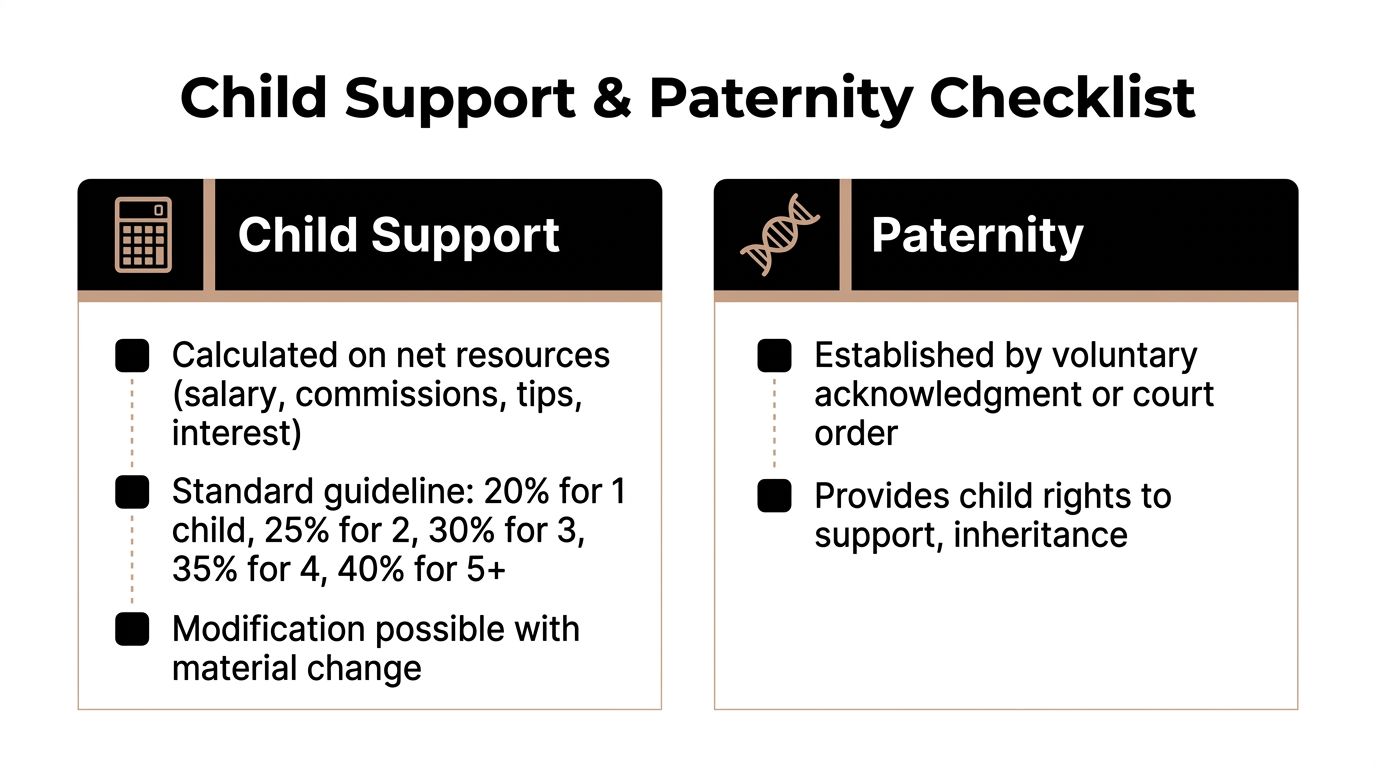
A father who is changing jobs, a mother who needs immediate protection, and a deployed service member may all be in different situations, but the paperwork still matters. Texas child support is generally based on net resources, which means the income left after certain deductions, not just the number on a paycheck. The court uses guideline percentages to calculate support, and support can be changed later if there has been a material and substantial change.
Support and paternity in real life
For a parent who is moving for work, the court may look at the move's effect on the child's routine, support, and possession schedule. For a parent seeking emergency protection, the court may act quickly to protect the child while the bigger case continues. For a deployed parent, military service can affect timing and logistics, but it does not erase parental rights.
Paternity is the legal father-child relationship. For unmarried parents, it can be established by a voluntary acknowledgment of paternity or by a court order with genetic testing if needed. For married parents, paternity is usually presumed, so the legal path can look different from an unmarried case.
Common documents help the court see the full picture. Pay stubs show income. A parenting plan shows how the child's week may work. A proposed possession calendar helps parents think through real schedules. School records and medical records show the child's daily needs and any special concerns.
The same section of the law also reaches military and relocation situations. If you want a focused look at move-related issues, military relocation and child custody is a useful place to start.
Emergency Custody, Relocation, and Military Cases
Some cases cannot wait for the normal timetable. If a child is in danger, a parent may need to ask for emergency custody or a temporary restraining order, which is a short-term court order meant to prevent immediate harm. In those first 24 to 72 hours, the parent should gather texts, photos, police reports, medical records, and school information, then get legal help quickly.
Three situations that change the usual path
A relocation case comes up when one parent wants to move with the child. The court then weighs the child's stability, school life, and the practical effect of the move on possession time. The question is not whether a move is convenient for an adult. The question is whether the move fits the child's best interest.
Military families face another layer of complexity. Deployment, permanent change of station orders, and service-member protections can affect timing, exchanges, and hearings. The court still looks at stability and best interest, but it also has to account for service obligations and the realities of military life.
If the situation feels urgent, don't wait to “see how it goes.” Document first, call a lawyer, and keep your communication with the other parent calm and brief.
A clear email, a saved text thread, and a dated timeline often help more than a long emotional explanation. Parents do best when they describe the safety concern, the child's current condition, and the immediate step they want the court to take.
When to Get Legal Help and How to Prepare
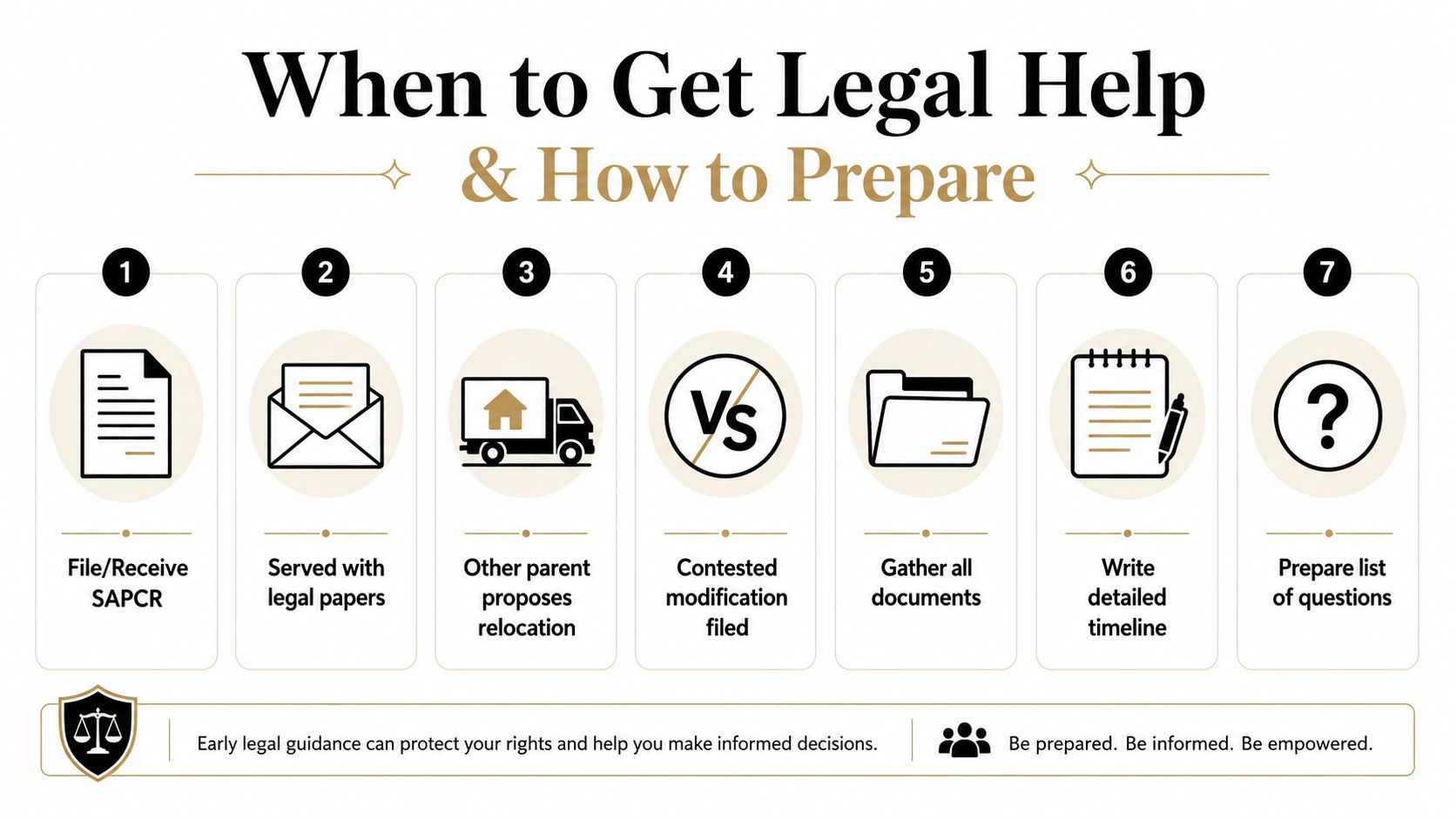
You should call a family-law attorney when you've been served with a SAPCR, when the other parent proposes a move, when a modification is contested, or when an emergency order may be needed. Those moments usually mean deadlines, evidence, and legal strategy matter right away. The sooner you get organized, the easier it is to protect your position.
What to bring and what to say
Before the first meeting, gather the court papers, your child's school and medical records, your pay information, and any messages that show parenting patterns or safety concerns. Write down a timeline with dates, not just feelings. Then make a short list of questions, such as what temporary orders may look like, what a judge will need to see, and what happens if the other parent refuses to cooperate.
For conversations at home, keep it simple. To a co-parent, you can say, “I want a schedule that works for our child, and I'm willing to put the details in writing.” To a judge, you can say, “My concern is the child's routine and safety, and I have records that show what's been happening.”
If you want to read a real example of how careful lawyering can change a custody fight, the overview of a high stakes custody battle win shows why preparation and evidence matter so much.
Key Takeaways, FAQs, and Next Steps
Texas uses conservatorship and possession instead of the more familiar words custody and visitation. Joint managing conservatorship is the default in many cases, but the court still looks at the child's best interest and can choose a different arrangement when needed. The parents who do best are usually the ones who stay organized, keep records, and think in terms of the child's daily life.
Common questions parents ask
How long does a custody case take?
It depends on whether the case is uncontested or contested, and whether the parents settle in mediation or need a trial. Some cases move quickly. Others take longer because the court has to hear evidence and decide disputed issues.
Can my child choose which parent to live with?
A child's preference may matter in some situations, but it does not control the case by itself. The judge still has to decide what serves the child's best interest.
What can grandparents do if they're being denied access?
Grandparents may have legal options, but the path depends on the facts and the child's relationship with them. Texas law treats access requests carefully, so it's smart to get advice before filing anything.
Do I need a lawyer if we agree on most things?
Often, yes. Even a mostly peaceful case can go off track if the order is vague. A clear order protects both parents and helps the child avoid future conflict.
If you're feeling overwhelmed, start with the next practical step. Gather your documents, write your timeline, and ask for legal advice before the disagreement hardens into a court fight.
If you need help with a child custody or visitation case in Texas, our experienced attorneys can guide you every step of the way. Contact The Law Office of Bryan Fagan, PLLC today for a free consultation. Visit Law Office of Bryan Fagan, PLLC to get practical help with conservatorship, possession schedules, support, paternity, or emergency custody issues.


