
When your child's future is on the line, understanding your rights matters most. You may be sitting at the kitchen table with a proposed order in front of you, wondering whether “joint” or “sole” custody will decide where your child lives, who makes medical decisions, or how much time you'll have together. That uncertainty can feel overwhelming, especially when the other parent is pushing for an arrangement you don't understand.
In Texas, the label is only the starting point. The actual court order controls the decision-making rights, duties, and possession schedule that shape your family's daily life. Texas uses the term conservatorship rather than relying only on the everyday word custody, and the difference between joint and sole often turns on the details written into the order.
When Custody Labels Feel Overwhelming
A parent may read “joint managing conservatorship” and assume the child will spend exactly half the time in each home. Another parent may see “sole managing conservatorship” and fear that the other parent will disappear from the child's life. Neither assumption is automatically correct.
One family might have joint managing conservatorship while the child lives primarily with one parent during the school week. Another might have sole managing conservatorship for major decisions while the other parent receives regular visitation under a detailed schedule. The words on the first page matter, but the rights and restrictions in the remaining pages usually matter more.
Practical rule: Don't evaluate a custody order by its title alone. Read who can make each decision, where the child will live, and when each parent has possession.
Texas Family Code Chapter 153 provides the framework for conservatorship, possession, and access. A court's goal isn't to reward one parent or punish the other. It is to create an arrangement that serves the child's best interests, meaning the child's safety, emotional needs, stability, relationships, and overall well-being guide the decision.
That standard can still leave parents with hard questions. Who chooses the school? Can one parent authorize therapy? Does a parent need permission to move? What happens if the parents disagree about religious training or an extracurricular activity? These questions cannot be answered from “joint” or “sole” alone.
A calmer way to read the paperwork
Start by identifying three separate parts of the order:
- Decision-making authority: Determine whether rights are shared, assigned exclusively, or limited by conditions.
- Possession and access: Find the schedule that states when the child is with each parent.
- Geographic and safety terms: Look for residence restrictions, travel provisions, supervised possession, or other limits.
Understanding those sections can replace fear with a practical plan. Whether you're a mother seeking stability, a father trying to remain involved, or a grandparent concerned about a child's care, Texas law gives you legal tools to address the facts of your family's situation.
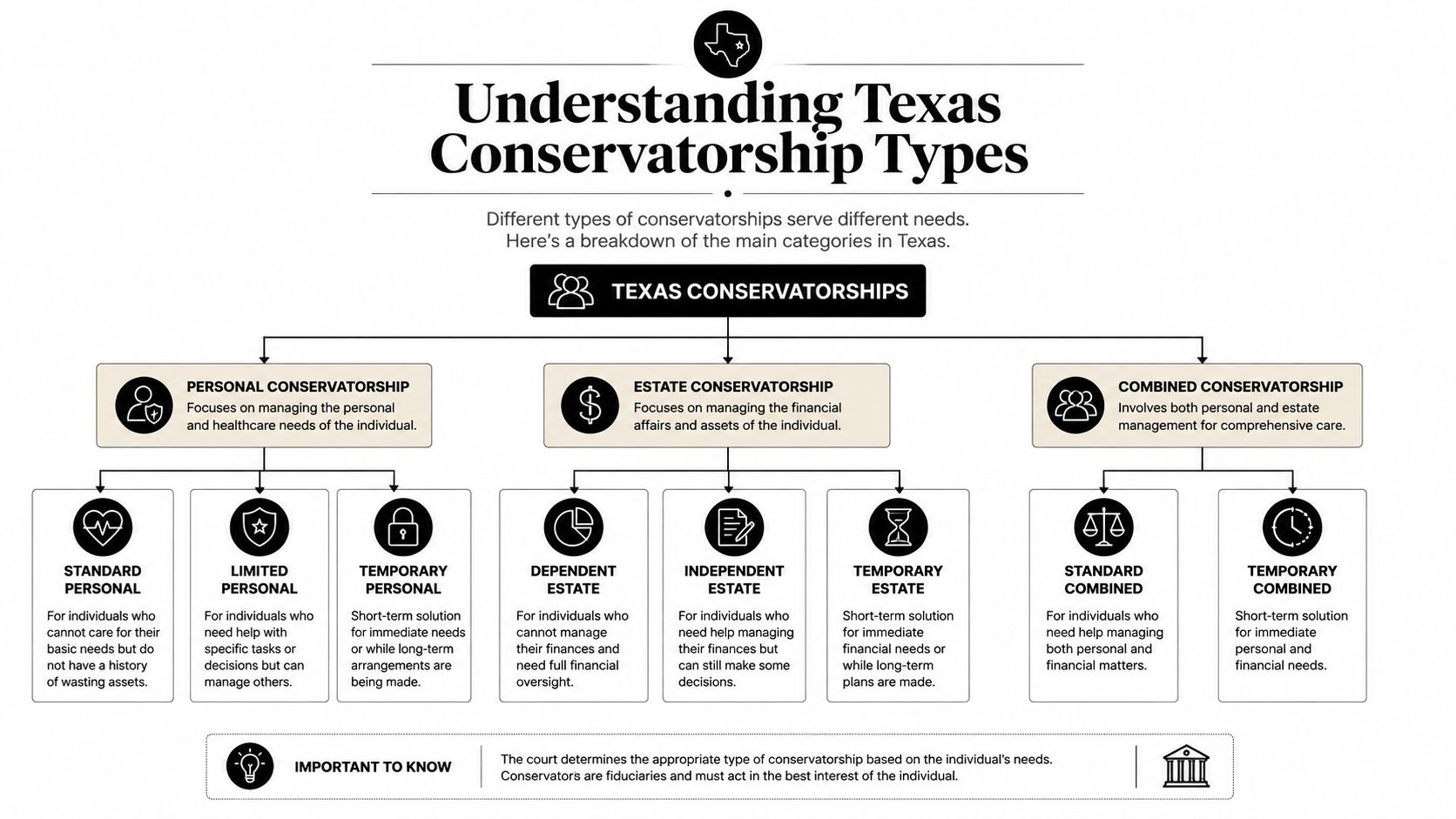
Understanding Texas Conservatorship Types
Texas custody terminology becomes easier once you separate conservatorship from possession. Conservatorship concerns legal rights and responsibilities. Possession concerns the time a parent spends with the child.
Joint managing conservatorship
A joint managing conservatorship means both parents share some form of legal responsibility for the child. It doesn't necessarily mean they'll share every right equally, and it doesn't automatically create equal parenting time.
The order may give both parents the right to receive information from schools and doctors while assigning one parent the exclusive right to make a particular decision. It may also require the parents to agree on education, medical care, or other major matters. The exact wording controls.
Texas law contains a general presumption favoring joint conservatorship in appropriate circumstances, but that presumption doesn't resolve every practical question. Parents who want a deeper explanation of that framework can review Joint Managing Conservatorship in Texas. A separate discussion of the rights involved is also available in this Texas joint managing conservatorship resource.
Sole managing conservatorship
A sole managing conservatorship gives one parent primary authority over the rights assigned by the order. That parent may have exclusive authority over important decisions, such as school enrollment or medical treatment, depending on the language used by the court.
Sole managing conservatorship doesn't automatically end the other parent's relationship with the child. The other parent may still be a possessory conservator and receive possession or access under a Standard Possession Order, an Expanded Standard Possession Order, or a customized schedule. Safety concerns may lead a court to require supervision or impose other protections.
Possessory conservatorship
A possessory conservator has court-ordered possession or access but may not hold the same decision-making authority as a managing conservator. This role can apply to a parent who doesn't have exclusive authority over major decisions.
A possession schedule is the timetable that explains when a parent may exercise possession of the child. It may address weekdays, weekends, holidays, school breaks, transportation, and exchanges. The schedule is legally important because it turns a general right to visitation into specific, enforceable instructions.
The most useful question isn't, “Which label sounds better?” Ask instead, “What rights does this order give each parent, and how does the schedule work in real life?” That question keeps the focus where Texas courts place it, on the child's needs and stability.
Comparing Decision-Making Rights and Daily Realities
Two orders can use different labels yet produce similar day-to-day routines. Conversely, two orders with the word “joint” can give parents very different authority and possession schedules.
| Aspect | Joint Managing Conservatorship | Sole Managing Conservatorship |
|---|---|---|
| Major decisions | Parents may share rights, or the order may assign specific rights to one parent | One parent generally holds exclusive authority over assigned major decisions |
| School choices | The order may require agreement or give one parent the exclusive right to decide | The sole managing conservator may hold exclusive enrollment authority |
| Medical care | Parents may share information and decision rights, subject to the order | The sole managing conservator may make specified medical decisions |
| Religious upbringing | The order may divide or share the authority | The court may assign the right to one parent |
| Extracurricular activities | Parents may need to coordinate schedules, transportation, and expenses | The managing parent may control the decision, while possession affects participation |
| Parenting time | Joint does not automatically mean equal time | The other parent may still receive regular possession or access |
| Relocation | Geographic restrictions and possession terms may limit practical choices | A move may still be restricted by the order or require court action |
| Everyday impact | Cooperation and clear communication often matter | One parent may make assigned decisions without obtaining the other parent's agreement |
Decision-making is more specific than the label
Suppose a child needs a new pediatrician. A joint order might require both parents to participate in the choice, or it might give one parent the exclusive right to make medical decisions. A sole order may give that authority to the sole managing conservator, but the other parent may still have rights to access medical information.
The same issue arises with school enrollment. If parents disagree about public school, private school, or a change in campus, the court order may identify who has the exclusive right to decide. If neither parent has that exclusive right, the dispute may require negotiation, mediation, or a court ruling. You'll want to review the actual provisions rather than rely on a general description of joint custody. This Texas sole managing conservatorship explanation addresses the role of exclusive decision-making authority.
Possession schedules create the family's routine
The Standard Possession Order provides a common structure for possession, but parents may agree to different terms and courts may tailor schedules to the child's circumstances. The Expanded Standard Possession Order gives the noncustodial parent more possession than the standard schedule. Texas-focused guidance describes the Expanded Standard Possession Order as providing about 46–48% of parenting time, while sole managing conservatorship is ordered in roughly 10% of Texas custody cases. Those figures come from Texas custody guidance on joint and sole arrangements.
Joint managing conservatorship doesn't make parents equal-time co-parents by itself. Texas Family Code Chapter 153 uses the concept of a possession schedule, and courts can design that schedule without granting equal possession. The statute also addresses possession and access mechanics, so parents should examine the decree's specific timetable and not stop at the conservatorship label. The Texas Family Code Chapter 153 provisions are the governing starting point.
How Texas Courts Decide What Is Best for Your Child
Texas judges apply the best interests of the child standard in custody disputes. In plain English, the court asks which arrangement is most likely to protect the child's safety, stability, development, and meaningful relationships, rather than which parent makes the stronger personal demand.
A judge may consider the child's emotional and physical needs, each parent's ability to meet those needs, the stability of each home, and the history of each parent's involvement. The court may also consider a child's preferences when the child is mature enough for that preference to carry weight, but a child doesn't choose the outcome.
Evidence that helps the court see daily life
Courts need reliable information, not broad accusations. Helpful evidence may include:
- Care records: School communications, attendance information, medical records, appointment history, and records showing who handles routine responsibilities.
- Communication history: Calm, complete messages can show attempts to cooperate. Threats, harassment, or repeated refusal to share information may also matter.
- Safety documentation: Police reports, protective orders, treatment records, or other admissible evidence may be important when violence, neglect, or substance misuse is alleged.
- Witness testimony: Teachers, caregivers, relatives, counselors, and other witnesses may provide context about the child's routines and each parent's involvement.
- A workable proposal: A detailed schedule that fits school, transportation, work, and the child's needs is more useful than a demand for time based only on parental preference.
A court isn't deciding which parent feels more hurt. It is examining facts that relate to the child's welfare and the practicality of the requested order.
Mothers, fathers, and the facts before the court
Texas courts don't decide custody solely because a parent is a mother or father. A mother seeking primary custody should be prepared to show how her proposed plan supports school continuity, health care, emotional security, and a healthy relationship with the other parent when safe. A father seeking primary custody or expanded possession should document hands-on involvement, reliable housing, work planning, school participation, and a child-centered schedule.
Research from Canada shows why custody labels should be viewed in historical context. Government data from the early 2000s found sole maternal custody in about 80% of divorce court files, sole paternal custody in 9%, and shared and split custody at 5% each. Earlier federal data from 1998–2001 found mothers received sole custody in 79.6% of cases, fathers in 8.8%, shared custody in 5.8%, and split custody in 5.2%. Later periods showed joint or shared custody expanding to 13% in one national review and 31% in Canadian court-order data for 2018–19. These figures provide historical context, but they don't replace a Texas court's individualized best-interests analysis. Government research on historical custody patterns explains that shift.
For additional discussion of the factors judges evaluate, parents can review Texas best-interest custody considerations.
The strongest presentation usually connects each requested term to a specific child need. “I want sole custody” is a position. “This schedule gives our child one stable school-week home while preserving safe, predictable time with the other parent” is a child-focused explanation.
Real-World Scenarios That Shape Custody Outcomes
Custody orders must work outside the courtroom. Parents may face military deployment, a job transfer, a long-distance move, grandparent concerns, or serious conflict between households. Texas courts can address these circumstances through decision-making provisions, possession schedules, geographic restrictions, and protective conditions.

Military service and relocation
A military parent may need a plan for deployment, temporary duty, or a change in residence. The order can address who exercises possession during deployment, how communication will continue, and how parenting time may resume afterward. A parent who needs to move for work or family reasons should review geographic restrictions before making plans, because relocation can affect school, transportation, and the other parent's possession.
The question isn't whether a parent has a legitimate reason to move. The court may weigh the child's relationship with each parent, the proposed school and home environment, travel demands, and whether the move supports or harms stability. Parents should raise relocation issues early and preserve written records of proposed schedules and transportation plans.
Grandparents and extended family
Grandparents may seek visitation or conservatorship rights when a child's circumstances justify court involvement. These cases can involve standing requirements and a focus on the child's welfare, so a grandparent shouldn't assume that a close emotional relationship automatically guarantees court-ordered access.
A grandparent should document the existing relationship, the child's needs, and the facts supporting the requested relief. The same child-centered approach applies to parents. Courts need concrete information about how an arrangement will affect the child, not only the adult conflict surrounding it.
High-conflict and safety concerns
Shared decision-making may become impractical when parents cannot communicate, repeatedly undermine the other household, or present safety concerns. A court may assign exclusive rights, require supervised possession, limit exchanges, or impose other terms when the evidence supports protection.
Keep messages brief and factual. Save school notices, medical records, exchange details, and reports of missed or denied possession. Avoid using the child as a messenger or asking the child to take sides. For emotional support during separation, parents may also find practical guidance in this resource on getting through separation.
A stable transition plan can include one consistent exchange location, direct communication between adults, and clear instructions for school personnel. These details often matter more to a child than the label printed above the schedule.
Modifying a Custody Order When Life Changes
A custody order doesn't change automatically because a parent is unhappy. Under Texas law, a modification dispute often turns on whether circumstances have changed in a material and substantial way and whether the requested change serves the child's best interests.
Examples may include a significant job change, relocation, a child's new medical or educational needs, or credible concerns about the other parent's fitness. A parent generally needs to connect the change to the requested relief. A complaint that the current schedule is inconvenient, without more, may not justify modification.
A practical modification path
Review the existing order. Identify the current conservatorship rights, residence terms, possession schedule, geographic restrictions, and any dispute-resolution requirements.
Identify the changed circumstance. Write down what changed, when it changed, and how it affects the child. Focus on facts rather than conclusions.
Gather supporting evidence. Collect school records, medical information, employment documents, communication records, witness details, and safety documentation when relevant.
File the appropriate request. A modification case begins with a petition asking the court to change specific terms. The requested relief should be precise, such as a new possession schedule or an adjustment to decision-making authority.
Consider mediation. Mediation can help parents create a workable agreement without leaving every detail to a judge. It works best when both sides can negotiate safely and exchange meaningful information.
Prepare for a hearing. If the parents can't reach an agreement, the court may hear testimony and review evidence before deciding whether the legal standard is met.
Emergency circumstances require faster action. If a child faces immediate danger, a parent may need to ask about emergency custody relief or temporary orders rather than waiting for an ordinary modification process. The appropriate response depends on the facts, available evidence, and local court procedures.
Modification cases don't have a guaranteed timeline. Scheduling, service, mediation, discovery, and the court's docket can affect how long a matter takes. A parent should avoid changing possession unilaterally unless the order or a new court directive allows it, because self-help can create additional legal problems.
Your Next Steps Toward Protecting Your Child's Future
The central lesson in the joint vs. sole discussion is simple: the order's details matter more than its label. Review decision-making rights, possession schedules, geographic limits, and safety terms together. Texas courts focus on the child's best interests, not a parent's preferred title.
Start with these steps:
- Gather documents: Collect the current order, school records, medical information, calendars, and relevant communications.
- Map the routine: Write down school, work, transportation, exchanges, activities, and the child's support network.
- Communicate carefully: Keep co-parenting messages respectful, direct, and focused on the child when communication is safe.
- Get legal advice: Ask a Texas family law attorney how the facts affect conservatorship, possession, support, relocation, or modification options.
Seeking advice doesn't mean escalating conflict. It means understanding your rights before a disagreement becomes harder to resolve. The Law Office of Bryan Fagan, PLLC handles custody, visitation, possession, paternity, support, modifications, enforcement, and emergency custody matters for Texas families.
If you need help with a child custody or visitation case in Texas, our experienced attorneys can guide you every step of the way. Contact Law Office of Bryan Fagan, PLLC to discuss how decision-making rights, possession schedules, or a custody modification may affect your child and to schedule a free consultation.