 Skip to content
When your child's future is on the line, understanding your rights matters most. You may have driven to the exchange location, prepared your child's room, and planned meaningful time together, only to receive a last-minute message that the visit is canceled. If missed weekends keep happening, the pain can feel personal. Under Texas law, however, the issue is more than a difficult co-parenting conversation. It may involve a denial of court-ordered possession and access.
Texas parents often search for “makeup visitation Texas” because they want a practical answer: Can the lost time be recovered, and is pursuing it worth the conflict? The answer depends on the wording of your order, the reason for the missed time, the quality of your documentation, and whether the problem is isolated or part of a larger pattern. Texas Family Code Chapter 153 and the enforcement provisions in Chapter 157 provide tools, but those tools work best when used carefully and with the child's stability in mind.
When a Missed Weekend Becomes a Legal Question
A parent arrives for Friday pickup. The other parent sends a text saying the child is sick. You understand that children get sick, so you agree to wait. Saturday passes. Then Sunday arrives, and there's still no pickup, no meaningful update, and no offer to reschedule the lost time.
One canceled weekend may come from a genuine illness or a communication mistake. It may be possible to resolve it with a calm written request. But repeated cancellations can create a different legal problem, especially when the other parent refuses to follow the possession schedule or won't discuss a reasonable solution.
The emotional problem and the legal problem
The emotional experience is usually immediate. You may feel rejected, powerless, or worried that your relationship with your child is being weakened. Mothers, fathers, grandparents, and caregivers can all face this uncertainty, particularly after divorce, a paternity case, or a difficult custody modification.
The legal question is narrower. What did the court order require, and what actually happened? Texas uses the terms “possession and access” rather than relying only on the word visitation. When a parent is denied a period required by an enforceable order, the missed time may be treated as denied possession or access rather than just an unhappy scheduling dispute. Texas courts place the child's best interest at the center of custody decisions, and the Texas State Law Library explains that courts can enforce possession orders when a parent fails to comply. Texas custody and support guidance provides an overview of that framework.
Practical rule: Treat each missed exchange as a fact to document, not an argument to win by text message.
When a pattern changes the response
A one-time disagreement may call for communication or mediation. A pattern of denied weekends, ignored messages, or interference with school and medical activities may justify discussing a Motion to Enforce Possession or Access with a Texas family law attorney.
That doesn't mean every missed visit requires an immediate court filing. It means the pattern matters. A parent who calmly preserves the order, messages, dates, and attempted exchanges will usually be in a stronger position than a parent who responds by withholding the child during their own possession time. Retaliation can create a second violation and distract the court from the original denial.
The goal isn't to punish the other parent. The goal is to restore a reliable relationship between the child and both parents, while using the legal process when informal cooperation no longer works.
What Makeup Visitation Actually Means in Texas
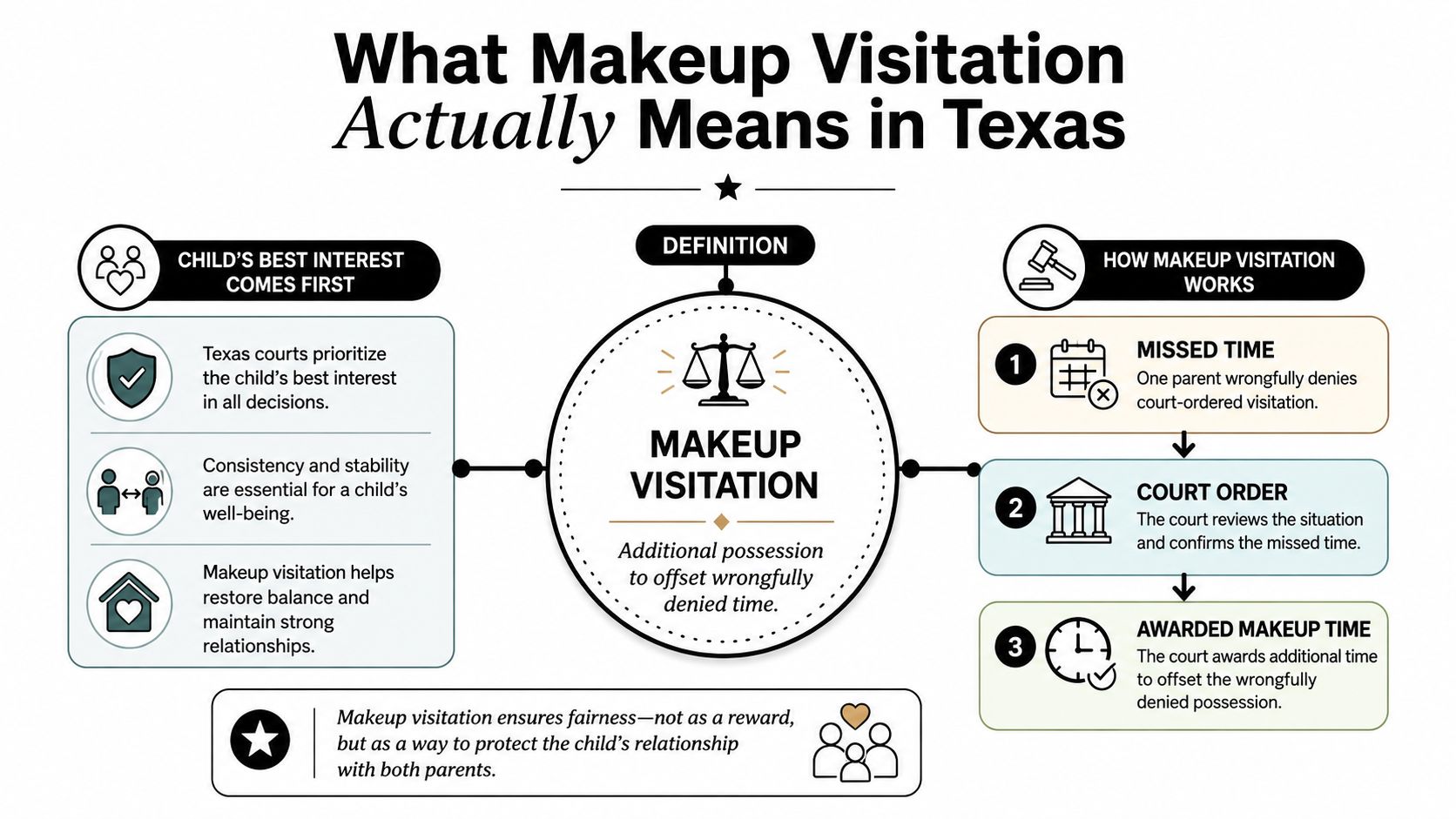
In plain English, makeup visitation means additional possession awarded to offset time a parent was wrongfully denied under a court order. Texas law generally describes that time as additional possession or access. The term “visitation” is common in everyday speech, but Chapter 153 uses the broader language of possession and access because an order can address more than a visit. It can define exchange times, holidays, weekends, summer periods, and other parenting responsibilities.
Many Texas families operate under a Standard Possession Order, often called an SPO. The Texas Access summary explains that when parents live within 100 miles of each other, the noncustodial parent typically has the first, third, and fifth weekends, one weeknight during the school year, about half of the holidays, and extended summer time. When parents live more than 100 miles apart, the summer period is 42 days rather than 30 days. These distance-based rules make the schedule more formula-driven than many parents expect. Texas Access and possession information explains how residence distance affects the schedule.
What can be made up
Makeup time usually relates to the specific possession period that was denied. A missed regular weekend isn't automatically converted into a holiday. A missed holiday isn't automatically replaced with a regular weekend. The type and length of the lost time matter because the remedy is tied to the actual denial.
Texas Family Code Section 157.168 authorizes a court to order additional periods of possession or access, including weekend, holiday, and summer possession. The remedy doesn't exist merely because a parent wishes for extra time outside the order. The parent must connect the requested time to a court-ordered period that was denied.
The child's best interest remains important. A court may consider whether the requested arrangement supports stability and whether the remedy fits the circumstances. Parents should also review the order itself. Some orders contain agreed language that differs from the standard schedule, and the written order controls when the parents can't reach a new agreement.
Documentation becomes critical because the court needs to identify the lost period, the order language, and the conduct that prevented possession.
Building a Record of Denied Possession and Access
Start your record on the day a scheduled period is missed. A dedicated journal, spreadsheet, or organized digital folder can help you separate the facts from the frustration. Your notes should make it possible for someone unfamiliar with your family to understand what the order required and what happened at the exchange.
What to record
For every missed period, include:
- Date and scheduled time: Write down the exact date, pickup time, return time, and location required by the order.
- Your attempted exchange: Record when you arrived, called, or sent a message.
- The stated reason: Use the other parent's actual words when possible, without adding conclusions.
- Communication method: Identify whether the message came by text, email, voicemail, a co-parenting application, or another channel.
- Witnesses: Note anyone who saw the attempted pickup or heard the relevant communication.
- The child's presence: Record whether the child was at the exchange location or whether you were told the child wasn't available.
- Your response: Preserve a calm request for clarification or replacement time.
Contemporaneous records can be more useful than a reconstruction months later. Preserve texts, emails, voicemails, and messages in their original form. Screenshots may help, but keep the full conversation, dates, sender information, and surrounding context whenever possible. Date-stamped photographs can also help establish that you were present at a designated exchange location, although a photograph alone won't prove every part of the dispute.
What weakens a record
Avoid writing emotional rants to the other parent. Don't accuse the other parent of alienation in every message, threaten retaliation, or send repeated demands after receiving no response. Don't contact the child during the other parent's possession time in a way that creates pressure or places the child in the middle.
A judge reviewing a Motion to Enforce will focus on the order and the specific conduct alleged. Guidance on how to present evidence in a custody case in Texas can help you organize records around dates, communications, and order language. For a broader overview of Enforcing a Texas Custody and Possession Order, focus on what to do when the other parent violates the custody order.
Your record should answer three questions: What time was ordered, what did you do to exercise it, and how did the other parent prevent or limit it? Those answers are more valuable than a long narrative about the relationship conflict.
Asking for Extra Time Versus Filing in Court
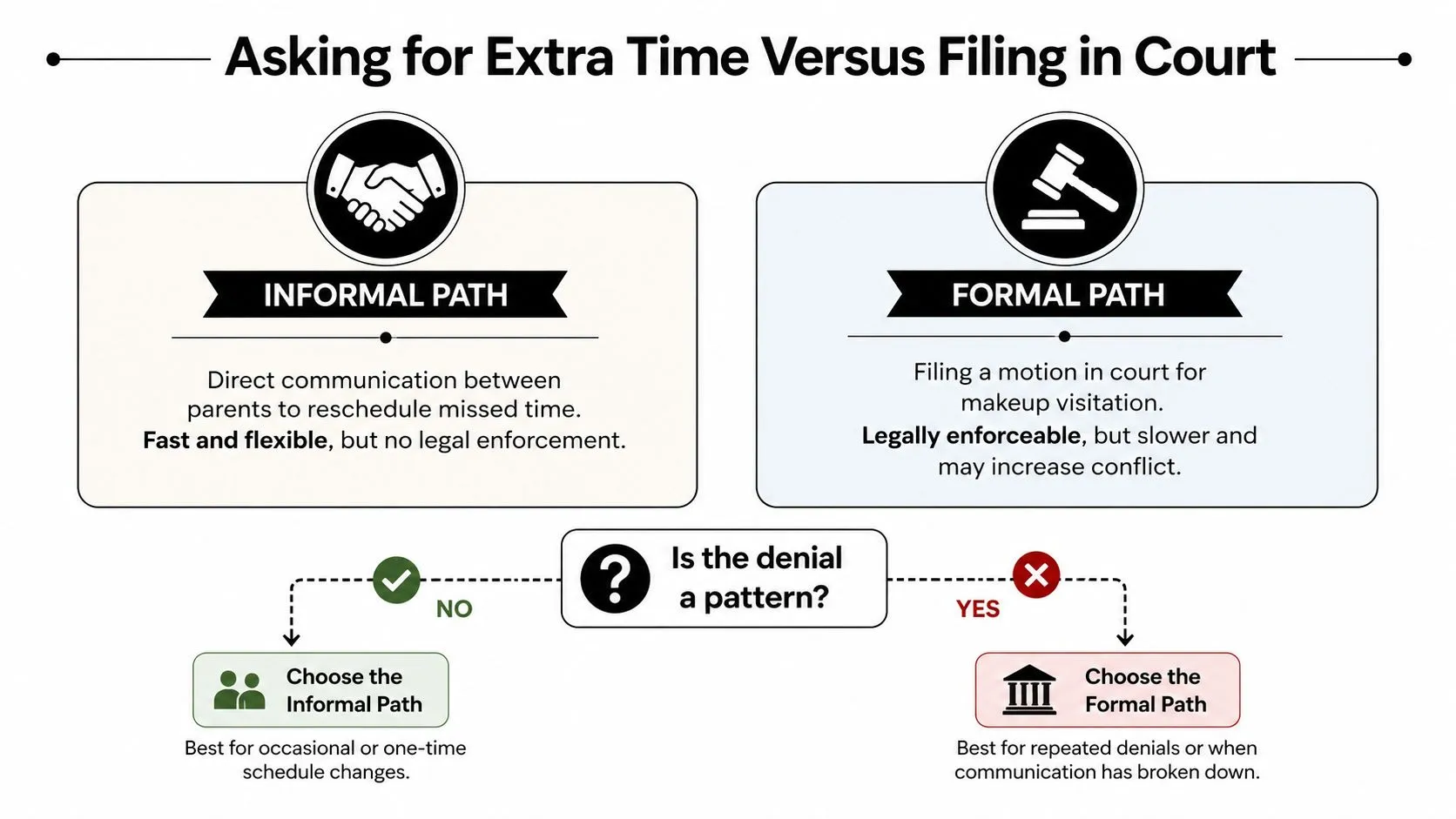
Parents generally have two practical paths after missed possession. They can try to resolve the issue directly, or they can ask the court to enforce the order. The right choice depends less on anger and more on the pattern, the clarity of the order, and the other parent's willingness to cooperate.
The informal path
Direct communication may work after an isolated incident, particularly when both parents recognize that a child's illness, transportation problem, or misunderstanding caused the missed time. Use a calm channel such as email, text, or OurFamilyWizard. State the missed period, identify the replacement time you're requesting, and give the other parent a reasonable opportunity to respond.
Family mediation can offer a structured setting when direct messages have become unproductive. Texas Civil Practice and Remedies Code Chapter 154 provides the legal framework for mediation. Mediation may help parents create a written agreement without immediately asking a judge to decide the dispute, but it won't provide the same enforcement power as a court order unless the agreement is properly incorporated or otherwise enforceable.
The informal route is usually more practical when:
- The incident appears isolated: The other parent offers a credible explanation and a replacement date.
- Communication remains possible: Both parents can discuss the child without threats or personal attacks.
- The order allows flexibility: The parents can mutually agree to a different time under the order's terms.
The formal path
A Motion to Enforce or Motion for Contempt under Texas Family Code Chapter 157 is more appropriate when denials repeat, communication stops, or the child misses important school or medical events because the order isn't followed. A formal case requires evidence. You'll need to identify the precise order provision, the denied period, and the facts supporting the alleged violation.
Court action can restore enforceability, but it can also take time, require legal expense, and increase conflict. Before filing, ask yourself:
Has the other parent made a good-faith effort to fix the problem, or has the refusal become the problem?
A useful decision test is simple. If the other parent will discuss one missed weekend and offer comparable time, try to resolve that incident in writing. If the parent denies a pattern, refuses all communication, or uses possession as leverage, a consultation about enforcement may be more appropriate. Parents considering whether an existing order can be adjusted by agreement can review whether a Texas custody order can be changed without going to court.
How Texas Family Code Section 157.168 Works
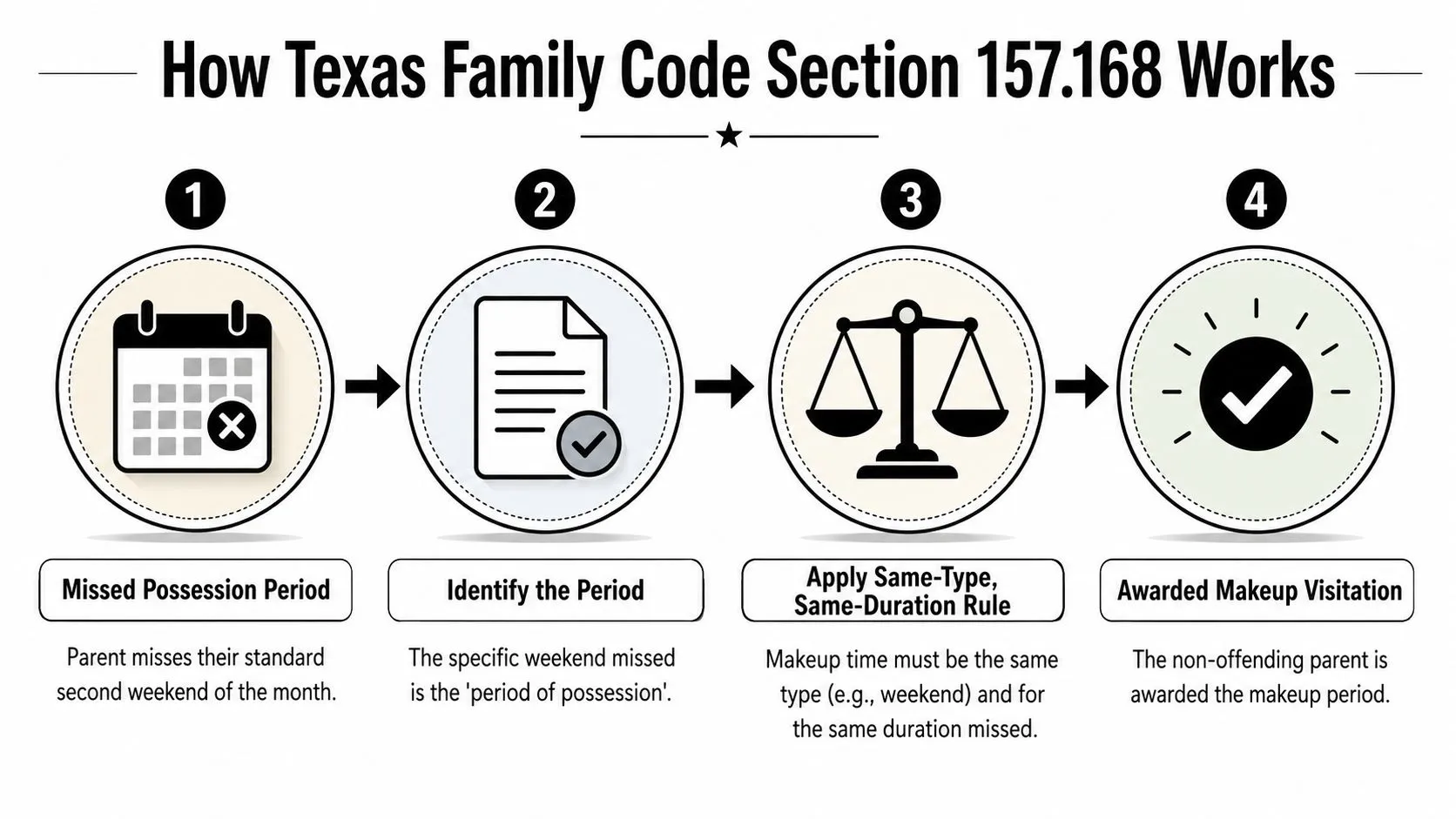
Section 157.168 is specific. It doesn't create an unlimited bank of extra weekends. It allows a court to order additional possession or access to compensate a parent who was denied court-ordered time, subject to limits tied to the lost period.
Consider a parent who was supposed to have a regular second weekend under the family's order but was denied that weekend. The period of possession is the particular block of time the parent was entitled to exercise. The parent's request should identify that weekend, not merely state that the other parent has interfered with visitation.
The statutory limits
The remedy generally follows these rules:
- Identify the denied period: The parent must connect the request to a specific missed period under the order.
- Match the type of time: Makeup time must be the same type as the time denied. A regular weekend is treated differently from a holiday or summer period.
- Match the duration: The additional possession must correspond to the duration denied. A parent can't automatically convert a partial missed period into an unrelated extended block.
- Use the statutory window: The additional time must occur on or before the second anniversary of the date the court finds the denial happened. Texas Family Code Section 157.168 discusses this time-limited remedy.
- Recognize who selects the timing: The parent who was denied possession or access gets to decide the timing of the additional period, while remaining subject to the same-type and same-duration limits.
The court still decides whether the facts support relief. A parent shouldn't assume that a demand for three extra weekends will be granted because three earlier exchanges went badly. The request must fit the statute and the order.
A careful written request
A written request might say:
On [date], the order provided for my possession from [time] to [time]. I was unable to exercise that possession because [brief factual description]. I'm requesting makeup possession of the same type and duration on [proposed date]. Please confirm whether you agree by [date].
Keep the tone neutral. Attach or preserve the relevant order language, but don't bury the request under accusations. If the other parent refuses or ignores it, save that response. A court may still require a Motion to Enforce to compel compliance or obtain an award.
Texas Family Code Section 153.312 supplies standard possession mechanics for parents living within 100 miles. The possessory conservator generally receives the first, third, and fifth Fridays from 6 p.m. until 6 p.m. the following Sunday, along with Thursday evening possession during the regular school term unless that visit isn't in the child's best interest. The same section addresses alternating spring break possession, with the possessory conservator receiving even-numbered years and the managing conservator receiving odd-numbered years. Texas Family Code Section 153.312 shows how a standard schedule translates into calendar terms.
When Makeup Time Is Not the Real Fight
Makeup time can be useful, but it isn't always the most important remedy. If the other parent repeatedly denies possession, pressures the child, or uses access as a tool, pursuing each individual weekend may consume energy without creating a dependable schedule.
Look for the larger pattern
A single missed period may be solved with a replacement date. Chronic denials raise broader questions:
- Is the schedule itself workable? Parents may need clearer exchange terms, transportation provisions, or geographic restrictions.
- Is the child's relationship being undermined? Repeated interference may call for a broader enforcement strategy rather than isolated makeup requests.
- Has the family situation materially changed? A modification of conservatorship or possession may be more useful than repeatedly restoring old time.
- Does safety require a different structure? Supervised visitation or emergency court relief may be relevant when the facts support it.
- Is contempt part of the issue? A court may address contempt findings and other enforcement remedies, including potential attorney's fees when legally available.
Texas Family Code Section 156.101 addresses modification standards, but a parent must show that the legal requirements fit the facts. A child's preference may matter in some cases, including situations involving a child who is 12 or older, but the child doesn't become the decision-maker. The court remains focused on the child's best interest and the evidence presented.
A child-focused decision
Ask whether the requested makeup period will create stability or merely produce another confrontation. That doesn't mean accepting repeated violations. It means choosing the remedy that addresses the cause. If the other parent denies one weekend because of a genuine emergency, a replacement period may solve the problem. If the parent denies possession to control the relationship, the central issue may be structure, accountability, or a custodial change.
Parents also face reputational concerns during high-conflict litigation. Keeping public statements measured can protect privacy and reduce distractions. General guidance on online reputation management for attorneys can help legal professionals and families understand why public-facing disputes may create additional complications.
Discuss the pattern with counsel before choosing a remedy. The right question may not be, “How do I get that weekend back?” It may be, “What order will give my child a stable and enforceable relationship with both parents?”
Practical Next Steps and When to Call an Attorney
You can take useful steps this week without escalating the conflict. Begin with a calm written request that identifies the missed period and proposes makeup time matching the type and duration of the possession denied. Avoid insults, threats, and long explanations. Write as though a judge may later read the message, because that is possible in an enforcement case.
A focused checklist
Gather these materials before speaking with a lawyer:
- Current possession order: Include every modification, agreed order, and attachment.
- Holiday schedule: Mark the holiday and summer periods separately from regular weekends.
- Denial log: List each date, scheduled time, attempted exchange, response, and witness.
- Original communications: Preserve texts, emails, voicemails, and co-parenting application messages.
- Third-party information: Identify people who personally observed an exchange or relevant event.
- Child-related records: Collect school or medical information if the missed possession affected those events.
Don't post angry accusations on social media. Don't ask the child to gather evidence or choose sides. Don't withhold your own scheduled possession to “balance” the situation. A parent who wants to understand the broader process may also review when to hire a custody lawyer in Texas.
Red flags that deserve prompt advice
Contact a Texas family law attorney promptly if denials continue, the other parent blocks communication, the child is being withheld from school or medical care, or you have concerns about child endangerment. A sudden move without notice can also require immediate attention. These circumstances may involve more than makeup visitation and could call for enforcement, modification, emergency relief, or another court strategy.
An attorney can evaluate whether Section 157.168 fits the facts, whether a Motion to Enforce is appropriate, or whether a modification case better addresses the repeated conduct. Some parents also use administrative support in demanding family law practices, and information about family law legal staffing solutions may help explain how legal offices organize case materials and communications.
The Law Office of Bryan Fagan, PLLC handles Texas family law matters involving possession, access, enforcement, modification, paternity, child support, and emergency custody issues. A consultation can help you move from a confusing series of missed exchanges to a clear, child-focused plan.
Key Takeaway
Makeup visitation in Texas is tied to a specific denial of court-ordered possession or access. The strongest approach is to preserve the order, document each missed period, request comparable time calmly, and recognize when repeated conduct requires court intervention. A single disagreement may call for cooperation, while a continuing pattern may require enforcement or a broader modification strategy.
If you need help with a child custody or visitation case in Texas, our experienced attorneys can guide you every step of the way. Contact The Law Office of Bryan Fagan, PLLC today for a free consultation.
The Law Office of Bryan Fagan, PLLC can review your possession order, denial records, and requested makeup time to help determine whether negotiation, enforcement, or modification fits your situation. Visit Law Office of Bryan Fagan, PLLC to schedule a free consultation about protecting your relationship with your child.


