
When your child's future is on the line, understanding your rights matters most. You may be considering a job offer, returning to family support, or leaving an unsafe situation. At the same time, you may fear that moving your child out of Texas before a custody order exists could damage your relationship or change where a custody case is heard.
The phrase “move out of state before custody order Texas” describes a difficult legal gap. There may be no signed order telling either parent where the child must live, but that doesn't mean a move has no legal consequences. Timing, the child's recent residence, the distance between homes, and the facts supporting the move can all shape what happens next.
This guide explains the rules in plain English for mothers, fathers, grandparents, and caregivers. It also covers Texas conservatorship concepts, the 100-mile possession trigger, the UCCJEA home-state rule, emergency concerns, and practical steps that can protect both your parental rights and your child's stability.
When Your Childs Future Is on the Line Before a Custody Order
Maria receives a job offer in another state. The position would give her a stable income and place her near relatives who can help care for her child. She and the child's father haven't completed a custody case, and no court has entered an order about residence, visitation, or decision-making. Maria wonders whether she can accept the job and take her child with her.
The father has a different concern. He wants regular contact and worries that, once Maria leaves Texas, a court may see the new state as the proper place to handle custody. He also knows that long-distance parenting may make ordinary weekend visits difficult. Both parents feel pressure, but neither should assume that moving first automatically decides custody.
Texas doesn't have one statewide relocation statute that creates a universal move-away rule for parents before a custody order is entered. Instead, courts focus on the best interests of the child, the facts surrounding the move, and the legal rules that determine custody jurisdiction. A parent may be free to move personally, but relocating the child can create a dispute over residence, access, and the proper court.
Practical rule: A parent's ability to change personal residence isn't the same as a legal guarantee that the child can be moved permanently without consequences.
The child's relationship with both parents matters. So do school, medical care, family support, safety, transportation, and the ability to maintain meaningful contact. A judge may examine whether the move supports the child's welfare or whether it makes the other parent's relationship substantially harder to maintain.
The safest approach is to plan before leaving. Gather documents, communicate carefully, consider filing a custody case, and ask about temporary relief if the move is urgent. If you're the parent who wants to relocate, preparation can help you present a child-focused plan. If you're the parent who opposes the move, acting promptly can help preserve your ability to ask a Texas court for relief.
Understanding Texas Family Code Chapter 153 is the starting point. The law uses terms such as conservatorship, possession, and access, but these terms describe everyday decisions and time with a child. You still have legal options, even when the situation feels unsettled.
How Texas Determines Custody and Residence Before an Order Exists
Texas custody law doesn't begin with the labels “custodial parent” and “noncustodial parent.” It begins with the child's welfare and the court's authority to make decisions.
Best interests and conservatorship in everyday language
The best interests of the child standard asks what arrangement supports the child's safety, stability, development, and continuing relationships. It isn't a reward for one parent or a punishment for the other. A parent asking to move should explain how the proposed change serves the child, while the other parent can explain how the move could harm stability or reduce meaningful contact.
Conservatorship means the legal rights and duties parents have toward a child. Texas commonly uses joint managing conservatorship, which means both parents share legal responsibilities. It doesn't necessarily mean equal time or that parents must agree on every decision. A court can still give one parent the exclusive right to determine the child's primary residence.
A court may also name one parent a sole managing conservator in appropriate circumstances. The labels matter less than the specific rights listed in the order, including where the child may live and how each parent exercises possession and access.
When parents are named joint managing conservators, Texas courts must designate the parent with the exclusive right to determine the child's primary residence. The order may also limit that residence to a geographic area until a later court order changes it, as reflected in the Texas custody framework discussed in Texas UCCJEA home-state jurisdiction guidance.
Why residence and possession are separate questions
Primary residence concerns where the child lives. Possession and access concern when the other parent spends time with the child and communicates with the child. A parenting arrangement may address holidays, school breaks, transportation, communication, and decision-making. Parenting Plans in Texas Custody Cases describes what a Texas parenting plan must address.
Before an order exists, no Texas order has yet assigned exclusive residence rights or created a geographic restriction. But the court can still evaluate the child's current home, each parent's involvement, and the effect of a proposed move when a parent files a custody case.
A parent shouldn't assume that being the child's day-to-day caregiver creates automatic primary-residence rights. Daily care is important evidence, but the court still makes its decision under the child's best interests. Likewise, a parent who hasn't had consistent contact may still seek conservatorship and possession.
Grandparents and other caregivers should document their role too. Records showing school involvement, medical support, transportation, and regular caregiving may help the court understand the child's existing stability.
Legal Risks of Moving Out of State Before a Texas Custody Order
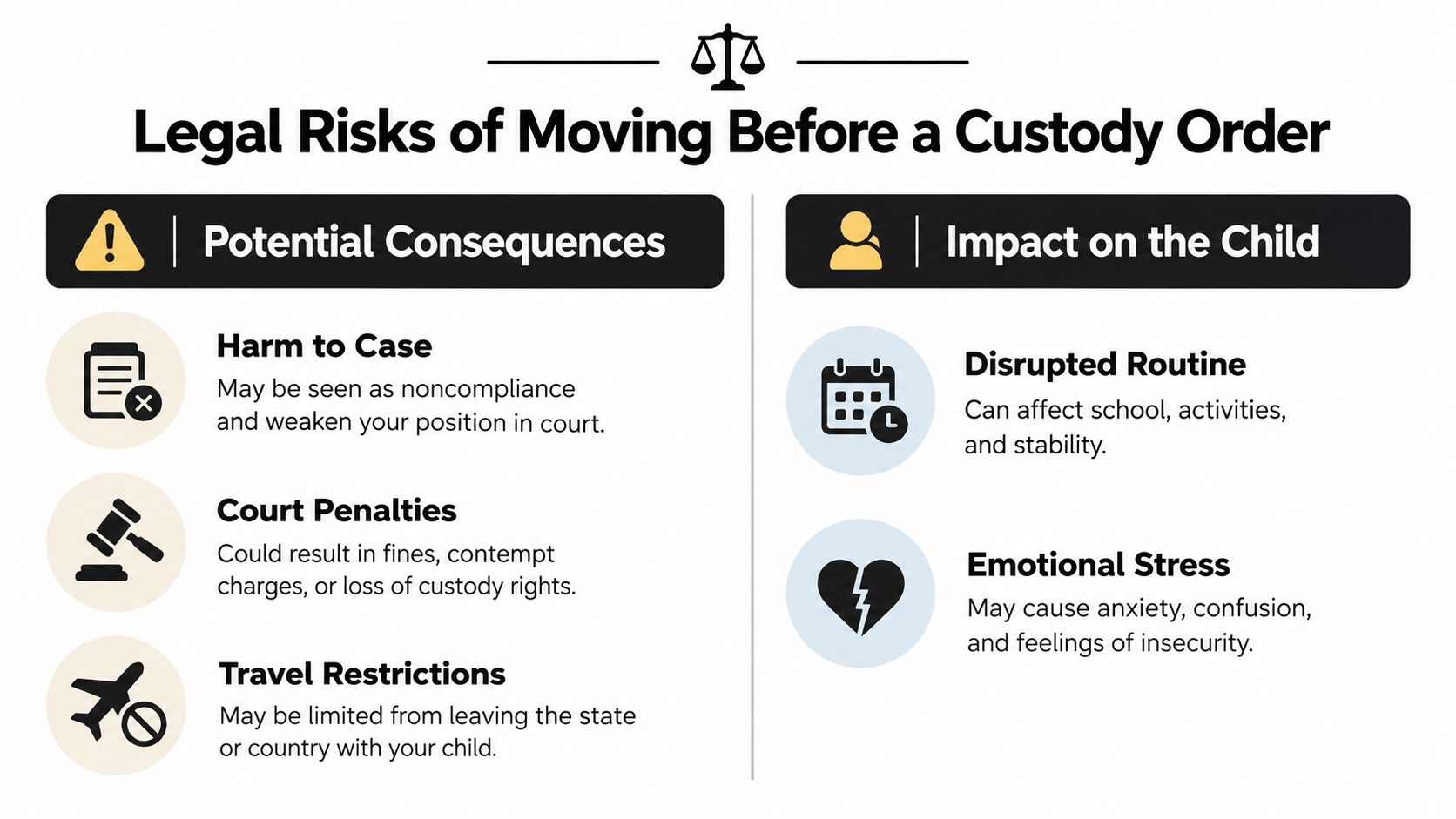
Moving early can affect both the practical schedule and the court system that handles the dispute. These risks don't mean every move will be rejected. They mean the decision can change the legal environment before either parent has a final order.
The 100-mile possession trigger
Texas standard possession rules are built around distance. When parents live 100 miles or less apart, the visiting parent typically receives first, third, and fifth weekends, along with weekday access. When parents live more than 100 miles apart, the schedule changes to one weekend per month at the parent's election, with 14 days' notice and a 90-day election window after the parents begin living more than 100 miles apart. These rules are described in the Texas standard possession framework at Texas Family Code Section 153.312.
That distance can reshape parenting time before a later modification is filed. A parent who moves from a nearby Texas city to another state may turn ordinary weekend access into a travel-heavy schedule. The change can affect school nights, transportation costs, holiday exchanges, and the child's ability to maintain familiar routines.
For parents living more than 100 miles apart, Texas Family Code Section 153.313 provides a different possession structure. The possessory conservator may have summer possession for 42 days, along with holiday rights, while the weekend schedule accounts for the distance. The Texas Attorney General also explains that parents separated by more than 100 miles receive options when completing a standard possession order. Review the statute at Texas Family Code Section 153.313.
The home-state jurisdiction risk
Texas follows the Uniform Child Custody Jurisdiction and Enforcement Act, codified in Chapter 152 of the Texas Family Code. The UCCJEA generally identifies the child's home state as the state where the child lived during the six months before the custody case. See Texas Family Code Chapter 152.
If a child leaves Texas before a case is filed, the move can create a jurisdictional race. After the child has lived in the new state long enough, that state may become the home state for future custody litigation. Texas may retain or lose authority depending on the child's residence, the parents' circumstances, and whether an earlier court order exists.
A move can change more than the drive between parents. It can affect which state decides the dispute.
A move doesn't transfer primary-residence rights automatically
A relocation may lead a parent to seek conservatorship or a new possession schedule, but the move alone doesn't automatically award primary-residence rights to either parent. Texas Family Code Section 156.101 generally requires a material and substantial change in circumstances, a best-interest finding, the child's stated preference in chambers when the statutory age requirement applies, or voluntary relinquishment of primary care and possession for the required statutory period. The statute is available at Texas Family Code Section 156.101.
How to Seek Permission to Relocate Before a Custody Order Is Entered
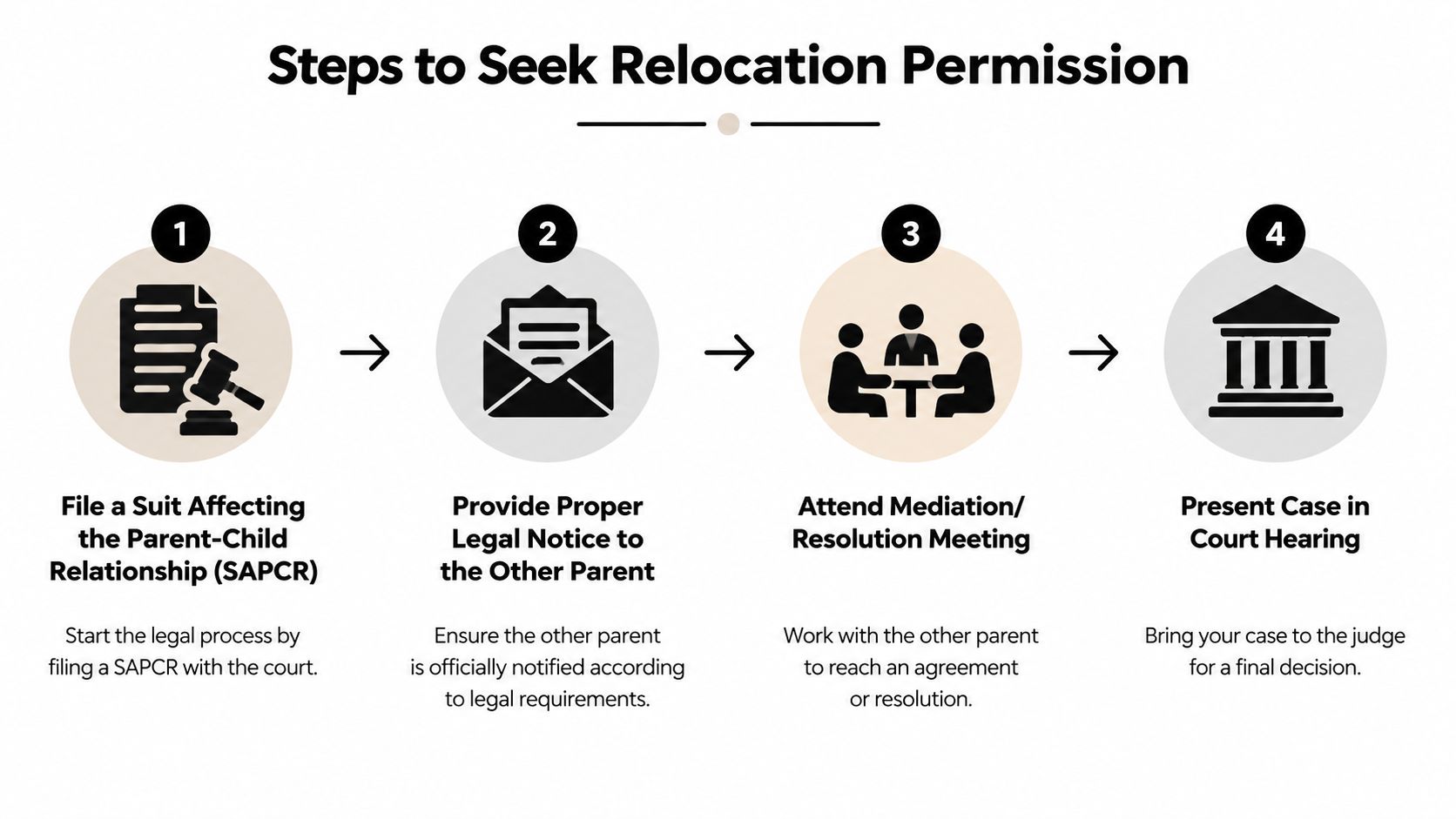
A parent who needs to move should avoid treating the relocation as a private decision involving only the parent and child. The better path is to create a legal record and present the court with a workable plan.
File the custody case
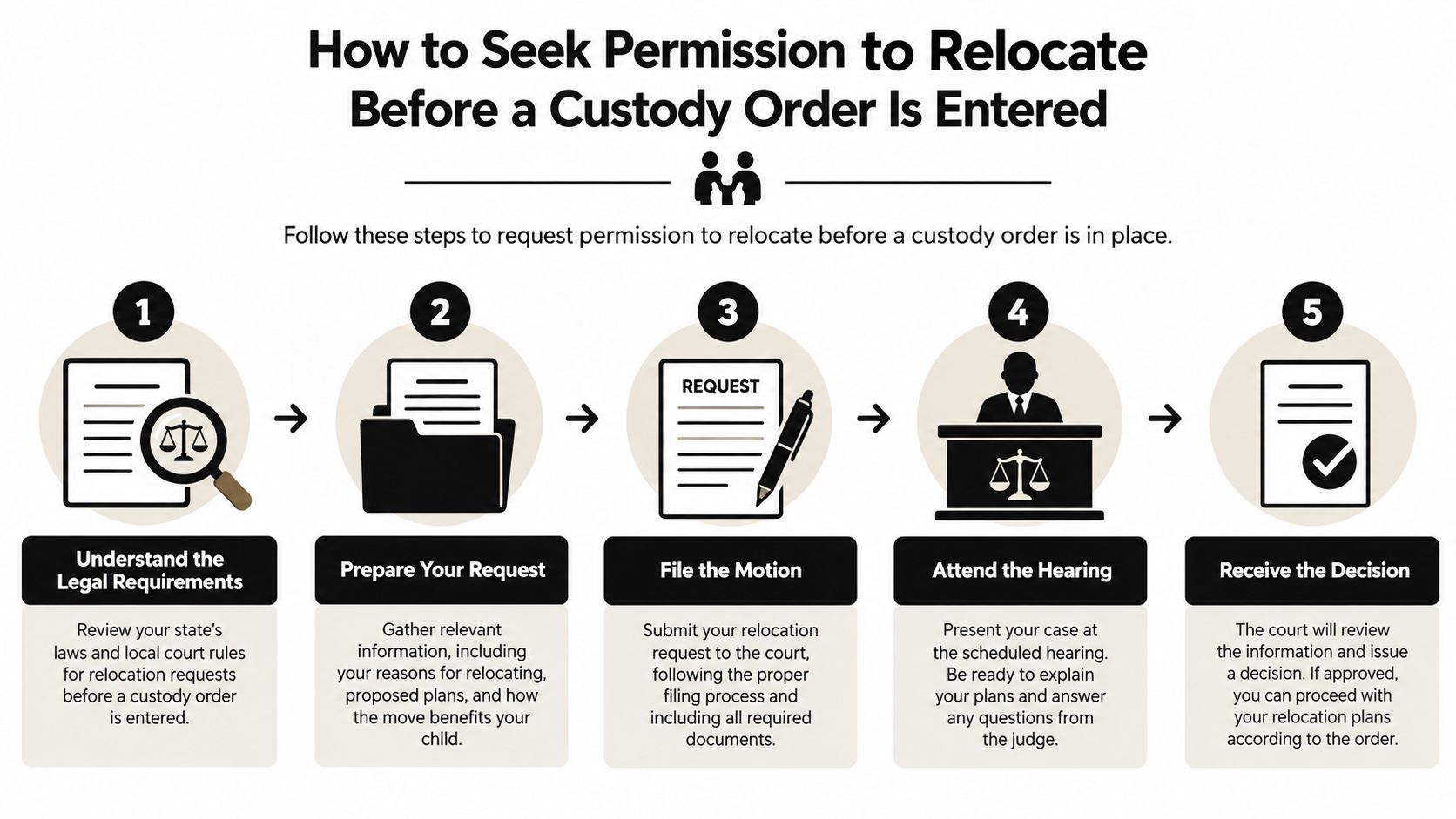
The usual starting point is a Suit Affecting the Parent-Child Relationship, often called a SAPCR. This case asks the court to establish conservatorship, possession, access, support, and other rights. If paternity hasn't been legally established, that issue may need attention as part of the case.
A SAPCR can allow the court to address the proposed residence before the move becomes permanent. The moving parent can request temporary orders explaining where the child should live while the case proceeds. The other parent can respond and ask for temporary possession, restrictions, or a different temporary arrangement.
If there's an immediate safety concern, ask a Texas family lawyer whether a temporary restraining order or other emergency relief is appropriate. Emergency procedures require specific facts and aren't a substitute for ordinary relocation planning.
Build evidence around the child
Judges need more than a parent's statement that the move will be better. Organize documents that show the concrete plan:
- Employment details: Preserve the job offer, work location, schedule, and expected effect on childcare.
- Housing information: Explain where the child would live and how the home supports safety and stability.
- School planning: Identify the proposed school or education arrangement and how the transition would be handled.
- Family support: Document relatives or caregivers who can provide dependable help, without overstating what they've promised.
- Caregiving history: Collect records showing your involvement with school, health care, activities, and daily routines.
- Transportation planning: Offer a realistic plan for exchanges, travel, holidays, calls, and school breaks.
The non-moving parent should gather different evidence. Show the child's current routine, your caregiving role, your relationship with the child, and the practical problems the move would create. A respectful proposed schedule is more persuasive than a general objection with no alternative.
Offer a workable long-distance plan
A strong proposal explains how the child will maintain a meaningful relationship with both parents. It might address extended school-break time, holiday rotations, video calls, travel responsibilities, and advance notice. The plan should match the child's age, school schedule, health needs, and travel tolerance.
Parents can negotiate or use mediation before asking a judge to decide every detail. Agreement can reduce uncertainty, but any agreement involving custody should be reviewed and properly presented to the court. For additional relocation planning information, see how to request permission to relocate with a child in Texas.
A custody lawyer can help identify the proper Texas court, prepare pleadings, request temporary relief, and organize evidence. The Law Office of Bryan Fagan, PLLC handles custody, visitation, emergency custody, paternity, support, modification, enforcement, military, and relocation matters for Texas families.
The following video offers another general explanation of relocation issues:
Possible Defenses and Exceptions That Texas Courts May Consider
Not every relocation situation looks the same. A parent leaving Texas for personal convenience presents different questions from a parent escaping violence or complying with military orders. The facts still matter, and a serious reason doesn't guarantee permission to relocate the child.
Relocating the parent versus relocating the child
A parent may decide to change personal residence, but the court's concern is usually whether the child will move and how that move affects custody, safety, and relationships. A parent who leaves alone may create different logistical problems from a parent who takes the child out of state. Neither situation should be analyzed without reviewing the facts and any existing legal documents.
| Defense or Exception | When It May Apply | What You Must Show |
|---|---|---|
| Imminent danger or family violence | The child or parent faces a credible, urgent safety threat | Specific evidence of danger, protective concerns, and why immediate action was necessary |
| Military deployment or orders | A service member must relocate or deploy under official orders | The orders, the proposed caregiving plan, and a way to preserve the child's relationship with both parents |
| Voluntary relinquishment of care | The other parent has voluntarily stopped providing primary care and possession | Reliable records showing the length and nature of the relinquishment, plus the child's best interests |
| Family, employment, or support-based move | The parent believes the new location offers meaningful stability or support | A detailed plan for housing, school, care, transportation, and continued contact with the other parent |
A safety emergency may justify seeking immediate court intervention, but it doesn't eliminate the need for legal action. Document threats, incidents, communications, and protective steps. If the concern involves family violence, prioritize immediate safety and ask about emergency remedies.
Military families face special timing problems because deployment and permanent-change orders may arrive quickly. Review military relocation and child custody before making commitments that affect the child's residence or care.
A parent who claims the other parent relinquished care must prove the history with records, not assumptions. Missed visits, financial disputes, or poor communication may matter, but they don't automatically establish legal relinquishment. Courts still focus on the child's welfare and the specific legal standard that applies.
Next Steps to Protect Your Parental Rights and Your Childs Stability
If you're considering a move, slow down long enough to create a clear record. Don't hide the plan, make promises you can't keep, or move based only on verbal assurances. Honest communication and prompt legal advice can help reduce confusion.
Start with this checklist:
- Write down the proposed move. Record the destination, reason, timing, housing plan, employment details, school plan, and support network.
- Preserve parenting records. Save calendars, messages, school records, medical information, transportation records, and evidence of each parent's involvement.
- Communicate carefully. Keep messages factual and child-focused. Avoid threats, insults, or statements suggesting the move is intended to limit contact.
- Prepare a contact proposal. Address regular communication, school breaks, holidays, travel, exchanges, and notice.
- Ask about filing promptly. A lawyer can evaluate a SAPCR, temporary orders, emergency relief, jurisdiction, and the risks of leaving before a court acts.
- If you already moved, seek help immediately. Don't assume that time alone resolves the issue. A lawyer can review whether Texas or another state has authority and whether an existing out-of-state order should be registered or enforced.
The Texas State Law Library explains that a custody or visitation order issued by another state or country may be registered with the appropriate Texas court when a family moves to Texas. Registration helps the Texas court recognize and enforce that order before a party seeks a change. Learn more through the Texas State Law Library child custody guide.

Key takeaway
Moving out of state before a Texas custody order exists can affect possession, evidence, and jurisdiction. It doesn't automatically give either parent primary-residence rights, and it doesn't erase the other parent's ability to seek custody or access. A careful plan keeps the focus on the child's stability while preserving both parents' legal options.
If you need help with a child custody or visitation case in Texas, our experienced attorneys can guide you every step of the way. Contact Law Office of Bryan Fagan, PLLC to discuss your proposed move, emergency concerns, SAPCR filing, or long-distance parenting plan during a free consultation.