 Skip to content
When your child's future is on the line, fear makes every text message, missed visit, and late-night call feel bigger. If you're staring at a pattern that feels unsafe, you don't need more noise, you need a clear standard for what Texas judges take seriously.
Texas custody cases are not about winning a blame game. They're about whether the child's physical health or emotional development is at risk, and whether you can prove it with records that hold up in court under Texas Family Code Chapter 153.
When Your Child's Safety Feels at Risk
A lot of parents reach this point after the same slow, unsettling pattern. One week it's a missed pickup. The next week it's a text that sounds intoxicated, a story that doesn't add up, or a child coming home hungry, exhausted, or frightened.
That's when the doubt starts. You know something is wrong, but you also know Texas judges don't remove a parent from a child's life because of one ugly argument or one bad day. They want proof that the child is being harmed by a continuing pattern, not just that the other parent is difficult.
Practical rule: If you can't tie the behavior to the child's safety, supervision, medical care, or stability, the court may treat it as conflict, not unfitness.
That's why this topic matters so much for mothers, fathers, and grandparents alike. The question isn't whether the other parent is annoying, unreliable, or impossible to talk to. The question is whether the evidence shows the child is being placed in danger, or whether you just have a painful co-parenting problem.
Texas law gives judges room to protect children, but it also keeps the focus on concrete proof. If you're trying to decide whether to move forward, start by asking a simple question, can I show a judge a real pattern, with records, witnesses, or official documents, that links the other parent's conduct to harm or risk for my child?
How Texas Courts Define an Unfit Parent
Texas courts don't treat “unfit parent” as a casual insult or a personality judgment. They look for evidence that a parent's conduct would significantly harm the child's physical health or emotional development, and they anchor custody decisions in the best interests of the child under Texas Family Code § 153.002 and the broader conservatorship framework. That's the test, even when people use the word “unfit” in everyday conversation.
What judges are looking for
A judge is usually not persuaded by ordinary co-parent conflict. Missed visits, poor communication, bitterness after divorce, and a single lapse usually don't carry enough legal weight on their own. What does matter is a pattern of conduct that shows recurring danger, like chronic neglect, violence, substance abuse that affects caregiving, or unsafe living conditions.
Texas child-welfare materials also point judges toward objective records, not just accusations. Police reports, medical records, CPS records, school records, and court-ordered psychological evaluations often matter more than a dramatic explanation in the courtroom, because they help the judge see whether the child's home life is unstable or unsafe. The legal burden is to create a firm belief or conviction in the trier of fact, which is why one-sided accusations rarely do the job by themselves. See the Texas child welfare law bench book for the evidentiary approach Texas courts use.
The difference between bad parenting and legally actionable harm
That distinction matters. A parent can be frustrating, careless, or hard to co-parent with and still not meet the legal threshold for unfitness. Texas judges are looking for conduct that connects to danger, not just conduct that annoys the other parent.
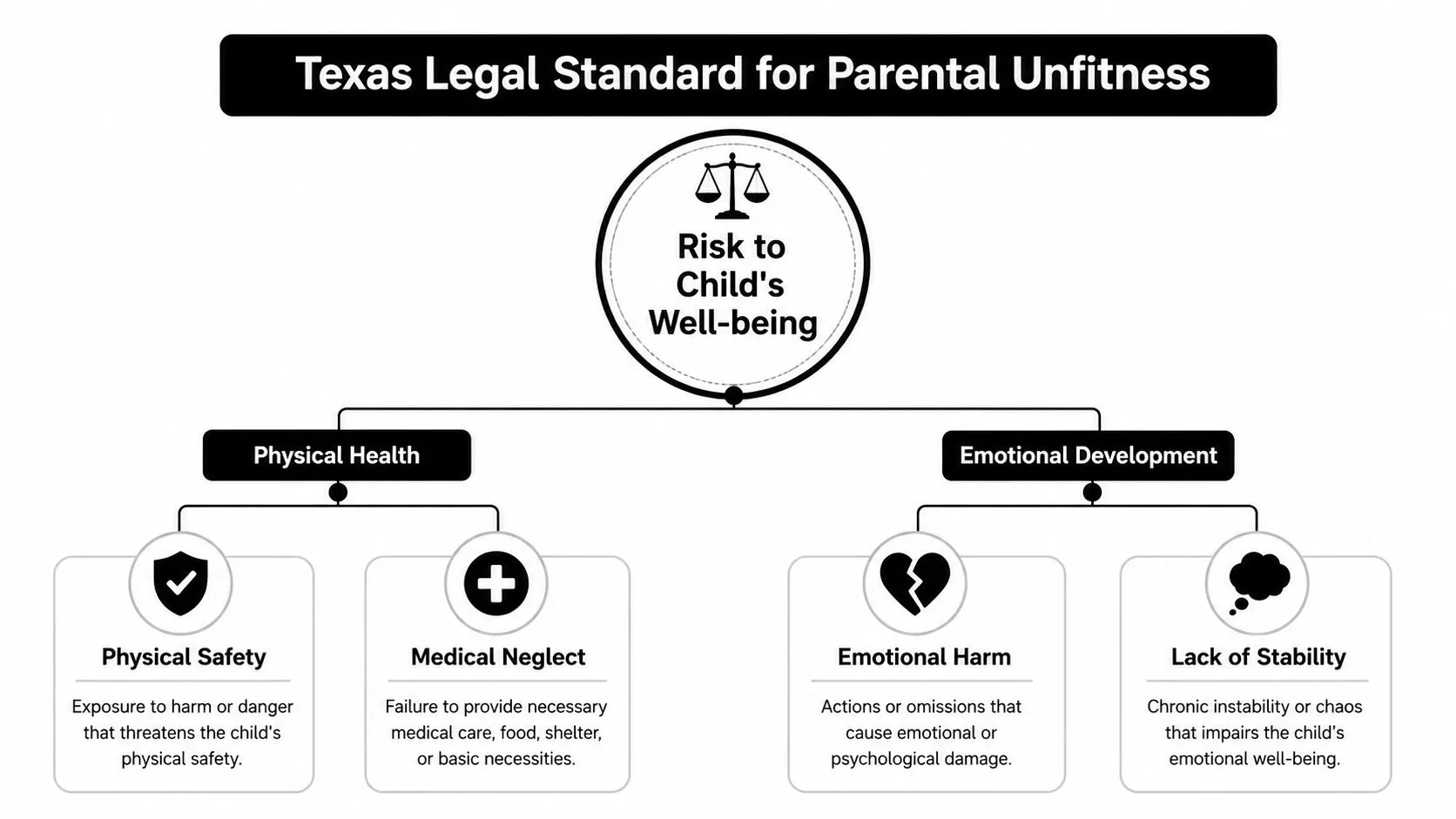
A useful way to think about it is this. If the evidence shows the child is getting food, supervision, medical care, and a safe home, the court may see conflict but not unfitness. If the record shows repeated failure in those basics, the case gets much stronger.
Texas courts also treat conservatorship and possession schedules as child-focused tools, not prizes. Conservatorship means who makes important decisions for the child, while a possession schedule is the calendar for when each parent has time with the child. The judge's job is to set both in a way that protects the child, not to reward the louder parent.
Types of Evidence That Persuade Texas Judges
The cases that hold up in court are built on convergent evidence. That means several independent sources point to the same problem. A parent's testimony matters, but it carries far more weight when official records, digital messages, and outside witnesses all line up on the same facts.
Official records carry the most weight
Police reports, CPS records, school attendance files, medical records, and court-ordered evaluations often form the backbone of a Texas custody case. Judges trust them because they come from neutral sources, and they create a timeline that is harder to dispute than a family argument.
A domestic violence claim backed by an ER record, a 911 call log, and threatening texts is much stronger than testimony alone. The same goes for neglect claims. Missed medical appointments, unexplained school absences, or documented CPS involvement can show a recurring problem instead of a single bad incident.
Digital evidence helps when it supports a larger pattern
Texts, emails, app logs, and social media posts can help, but they are not magic. Screenshots can be challenged, and the other side may say messages were edited or taken out of context. Digital proof works best when it confirms conduct already shown in a record from school, a doctor, law enforcement, or a therapist.
If you are organizing messages for a lawyer or court, the guide to transcript formatting can help you present conversations clearly and in order. That kind of structure matters when a judge needs to see what happened, when it happened, and how it connects to the child.
Witnesses and professionals fill in the gaps
Teachers, doctors, neighbors, relatives, and therapists can describe what they saw, but their value rises when they observed the child directly or documented concerns at the time. A coach who noticed a child arriving hungry, or a teacher who tracked repeated absences, usually helps more than a family member repeating what was heard later.
| Evidence Type | Strong Examples | Weak Examples | Persuasive Weight |
|---|---|---|---|
| Official records | Police reports, CPS records, medical charts, school attendance logs | Unverified complaints, memory-only accounts | High |
| Digital evidence | Texts with dates, emails, app logs, photos with context | Screenshots with no source, edited-looking images | Medium to High |
| Witness testimony | Teachers, doctors, neighbors, therapists with direct observations | Family arguments, secondhand stories | Medium |
| Expert evaluations | Court-ordered psychological evaluations, substance testing | Personal opinions about diagnosis | High when tied to child impact |
A case gets stronger when the proof connects across categories. A school record showing missed classes, a doctor's note showing untreated medical issues, and texts admitting the parent never followed through tell a judge something different than any one item alone. That is the evidentiary gap parents miss, the court does not care about one alarming moment as much as a pattern that shows the child is being put at risk.
If your situation involves changing an existing order, Modifying a Texas Custody Order is the right kind of issue to discuss with counsel, because the court will want to know what changed and why it matters now. For a practical overview of how evidence fits into custody litigation, see this Texas custody evidence guide.
Common Evidence Mistakes That Weaken Your Case
A parent can have real concern and still walk into court with weak proof. One failed drug test, one missed visit, or one angry text may feel damning, but Texas judges usually need more than a single bad moment before they treat a parent as unfit.

Why isolated proof often falls short
Texas courts look for a pattern, not a one-off lapse. A missed exchange may show poor judgment, but a record showing repeated missed care, unsafe supervision, or recurring impairment is what starts to look like unfitness. Frequency, recency, and corroboration matter because they show the court that the risk is ongoing, not just upsetting.
The earlier discussion of the six-month benchmark in the Texas parent fitness guidance points to the same idea. Judges want to see conduct that repeats and affects the child, not a single episode that got everyone's attention for a day.
Screenshots without context are easy to attack
Digital evidence helps only when it is preserved correctly. A screenshot with no date, no surrounding conversation, and no way to verify who sent it invites the other side to argue it was edited or stripped of context.
Keep the full thread. Keep the original file if you can. Keep the date visible. If you are organizing messages, a guide to transcript formatting can help you keep the record readable and easy to follow.
Evidence of bad co-parenting is not the same as child endangerment
Late child support, fights over extracurriculars, and stubborn communication problems may matter in a broader custody dispute, but they do not automatically prove unfitness. Judges are looking for danger to the child, not just frustration for the other parent.
Emotional testimony can also backfire when it stands alone. If your story sounds angry but is not backed by records, the court may treat it as a custody fight instead of a child-safety issue. A stronger approach is to pair your account with school records, medical notes, photos, and witness names, the same practical approach discussed in how to present evidence in a custody case in Texas.
Build convergent proof, not a pile of complaints
Judges respond to evidence that points in the same direction. A single text about drinking means little by itself. That same text, tied to missed pickups, a school attendance problem, and a witness who saw the parent impaired, starts to form a chain the court can trust.
That is the threshold gap parents miss. Strong feelings do not carry the day. Connected proof does.
Building a Documentation Strategy That Works
If you suspect unfitness, start building a record the way a judge would read it, in order. A timeline is the simplest way to do that, because it shows frequency, recency, and corroboration, the three things that help a court see an ongoing risk instead of a collection of complaints.
Build the timeline first
Write down each incident as soon as you can. Include the date, time, what happened, who saw it, and how the child was affected. Don't write a novel, just the facts.
A good timeline usually includes:
- The event itself, such as a missed pickup, intoxicated call, or unsafe home condition
- The impact on the child, such as missed school, no supper, no supervision, or emotional distress
- The outside proof, such as texts, photos, school records, or a witness who was there
Preserve digital evidence the right way
Take screenshots that include the date and surrounding conversation, then save the original file if you can. Back it up to a cloud folder and keep the file name simple so you can find it later.
Keep the original, keep the context, and keep the date. If a message matters enough to mention in court, it matters enough to preserve correctly.
Request official records early
School attendance records, medical appointment histories, police reports, and CPS documents can turn a shaky claim into a credible case. Teachers, counselors, doctors, and therapists may also have observations that matter, especially when they've seen the child repeatedly over time.

If a child is in immediate danger, call law enforcement or CPS and create an official record right away. If the situation is serious but not an emergency, document it and talk with a lawyer before making a move that could muddy the case.
Emergency Relief Versus Standard Custody Proceedings
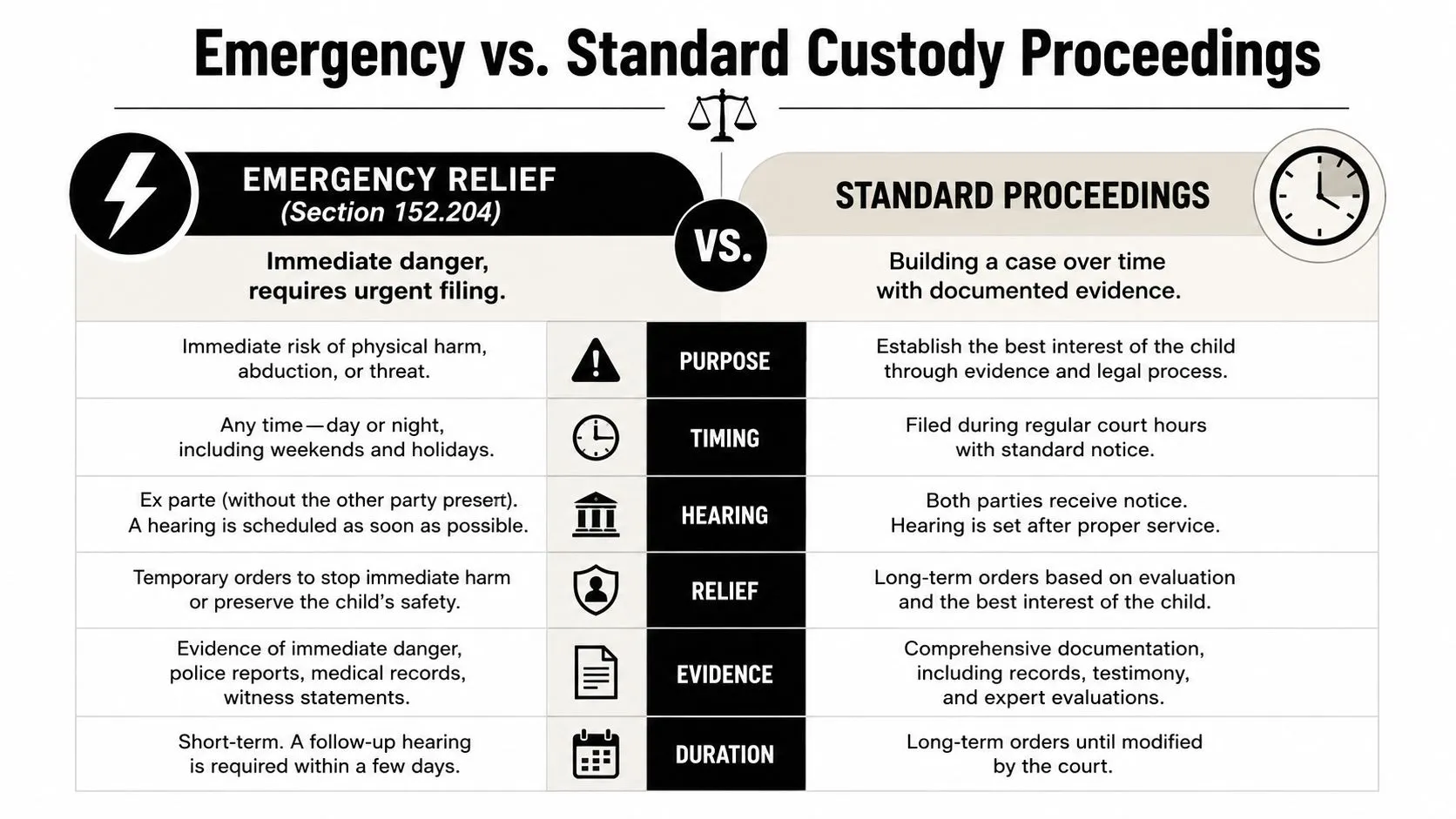
Texas gives parents two very different paths. One is for immediate danger. The other is for building a custody case over time.
When the law treats it as an emergency
Under Texas Family Code § 152.204, a court can act when a child faces immediate danger, abandonment, or abuse. That can lead to an ex parte hearing, which means a judge can issue temporary orders without first notifying the other parent.
This is the path for real emergencies, not routine frustration. If a child is with an intoxicated parent, exposed to domestic violence, or at risk of being left without safe supervision, don't wait around hoping the problem fixes itself. Protect the child first, then gather the paperwork.
When standard custody litigation makes more sense
If the child is not in immediate danger, you usually need a longer record before asking for a major custody change. Standard modification cases focus on a material and substantial change in circumstances, and the court wants to see documented evidence that supports the requested change.
That's where patient documentation wins. A steady pattern of unsafe conduct, backed by records, is far stronger than a panicked filing based on one ugly weekend. For a deeper look at urgent filings, see emergency motions for custody in Texas.
Before you decide which path fits, ask one blunt question. Is the child in immediate danger right now, or do I have time to build a cleaner, stronger case?
For context, here is a short video on custody decision-making in Texas.
Your Next Steps and When to Seek Legal Help
The best cases are not built on emotion alone. They're built on a clean legal theory, a documented pattern, and evidence that ties the other parent's conduct to real risk for the child. If you can show that, you're in a much stronger position than the parent who walks in with a stack of complaints and no timeline.
What to do now
Start by organizing what you already have. Put your texts, photos, school records, medical notes, and witness names in one place, then sort them by date. If you're missing records, request them now while the paper trail is still fresh.
A family law lawyer can help you decide whether your facts fit a custody modification, an emergency request, or a different remedy altogether. Early advice matters because the wrong move can damage credibility, especially when the other side is already accusing you of exaggeration.
Parents often think they need to wait until things get worse. That's not always true. If the child's safety, health, or stability is at stake, it makes sense to get legal advice before the situation hardens into a bigger mess.
For families who want a deeper sense of how legal services are presented online, you can also see how Howard Family Law grew, which shows how a focused family-law practice can communicate clearly with the families it serves. The same principle applies here, keep the message plain, keep the proof organized, and keep the child's welfare at the center.
If you need help with a child custody or visitation case in Texas, our experienced attorneys can guide you every step of the way. Contact The Law Office of Bryan Fagan, PLLC today for a free consultation.
If you need help with a child custody or visitation case in Texas, our experienced attorneys can guide you every step of the way. Contact The Law Office of Bryan Fagan, PLLC today for a free consultation. Visit Law Office of Bryan Fagan, PLLC to discuss your custody concerns, review your evidence, and get clear guidance on protecting your child's best interests.


