 Skip to content
When your child's future is on the line, uncertainty can feel overwhelming. You may be wondering whether a psychologist will evaluate your parenting, whether your child will be interviewed, or whether a report could affect visitation, conservatorship, or relocation. A psychological evaluation in a Texas custody case is serious, but understanding the process can help you respond calmly and protect your child's interests.
Texas courts use evaluations when the available evidence doesn't fully answer what arrangement serves the child. The evaluator doesn't decide the case. Instead, a qualified professional gathers information and gives the court findings, opinions, recommendations, and answers to specific questions. The judge still makes the final decision under the best-interest standard.
When the Court Steps Into Family Decisions
A seven-year-old wakes repeatedly at night. One parent believes anxiety comes from the other parent's home. The other parent points to the tension between households and says the first parent is creating fear. Conversations in the kitchen become accusations, and neither parent trusts the other's description of the child's needs.
When a disagreement like this reaches a Texas courtroom, the judge may need information that pleadings and short hearing testimony can't provide. A court can appoint a neutral child custody evaluator, often a qualified mental health professional, to study the family and report what the evaluator finds. The evaluation may address the child's needs, each parent's functioning, parent-child relationships, safety concerns, and possible parenting arrangements.
Situations that may lead to an evaluation
Parents commonly ask about evaluations when the case includes:
- High-conflict co-parenting: The parents can't make basic decisions or communicate without repeated disputes.
- Relocation: One parent wants to move, and the move could affect school, routines, or the child's relationship with the other parent.
- Alienation allegations: One parent claims the other is damaging the child's relationship with them.
- Mental health or substance-use concerns: A party raises questions about diagnosis, treatment, medication, impairment, or safety.
- Grandparent access: A grandparent seeks conservatorship or possession and the court needs a closer look at family relationships.
- Military deployment: A parent's service obligations create questions about continuity of care, temporary arrangements, or a family care plan.
An evaluation isn't punishment. It's the court's method for obtaining focused information when parents offer sharply different accounts. The evaluator is not a therapist for either parent and isn't there to help one side “win.”
Practical rule: Treat the evaluator as a neutral professional gathering evidence for the court, not as an advocate for either household.
The process can feel invasive, especially for a worried mother, father, grandparent, or caregiver. You still have legal options, including presenting records, challenging inaccurate information, questioning the evaluator at a hearing, and asking your attorney to address an evaluation's scope or methodology.
The Legal Basis for Custody Evaluations in Texas
Texas custody decisions rest on two connected legal ideas. The first is the child's welfare. Under Texas Family Code Section 153.002, the best interest of the child is always the primary consideration when a court decides conservatorship, possession, or access.
In plain English, the judge focuses on the child rather than either parent's preferred outcome. The court may consider safety, stability, school needs, medical care, routines, emotional relationships, and each parent's ability to meet the child's needs. A joint managing conservatorship means both parents share certain rights and duties, although it doesn't automatically mean equal time. A possession schedule sets when the child is with each parent, including regular periods, holidays, school breaks, and transportation responsibilities.
The second anchor is Chapter 107 of the Texas Family Code, which governs child custody evaluations and related professional appointments. Texas law permits a court to order a custody evaluation only after notice and a hearing or by agreement of the parties. The order must identify the evaluator, explain the evaluation's purpose, and list the specific issues to be addressed. Each evaluator must meet the qualification requirements in Section 107.104.
Who can request an evaluation
A parent, grandparent, or another legally involved caregiver can ask the court to order an evaluation. The request alone doesn't guarantee one. The judge decides whether the evaluation is appropriate and whether the proposed scope addresses a genuine need.
Texas law also includes a special safeguard in nonparent cases. Before appointing a child custody evaluator in that setting, the court must make a specific finding, after notice and hearing or agreement, that good cause exists for the appointment. This protects families from treating a specialized evaluation as an automatic step.
A court-ordered evaluation differs from a privately retained professional opinion. The court order defines the evaluator's role, and Chapter 107 governs the resulting report. In a dispute about an existing order, Enforcing a Texas Custody and Possession Order addresses what to do when the other parent violates the custody order. That issue may require enforcement evidence rather than a custody evaluation.
Types of Evaluations a Court Can Order
Not every family needs the same level of investigation. The court may order a broad evaluation, limit the inquiry to a specific concern, authorize a social study, or address psychometric testing within the statutory requirements. The order's wording matters because it tells the evaluator what questions to answer.
A full child custody evaluation examines the family as a whole. The evaluator may interview both parents and the child, observe interactions, review records, contact collateral sources, conduct home visits, and use testing when legally permitted and professionally necessary. This format may fit a case involving several disputed issues, such as relocation combined with mental health concerns and severe co-parent conflict.
A limited or focused evaluation narrows the assignment. For example, the court may ask an evaluator to examine one parent's substance-use history or a particular safety concern. A focused order can reduce unnecessary investigation, but it still needs a clear purpose.
A social study under Chapter 107 is generally more observational and may be conducted by a qualified social worker or another authorized professional. It can address household conditions, family relationships, and practical parenting circumstances without functioning as a complete clinical assessment.
A psychological testing-only order involves formal testing and interpretation. Texas law allows psychometric testing only when the court orders it or the evaluator finds it necessary. The evaluator must be properly licensed, trained to administer and interpret the selected tests, and trained in the forensic use of psychometric testing. Testing alone isn't proof of parenting fitness.
| Evaluation Type | Who Conducts It | Scope | Best Use Case |
|---|---|---|---|
| Full custody evaluation | Qualified Chapter 107 evaluator | Family history, interviews, records, observations, collateral information, and testing when authorized or necessary | Multiple disputed parenting, safety, or developmental issues |
| Limited evaluation | Qualified evaluator with a defined assignment | One issue or narrow set of questions | A focused concern, such as substance use or a specific parenting dispute |
| Social study | Authorized social-study professional | Household conditions, relationships, and practical observations | The court needs family and home information without a full clinical evaluation |
| Psychological testing only | Properly licensed and trained professional | Administration and forensic interpretation of selected tests | The court needs specialized psychometric information tied to a broader case |
For a related explanation of how a social study differs from a custody evaluation, review the Texas custody evaluation social study. The right format depends on the court's questions, the child's circumstances, and the evaluator's qualifications.
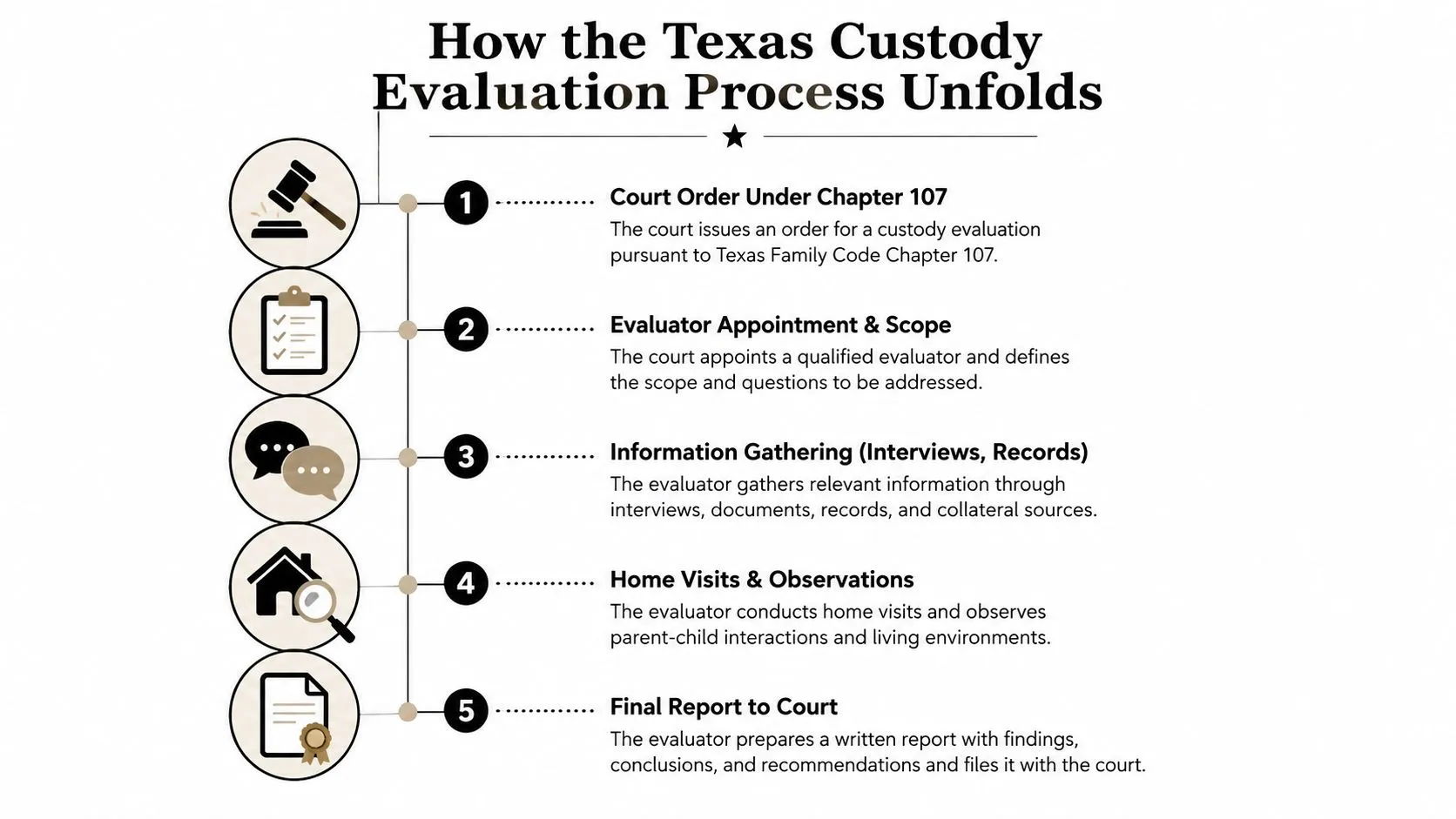
How the Evaluation Process Unfolds
The process begins with a court order or an agreement between the parties. The order identifies the evaluator, purpose, and issues. The evaluator then contacts the attorneys or parties to discuss scheduling, required materials, communication rules, and fees.
Parents usually complete detailed questionnaires and provide records. The evaluator may interview each parent separately, speak with the child, contact teachers or doctors, review school and medical information, and arrange home visits. Observations of each parent with the child can show routines and interaction patterns that aren't visible in courtroom testimony.
Documents, testing, and the written report
Evaluators often set a document-exchange deadline. Texas practitioners may use a 30-day exchange period, but the controlling order and evaluator's instructions govern your case. Psychological testing may occur after initial interviews and records review, rather than at the very beginning.
Some evaluations take several weeks or longer, depending on the number of participants, records, disputed issues, and scheduling challenges. If the evaluator needs more time, the evaluator may request a court extension. Your attorney should track every deadline and confirm whether a draft is being circulated for permitted comments.
Texas law requires a written report containing findings, opinions, recommendations, and answers to the court's questions. The report must be provided to the parties or attorneys as soon as 3 days after completion in a private evaluation or 7 days in a domestic-relations-office case, according to Texas Family Code Section 107.103. The final report may become evidence at the SAPCR hearing, and the evaluator can be questioned about it.
Families also need support when a dispute reveals a serious mental-health concern. If you're researching treatment options, find inpatient mental health care may provide general information, but treatment providers and custody evaluators serve different roles.
What Evaluators Look At and Ask
An evaluator may ask a mother or father about childhood history, mental health treatment, substance use, domestic violence, discipline, work hours, childcare, and the ability to support the child's relationship with the other parent. The purpose isn't to demand a perfect history. It's to understand whether past or current issues affect safe, consistent parenting.
A parent who says, “The other parent is terrible,” gives the evaluator little useful information. A stronger answer identifies a specific event, explains how it affected the child, and points to records or witnesses when available. Evaluators often look for patterns rather than isolated accusations.
Children may be asked about school, friends, fears, routines, family relationships, and what happens in each home. A child's stated preference can matter, but it doesn't automatically decide the case. Courts still apply the best-interest standard, and children's statements must be considered in context.
The main review areas
| Domain | What Evaluator Reviews |
|---|---|
| Parent functioning | Mental-health history, treatment, substance use, stress, judgment, and daily functioning |
| Safety and conflict | Domestic violence allegations, discipline, household safety, and co-parent communication |
| Child needs | School performance, medical care, emotional needs, friendships, fears, and routines |
| Parent-child relationship | Comfort, attachment, responsiveness, boundaries, and ability to manage conflict |
| Stability | Work schedule, housing, childcare, transportation, and continuity of care |
| Collateral information | School, medical, therapy, CPS, and other relevant records or references |
Testing may include instruments such as the MMPI-3, PAI, or Parenting Stress Index when the evaluator determines testing is necessary and follows Texas requirements. Under Texas Family Code Section 107.110, an evaluator who identifies a potentially undiagnosed serious mental illness but lacks the qualifications to assess it must refer the person for a mental examination and may request additional court orders.
Texas law also creates an important limit on expert testimony. A therapist or psychologist who hasn't conducted a Chapter 107 custody evaluation generally can't offer an expert opinion about conservatorship, possession, or access under the applicable evidence rules. That doesn't make therapy records irrelevant, but it does explain why a counseling opinion and a formal custody evaluation aren't interchangeable.
Costs and How County Practice Affects Access
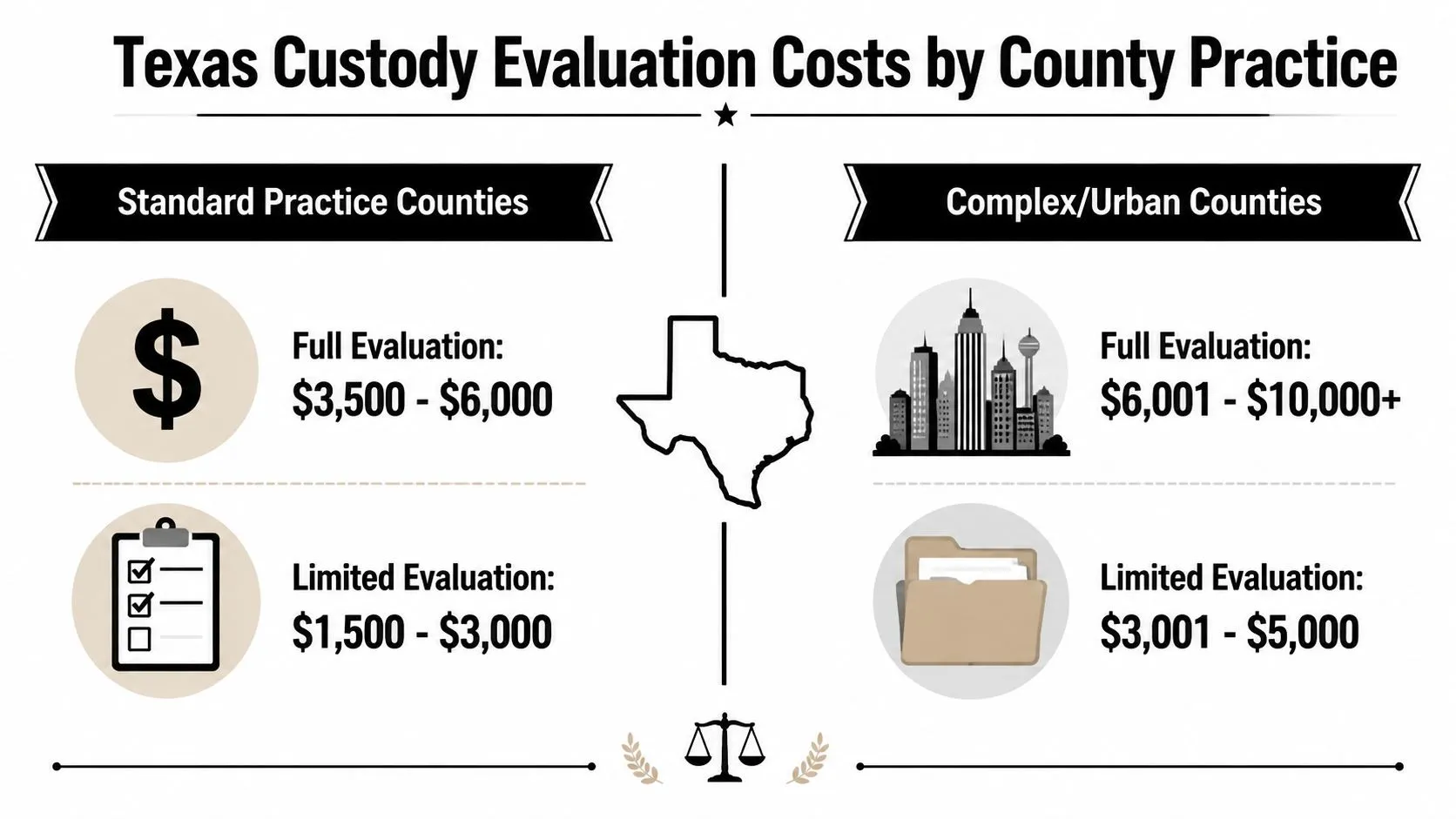
The cost of a custody evaluation can become a fairness issue before anyone reaches the merits of the case. Texas-facing county guidance describes evaluations that may include interviews, home visits, criminal, CPS, medical, and psychological-history review, along with collateral references. The scope and administration can vary by county and provider, so parents should ask for a written fee structure before agreeing to an evaluator.
Publicly available Texas discussions place evaluation costs anywhere from roughly $1,500 to more than $5,000 in one county-level discussion, while complex urban cases may reach as high as $15,000 per side, as summarized in the verified Texas county-practice data. Those figures aren't a universal statewide price list. They show why affordability can shape access, particularly when one parent has limited resources.
Questions to ask about county practice
- Fee responsibility: Ask whether the court expects one party to advance the fee, whether costs may be allocated between parties, and what happens if a payment is missed.
- Evaluator availability: Ask the clerk, domestic relations office, or family court services about local procedures and the professionals who commonly accept appointments.
- Scope and billing: Confirm whether testing, home visits, records review, travel, and testimony are billed separately.
- Financial hardship: Tell your attorney early if the proposed process is unaffordable. The court may need to address scope, payment timing, or alternatives.
One county may have established administrative procedures, while another may handle appointments differently. That local practice can determine whether a parent gets a meaningful opportunity to present evidence. A family facing related legal expenses can also review child custody attorney fees as part of a broader case budget.
How Parents and Caregivers Can Prepare
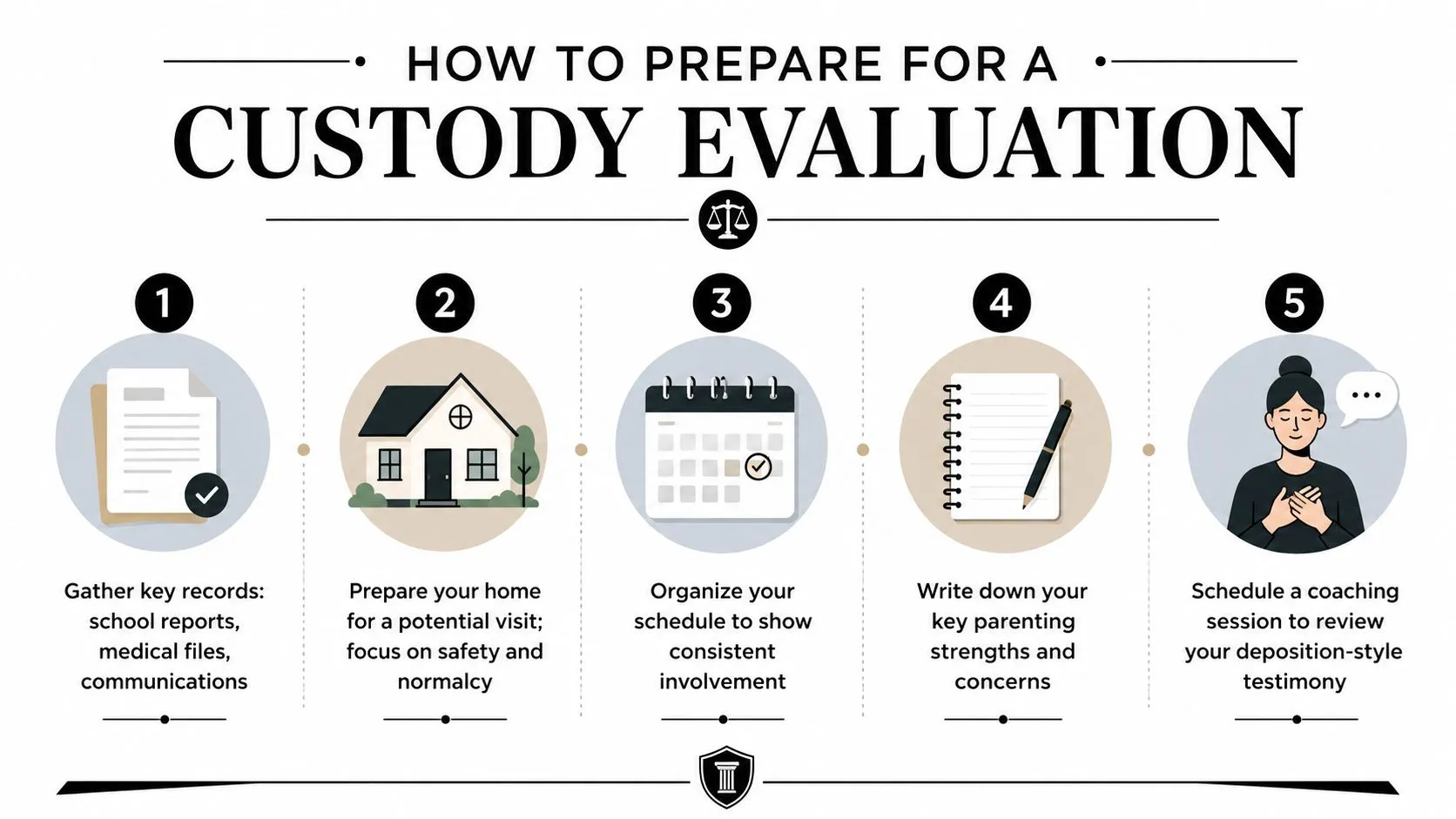
You can't “win” an evaluation by performing. You can prepare the way you'd prepare for a deposition, by organizing facts, answering accurately, and avoiding exaggeration.
Start with the records an evaluator is likely to request. Gather school reports, medical history, parenting-class records, texts about the child, relevant communications, and prior court orders. Keep the collection organized by date and topic, and don't delete unfavorable messages. Your attorney can help determine what should be disclosed and how to explain context.
Build a factual parenting picture
Write a short narrative for each child. Include the child's routine, school needs, medical needs, activities, sleep patterns, and history with each parent. Explain what you personally do, not just what you believe the other parent does wrong.
When difficult questions arise, answer with calm facts. If asked about the other parent's discipline, describe what happened, when it happened, who observed it, and how you responded. Character attacks can distract from the child's needs.
Your home should be safe and functional, not staged. Clean hazards, secure medications, prepare sleeping arrangements, and keep the child's normal routine. Don't coach the child, rehearse answers, or suggest that the child choose one parent.
Grandparents and military families
A grandparent pursuing access or conservatorship under Texas Family Code Section 153.432 should organize evidence showing the family relationship and the child's needs. The grandparent's personal disappointment with a parent usually matters less than specific facts about the child's welfare, stability, and support system.
Military families need a practical plan for deployment, not just assurances that the child will be fine. Organize a family care plan, identify dependable caregivers, document school and medical continuity, and explain how communication and transitions will work. A deployment doesn't erase parental rights, but the court will focus on protecting the child from unnecessary disruption.
A support team may include a therapist, pediatrician, daycare provider, family therapist, teacher, or another person with direct knowledge. Don't pressure anyone to take sides. Ask whether the person can provide accurate collateral information about the child's functioning and care.
A Texas family law attorney can help frame the request, respond to an evaluation motion, identify appropriate records, monitor disclosure deadlines, and prepare testimony that matches the evidence. For a practical preparation checklist before meeting counsel, see how to prepare for a custody consultation in Texas.
Key Takeaways and Next Steps for Texas Families
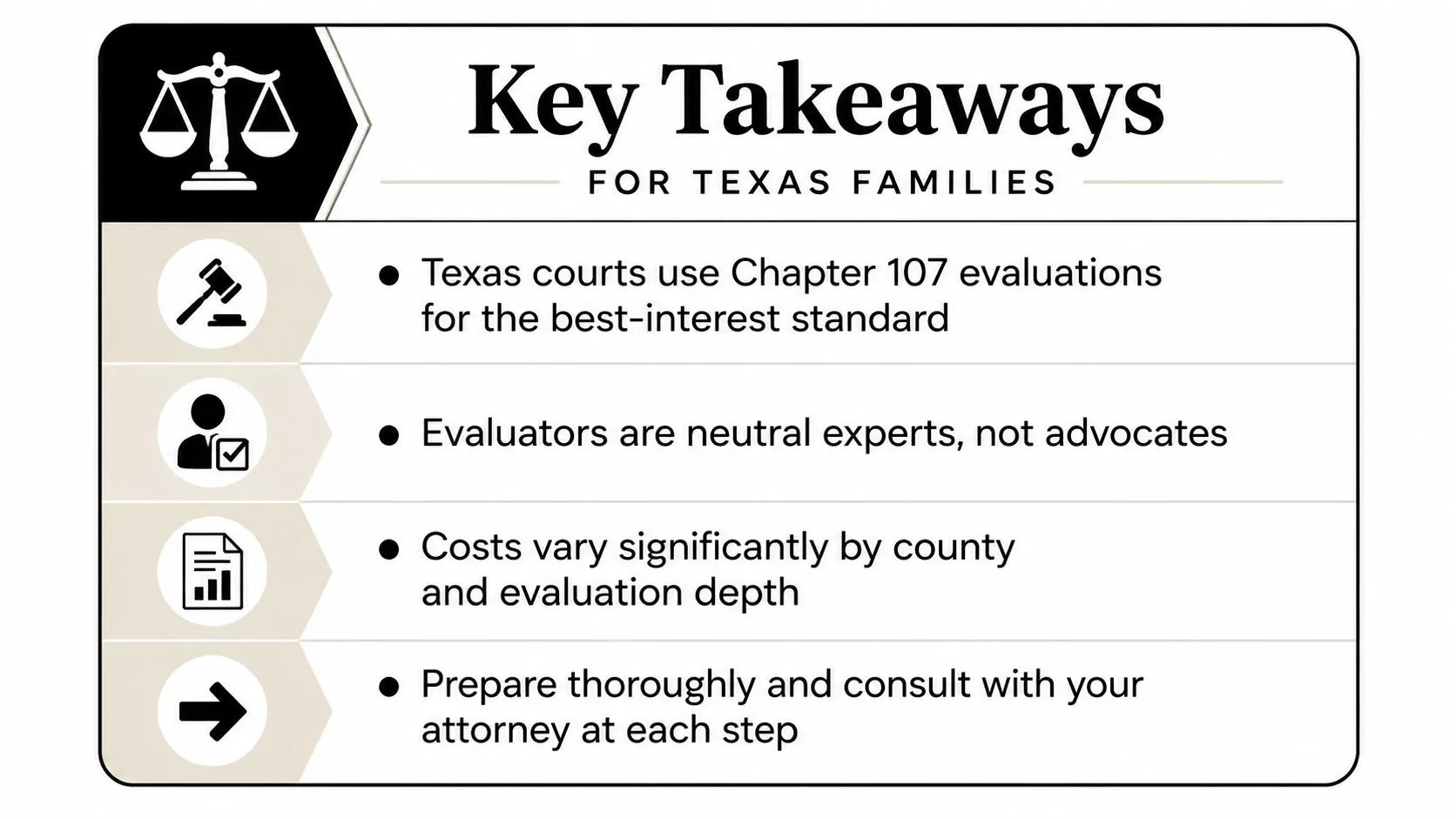
Texas courts may order a Chapter 107 psychological evaluation as part of deciding the child's best interests.
The evaluation may be full, limited, a social study, or psychometric testing within the law's safeguards.
The report can carry substantial weight at a final hearing, but it's evidence, not the judge's decision, and the evaluator may be questioned.
Cost and county practice can affect whether a parent, grandparent, or caregiver can realistically pursue a fair evaluation.
Five actions to take this week
- Identify the concern: Write down the specific parenting, safety, relocation, communication, or developmental concerns you want the court to consider.
- Collect records: Gather the available school, medical, and communication records from the last two years, as identified in the requested preparation plan.
- Research local procedure: Review your county's standing orders and recent SAPCR evaluation orders to understand local practice.
- Confirm fees: Contact the county's friend-of-the-court office or family court services to ask how evaluation fees are handled.
- Schedule legal advice: Meet with a Texas family law attorney to review the facts, budget, timing, and whether requesting or opposing an evaluation makes sense.
Common questions
Does a psychological test decide custody? No. Under Texas Family Code Section 107.108, testing is one part of a broader forensic process, and a mental examination alone doesn't satisfy the requirements for a full custody evaluation.
Is a Rule 204.4 mental examination the same as a custody evaluation? No. Section 107.1025 states that a Rule 204.4 mental examination doesn't by itself satisfy Chapter 107's custody-evaluation requirements, although an evaluator may include and rely on the examination as appropriate.
Can I disagree with the report? Yes. Your attorney can identify factual errors, challenge methodology or scope, present other evidence, and question the evaluator at the hearing.
A prompt consultation can align your evidence, budget, and deadlines before the next hearing. The Law Office of Bryan Fagan, PLLC handles Texas custody, visitation, modification, enforcement, relocation, emergency, grandparent, and military-family matters, and you can review your options by visiting Law Office of Bryan Fagan, PLLC.
If you need help with a child custody or visitation case in Texas, our experienced attorneys can guide you every step of the way. Contact The Law Office of Bryan Fagan, PLLC today for a free consultation.


