 Skip to content
When a parent tells me, “I just got an offer in another state,” or “My co-parent says they're moving with the kids,” the fear is usually the same. Will the court let it happen, and what happens to the relationship you've built day after day with your child?
Texas relocation disputes are painful because they're never just about a house, a job, or a map. They're about school drop-off, bedtime routines, weekend visits, and whether a child still has real access to both parents after the move. If you're sorting through the practical side of a breakup too, selling your marital home with Buys Houses is the kind of separate issue that can sit right next to a custody fight, even though the legal questions are very different.
The good news is that Texas judges do not rule on relocation by gut instinct or by automatically favoring the parent who wants to move. They look at the child's life, the order already in place, and the evidence each side can prove. That means both mothers and fathers have options, but the winning case usually depends on how well the facts are organized and how clearly they show what serves the child.
When Your Child's Home Is on the Line
A parent can feel trapped fast when a job offer lands in another city or a co-parent announces plans to leave Texas with the child. In that moment, the biggest mistake is thinking the court will care most about adult inconvenience. Texas judges care about the child's home life, the strength of each parent-child relationship, and whether the move can be managed without tearing that apart.
The question judges ask first
Texas law starts from a simple policy baseline, frequent and continuing contact with both parents, a safe and stable environment, and shared parental rights and duties under Texas Family Code § 153.001(a). That policy matters even when one parent has the practical benefit of having the child day to day. It is the backdrop for nearly every relocation fight.
The judge is not asking, “Who wants this more?” The judge is asking whether the proposed move fits the child's welfare and whether the parent-child relationship can still be protected in a meaningful way. That is why a move that looks reasonable on paper can still fail if the proof is thin.
If you're comparing relocation issues with broader custody concepts, the article on Parental Relocation and Move-Away Cases in Texas gives a plain example of how custody changes when a parent wants to move with the child. It helps frame why these cases are so fact-sensitive.
The parent who can connect the move to the child's daily life, not just the parent's next opportunity, is usually in the stronger courtroom position.
How Texas Law Frames Relocation Decisions
Texas law gives judges structure, but not a single bright-line rule. A court may define a geographic restriction under Texas Family Code § 153.134(b)(1)(A), which limits where the child's primary residence can be. The court may also choose no geographic restriction under § 153.134(b)(1)(B), which gives the managing conservator broader freedom to live elsewhere if that fits the child's best interest.
The balancing scales Texas judges use
The Texas Supreme Court's decision in L. v. L., 79 S.W.3d 10, 14 (Tex. 2002), confirms that even a sole managing conservator, who ordinarily has the exclusive right to designate the child's primary residence under Texas Family Code § 153.132(1), can still be subject to a geographic restriction if it serves the child's best interest. That is the starting point for Texas relocation analysis.
The practical framework became more structured through Lenz v. Lenz. Texas courts now look at recurring factors such as the reasons for and against the move, education and leisure opportunities, special needs or talents, extended-family effects, visitation impacts, the noncustodial parent's ability to relocate, and the child's age. Those factors do not create a mathematical formula. They work like balancing scales, where the judge weighs the child's life on both sides before deciding whether the move helps or harms that child's future.
That is why Texas judges do not favor mothers over fathers, or fathers over mothers, in relocation disputes. They favor proof. Good motives matter, but they matter most when they are tied to concrete benefits for the child, not just to the adult's preference.
If you want another plain-English view of how courts think about custody evidence, the The Best-Interest Standard and the Holley Factors resource is useful because relocation always lives inside the broader best-interest framework.
The Evidentiary Threshold That Changes Everything
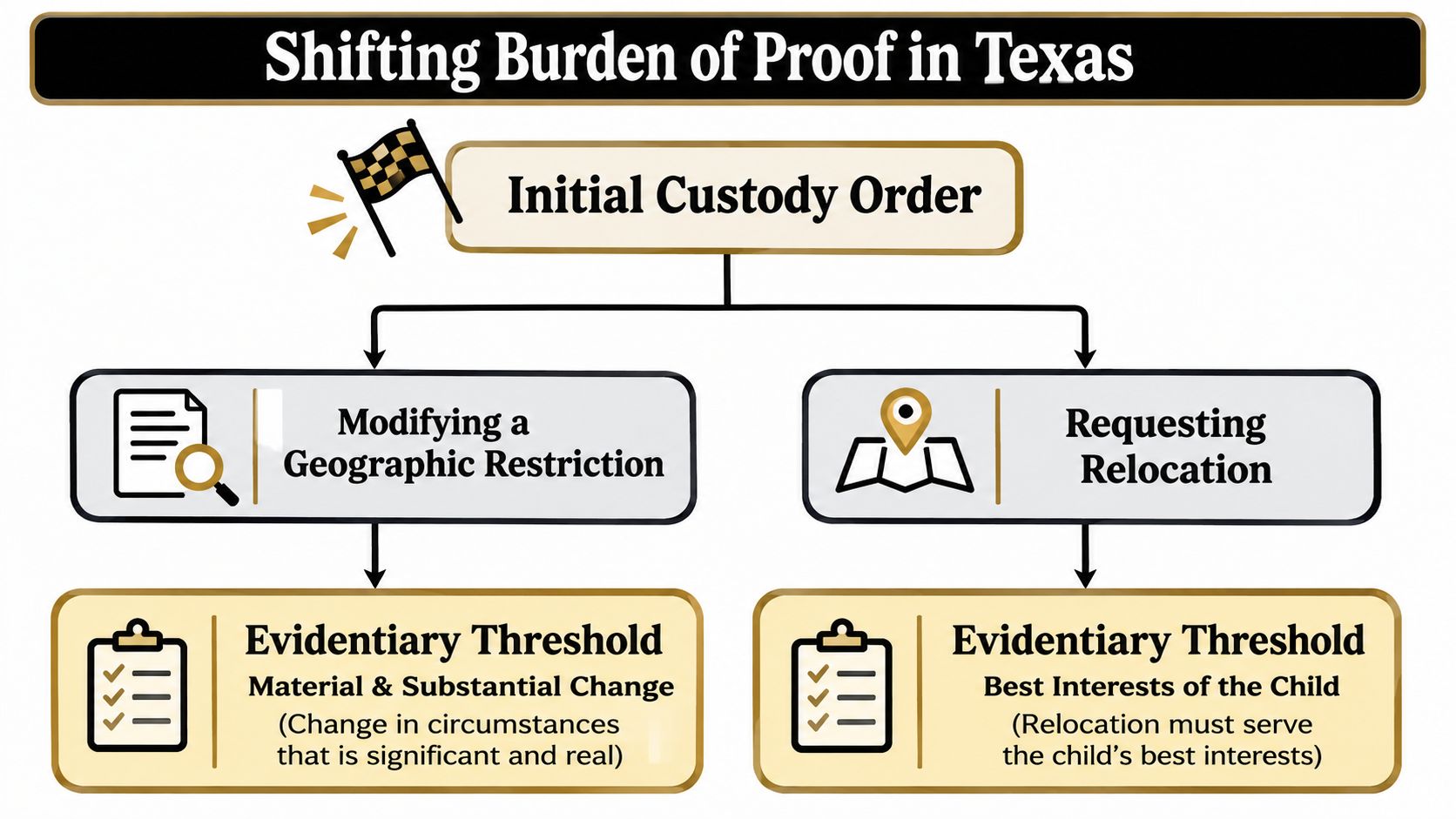
Most parents think the fight is about whether a move sounds reasonable. In court, the fight is over the burden of proof, and that burden changes depending on the posture of the case. An initial custody order, a request to modify an existing restriction, and a request for temporary relief are not treated the same way.
Modification is not just a new plan
A parent seeking to change a geographic restriction generally has to show a material and substantial change in circumstances and that lifting or changing the restriction is in the child's best interest. That means the court wants more than a fresh job offer, a new relationship, or a desire to start over. The parent has to connect the change in life circumstances to the child's actual welfare.
Texas practice materials on custody modification emphasize that point, and the same principle appears in the article on winning a custody modification and proving material and substantial change. The legal standard does not bend just because the move feels understandable.
Temporary orders are even harder
Temporary relief can be tougher still. Texas law allows a temporary order creating, changing, or eliminating a geographic restriction only if it is in the child's best interest and the current arrangement would harm the child emotionally or physically. Recent appellate discussion has also sharpened the focus on safety and welfare, not the parent's career path.
That matters because the old courtroom line, “I got a better job,” usually isn't enough. A 2025 Amarillo Court of Appeals decision discussed in Texas legal reporting rejected the idea that career advancement or higher earning potential alone justifies removing a restriction. Judges want child-centered proof, not adult ambition dressed up as necessity.
Practical rule: If the move only changes the parent's life, but not the child's, the case is usually weak.
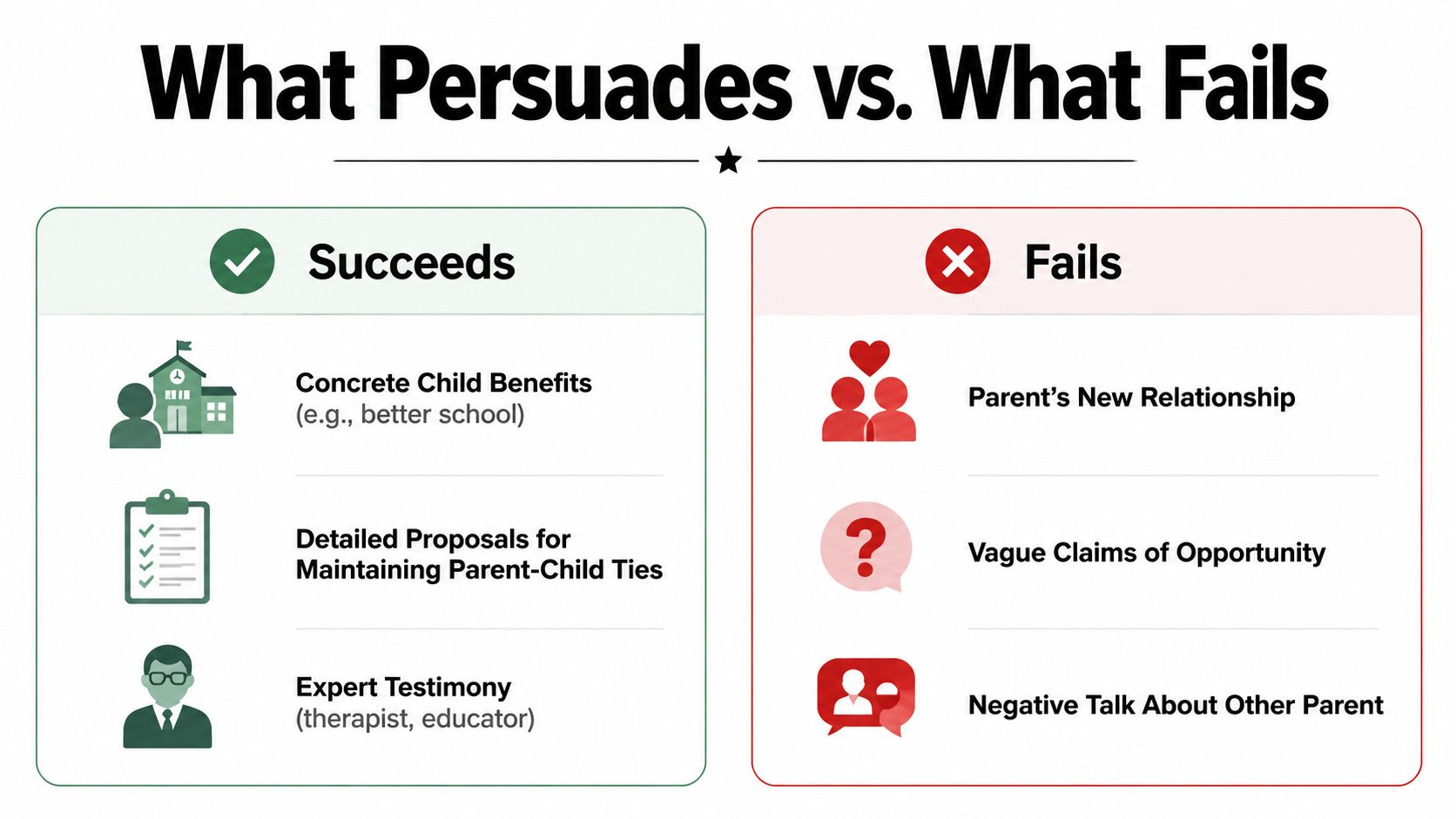
Concrete child benefits carry more weight. Better schooling, stable housing, a stronger support network, or better access to needed services can matter if the proof is specific and credible. Vague hopes for a better future usually don't.
What Persuades Judges and What Falls Flat
Texas judges respond to facts that show how a relocation improves or protects a child's life. They also notice when a move looks designed to widen the distance between the child and the other parent. That difference can decide a case.
What tends to work
A parent who wants to move should be ready to show good-faith reasons for the move, plus the child's economic, educational, and health opportunities in the new location. Judges also look at the emotional impact on the custodial parent, extended-family ties, and, critically, whether the noncustodial parent can still preserve a meaningful relationship through visitation and communication.
The best evidence is specific. A school comparison beats a general claim about “better schools.” A concrete visitation schedule beats a promise to “make it work.” Support from grandparents, cousins, or other caregivers in the new city can help if it shows genuine stability for the child.
What usually fails
General statements are weak. So are moves explained only by a new spouse, a personal preference for a different city, or a desire for more money without any child-centered detail. Judges also look hard at whether the move appears to limit the other parent's access.
A parent opposing relocation should focus on the child's current stability, existing routines, and ties to school, friends, and family. If you need a deeper look at how evidence is evaluated in custody disputes, the article on what evidence matters most in a Texas custody case is a helpful companion piece.
If the relocation plan does not show how the child will keep seeing, hearing from, and relying on the other parent, judges notice that gap fast.
Building Your Case Whether You're Moving or Opposing
A relocation dispute can turn on the record you build before the hearing. Once notice goes out, the pace changes fast, and a thin file is hard to repair later. Whether you want permission to move or you need to stop the move, the proof should stay focused on the child, not on the parent's preferences.
If you're asking to move
Start with the child's daily life and the reason the new location helps it. School records, report cards, counselor notes, medical records, and other documents can show why the move serves the child's needs. If the child has special needs, bring that forward early, because Texas judges pay close attention to continuity of care and whether the new setting can maintain it.
You also need a real plan for the other parent. A court wants to see how the child will keep a meaningful relationship through holiday time, school breaks, video calls, transportation, and regular sharing of school and health information. A promise to “figure out visitation later” usually reads as a gap, not a plan. If you need guidance on the formal process, the article on how to request permission to relocate with a child in Texas walks through the notice requirements and steps.
If you're opposing the move
The stronger response is grounded in what the child already has where the child lives now. School stability, predictable routines, regular contact with both sides of the family, and evidence that the child is doing well under the current order all matter. If the proposed move would break an established schedule or make weekday parenting unrealistic, show that with specifics, not general concern.
Useful evidence often includes:
- Teacher or counselor testimony that explains how the child is doing now and what could change.
- Extended-family affidavits that describe the child's support system.
- Communication logs that show a consistent co-parenting pattern.
- Detailed parenting plans that show whether the move can preserve real access.
Texas custody and relocation cases also turn on posture. The showing needed for an initial order is not always the same showing needed for a modification or for temporary orders, and judges notice that difference. In an initial case, the court is building the framework from scratch. In a modification, the parent asking for the change usually needs a stronger reason to disturb an existing order, and temporary orders often rise or fall on what can be shown quickly and concretely. If you are talking to counsel, bring the order, the proposed address, school information, travel costs, and every written exchange about the move. The Law Office of Bryan Fagan, PLLC routinely handles these kinds of relocation and geographic restriction disputes, along with broader custody and visitation matters, so a document-first approach is usually the most useful place to start.

Special Circumstances That Change the Analysis
Not every relocation fight fits the standard pattern of one parent trying to leave with the child. Military families, interstate moves, and situations where the other parent has already left the area can change the legal posture in important ways.
Military families face their own realities
A deployment or reassignment can create pressure that has nothing to do with preference. Courts still care about the child's best interest, but they also recognize that service members do not always control where the military sends them. In those cases, the parent should be ready to show how the child's schedule, schooling, and relationship with the other parent will be preserved despite the move.
That kind of case often turns on planning. If the order already contains a geographic restriction, the parent may need to ask the court for relief tied to the service-related change rather than treating the move like a simple choice.
Interstate moves add jurisdiction questions
An out-of-state move can trigger issues under the Uniform Child Custody Jurisdiction and Enforcement Act, or UCCJEA. That statute matters because it helps determine which state keeps authority over custody decisions and enforcement. Parents sometimes assume that crossing a state line automatically ends Texas involvement. It does not.
If the nonmoving parent has also moved away from the restricted area, the judge may look differently at the practical effect of a geographic restriction. Visitation may be harder to preserve if both parents are already scattered, but that does not mean the restriction disappears automatically. The court still looks at the child's stability and whether the current order still serves the child's best interest.
These cases are often fact-heavy and emotionally charged. The child's age, school needs, and support network still matter, but the court may weigh logistics in a very different way when the adults have already shifted the situation themselves. That is why specific legal advice matters so much in deployment and interstate disputes.
Your Next Steps Toward Protecting Your Relationship
Texas judges use a multi-factor best-interest analysis, not a simple yes-or-no rule. The evidentiary burden changes depending on whether you're dealing with an initial order, a modification, or temporary relief, and child-centered proof always carries more weight than a parent's preference.
If you're facing a move, or trying to stop one, the difference between winning and losing often comes down to preparation. Careful records, a workable visitation plan, and evidence that speaks directly to your child's welfare can make your case far stronger.
If you need help with a child custody or visitation case in Texas, our experienced attorneys can guide you every step of the way. Contact The Law Office of Bryan Fagan, PLLC today for a free consultation.
The Law Office of Bryan Fagan, PLLC helps Texas parents, grandparents, and caregivers handle relocation disputes, geographic restrictions, custody modifications, and visitation problems with clear legal guidance. If you're facing a move with your child, or trying to protect your parenting time, visit Law Office of Bryan Fagan, PLLC to schedule a free consultation and talk through your options.


