 Skip to content
When your child is in the other parent's care, the hardest part is often not the schedule itself. It's not knowing whether your child is with that parent, a babysitter, a grandparent, or someone else you never agreed to.
That uncertainty can leave even a good co-parent feeling powerless. In Texas, the right of first refusal can help solve that problem by giving one parent the chance to care for the child before child care is handed to a third party, but only if the clause is written clearly into the custody order and it fits the family's daily reality.
Understanding Your Rights as a Parent
A lot of parents first ask about this issue when a simple plan starts feeling too loose. Maybe your ex works late, travels often, or says the child is “fine” with whoever is available. That can be stressful, especially when you want your child to spend time with a parent, not just another caregiver.
In Texas custody cases, parents usually share rights and duties under a joint managing conservatorship, which is just the legal structure Texas uses for many custody orders. That structure can still leave a lot of room for detail, because the order must spell out possession schedules, decision-making rights, and any extra tools the parents want the court to approve. For a plain-English overview of how those rights are divided, Parental Rights and Duties in Texas Conservatorship is a useful reference.
Practical rule: If the order does not say it clearly, you may have a hard time enforcing it later.
That is why the right of first refusal matters. It is not about winning points against the other parent. It is about giving your child a more stable routine and giving both parents a fair chance to stay involved.
For parents dealing with high-conflict communication, advice from Be Your Best Self Thrive can also help with the day-to-day side of co-parenting, especially when the emotional part is making practical decisions harder. The legal tool and the communication strategy work best together.
What Is the Right of First Refusal in Texas
Think of the right of first refusal like offering a friend the first chance to buy concert tickets before you sell them to someone else. In custody terms, the parent who has the child during their possession time must first offer the other parent the chance to care for the child before arranging a babysitter, relative, or daycare.
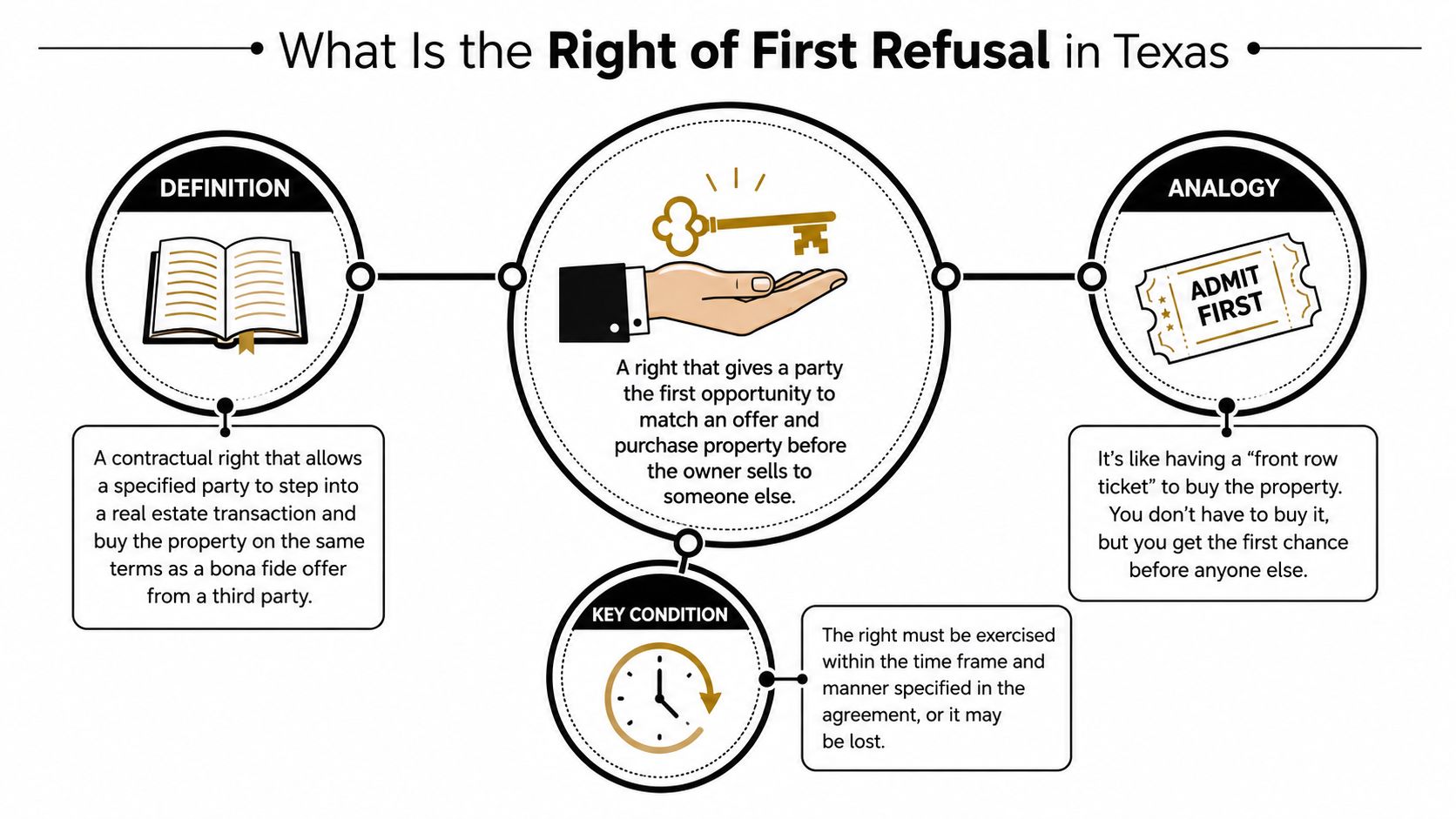
That sounds straightforward, but Texas law makes one point very clear. The Texas Family Code does not contain a mandatory ROFR provision, so it is not automatic in a Texas custody case. It only becomes enforceable if the parents negotiate it into the order or a judge specifically approves it based on the child's best interest. Texas practice sources explain that the clause is really an optional scheduling tool, not a default entitlement, and that it has to be written into the order to matter in later disputes. The Right of First Refusal in Texas Child Custody Cases describes that same practical point.
A well-drafted ROFR clause works as a process trigger. When the parent with possession cannot personally care for the child, that parent must offer the time to the other parent before calling in outside child care. That gives the child more time with a parent and less time with a substitute caregiver, but only when the order says so.
The best ROFR clause is specific enough that both parents know exactly when it starts, how notice is given, and how long the other parent has to respond.
Texas courts look closely at that specificity because vague language causes conflict. The order should tell the parents when the right starts, who gets notified, and what happens if the other parent does not respond. Without that detail, the clause can turn into a source of arguments instead of a source of stability.
How Texas Courts View the Right of First Refusal
Texas judges look at ROFR through the same lens they use for every custody decision, the best interest of the child. That standard matters more than a parent's preference, frustration, or sense of fairness. If a ROFR clause will support the child's routine and strengthen parent-child contact, a judge may be open to it.
The court also thinks practically. A child who moves easily between two nearby homes may do well with a ROFR clause, while a child whose parents live far apart may struggle with frequent handoffs. The parents' ability to communicate calmly matters too, because a clause that depends on quick notice and quick answers will not work if every exchange turns into a fight.
What Judges Usually Weigh
- Child's age and maturity. Younger children may benefit from more time with a parent, while older children may need a steadier school and activity routine.
- Distance between homes. Short transfers are easier to manage than long drives.
- Communication history. Parents who can text, call, or email without conflict are more likely to make ROFR workable.
- Conflict level. If the clause is likely to become another battleground, a judge may hesitate.
Texas custody law also allows modification only when there is a material and substantial change in circumstances under Tex. Fam. Code § 156.101, so a ROFR request or change should be tied to a real parenting need, not a temporary disagreement. That is the legal backdrop for why judges tend to prefer workable, child-focused language instead of broad promises that sound good on paper.
When the facts show that the clause would reduce outside child care and support the child's relationship with both parents, it makes more sense. When the facts show it would create constant tension, it usually does not.

Drafting an Effective ROFR Clause for Your Custody Order
A strong ROFR clause starts with one question, what exactly triggers the right? Some Texas practice materials describe triggers tied to absences of about 4 to 8 hours or overnight, with notice windows often set at 12 to 24 hours and response windows at 2 to 4 hours. Those numbers are not magic rules, but they show why the clause needs clear boundaries from the start. The Right of First Refusal in Texas Child Custody Cases notes those common drafting patterns.
If the trigger is vague, both parents may claim they were right. That is where the fight begins.
The terms that should be spelled out
- Clear trigger event. Say whether the clause applies to short errands, work shifts, evening plans, overnight absences, or only certain time blocks.
- Notice method. Decide whether notice must be by text, email, or both.
- Response deadline. Give the other parent a clear time to accept or decline.
- Transportation plan. State who picks up and who drops off the child.
- Backup arrangement. Say what happens if the other parent cannot respond in time.
A clause without these details is hard to enforce because nobody can tell when it was triggered. Texas family-law sources repeatedly emphasize that specificity is what makes the provision usable later, not just agreeable in theory. That is especially true when parents already have a tense relationship.
For families who need to add ROFR to an existing case, a custody modification may be the better path. A related resource on modifying custody orders can help you think through when a change to the order makes sense and what a court will want to see.
The right drafting approach is usually simple. Write the rule so a parent can follow it on a tired Tuesday night without guessing.

ROFR in Practice Modern Schedules and Special Situations
A parent who works from home is not always “available” in the way a custody order imagines. A call from work can still pull that parent into another room, an on-call shift can make sleep unpredictable, and a short business trip can leave the child with a third-party caregiver even if the parent technically started the day at home. Those modern realities are exactly why a generic ROFR clause can create arguments if it does not define what counts as being unavailable.
The harder question is whether more ROFR is always better. It isn't. In some families, repeated handoffs create more conflict than comfort, especially if the parents live far apart or one parent uses the clause to monitor the other's schedule instead of supporting the child. First Right of Refusal in Custody makes the same practical point, a clause that looks helpful can backfire when communication is poor.
Situations that need special wording
Military deployment, relocation, and travel-heavy jobs often need custom language. So do cases involving grandparents or other relatives who may regularly care for the child. If the parents want the clause to apply only to outside caregivers, or only to nonfamily sitters, that needs to be written out.
For fathers, the practical issue is often making sure time with the child is preserved in a schedule that already feels tight. A resource on Fathers' Rights in Texas Custody Cases can be helpful when you are trying to balance ROFR with a broader possession plan.
A Texas standard possession framework can also affect how ROFR fits into the overall plan, because the clause has to work with the existing visitation structure rather than fight it. If the order is already packed with exchanges, adding more mandatory handoffs may make life harder for the child.
Practical rule: A good ROFR clause should reduce confusion, not create a second custody calendar.
That is why careful drafting matters so much for hybrid workers, traveling parents, and families with unusual schedules. The best version is the one that fits your life.
Enforcing or Modifying Your Right of First Refusal
If the other parent ignores the clause, start with proof. Save the texts, emails, and timestamps, and keep your tone calm and factual. Courts care far more about documentation than about emotional arguments in the moment.
The next step depends on the pattern. Sometimes a direct reminder resolves the issue. If it does not, a lawyer can help you consider a motion for enforcement, which asks the court to require compliance with the custody order. A practical guide to that process is available in how to enforce a custody order in Texas step by step.
When modification makes more sense
Sometimes the clause is the problem, not the parent. A move, a new job, a changed shift schedule, or a child's changing needs can make the original ROFR language impractical. In those cases, modifying the clause can be more productive than fighting about every exchange.
That is especially true when the original wording no longer matches reality. If the trigger is too broad, the parents may spend more time debating whether the clause applies than co-parenting. If it is too narrow, it may not protect the time one parent hoped to preserve.
A Texas court can enforce a valid order, but it can also consider whether the existing terms still make sense for the child's current life. That is where legal strategy matters. A focused request can protect your rights without turning every disagreement into a courtroom fight.
Next Steps Is ROFR Right for Your Family
The right of first refusal is useful when it is treated as a planning tool, not a weapon. It works best when both parents can follow clear rules, communicate in a respectful way, and keep the child's schedule at the center of the discussion.
It is not the right fit for every family. For some, it builds more parenting time and reduces outside child care. For others, especially where conflict is already high or work schedules are unpredictable, it can create more friction than peace. The question is not whether ROFR sounds fair in theory. It is whether it will make your child's day calmer and your custody order easier to follow.
If you are thinking about adding ROFR to a new order, changing an existing clause, or enforcing a provision the other parent keeps ignoring, now is the time to get clear legal advice. A careful review of your possession schedule, communication patterns, and work demands can keep a small scheduling issue from becoming a bigger custody dispute.
If you need help with a child custody or visitation case in Texas, our experienced attorneys can guide you every step of the way. Contact The Law Office of Bryan Fagan, PLLC today for a free consultation. Visit Law Office of Bryan Fagan, PLLC to talk through your right of first refusal custody Texas concerns, review your custody order, and get practical guidance that fits your family's life.


