 Skip to content
When your child's future is on the line, a court order for a custody evaluation can feel like a punch to the gut. Parents often read those papers and wonder whether they're already losing before anyone has heard their side. They're not. The evaluation is a fact-finding process, and once you understand what happens inside it, you can respond with more calm and more control.
Texas families also run into overlap with treatment orders, counseling requirements, and other court-driven issues. If that's part of your case, a useful companion read is rehab and court mandated treatment laws from Tru Dallas Detox & Recovery Center, especially when a judge is trying to understand how safety, sobriety, and parenting fit together. That kind of context matters because custody cases rarely involve only one issue.
When a Judge Orders an Evaluation
A father opens his mail and sees a court order for a custody evaluation. A mother gets the same notice and feels her stomach drop because she knows the other side has already been telling stories about the home, the kids, and the past. That reaction is normal. A Texas custody evaluation / social study can sound like a verdict, but it isn't one.
It's a structured way for the court to get outside information before deciding conservatorship, possession, and access. Texas courts use these evaluations when parents can't agree on what arrangement serves the child's best interests, the legal standard that guides custody decisions under Texas Family Code Chapter 153. For families who want a plain-language look at how parenting style and child behavior can affect a case, compare parenting approaches can help frame the bigger picture without making the process feel so mysterious.
Practical rule: a custody evaluation is evidence, not destiny. The judge still decides the case.
That matters because parents often think the evaluator is the one who gives the final answer. The evaluator doesn't. The report can help shape the court's view, but it's still one piece of the larger record.
If you're feeling overwhelmed, that doesn't mean you're unprepared. It means you're paying attention to something important. Understanding the process early gives you room to make steady, child-focused choices before the evaluator ever walks through the door.
What a Texas Custody Evaluation Actually Is
A Texas custody evaluation is a court-ordered forensic assessment. In plain English, that means a neutral professional gathers information and gives the judge an independent picture of each parent's ability to meet the child's needs when conservatorship or possession is disputed. The evaluator is not there to take sides. Think of the evaluator as a court-appointed investigator, not a referee handing out points.
Texas modernized its language in 2015. House Bill 1449 standardized the phrase “child custody evaluation” in place of the older term “social study,” while keeping the same basic function: helping courts learn more about parenting capacity, child welfare, and home conditions Texas House Bill 1449 analysis. The law that governs the process sits in Texas Family Code Chapter 107, which covers custody-evaluation procedures and related expert investigations.
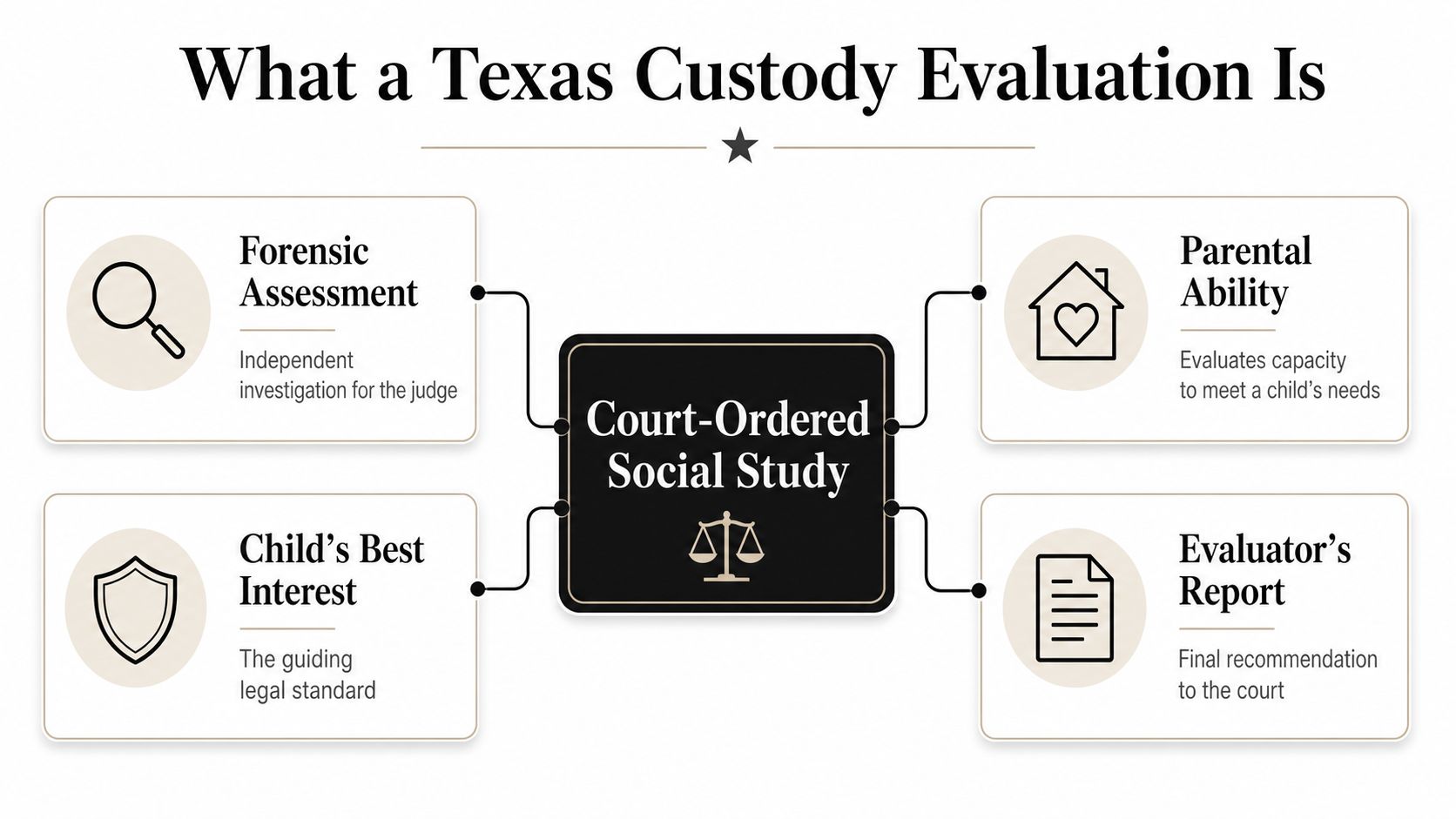
What the evaluation is built to do
The process is designed to gather information from more than one source. Texas law treats it as a multi-source investigation, not a simple interview or a quick home check. That's why courts can use it in cases where parents tell very different stories about routines, supervision, communication, or safety.
A useful way to think about it is this, the evaluator builds the factual record, but the judge weighs that record against everything else in the case. That includes testimony, records, and any evidence of family violence, instability, or a child's special needs. For a related family-law role that sometimes gets confused with a custody evaluator, see what is a guardian ad litem. They're not the same thing, and the distinction matters.
The older phrase “social study” still appears in some county materials, but the core idea is unchanged. It's a formal investigation into what arrangement best protects the child and supports healthy parenting.
Who Is Allowed to Conduct the Evaluation
A custody evaluation can shape a case, but only if the person doing it is qualified to do that work. Texas keeps that gate narrow on purpose. Under Texas Family Code Section 107.104 Texas Family Code Section 107.104, the evaluator must meet specific education, licensing, and experience requirements, so the report comes from a neutral professional rather than someone giving an amateur opinion with a professional title attached.
The credentials Texas requires
The starting point is a master's degree in a human services field. The evaluator also needs a Texas license in social work, counseling, marriage and family therapy, or psychology, or a Texas medical license with psychiatry board certification. Section 107.104 also requires two years of supervised relevant experience and at least 10 court-ordered child custody evaluations completed under supervision.
The statute goes further and requires 8 hours of family-violence dynamics training under Section 107.104. That requirement matters because a case involving family violence is not just a parenting dispute with harder feelings attached, it can change how a judge looks at conservatorship, possession, and safety.
Court-appointed or private
Sometimes the judge appoints the evaluator. Other times, a party retains a private evaluator if the court order allows it. Which path applies depends on the order and the local practice in your case, but the basic rule stays the same. The evaluator serves the court, not either parent.
That point is easy to miss when emotions are high. A parent may hope the evaluator will immediately spot the other side's problems, or fear the evaluator will believe every accusation in the room. Neither reaction helps. The better approach is to verify credentials, stay respectful, and give the evaluator accurate facts they can test against records, interviews, and observations.
If you are also trying to sort out how a child's wishes fit into a Texas custody case, Does a Child Get to Choose Which Parent in Texas? explains how those preferences can matter without taking over the whole decision. That issue often comes up alongside evaluations, but it does not give the child the final word.
Parents dealing with wider conflict often hear that family therapy improves communication. Courts tend to notice whether a parent can support healthier co-parenting, not just argue their own side well.
How the Evaluation Process Unfolds
A custody evaluation usually begins with the court order and the fee arrangement, then moves into forms, interviews, observation, and records. Parents often want a simple answer about timing, but the process rarely feels simple while you are in it. County guidance in Texas shows that, if everyone cooperates, the work commonly takes at least 90 days from fee payment, and other guidance says it often takes four to five months from the first interview Tarrant County social studies guidance. More contested private evaluations can last 4 to 18 months.
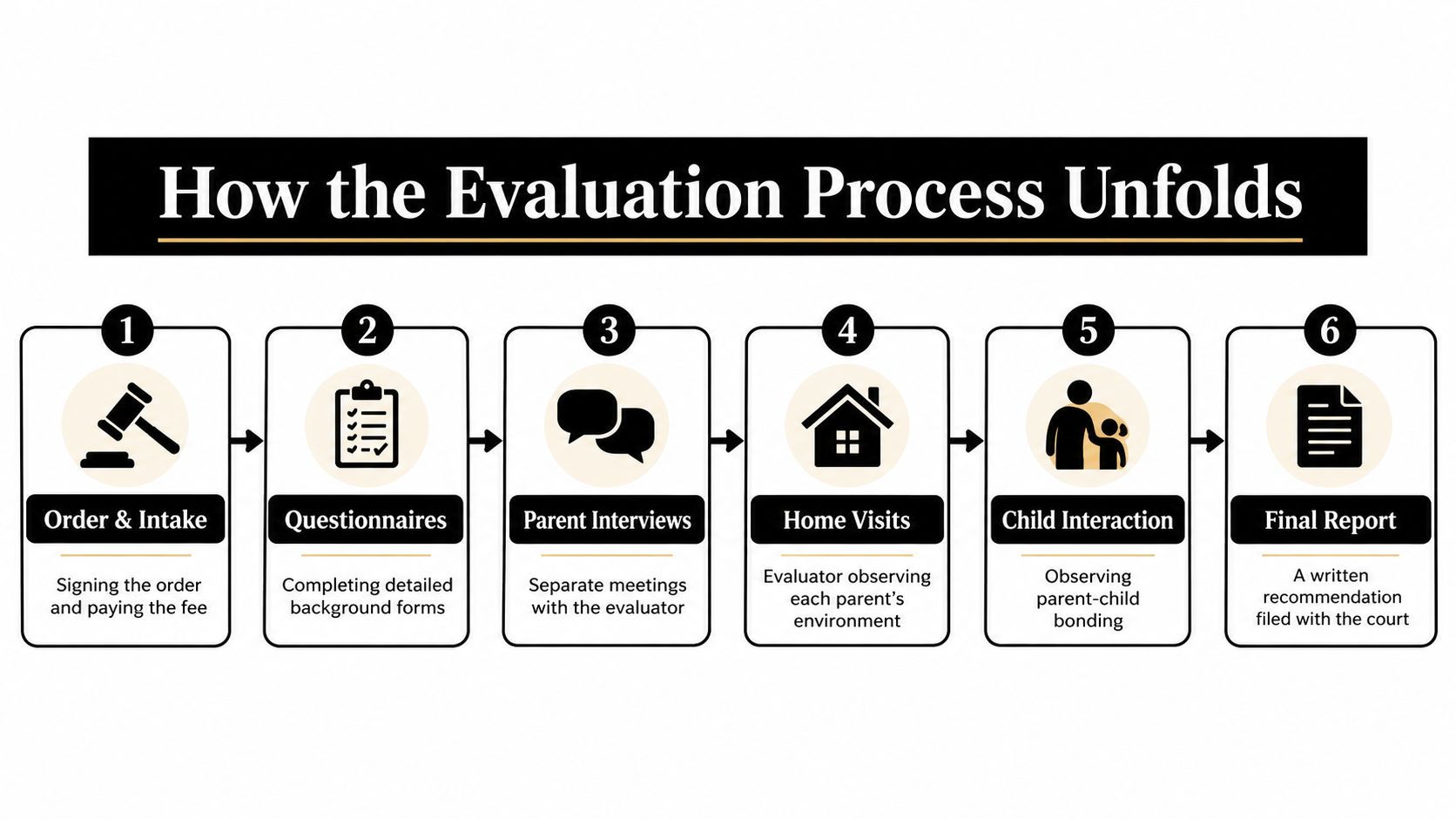
What the evaluator usually does
Bexar County's guidelines make the scope more concrete. The evaluator interviews each party, interviews each child age 4 and older in a developmentally appropriate way, observes each child regardless of age, gathers information from collateral sources, and evaluates the home environment of each parent seeking conservatorship unless the home is not disputed Bexar County guidelines. The same Bexar County guidelines also require review of criminal history and any DFPS or law-enforcement contact involving abuse or neglect for each person living in a residence.
Texas Family Code Section 107.109 requires the same basic multi-source approach, including interviews of each party, child interviews, observation of each child, collateral review, home-environment review when disputed, criminal and CPS history review, and an assessment of the child's relationship with each party seeking possession or access Texas Family Code Section 107.109. That is why the process feels so detailed. It is meant to test what each person says against other sources, the same way a careful teacher checks a student's story against the homework, the test, and the classroom work.
The timeline can be frustrating, but the breadth of the process is there to protect children, not to punish parents.
A parent may also complete questionnaires or provide records before the first interview. After that, the evaluator usually connects the pieces through home visits, collateral contacts, and direct observation of parent-child interactions. If you want a plain-English explanation of how the court evaluates that kind of evidence, the Holley factors in a Texas custody case help show the kinds of facts judges often consider when they sort through competing claims.
How Courts Weigh the Final Report
This is the question most parents ask, usually after the evaluator leaves the home. How much does the report really matter? The honest answer is that it can matter a lot, but it does not control the case. Texas judges decide conservatorship and possession under the best interests of the child standard in Texas Family Code Chapter 153, and the evaluator's report is only one part of that decision.
A judge is more likely to rely on findings that are grounded in the record, consistent with other evidence, and tied to the child's needs. That means the court tends to give more weight to a report that lines up with school records, medical records, therapist notes, and credible collateral witnesses. A report that ignores contradictory facts, stretches one parent's statement into a conclusion, or lacks clear notes behind a recommendation can lose force quickly.
What tends to move the court
School records can show attendance, stability, or repeated problems. Medical and therapy records can show who takes the child to appointments and who follows treatment recommendations. Testimony from teachers, doctors, counselors, and other credible collateral witnesses can help confirm the day-to-day picture. Documented findings of family violence can also shift the analysis in a serious way.
That's why it's a mistake to think of the report as the final word. It's persuasive evidence, not a binding order. If a parent has strong contrary proof, the judge can weigh it against the evaluator's view and reach a different result.
For a deeper legal lens on the factors Texas courts use in custody cases, understanding Texas custody and the Holley factors is a useful companion resource. It helps explain why the court looks at the whole child-centered picture, not just one professional's opinion.
Plain truth: the strongest case is the one with the clearest, most consistent evidence, not the loudest accusations.
Parents who treat the report as one piece of evidence, not the whole case, usually make better decisions. That mindset helps before trial, during settlement talks, and if the case ends up in front of the judge.
Preparing Yourself, Your Home, and Your Witnesses
The weeks before a custody evaluation often feel uncertain. Parents want to know what the evaluator will notice, what the report will mean, and whether anything can still change the result. The short answer is yes, there is still room to shape the outcome, but it happens through preparation, honesty, and steady conduct, not through performance.
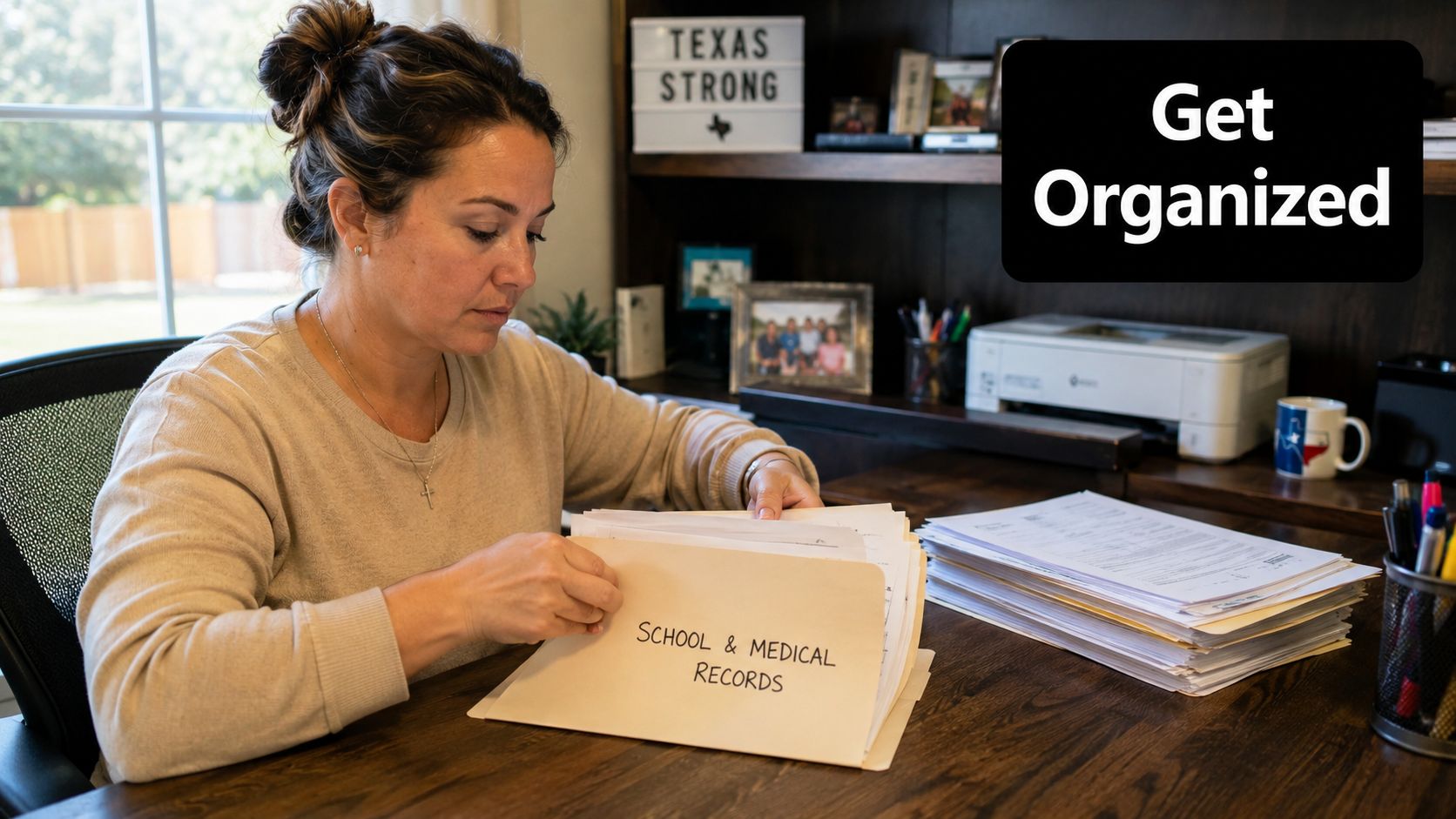
What to gather before the interview
Start with records that show your child's routine and care. School records, medical records, communication logs, parenting schedules, and dated photographs can all help build a clear picture of daily life. If there is a history of family violence or safety concerns, keep Court-Ordered Family Violence information together so you can give it to your lawyer in an orderly way.
Good evidence works like a well-labeled file folder. The evaluator does not need a stack of random papers. The evaluator needs a story that can be checked against documents, and our guide on presenting evidence in a custody case in Texas explains how to organize that story so it is easy to follow.
How to behave during interviews and home visits
Stay calm and answer the question you were asked. If you add extra accusations about the other parent, or you try to coach the child on what to say, the evaluator may see that as more about control than about the child's needs. A parent who stays focused on facts usually looks steadier than a parent who tries to win every moment.
The home itself sends a message. Working smoke detectors, safe sleeping areas, and age-appropriate supervision plans show that you are thinking about the child's day-to-day safety. If the evaluator is allowed to meet other adults or household members, they should show the same respectful, calm behavior. A tense home visit can matter, because the evaluator is watching how the household functions, not just how the parent answers questions.
What to tell witnesses
Collateral witnesses such as teachers, pediatricians, therapists, and family members may be contacted. They do not need a script. They need the truth. If they speak with the evaluator, the safest advice is plain, be honest and stick to what they know firsthand.
Text messages and social media posts from the date of filing forward can also become evidence. A respectful message today usually helps more than a sharp post that feels satisfying for a minute. Parents who stay child-focused throughout the case often build a stronger record than parents who try to manage every detail or every conversation.
For fathers who want a broader understanding of how their role is viewed in Texas custody litigation, the firm's resource on fathers' rights in Texas may be a helpful place to start, especially when parenting time and decision-making are being disputed.
Costs, Payment, and How to Challenge a Report
Custody evaluations can be expensive, especially when the case is contested and the evaluator spends significant time on interviews, collateral contacts, and travel. In Texas practice, courts often split fees between the parties or assign them based on income and ability to pay, and a parent who can't afford the full share can ask the court to reconsider the allocation.
What to do if the report hurts your case
A bad report is upsetting, but it is not the end of the road. A parent can file a written objection, ask for a hearing, subpoena the evaluator for cross-examination, and present contrary evidence. The court can then decide whether to discount specific findings or give the report less weight.
The key is to respond with substance, not panic. If the report misses school records, ignores therapy notes, or fails to account for credible witnesses, those gaps can matter. If your case also involves parenting-time questions, Is 50/50 Possession the Default in Texas? is a useful reminder that possession schedules are decided by the court, not by assumptions about equal time.
A table can help keep the options straight.
| Response Option | What It Does | When It Helps Most |
|---|---|---|
| Written objection | Puts your disagreement in the record | When the report has factual errors or omissions |
| Hearing request | Lets the judge hear the dispute | When the findings need live explanation |
| Cross-examination | Tests the evaluator's reasoning | When notes, sources, or methods are weak |
| Contrary evidence | Shows a different picture of the child's life | When records and witnesses support your position |
A full custody evaluation and a narrower home study or social study can cover different scopes depending on the order, so the right response depends on what the court asked the evaluator to do. Parents do best when they treat the report as a serious event, but not a final judgment.
Common Questions and Your Next Step
Can I refuse to take part? No. If the court orders the evaluation, participation is mandatory, and refusal can reflect badly on you. Do the children have to be interviewed? Often yes, especially if they're age 4 or older, but the evaluator uses a developmentally appropriate format.
How long does the report stay important? Its value is strongest near the time of the evaluation, and it can lose force if life changes significantly afterward. That's one reason new incidents, new records, or changed living arrangements can matter later.
Every case is different, and small details can shift how a judge sees the evidence. If you're facing an evaluation, the smartest next step is to get advice before the first interview, not after the report is already filed. If you need help with a child custody or visitation case in Texas, our experienced attorneys can guide you every step of the way. Contact The Law Office of Bryan Fagan, PLLC today for a free consultation.
If you need help with a child custody or visitation case in Texas, our experienced attorneys can guide you every step of the way. Contact Law Office of Bryan Fagan, PLLC today for a free consultation.


