 Skip to content
When a custody order lands in your hands, the calendar can feel bigger than the law. You're trying to answer simple questions, like who gets Thanksgiving, when the school-week overnight starts, and whether you can plan a trip without creating a fight. The Texas Standard Possession Order gives you the default answer in many Texas cases, and once you understand it, the rest of the schedule gets a lot less mysterious.
What the Texas Standard Possession Order Actually Is
A parent sitting at the kitchen table with a holiday calendar usually isn't asking for a legal lecture. They want to know who has the child, when, and whether the order they signed can really be changed later. That's where the Texas Standard Possession Order, often called the SPO, comes in.
Under the Texas Family Code, the SPO is a possession schedule that gives a parent rights of possession under Subchapter F, Chapter 153, and it serves as the state's default parenting-time framework when parents can't agree on a different schedule (Texas Family Code definition). In plain English, it's the court's starting point for possession schedules, which is the legal term for the time each parent spends with the child. It's not the same thing as custody itself.
In Texas, many parents are named joint managing conservators, which means they share legal decision-making rights and duties. But even in those cases, one parent usually has the right to decide the child's primary residence, and the SPO controls most of the day-to-day parenting time unless the parents agree otherwise or the court orders a different plan.
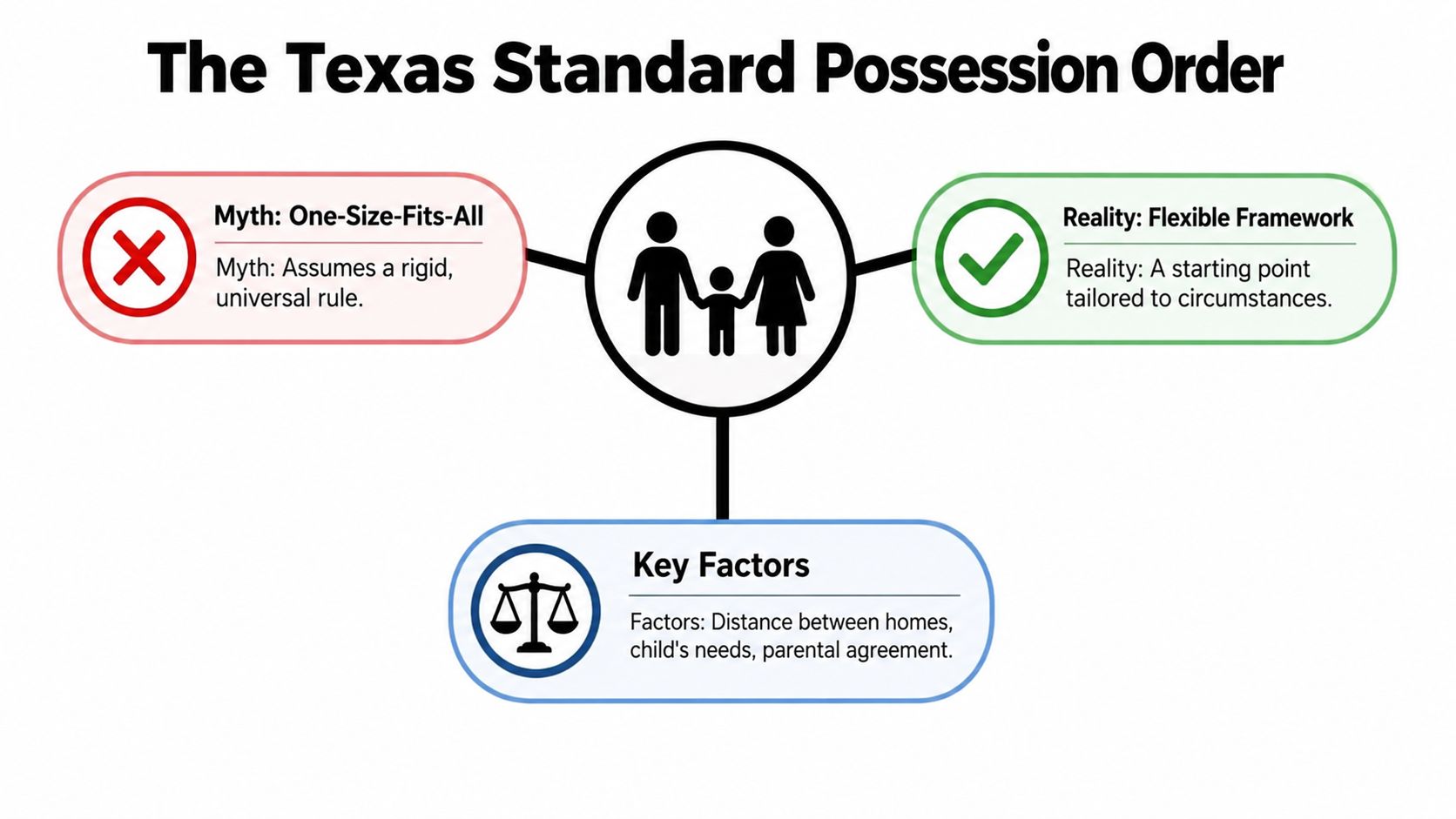
The reason courts use the SPO so often is simple, children do better when the schedule is predictable. The law tries to balance stability with frequent contact with both parents. That's why the SPO works as a framework, not a punishment. It gives a child a rhythm they can count on, while still leaving room for parents to negotiate, modify, or litigate when real life doesn't fit the default calendar.
Practical rule: If you don't have a custom order, assume the SPO controls until a judge signs something different.
How the Regular Weekend and Weekday Schedule Works
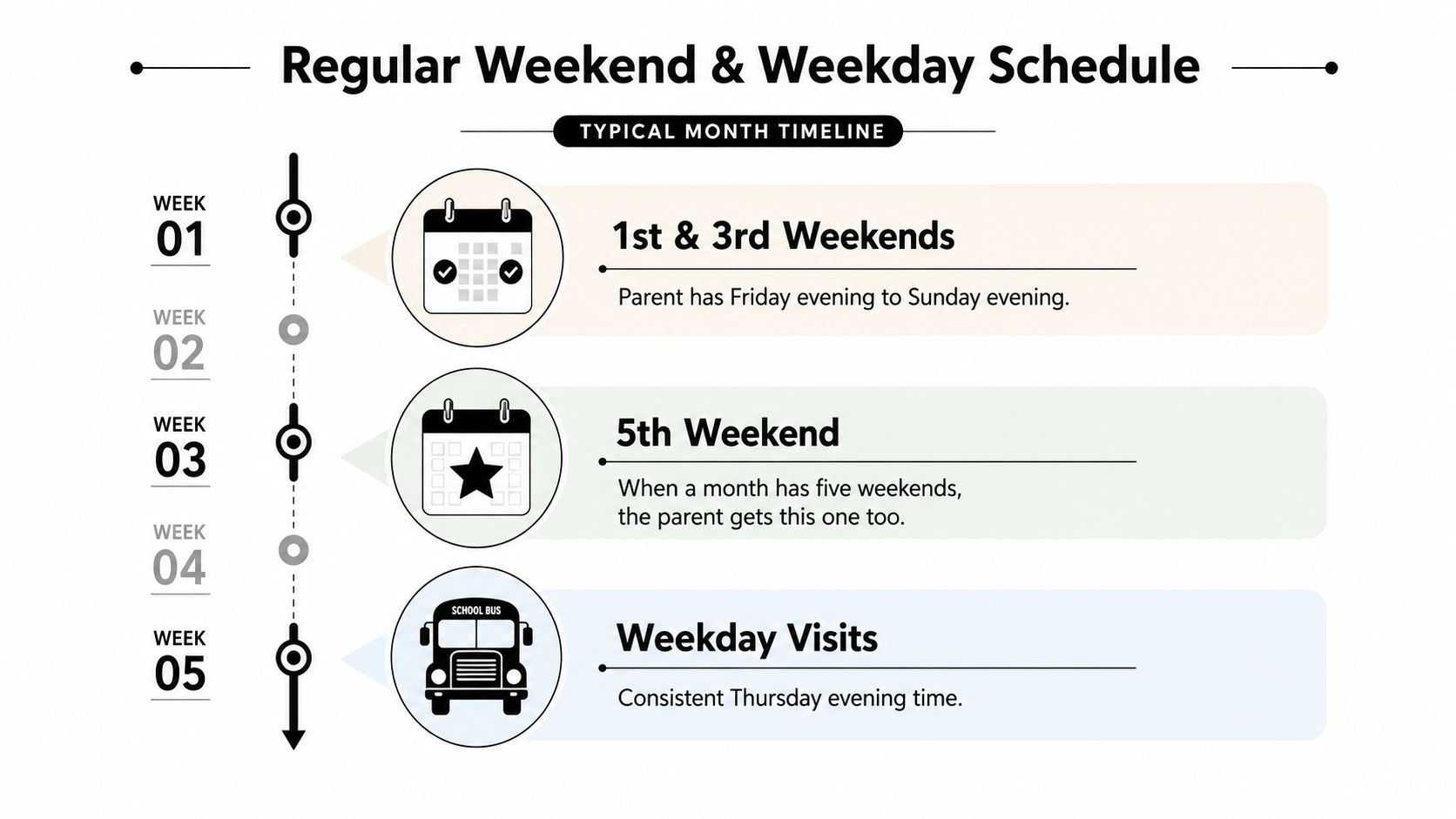
A lot of parents hear “first, third, and fifth weekends” and still cannot picture what that means on a real calendar. The easiest way to read it is month by month. The possessory parent in a Texas order gets possession on those specific weekends, and the pattern repeats each month unless a holiday or special provision changes it.
Under the regular SPO, a weekend usually starts Friday evening and ends Sunday evening. Texas guidance materials describe the baseline structure as a calendar-based schedule, and the Texas Attorney General parenting-time guidance explains that when parents live 50 miles apart or less, the order can include choices that affect the weekend cadence and election options. In everyday terms, that means one weekend may belong to Dad, then the next to Mom, then back again, depending on the order and any holiday override.
A simple month example
If the first Friday of the month falls on the 2nd, that weekend is the first weekend. The third Friday is the third weekend. If the month has five Fridays, the fifth Friday creates a fifth weekend, which gives the possessory parent an extra possession weekend that month. That is one reason parents need a real calendar instead of trying to guess from memory.
The school-week overnight or evening visit usually fits around homework, sports, and bedtime routines. The point is to build a repeatable pattern that works with school-age life rather than against it. For a plain-language overview of how the default Texas visitation schedule works, some parents also review The Texas Standard Possession Order Explained, which can help them compare the clock-time version with the school-day version.
Parents who work nights, swing shifts, or rotating schedules often feel the regular SPO most sharply. A calendar that looks clean on paper can still feel complicated at handoff time if one parent gets off work at 6:00 a.m. and the other leaves for work at 7:00 p.m. The same is true in long-distance families, military households, and high-conflict exchanges, where a “standard” weekend may need a different setup to stay workable. In those situations, the order can still give structure, but the details may need to be changed so the schedule matches real life instead of fighting it.
When the weekend schedule feels confusing, mark the first Friday of each month first. That one date usually makes the rest of the pattern easier to see.
Holidays and Special Days Under the Standard Possession Order
Holidays create more conflict than almost anything else in a possession order because they interrupt the normal routine. The good news is that the SPO usually handles them with a rotation, so parents aren't arguing from scratch every year. The key is to follow the holiday block, not the regular weekend block, because the holiday schedule controls when both overlap.
The holiday rotation parents miss most often
Thanksgiving and spring break generally alternate by year, while Christmas is divided into two separate periods that also alternate. Mother's Day and Father's Day go to the named parent, regardless of who has the usual weekend. The child's birthday is a separate issue unless the order adds a special birthday provision.
| Holiday Rotation Under the Texas Standard Possession Order | Even Years | Odd Years |
|---|---|---|
| Thanksgiving | One parent's turn | The other parent's turn |
| Spring Break | One parent's turn | The other parent's turn |
| Christmas period one | One parent's turn | The other parent's turn |
| Christmas period two | The other parent's turn | One parent's turn |
The exact start and end times matter. Orders often tie the holiday block to the time the child is released from school and end it at a specific time on the listed return date. That language matters because it controls travel, family gatherings, and school events.
The holiday schedule overrides the regular weekend pattern when they conflict. If a holiday block is active, the normal Friday-to-Sunday possession doesn't control.
If you're trying to map this onto your decree, the most useful guide is the actual wording in your signed order, along with a Texas holiday possession overview like Texas holiday possession schedule guidance. That way, you're reading the dates the same way the court expects you to read them.
Summer Possession and the 30-Day Window
Summer feels different because the SPO shifts away from short exchanges and into longer blocks of time. For many families, that's the easiest season to repair lost weekday time, plan a trip, or let a child settle into one household for a stretch without constant handoffs.
Under the default SPO, the noncustodial parent can usually have 30 consecutive days in the summer, and the other parent may have a two-week option depending on the order and the distance rules that apply. Texas guidance also uses a written notice deadline, and that deadline matters because the court wants each parent to know the plan early enough to arrange work, childcare, and travel.
Why notice matters
If a parent doesn't give notice in time, the default dates in the order usually take over. That's where a lot of avoidable disputes start. One parent assumes the dates can wait, the other parent books travel around the default block, and suddenly both households are working from different calendars.
A simple way to handle summer scheduling is to pick the dates in writing, then compare them with school camps, vacation plans, and any travel-heavy job schedules. If a child has a summer program, that doesn't erase the possession right, but it can create a practical conflict that needs planning. Parents who leave the summer block until the last minute usually spend more time arguing than planning.
Keep the summer notice in writing and save a copy. If a dispute comes up later, your calendar and email trail matter more than a memory of the conversation.
The SPO is meant to give children a stable summer rhythm, not force families into repeated emergency meetings. If your signed order has different summer language, use that language first, because the order controls.
The Expanded Standard Possession Order and the 50-Mile Rule
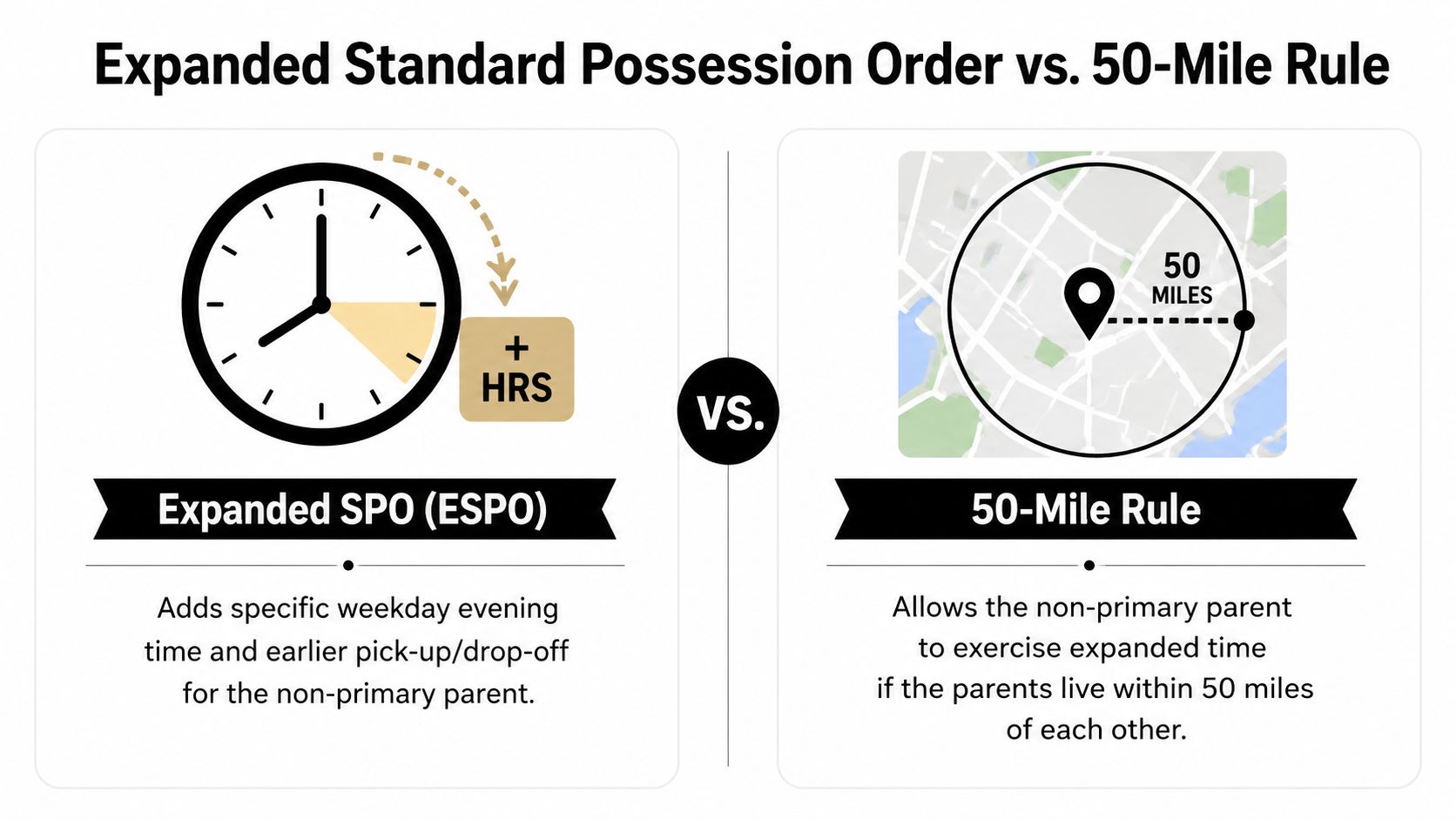
A lot of parents hear “Texas custody schedule” and assume there is only one version. The starting point has changed. Under SB 1936 from the 87th Texas Legislature, the Expanded Standard Possession Order became the default for a noncustodial parent who lives within 50 miles of the child's primary residence (Texas expanded SPO default analysis). That matters because the order now begins with distance, not with a parent having to ask for a better schedule first.
The practical effect shows up at home, not just on paper. The expanded order is designed to give more time, more overnights, and less of the hurried back-and-forth that can strain a school night or a workday. One analysis notes that the expanded version produces roughly 43% to 47% parenting time, while the basic standard order is lower, with the custodial parent holding roughly a 60/40 split in their favor under the basic order (Texas expanded SPO default analysis). Those figures help explain why two parents can look at the same order and have very different reactions. A parent who works late or handles shift work may see relief, while a parent managing school drop-off may notice fewer short, stressful exchanges.
What changes under the expanded schedule
The expanded version is often built around the school calendar. Weekend possession can begin when school lets out and end when school starts again, and the weekday period may include an overnight instead of a quick evening visit. That matters for families who are trying to keep a child's life predictable. A child who knows where the backpack goes on Thursday night usually has an easier time than a child who is being driven across town for a short visit after dinner.
Parents who work irregular hours often feel the difference right away. The schedule can fit better when a parent travels for work, works evenings, or needs fewer handoffs to make the week run smoothly. Texas Access also explains that the standard possession order changes depending on whether parents live over or under 100 miles apart, so distance still needs to be checked before anyone assumes the same template fits every family (Texas Access standard possession order guidance). That distance check is part of the practical analysis, especially for families where one parent's commute, school pickup route, or housing change has shifted since the order was signed.
A more detailed explanation of how the expanded schedule works is available in this Texas expanded standard possession order guide. Families often find that a side-by-side review helps them see whether the school-based exchange structure matches their routines or creates new friction.
For a closer comparison, some parents also review The Expanded Standard Possession Order (ESPO) in Texas to see how the practical calendar changes from one version to the next.
Exceptions for Military Families, Relocation, and Grandparents
A Texas possession order can look tidy on paper and still miss the way a family lives. A parent may work nights, a service member may be gone for training, or one household may have moved far enough away that the usual exchange point no longer makes sense. Grandparents face a different problem, because Texas law does not give them automatic visitation rights just because they care about a child.
Long distance and deployment realities
Distance changes the schedule in practical ways. Once parents live more than 100 miles apart, the default plan can shift, and the noncustodial parent may choose one weekend per month after giving written notice within the required window described in Texas Access guidance. For a family dealing with a move for work, a new marriage, or a change in housing, that notice rule matters because a missed deadline can limit the schedule that would otherwise have been available.
Military families usually need even more flexibility. Deployment, training rotations, and Temporary Duty orders can interrupt a possession calendar even when everyone is trying to follow the order in good faith. The child still needs predictability, but the court also has to account for obligations that a parent cannot ignore. A service member should raise the issue before the schedule starts breaking down, not after exchanges have become a source of conflict.
Grandparents and court access
Grandparents in Texas do not get visitation automatically. Chapter 153 limits when a grandparent can ask the court for access, and the question usually turns on whether cutting off contact would cause significant impairment to the child's physical health or emotional well-being. That standard is demanding for a reason. Courts want more than a close relationship, they want a showing that the child would be harmed without it.
When a grandparent is considering a court case, the first question is usually whether the legal path is even open. The next question is whether the facts support it. A grandparent who has been a steady caregiver may still need to show more than family history and good intentions, so getting clear legal advice before filing is the safer move.
If the schedule keeps falling apart because of distance, deployment, or work travel, the issue may be the order itself. Sometimes the order was never built for the family's real routine.
Families in these situations often do better with a customized order than with a standard one. The SPO can still provide a starting framework, but it should be adjusted to fit shift work, school pickups, military obligations, and the reality of high-conflict exchanges. If a parent needs to change an existing order because life has shifted, a focused guide like how to modify custody in Texas can help explain the process in plain English.
Enforcement and Modification of the Standard Possession Order
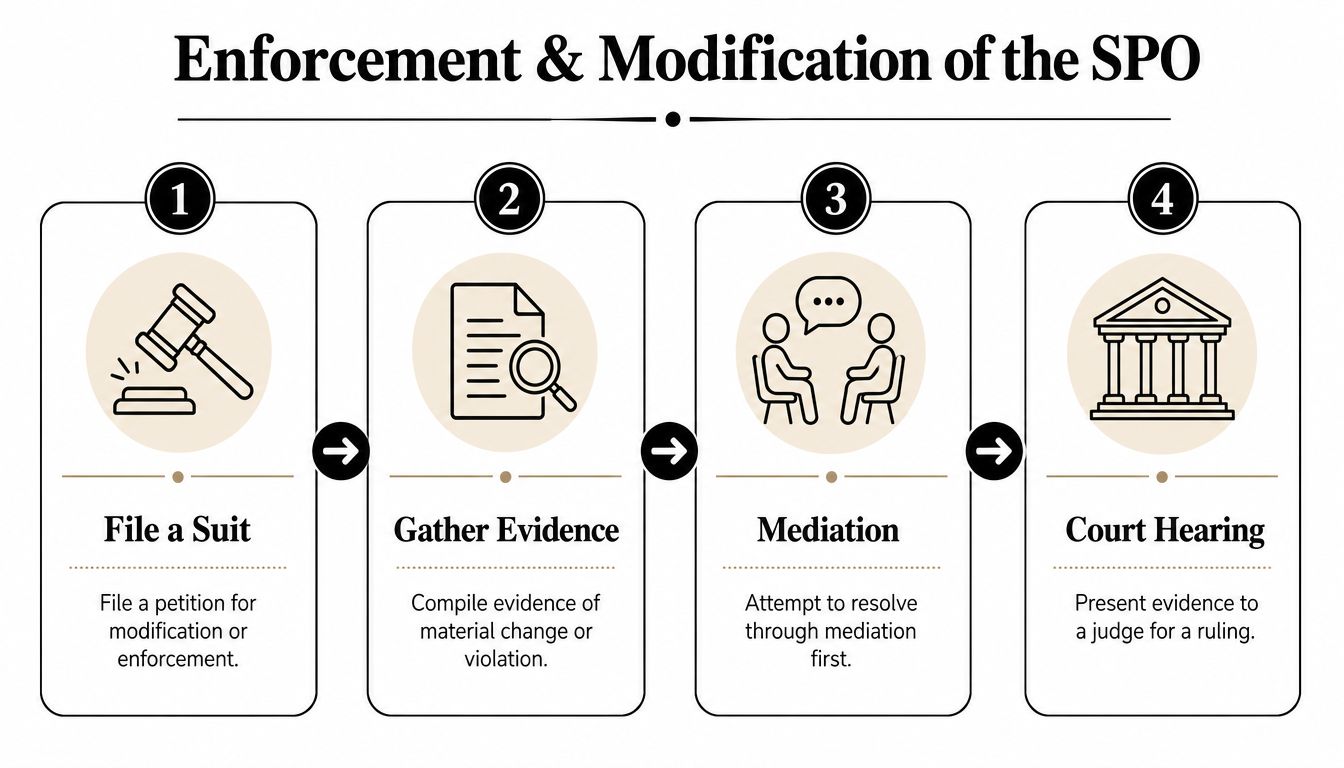
A possession order only works if both parents follow it. When one parent misses exchanges, changes pickup times without agreement, or keeps ignoring holiday provisions, the other parent may need to ask the court to enforce the order. When the schedule no longer fits the child's life, the parent may need to ask for a modification instead.
The difference matters. Enforcement asks the court to make an existing order happen. Modification asks the court to change an order because life has changed enough that the old schedule no longer fits.
How Texas changes an existing order
TexasLawHelp explains that a parent or nonparent can file a modification case to change an existing visitation or possession order (TexasLawHelp child visitation and possession orders). For most existing orders, the court looks for a material and substantial change in circumstances before it will alter the schedule. That can mean a new job with shift work, a move, a school change, or another real-world shift that makes the current order hard to follow.
Courts usually want to see more than frustration. They want a record that shows the pattern. Keep copies of missed exchanges, texts or emails about schedule changes, school calendars, travel records, and anything else that shows how often the current plan breaks down. A judge is still looking at the child's best interests, but the judge also needs clear facts before the problem comes into focus.
Best practice: Save texts, emails, and a simple possession log. If you ever need a judge to sort out the dispute, details beat frustration.
Texas Attorney General guidance also explains that once a court has set the SPO, the Child Support Division generally does not change it on its own. In other words, if the order itself needs to change, you usually need a court process, not just a phone call, to fix it.
That becomes especially important for parents whose routines have shifted because of shift work, long-distance parenting, military service, or repeated handoff problems. A standard order can still be the starting point, but the practical question is whether it fits the family's actual week. For parents comparing options before filing, a plain-English guide on how to modify custody in Texas can help you see what kind of change may make sense.
Key Takeaways and Your Next Steps
The Texas Standard Possession Order is the default schedule, but it's still just a starting point. Distance, school calendars, travel demands, and family conflict can all change how that schedule works in daily life. The more you understand the calendar, the easier it is to spot when the order fits and when it doesn't.
If your family is dealing with shift work, relocation, military service, or repeated handoff problems, don't assume you're stuck. Texas law allows changes when the facts support them, and the child's best interests still drive the court's decision. You may need a clarification, a modification, or a completely different possession plan.
If you want help reading your decree or planning your next step, The Law Office of Bryan Fagan, PLLC can review your situation and explain your options in plain English. For more background, you can also explore the firm's related resources on the The Texas Standard Possession Order Explained and the Expanded Standard Possession Order.
If you need help with a child custody or visitation case in Texas, our experienced attorneys can guide you every step of the way. Contact The Law Office of Bryan Fagan, PLLC today for a free consultation.


