 Skip to content
When your child's summer depends on a deadline, a missed notice can turn a carefully planned vacation into a fixed calendar you never chose. Many Texas parents also become confused by references to a “thirty and fifty day summer possession election Texas” schedule, even though the distance-based rule described in the governing guidance provides 30 days for parents living within 100 miles and 42 days for parents living more than 100 miles apart, not a standard 50-day summer block.
This distinction matters to mothers, fathers, grandparents, and caregivers trying to protect a child's stability while preserving meaningful time with both parents. The right answer depends on the wording of your possession order, the distance between the parents' residences, the type of conservatorship, and whether the election was made correctly.
What the Standard Possession Order Means for Texas Parents
A parent may be sitting at a kitchen table with a school calendar, work schedule, and travel plans spread out in front of them. The dates look simple until the parent notices the April 1 notice deadline and realizes that the other parent may have a separate weekend right during the selected summer period.
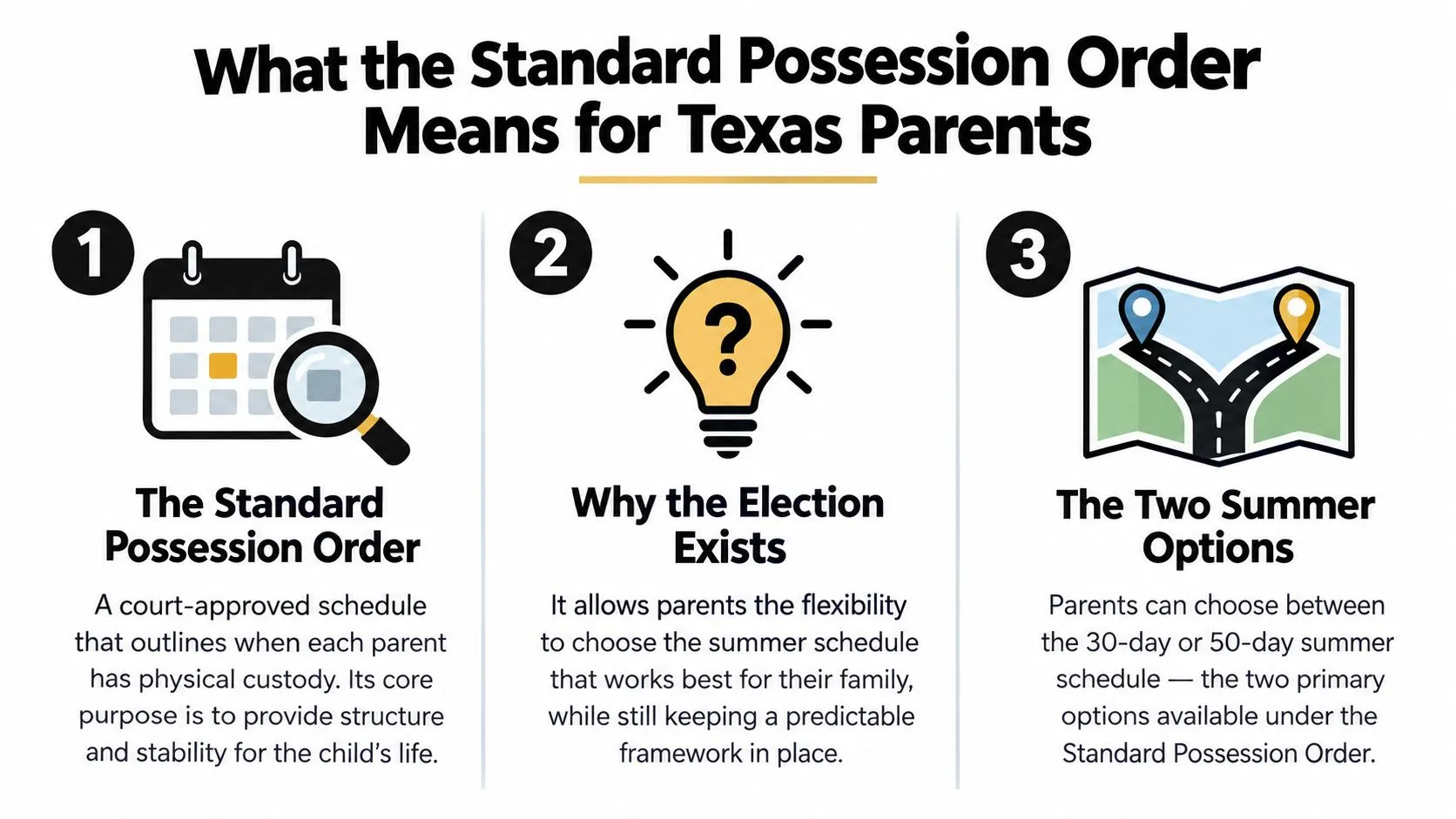
A Standard Possession Order, often called an SPO, is a court-approved framework for deciding when a child spends time with each parent. It generally provides predictable periods of possession, while allowing the parents to plan school breaks, holidays, weekends, and summer time. A possession schedule doesn't decide which parent loves the child more. It creates a structure so the child can maintain frequent and continuing contact with both parents.
Texas courts use terms such as managing conservator and possessory conservator. In plain English, a managing conservator generally has the primary authority or residence-related responsibilities identified in the order. A possessory conservator has court-ordered periods of possession and access. Parents may also share a joint managing conservatorship, which means both parents have legally recognized rights and duties, even if the child lives primarily with one parent.
The summer election exists because families need flexibility within a predictable system. Instead of leaving summer dates entirely open to conflict, Texas law gives the eligible parent a defined opportunity to choose dates, subject to deadlines and limits.
Why the number can be confusing
For parents who live within 100 miles, the summer period under the standard framework is 30 days. The eligible parent may select those days by providing written notice by April 1. The selected period can be one continuous block or split into two periods of at least seven consecutive days each. If timely notice isn't given, the default is 30 consecutive days from 6 p.m. on July 1 to 6 p.m. on July 31. These rules appear in Texas Family Code Section 153.312 and related provisions, as summarized in Texas guidance on the Standard Possession Order.
Parents sometimes refer to a 50-day option because they have heard different descriptions of expanded schedules or distance-based arrangements. Before relying on that label, read the exact order and determine which statutory distance category applies. A written calendar, service record, and clear exchange instructions can prevent an avoidable disagreement. Some families also use document tools to track contract views with video walkthroughs, which can help organize proof that a document was received or reviewed.
How Distance Decides Between 30 and 50 Day Summer Possession
A parent moving across the county line may discover that the summer schedule changes with the distance between the parents' residences. The address of a grandparent, vacation home, or temporary destination usually does not determine the category. Under the standard framework, parents who live within 100 miles generally have a 30-day summer period. When the residences are more than 100 miles apart, published Texas custody guidance identifies 42 days of summer parenting time, as explained in the guide to the Standard Possession Order over 100 miles.
That distinction matters for those seeking a thirty and fifty day summer possession election Texas arrangement. The verified framework described here provides a 30-day track and a 42-day track, rather than a standard 50-day period. The final order controls, especially if it contains customized terms.
| Distance Between Residences | Summer Possession Length | Block Period | Weekend Right During Election |
|---|---|---|---|
| Within 100 miles | 30 days | One block, or two periods of at least seven consecutive days each | Managing conservator may designate one weekend during the elected period |
| More than 100 miles | 42 days | The applicable distance-based summer period, subject to the order | Review the order for the specific weekend and notice provisions |
Distance functions like a travel trigger. As the parents live farther apart, repeated exchanges become harder for the child and both households. A longer summer period can provide meaningful time with the distant parent while reducing the number of trips.
Distance isn't the same as preference
A parent cannot select the longer schedule because it fits better with work, travel, or family plans. The court order sets the schedule unless both parents agree to another arrangement or a court changes the order. The child's wishes may matter in some custody decisions, but those wishes do not automatically replace the possession terms. For background on that separate issue, see Does a Child Get to Choose Which Parent in Texas?.
Homes near the distance threshold require extra care. Confirm which residences the order uses, record how the distance was calculated, and check whether the order defines a particular address, county, or measuring method. That information should be settled before a parent sends a summer election notice, because choosing the wrong schedule can create a dispute before the child's vacation even begins.
Who Can Make the Election and When Notice Is Due
The parent who makes the summer choice is generally the possessory conservator, meaning the parent who has the ordered periods of possession. That parent doesn't gain an unlimited right to choose any dates or any length of time. The election operates inside the limits of the possession order and Texas Family Code provisions.
For the 30-day within-100-miles framework, the parent must give written notice by April 1. The notice should identify the child, the dates selected, and the person receiving the notice. It should also use a delivery method that lets the parent later prove when the notice reached the other parent.
The date selection has boundaries
The elected time must start no earlier than the day after school dismisses and end no later than seven days before school resumes. The period may be split into two periods of at least seven consecutive days each, rather than scattered across isolated weekends or single days. This structure helps the child understand the schedule and gives both parents a workable planning framework.
Practical rule: A notice isn't complete because you drafted it by April 1. The other parent must receive the required notice by the applicable deadline.
The managing conservator also has a separate right to designate one weekend during the summer possession period. That weekend right can affect the practical flow of the elected block, so both parents should read the exact order and calendar the additional notice deadline. The managing conservator's designation isn't a reason to ignore the election. It is an overlay that must be coordinated with it.
Parents should also remember that the election may need to be made before or at the time the possession order is rendered, depending on the statutory provision and the order's language. Texas Family Code Section 153.317 addresses related election requirements, including the importance of recording the election in writing or orally in open court. If your order is unclear, don't assume the other parent will interpret it the same way.
How to Make the Election in Writing or Open Court
Texas parents usually encounter two important ways to preserve the election. The first is to include the election right directly in the final divorce or custody order. The second is to state the election in open court and make sure the record accurately reflects what was chosen.
A final order should identify the parent, the child, the number of days, the statutory section, and the way dates will be selected. Precise language reduces the chance that a later reader will confuse a 30-day provision with a distance-based schedule. A provision might state:
IT IS ORDERED that [parent] shall have the right to designate thirty consecutive days of summer possession under Texas Family Code Section 153.313(a)(2).
That sample language is only a starting point. The final order must match the case's actual distance category, the court's ruling, and any negotiated terms. A parent shouldn't copy a clause into an order without confirming that the cited subsection and schedule fit the family's circumstances.
When the election happens in court
If the order doesn't cover the election clearly, the parent may announce the election orally on the record in open court, with a court reporter present. Afterward, filing written notice provides a separate paper trail, but filing alone doesn't cure an oral statement that was never properly recorded or a notice that arrived late.
The written notice should be direct. For example:
I, [parent's full name], elect summer possession of [child's full name] from 6 p.m. on July 7 through 6 p.m. on August 5, subject to the terms of the Final Order in [case name and cause number]. I provide this notice to [receiving parent's full name] under the applicable Texas Family Code provisions.
The dates in that example are illustrative. Your dates must comply with the school calendar, the possession order, and the applicable distance rule.
Build proof of delivery
Send the notice using a method that creates reliable evidence, such as certified mail with a return receipt, or an appropriate court electronic filing and service system. Keep the signed receipt, filing confirmation, email or electronic service record, and a complete copy of what was sent.
The critical point is simple: the notice must reach the other parent by April 1. Drafting it on time isn't enough if delivery occurs afterward. If service becomes disputed, a clean record can help the court determine what happened.
A Worked Summer Schedule Example for a Texas Family
Consider a Houston-area family. The children's primary residence is about 85 miles from the noncustodial parent's residence, so the family falls within the within-100-miles framework described in the order. On April 1, 2025, the noncustodial parent gives written notice selecting July 7 through August 5, a 30-day period.
That election gives the parent a clear summer block, but the other parent's separate weekend designation still must be considered. Suppose the managing conservator properly designates one weekend during the selected period, from Friday evening through Sunday evening. The parents should identify the exact weekend, exchange times, and whether the order treats the designated weekend as a displacement, interruption, or adjustment that extends the overall possession window.
The calendar should show both the elected period and the weekend right. Parents shouldn't rely on a verbal understanding such as “we'll work it out.” The written order controls, and a written calendar can reveal whether the selected dates produce the possession time the parent expects.
| Date | Within 100 Miles, 30-Day Election | Over 100 Miles, 42-Day Alternate |
|---|---|---|
| April 1, 2025 | Written notice selects July 7 through August 5 | Written notice should identify the applicable longer summer period under the order |
| July 7 | 30-day possession begins at the order's stated time | The longer-distance summer period begins according to the order |
| During the elected period | Managing conservator's designated weekend is placed on the calendar and coordinated with the elected period | Review the order's distance-based weekend and summer provisions |
| August 5 | 30-day period ends at the order's stated time | Continue until the elected 42-day period ends under the order |
Now compare a Dallas-to-Lubbock family whose residences are more than 100 miles apart. The verified Texas guidance identifies a 42-day summer period for that distance category. The parent shouldn't select a 30-day block because a friend's order uses that schedule, and shouldn't call the period 50 days unless the actual order contains a separate provision allowing it.
What parents should verify
Check the school dismissal and resumption dates, the order's pickup and return times, travel arrangements, and the managing conservator's weekend designation. If the children attend different schools or have different calendars, the order may require additional interpretation.
This example is not a substitute for reading the signed order. A court may have entered a customized schedule, and an agreement between parents may change the practical plan if it is valid and properly documented.
Common Pitfalls That Cost Parents Their Elected Time
A summer election can fail because of a small procedural mistake, even when the parent acted in good faith. The most common problems involve delivery, documentation, and assuming that a familiar schedule applies to every family.
Missing the receipt deadline
A parent may mail notice on April 2, or mail it on April 1 without proof that it arrived that day. If the deadline requires receipt by April 1, late delivery can allow the default schedule to control. Use certified mail with a return receipt or another verifiable service method, and send early enough to account for delivery time.
Making an oral announcement without a reliable record
Telling the other parent over the phone isn't the same as making an election in open court. If the parent announces dates in court but no court reporter or clear record preserves the statement, the later dispute may become a credibility contest.
Keep a copy of the written election, the delivery record, and the court record. If a final order contains the election, mark the relevant provision and use its exact language.
Ignoring the other parent's weekend right
The managing conservator may have a right to designate one weekend during the elected summer period. Ignoring that provision can create an exchange dispute and may cause the parents to argue over whether the elected block was interrupted or extended.
Calendar that weekend as soon as the designation arrives. If the wording is unclear, ask for written clarification rather than changing the schedule unilaterally.
Trying to change the election after entry
Once the final order is signed, a parent generally can't rewrite the election because work, travel, or personal plans changed. A modification may require proof of a material and substantial change and that the requested arrangement serves the child's best interests. Parents may agree to a different schedule, but the agreement should be put in writing.
Confusing 30 days with the distance-based period
A parent living more than 100 miles away may have the 42-day framework, while a parent within 100 miles may have the 30-day framework. Check the parents' actual residences, not a grandparent's address or the child's vacation location. For firms and professionals organizing family-law information, resources on law firm marketing tactics for 2025 are separate from the legal rules and shouldn't be treated as a substitute for reviewing the order.
Enforcement and Modification When Summer Plans Go Wrong
When a parent withholds court-ordered summer possession, the issue is more serious than a scheduling disagreement. The parent who lost time may ask the Texas court to enforce the possession order under Family Code Chapter 309. Depending on the facts and the court's findings, possible relief can include contempt, make-up possession, attorney's fees, or changes to future possession terms.
Start with evidence. Save the signed order, the election notice, delivery confirmation, school calendar, exchange details, text messages, emails, and any records showing that the child wasn't made available. Dated calendar entries are useful because they connect each missed exchange to a specific provision and time.
Organize the enforcement record
Create a simple timeline:
- Notice: Keep the date, method, recipient, and proof of delivery.
- Exchange: Record the scheduled location, time, and what happened.
- Communication: Preserve texts and emails without editing the surrounding context.
- Impact: Note missed travel, childcare changes, or other concrete consequences.
- Requested remedy: Identify the make-up days or future calendar that would solve the problem.
The step-by-step guide to enforcing a Texas custody order can help a parent understand the general process, but a lawyer should review the specific order before filing.
If a child is wrongfully kept from the parent entitled to possession, a petition for writ of habeas corpus may be appropriate in some circumstances. A parent may also request an expedited hearing before school resumes when delay would make the missed summer time impossible to restore. Courts can evaluate requests for make-up periods, contempt findings, fees, or a more specific future calendar.
When modification may be appropriate
Enforcement asks the court to make the existing order matter. Modification asks the court to change the order. Under Texas Family Code Section 156.101, a post-judgment modification generally requires a material and substantial change in circumstances and proof that the proposed change serves the child's best interest.
The best interests of the child means the court focuses on the child's safety, stability, emotional needs, relationships, and practical welfare rather than treating possession as a prize for either parent. Mothers and fathers can both request relief, and a parent's gender doesn't decide whether enforcement or modification is available. Grandparents and caregivers may need a different legal pathway because their rights depend on their relationship to the child and the order already in place.
Sanctions are discretionary. A clean evidentiary record, a cooperative tone where possible, and a specific proposed order with exact future dates can make the request easier for a judge to evaluate. The Law Office of Bryan Fagan, PLLC helps Texas families address possession enforcement, custody modifications, paternity, support, relocation, and emergency custody concerns.
A parent facing a missed summer election should gather the signed order and delivery records before confronting the other parent or filing paperwork. For personalized help interpreting the 30-day or 42-day schedule, documenting a missed exchange, or preparing an enforcement or modification request, visit Law Office of Bryan Fagan, PLLC to discuss the family's options.
If you need help with a child custody or visitation case in Texas, our experienced attorneys can guide you every step of the way. Contact The Law Office of Bryan Fagan, PLLC today for a free consultation.


