
When your child's future is on the line, understanding your rights matters most. You may be planning a family vacation, responding to a co-parent's travel request, or worrying that your child could be taken abroad and not returned. In Texas, international travel is never just a matter of buying tickets. Your custody order, passport rules, written consent, and the child's best interests all work together.
The safest approach is direct: read the existing order before making plans, obtain written permission or court authorization when required, confirm passport control, and act quickly if abduction risk exists. This guide walks through that decision sequence under Texas Family Code Chapter 153, whether you're a mother, father, grandparent, or caregiver trying to protect a child while preserving healthy family relationships.
Why Your Custody Order Comes First Before Any Travel Plans
You've booked the flights, packed the bags, and told your child about the trip. Then you realize you haven't checked whether the Texas custody order allows international travel. Stop there. The signed custody order controls your next move, even if the trip falls during your regular possession period.
Texas custody orders can contain geographic restrictions, notice requirements, passport provisions, and specific limits on leaving Texas or the United States. A parent who ignores those terms may face a denied passport application, a court enforcement action, or a contempt claim. A travel plan that seems reasonable can still violate the order if it conflicts with a restriction you didn't notice.
Read the complete order
Pull together the original final order and every later modification. Don't rely on a summary, an old email, or what you remember from the hearing. Pay close attention to language addressing:
- Geographic restrictions: Check whether the child's residence must remain within a defined Texas area.
- Travel notice: Look for deadlines, destination requirements, itinerary details, and emergency contact provisions.
- Passport possession: Identify which parent may hold the passport and whether surrender is required.
- International travel: Search for express permission, consent, visa, or border-crossing language.
- Possession schedules: Confirm whether the trip would cause missed periods and whether make-up possession is addressed.
If you can't find your order, request a certified copy from the district clerk before booking travel. A certified document gives you the exact language the court entered, not an interpretation passed from one parent to another.
Practical rule: Never treat silence in a custody order as automatic permission to travel internationally. Have the language reviewed when the order is unclear.
The terms conservatorship, possession, and access also matter. Conservatorship concerns parental rights and decision-making. Possession and access describe when a parent may spend time with the child. A parent's possession period doesn't automatically override a travel restriction or passport condition. For a plain-language explanation of the Texas Standard Possession Order, review the Texas Standard Possession Order before you make travel arrangements.
Reading Your Conservatorship and Possession Order for Travel Rights
Texas orders commonly name parents as joint managing conservators, a sole managing conservator, or a possessory conservator. These labels describe legal authority, but the specific decree still controls. Don't assume that one label answers every international travel question.
A joint managing conservatorship generally means both parents share important rights and duties. One parent usually can't take the child abroad over the other parent's objection because the trip occurs during that parent's possession time. Written consent or a court order may be necessary, particularly when the decree requires it or when passport authority is shared.
A sole managing conservator usually has broader authority over passport matters, but that parent still must read the order for travel restrictions. Texas Family Code Section 153.132 gives a parent named sole managing conservator the right to apply for and renew a child's passport and keep possession of it, unless a court order limits that authority. The judge can tailor those rights to protect the child.
Compare the order language carefully
| Conservatorship Type | Travel Authority | Other Parent Consent Needed? |
|---|---|---|
| Joint managing conservators | Authority is shared, subject to the exact decree and any travel restrictions | Often, if the order requires consent or the other parent's legal rights would be affected |
| Sole managing conservator | Broader passport authority under Texas Family Code Section 153.132, subject to court limits | Not always for passport handling, but the order may still require consent or restrict travel |
| Possessory conservator | Possession provides parenting time, not automatic authority to override travel or passport restrictions | Usually, when the order requires it or travel affects the other parent's rights |
A useful explanation of the difference between managing and possessory conservatorship appears in Conservatorship in Texas. Read the provisions that address notice, destination, travel dates, passport surrender, and missed possession. Highlight anything ambiguous and ask counsel to interpret the actual wording.
If the other parent already violated the order, Enforcing a Texas Custody and Possession Order addresses what to do when a parent fails to follow a custody order. Enforcement is different from asking for permission to travel, so don't confuse the two remedies.
Mothers and fathers should use the same standard here. A mother seeking a safe family trip needs to follow the written order. A father concerned about nonreturn needs to rely on evidence and the order, not assumptions about the other parent's nationality, family, or destination. The court focuses on the child's welfare and each parent's legal rights.
Getting Written Permission From the Other Parent or the Court
If the order requires consent, obtain it before you make the trip nonrefundable. A casual text saying “the trip sounds fine” may not protect you at the airport or in court. Use a written travel consent letter that clearly identifies the child, both parents, the destination, and the travel dates.
A strong letter should include:
- Child information: Full legal name, date of birth, and passport details if appropriate.
- Parent information: Full names, addresses, phone numbers, and email addresses.
- Trip details: Every country to be visited, departure and return dates, flights, lodging, and transportation.
- Accompanying adults: Identify anyone traveling with the child.
- Emergency contacts: List relatives, hotels, physicians, and both parents.
- Consent language: State that the signing parent authorizes the described international trip.
- Signature protection: Have the consenting parent sign before a notary and provide copies to both parents.
Keep the itinerary, lodging confirmations, return information, and signed consent together. Give the other parent a complete copy. If you're traveling with the child, carry the original or a properly authenticated copy rather than relying only on a phone image.
When consent isn't available
If the other parent refuses, can't be located, or imposes unreasonable conditions, don't cross the border first and ask questions later. File a motion under Texas Family Code Chapter 153 requesting specific travel authorization or modification of the existing order. The request should explain the trip's purpose, dates, destination, safety arrangements, communication plan, and how the child's relationship with the other parent will continue.
The judge applies the best-interests-of-the-child standard. In plain English, the court asks what arrangement protects the child's safety, stability, development, and meaningful relationship with both parents. A parent's personal desire to travel matters less than a complete plan showing why the trip benefits the child and doesn't undermine the other parent's rights.
If you need to confirm what the court signed, use this step-by-step guide to obtaining a copy of your final custody order in Texas. You can't obtain reliable consent to terms you haven't accurately identified.
Passport Steps for Texas Children Traveling Abroad
Passport rules are federal, while custody authority comes from the Texas order. Both systems matter. For a child under 16, U.S. passport rules generally require both parents' consent unless one parent can establish that consent isn't required. A standing Texas custody order doesn't automatically replace the passport agency's consent requirements.
Start by gathering proof of the child's U.S. citizenship, such as a birth certificate, and valid identification for both parents. The child generally applies using Form DS-11 through an authorized passport acceptance facility. If one parent can't appear, the absent parent may need to complete Form DS-3053, Statement of Consent, and have it notarized.
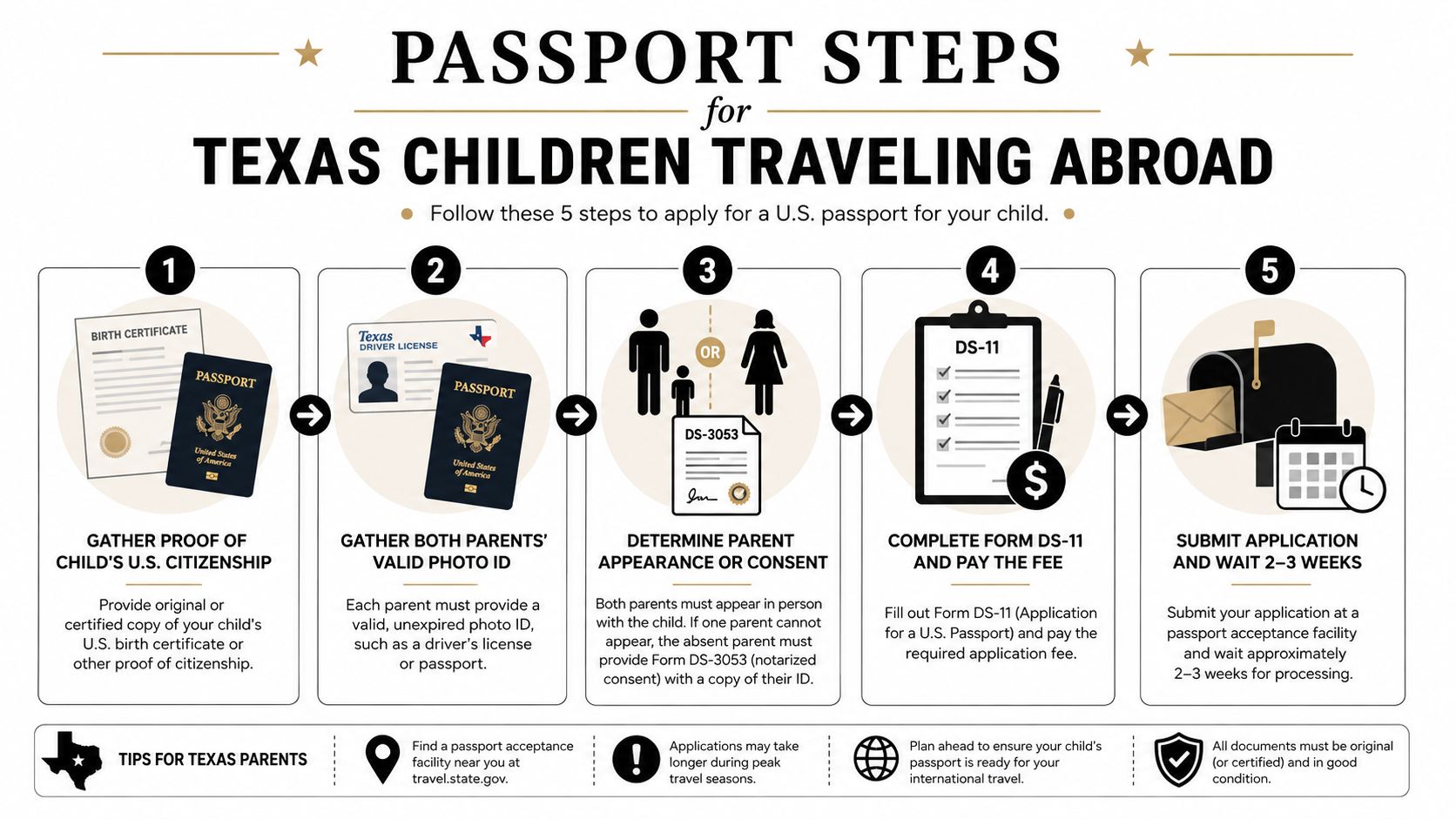
A parent who refuses to sign may need to complete Form DS-5525, Declaration of Exigent/Special Family Circumstances, with supporting documentation. The State Department may expect evidence explaining why the other parent's consent can't be obtained. A Texas court order specifically addressing passport issuance or international travel can provide the authority needed for the application, but the order should be reviewed for the exact relief it grants.
Don't assume that passport issuance settles the travel dispute. Both parents may consent to issuing a passport and later disagree about a particular trip. Conversely, a parent may have passport authority under Texas Family Code Section 153.132 while still being subject to travel restrictions in the decree or a later court order.
Ask about current processing options, expedited processing, and whether additional passport pages are available before finalizing travel. Photograph the child's existing passport identification page and keep copies of the passport, consent letter, custody order, insurance information, and emergency contacts in a secure travel folder. Keep a copy accessible to the traveling parent and a trusted adult at home.
Handling the Other Parent's Objection or Court Intervention
A refusal should trigger organization, not an argument. Send a written request with the exact destination, travel dates, flight information, lodging, accompanying adults, and return plan. Give the other parent a reasonable chance to respond and preserve every response, including silence, threats, or conditions.
If the objection continues, ask the court for specific authorization. Depending on the case posture, that may involve an original petition, a motion to modify, or a request for temporary relief under Texas Family Code Chapter 153. The judge needs facts, not accusations. Explain why the trip serves the child, how the child will maintain contact with the other parent, and what safeguards address the stated concern.
What belongs in the travel request
Bring a complete plan, including:
- Purpose and duration: Explain whether the trip involves family, education, culture, medical care, or a vacation.
- Destination information: Identify the countries, lodging, local contacts, and return arrangements.
- Parenting continuity: Offer scheduled calls, messages, or other age-appropriate contact with the parent at home.
- Possession adjustments: Address missed time and propose reasonable make-up possession.
- Safety details: Provide transportation, supervision, medical, and emergency information.
- Return evidence: Include employment, school, family, residence, and other facts supporting the child's return.
A judge may issue temporary orders when immediate action is needed for the child's safety or welfare. If departure appears imminent, ask an attorney about emergency relief, including a temporary restraining order or expedited hearing under Texas Family Code Section 105.001.
| Factor | What Courts Typically Examine |
|---|---|
| Trip purpose | Whether the travel benefits the child or serves a legitimate family need |
| Duration | Whether the absence disrupts school, routines, or possession |
| Destination | Safety, practical return issues, and the child's connection to the location |
| Parent-child relationship | How the plan protects the child's bond with both parents |
| Travel history | Whether the child and parents have previously traveled internationally without problems |
| Objection basis | Whether the concern is supported by specific facts or is merely general distrust |
Ignoring the order and traveling anyway can expose a parent to enforcement remedies, including make-up possession, contempt, a bond, or passport surrender orders. If you're the parent opposing travel, document the facts carefully. If you're the parent seeking travel, don't treat an objection as permission to proceed without court guidance.
Abduction Risk and the Hague Convention Explained
International parental abduction is a serious concern, not a theoretical problem. The U.S. government has tracked these cases for decades. The State Department has reported that about 1,000 children were abducted by a parent from the United States annually, while congressional research summarizing State Department data found about 1,500 children across 2008 through 2010, falling to below 1,000 by 2014. It later estimated approximately 700 children were abducted from the United States by parents in 2018 and 2019. These figures are summarized in the Government Accountability Office report on international child abduction.
The Hague Convention on the Civil Aspects of International Child Abduction gives the United States a process for seeking a child's return or access in participating treaty countries. It generally focuses on whether a child was wrongfully removed from or retained outside the country where the child habitually lived, and whether the removal violated a parent's custody rights. It isn't a substitute for prevention, and a Hague case still involves foreign courts and procedures.
Warning signs deserve prompt attention
Abduction risk depends on the facts, not a parent's citizenship or heritage. Concerning evidence may include:
- Past violations: The parent previously withheld, concealed, or kept the child against possession rights.
- Threats to leave: Messages, statements, or plans to relocate abroad permanently.
- Foreign ties: Strong family, residence, employment, or financial connections in another country.
- Passport activity: Attempts to obtain or replace travel documents without proper disclosure.
- Domestic violence: A history that increases concern about coercion, concealment, or danger.
- Sudden secrecy: Unexplained travel bookings, school withdrawal, or refusal to share location details.
If a child has already been taken, contact the U.S. State Department's Office of Children's Issues promptly and ask counsel about a Hague application and proceedings in the destination country. The State Department's 2026 annual report states that during calendar year 2025, the Office handled 908 active abduction cases, including 845 cases involving 1,164 children seeking return and 63 access cases involving 88 children. It reported 169 resolved cases involving 256 children returned to the United States. The report is required under the International Child Abduction Prevention and Return Act and is available through the State Department's 2026 annual report.
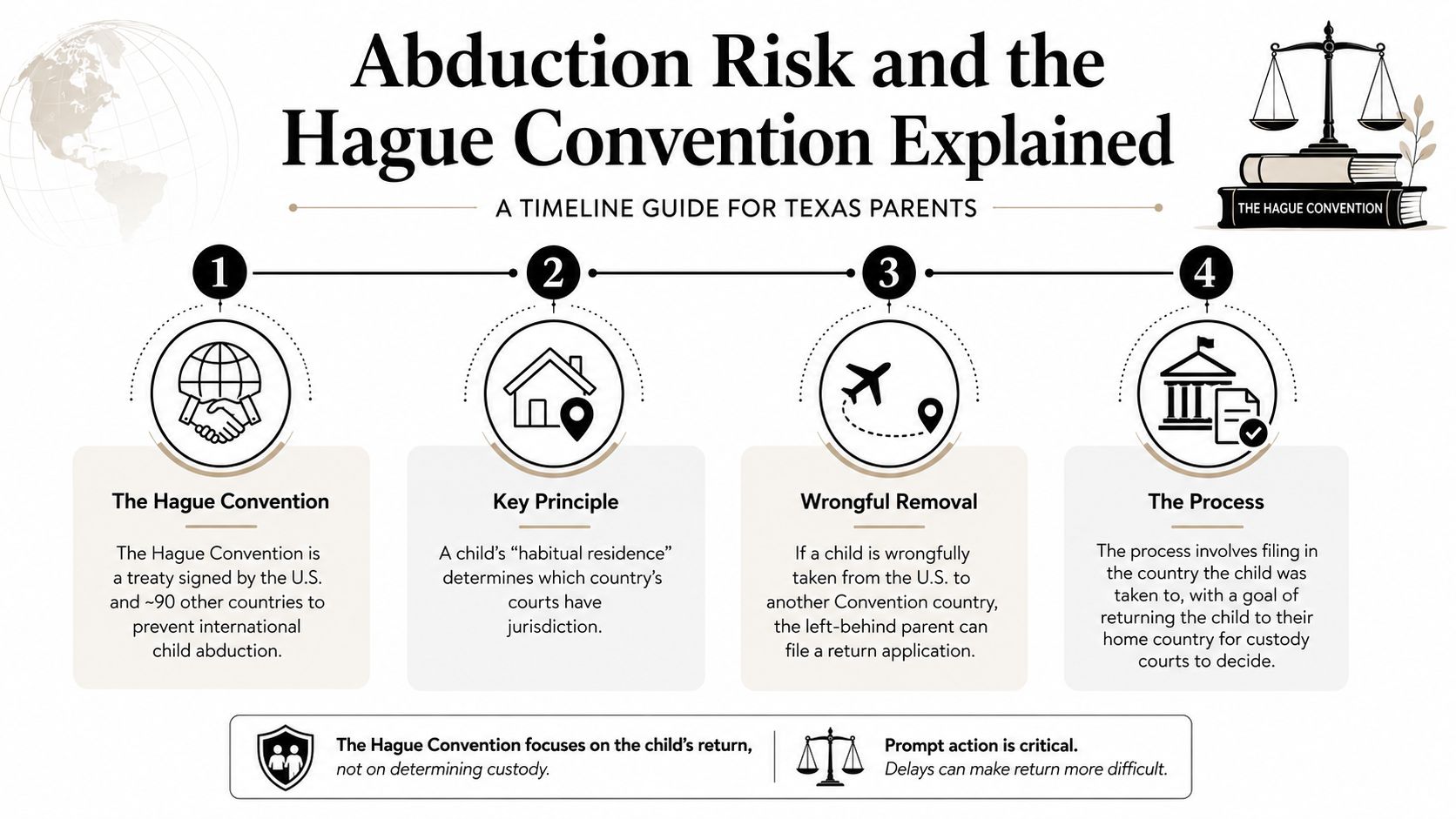
Texas courts can complement international remedies with passport surrender, travel restrictions, notice to federal officials and foreign consulates, supervised possession, and other protections authorized by Texas Family Code Section 153.503. Ask about the Children's Passport Issuance Alert Program when appropriate, and act before departure whenever possible.
Your Next Steps and When to Call a Texas Custody Attorney
You don't need to solve every custody and travel issue at once. Follow the decision sequence in order, and keep a written record of what you find.
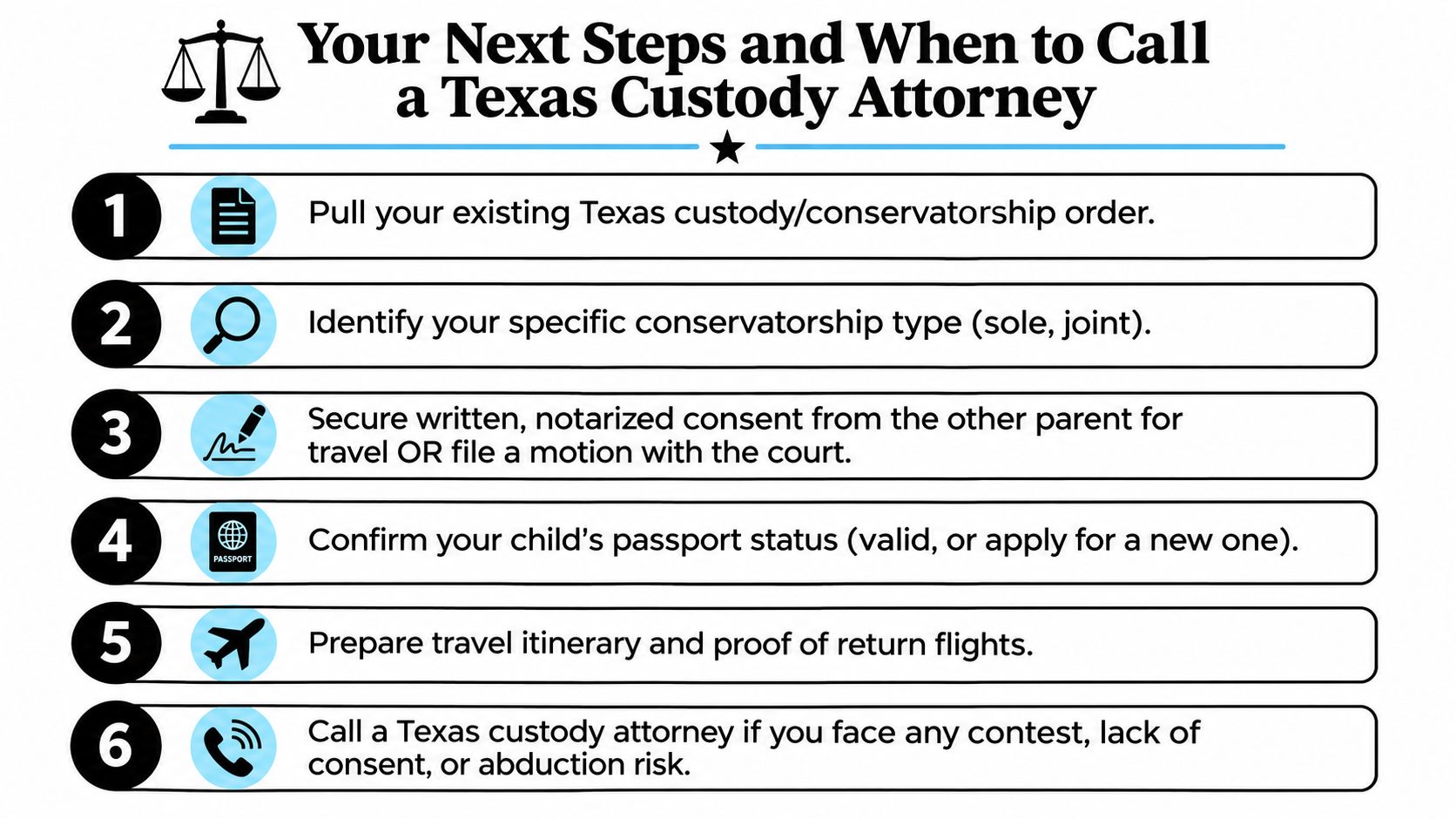
- Pull the order: Gather the final custody decree and every modification.
- Identify authority: Determine whether you're dealing with joint managing, sole managing, or possessory conservatorship.
- Confirm consent: Obtain written, notarized consent when required, or prepare a motion asking the court for permission.
- Check the passport: Confirm whether the child has a valid passport, who controls it, and whether a new application is necessary.
- Build a travel binder: Include the itinerary, lodging, return information, emergency contacts, medical details, consent letter, and custody order.
- Get legal help: Contact a Texas custody attorney if the other parent objects, refuses to cooperate, threatens relocation, or creates an abduction concern.
Call well before departure, not when you're standing at the airport. A lawyer can review the order, identify missing authority, prepare a consent document, negotiate safeguards, or request temporary relief. Bring the complete order, communications with the other parent, passport records, proposed itinerary, lodging details, and any evidence supporting or opposing travel.
Mothers and fathers both deserve clear guidance. A parent seeking travel should receive help presenting a responsible plan. A parent worried about nonreturn should receive help requesting focused protections rather than relying on fear alone. Grandparents and caregivers should preserve documents and notify the child's legal parent or attorney when they notice sudden travel activity or threats.
Preparation protects the child and reduces avoidable conflict. If travel is likely, address passport possession, notice, communication, return arrangements, and make-up possession in writing before the trip becomes urgent.
The Law Office of Bryan Fagan, PLLC helps Texas parents address international travel, custody modifications, passport restrictions, visitation disputes, and emergency custody concerns under Chapter 153. Contact the firm for a free consultation so an attorney can review your order, assess the travel or abduction risk, and explain the next practical step for your family. If you need help with a child custody or visitation case in Texas, our experienced attorneys can guide you every step of the way. Contact The Law Office of Bryan Fagan, PLLC today for a free consultation.