 Skip to content
When your child's future is on the line, the first question isn't always who gets custody. It's which state even has the power to decide. That can feel cold and technical when you're already worried about school, schedules, and how your child is handling the move, but UCCJEA home-state jurisdiction in Texas often determines everything that comes next.
A parent can be doing the right thing, staying calm, gathering records, and trying to co-parent, only to get served with papers from another state. Another family may have just arrived in Texas after a military move and assume Texas courts will handle the case right away. The law is more specific than that, and it protects against parents racing to different states looking for a better result.
Texas Family Code Chapter 152, which follows the Uniform Child Custody Jurisdiction and Enforcement Act, is meant to keep custody disputes in one proper courtroom instead of letting two states issue conflicting orders. If you're trying to protect your parenting time, respond to a filing, or understand where your case belongs, the timeline matters just as much as the facts about your child's care. For practical support behind the scenes, some family law offices also rely on family law staffing solutions to keep multi-state custody files organized and moving.
When Your Child's Home State Becomes a Legal Battleground
A mother moves to Texas with her toddler after a separation. A week later, the other parent files in the former state and says that court should decide custody. A father in the military gets orders to relocate and wonders whether Texas still counts if the child spent part of the year elsewhere. These are not unusual situations, and they all turn on one threshold question, which state has home-state jurisdiction?
The UCCJEA was built to stop forum shopping, the race to file in the friendliest court. Texas courts generally do not jump in first just because a parent lives here or prefers Texas law. They look first at whether Texas is the child's home state, because that status decides whether the court can make the initial custody determination at all.
Practical rule: If another state qualifies as the home state, Texas usually cannot make the first custody decision unless that state steps aside or no home state exists.
That matters for mothers, fathers, grandparents, and caregivers alike. A parent may think the fight is about best interests of the child, joint managing conservatorship, or a possession schedule, but the court cannot reach those questions until it answers jurisdiction. In plain terms, home-state jurisdiction is the doorway. If the door is closed, the judge may never reach the rest of the case.
Texas practitioners often build the file around that doorway. School calendars, lease agreements, daycare records, and travel dates matter because they help show where the child lived. For a broader look at related jurisdiction issues, see this discussion of exclusive continuing jurisdiction in Texas custody cases.
How Texas Defines Your Child's Home State
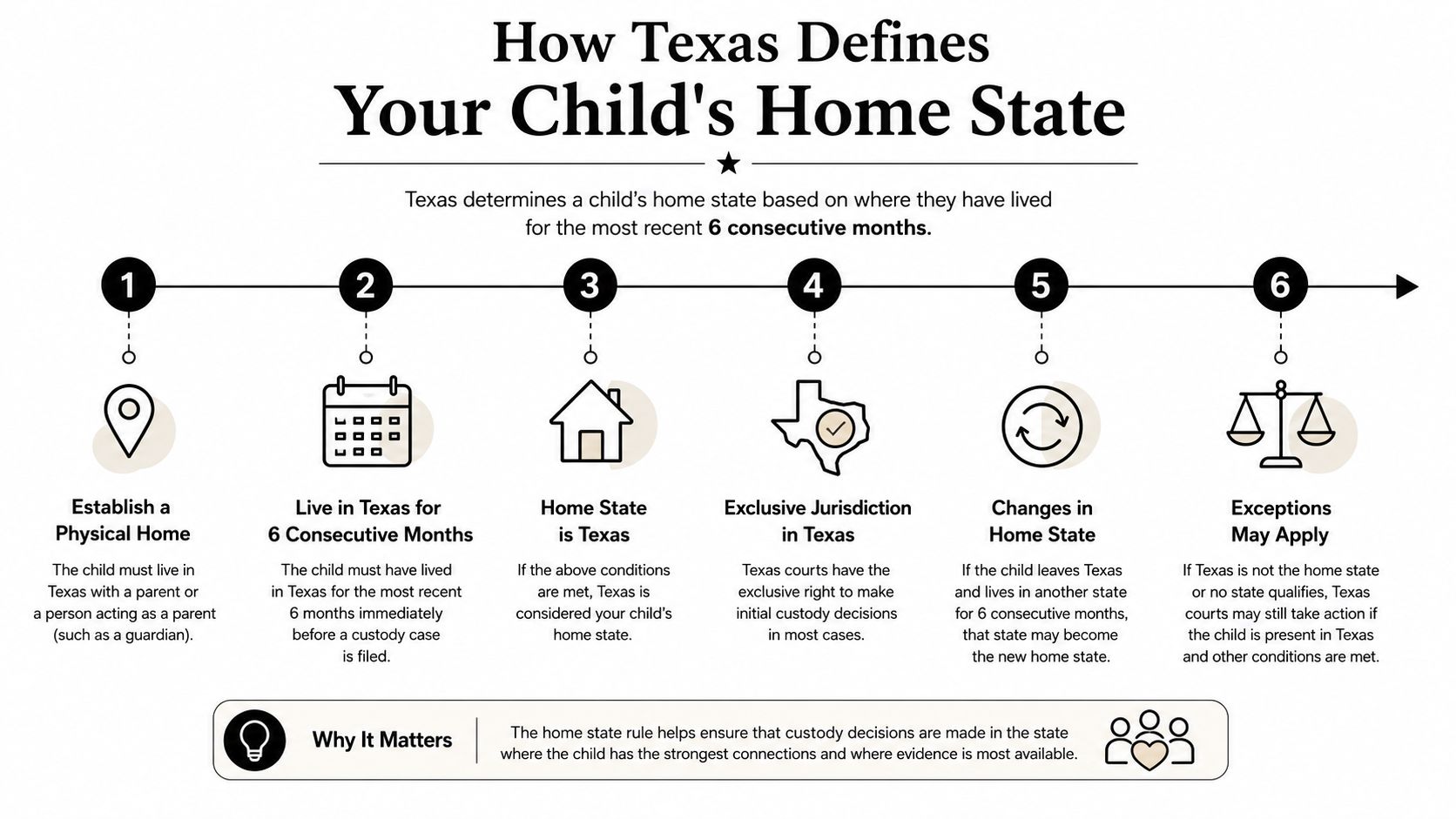
Texas applies the six-month residency test for home-state jurisdiction. Under the Texas Family Code framework used by courts and practitioners, Texas is the child's home state only if the child lived in Texas with a parent or a person acting as a parent for at least six consecutive months immediately before the case was filed, and if the child is under six months old, Texas qualifies only if the child has lived here since birth. That timing rule is the starting point for nearly every interstate custody analysis in Texas. Texas Law Help explains the rule here.
The timeline test in plain language
The court looks at where the child lived before the lawsuit began. If the child had already spent six continuous months in Texas with a parent or a person acting as a parent, Texas can usually serve as the first court to decide custody. If the filing comes earlier, another state may still control the case, even if the family has already started making plans to stay in Texas.
Temporary absences do not automatically break the timeline. Short trips, visits, and similar breaks can still count toward the six months if the child otherwise lived in Texas with a parent or person acting as a parent during that period. A useful flow chart on this point explains that a temporary absence does not break continuity under Texas law. See the Texas UCCJEA flow chart.
A child can leave Texas for a visit and still keep Texas as the home state if the underlying Texas residence never really stopped.
What newborn cases look like
Newborn cases confuse a lot of parents because a baby under six months old has not lived anywhere for six months yet. Texas addresses that by using a different rule for infants, the child must have lived in Texas since birth. In practice, that means the birth location, the first home after discharge, and the family's day-to-day living arrangements can matter a great deal in those early weeks.
The court is not asking where a parent wants to file. It is asking where the child lived in the world. That is why home-state status is so evidence-driven, especially when the parents are in different states.
School records are not the only proof that matters. Parents often need hospital records, pediatric visits, daycare sign-in sheets, lease paperwork, military housing documents, or travel records to show where the child lived and when. If you need to sort out how one Texas court keeps or loses authority after the first case is filed, see the discussion of Texas custody exclusive continuing jurisdiction.
If you are also sorting out where a custody case should be filed within Texas itself, this guide on filing for custody in the correct Texas county can help you think through the next filing step after jurisdiction is established.
Common Scenarios That Complicate Home-State Status
Not every family fits neatly into a calendar. Military orders, overlapping moves, split households, and newborns can all make the six-month test harder to read at first glance. The rule still applies, but the facts can get messy fast.
Military moves and sudden relocations
A service member may receive orders with little warning, and the child may bounce between states while one parent stays behind. In that setting, the court will still ask whether Texas had become the child's home state before the filing date. If the move was recent, Texas may not qualify yet, even if the family fully intended to stay.
That is one reason relocation disputes often need close legal attention. If the move is part of a broader custody conflict, the issues can overlap with Parental Relocation and Move-Away Cases in Texas, because custody can shift when a parent wants to move with the child.
Parents in different states
Some parents share time across state lines, especially after separation. One parent may live in Texas while the other remains in another state, and the child may spend school months in one place and breaks in another. Texas courts will still focus on where the child lived with a parent or person acting as a parent for the six consecutive months before filing.
If the child's time in Texas is interrupted by short trips or visits, that alone does not break home-state status. The law treats a temporary absence as part of the same residence period. That matters for families who travel often or who have children visiting relatives out of state during school breaks.
Newborns and very young children
Newborn situations deserve special care because a baby may have only a few weeks of life outside the hospital. If the child is under six months old, Texas is the home state only if the child has lived here since birth. A parent who files too early may find that the court looks elsewhere, or that the case must wait for another state's jurisdiction to become clear.
Why these facts matter so much
The court does not start with school records or medical visits unless the home-state question is unresolved. Under Texas practice, those details become relevant after the home-state filter, especially if the case shifts to the significant-connection analysis. That is why parents should save proof of residence early, not after the dispute escalates.
Emergency Jurisdiction and When Texas Steps In Without Home-State Status
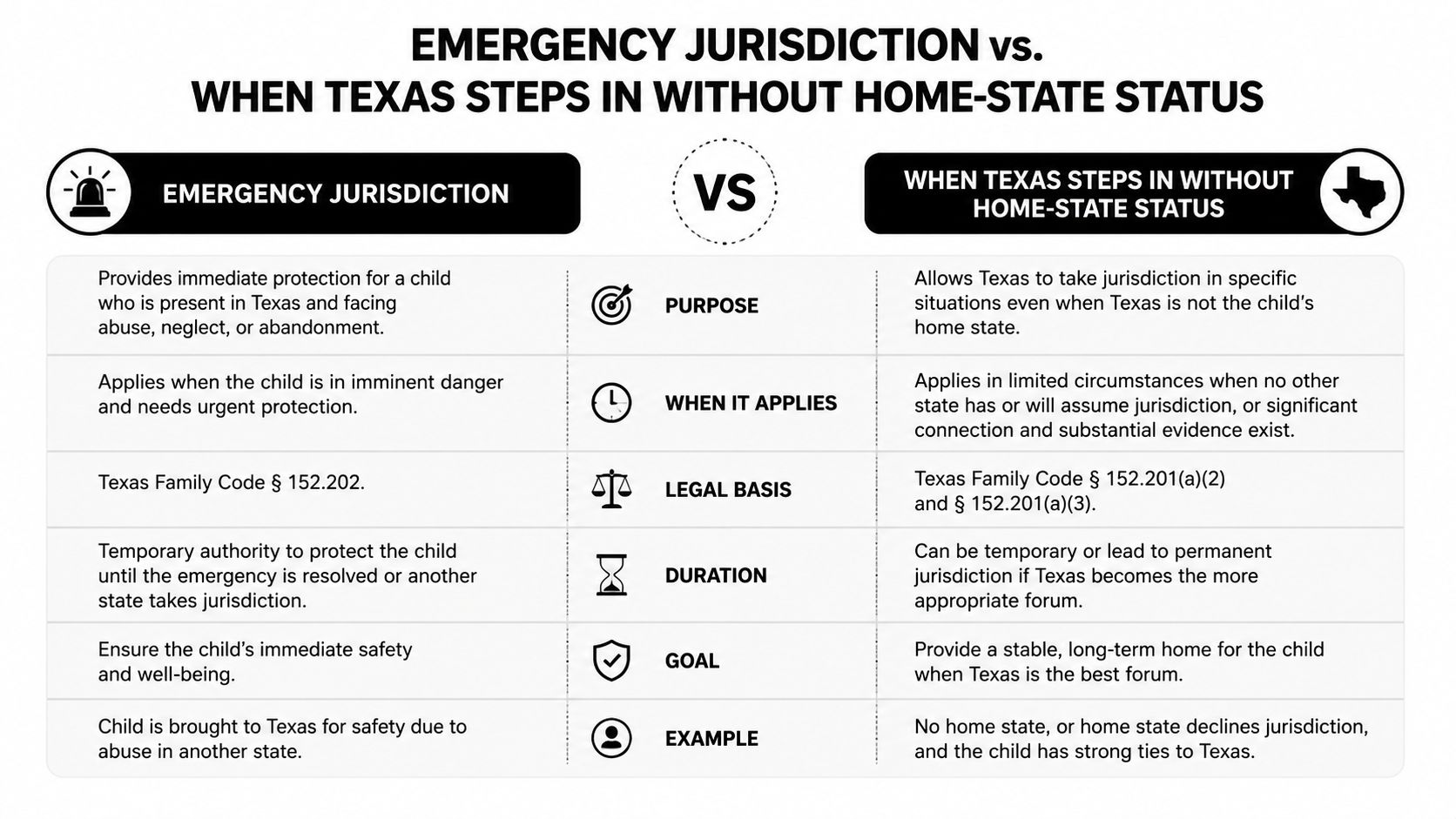
Texas does have emergency tools, but they are narrow. If a child is in immediate danger, a Texas court can act to protect the child even when Texas is not the home state. That emergency power is separate from ordinary custody jurisdiction, and it exists so courts can respond fast when a child faces abandonment, abuse, or another urgent threat.
Home-state jurisdiction versus fallback jurisdiction
Home-state jurisdiction is the first choice. It gives the court power to make the initial custody decision without waiting for another state to step away. Fallback jurisdiction comes later, and only if the home-state path is unavailable.
If Texas is not the home state, Texas can still take an initial custody case in limited situations, including when no other state has home-state jurisdiction or when another state declines jurisdiction and the child and at least one parent have a significant connection to Texas and there is substantial evidence in Texas about the child's care, protection, training, and personal relationships. That narrow rule is described here.
Texas does not use significant connection jurisdiction as its normal starting point. It uses it only after the home-state question fails.
This is why evidence matters differently depending on the path. If the case reaches fallback jurisdiction, records about daycare, doctors, school, and daily caregiving become much more important. If emergency jurisdiction is involved, the focus shifts to immediate safety rather than long-term residence.
A related overview of urgent custody relief is available in this guide to when Texas can exercise emergency custody jurisdiction. That topic is especially important for parents trying to protect a child quickly while still respecting the UCCJEA's limits.
A simple way to think about it
If the issue is, “Which state should decide the case first?”, that is a home-state question. If the issue is, “Does Texas need to act right now to protect a child?”, that is an emergency question. The answers can be different, and a parent may need one without the other.
How to File or Challenge Jurisdiction in Your Custody Case
A custody case can stall before it really begins if the court is in the wrong place. A parent may feel sure Texas should hear the case, yet the judge will look first at where the child lived and when the filing happened. That makes the timeline, and the documents behind it, the starting point.
If you believe Texas is the home state, begin with proof rather than assumptions. Gather records that show the child's day-to-day residence before the case was filed, because the court will care more about the child's actual living pattern than about where the parents expected to litigate.
What to gather before you file
Use documents that show where the child lived in ordinary life. School enrollment papers, pediatric records, daycare invoices, lease agreements, utility records, and messages about the child's routine in Texas can all help show the child's home base. Witness statements from caregivers, relatives, teachers, or neighbors may also matter when they describe where the child slept, ate, and received care.
The timeline matters just as much as the paper trail. If a child moved recently, or if a military family shifted between assignments, the question is not only whether Texas appears on a document, but whether the child lived here long enough for the UCCJEA rule to apply. For newborns, the court may focus on residence since birth, so hospital records, discharge paperwork, and early caregiving records can carry real weight.
If you work with counsel, your file should be organized enough to answer the jurisdiction question quickly. A lawyer may also need to compare the child's dates against the filing date, and then compare those dates with the evidence already in hand. That is the same kind of document discipline a family law office uses when building a record for a legal professional portrait studio, although the court cares far more about the residency proof than about appearance.
Keep every date straight. The filing date controls the jurisdiction analysis, so even a small gap in the timeline can change which court gets the case.
How to challenge the wrong filing
If the other parent filed in Texas too soon, raise the issue quickly. A motion to dismiss for lack of jurisdiction can ask the court to stop the case if Texas does not qualify as the home state. If you wait too long, the case may keep moving while the court assumes no one objects.
The argument usually turns on a simple comparison. Texas is not yet the home state, or another state already holds that status. A strong challenge should point to the child's actual six-month timeline, any temporary absences, and the child's real home before the filing. If the facts involve a recent military move or a newborn, the dates should be laid out even more carefully, because those situations can make the home-state analysis harder to read at a glance.
For a related filing issue, see filing for custody in the correct Texas county for a discussion of where a case should be opened once Texas is the proper forum.
Common errors that create trouble
Parents often file too early because they count the move date instead of the child's residency date. Others do not save records from the first weeks in Texas, which leaves the timeline thin when the court asks for proof. Some parents also miss the chance to object when the wrong state gets the first filing, and that delay can make the response harder later.
The UCCJEA helps because it is widely adopted in 49 states, all except Massachusetts, so the basic jurisdiction rules are nearly uniform across the country. A Texas appellate discussion of that point appears here. That near-national consistency makes the residence timeline even more important, because courts across state lines are often working from the same framework.
Your Next Steps for Protecting Your Parental Rights
Start with the child's timeline, not the parents' plans. Write down where the child lived, when the family moved, and whether any absences were temporary, because a short trip or a brief stay elsewhere may not change home-state status. If the child is under six months old, the since-birth rule controls the analysis, so the dates from birth forward matter more than the parents' later move.
Recent military moves deserve the same careful treatment. A transfer can make the papers look clean on their face, yet the actual residency record may tell a different story once the court compares the child's real home, the filing date, and any short stays that interrupted the timeline. Newborn cases can be even harder to read at a glance, which is why the earliest records should be saved in one place.
If Texas is not clearly the home state, do not assume the case will still stay here. Texas may still have a path to act if no other state qualifies or if an emergency creates a basis for temporary jurisdiction, but those rules are narrower and often depend on proof that is easy to overlook. A parent who files in the wrong court may end up with a dismissal or a transfer, and that usually means more delay and more expense.
The questions parents ask most often are straightforward. Does home-state status change after an order is entered? Usually not in the way people expect, because the court's power to hear the case is separate from later enforcement or modification issues. What if both parents move to new states? Then the court may need to decide whether any state still has authority to modify the order under the continuing-jurisdiction rules.
The safest next step is to gather proof before the filing deadline becomes a problem. Keep lease records, school or medical records, travel documents, and any military orders that help show where the child lived during the relevant time. If you need to challenge jurisdiction, the same records can show why the other side filed too early or in the wrong place.
If you are unsure whether Texas is the right forum, a lawyer can sort through the timeline, identify the weak spots in the other side's claim, and help you decide whether to object. A parent dealing with custody, support, relocation, and home-state questions often needs the facts organized before the court hearing begins, and a digital marketing agency for lawyers may help law firms reach families who are looking for that guidance.
If you need help with a child custody or visitation case in Texas, our experienced attorneys can guide you every step of the way. Contact The Law Office of Bryan Fagan, PLLC today for a free consultation. If you're ready to talk through UCCJEA home-state jurisdiction in Texas and what it means for your family, visit Law Office of Bryan Fagan, PLLC to get started.


