 Skip to content
When your child's future is on the line, understanding your rights matters most.
It's Sunday night. Your child's backpack is by the door, your work calendar is already full, and a text comes in from the other parent about changing the holiday exchange again. You're trying to stay calm, but you're also wondering a very basic question that shouldn't feel this hard to answer. What is the actual visitation schedule for a non custodial parent in Texas?
That confusion is common. Parents often know they have rights, but they don't know how those rights play out on a real calendar. They hear terms like “Standard Possession Order,” “Expanded Standard Possession Order,” and “joint managing conservatorship,” but those words can feel far away from school pickups, summer plans, and missed exchanges.
For many mothers, fathers, grandparents, and caregivers, the stress isn't just legal. It's personal. You're trying to protect routines, avoid conflict, and stay connected to a child who needs stability from both homes. When the rules are unclear, every weekend and holiday can feel like a negotiation.
This guide is built to make that easier. You'll get a plain-English explanation of how Texas handles custody and possession under Chapter 153, how the newer Expanded Standard Possession Order changes parenting time, how summer and holiday periods work, and what to do if the other parent refuses access. You'll also find simple calendar templates you can adapt for everyday planning, because legal rights matter most when you can effectively use them.
Understanding Conservatorship and Possession Rights
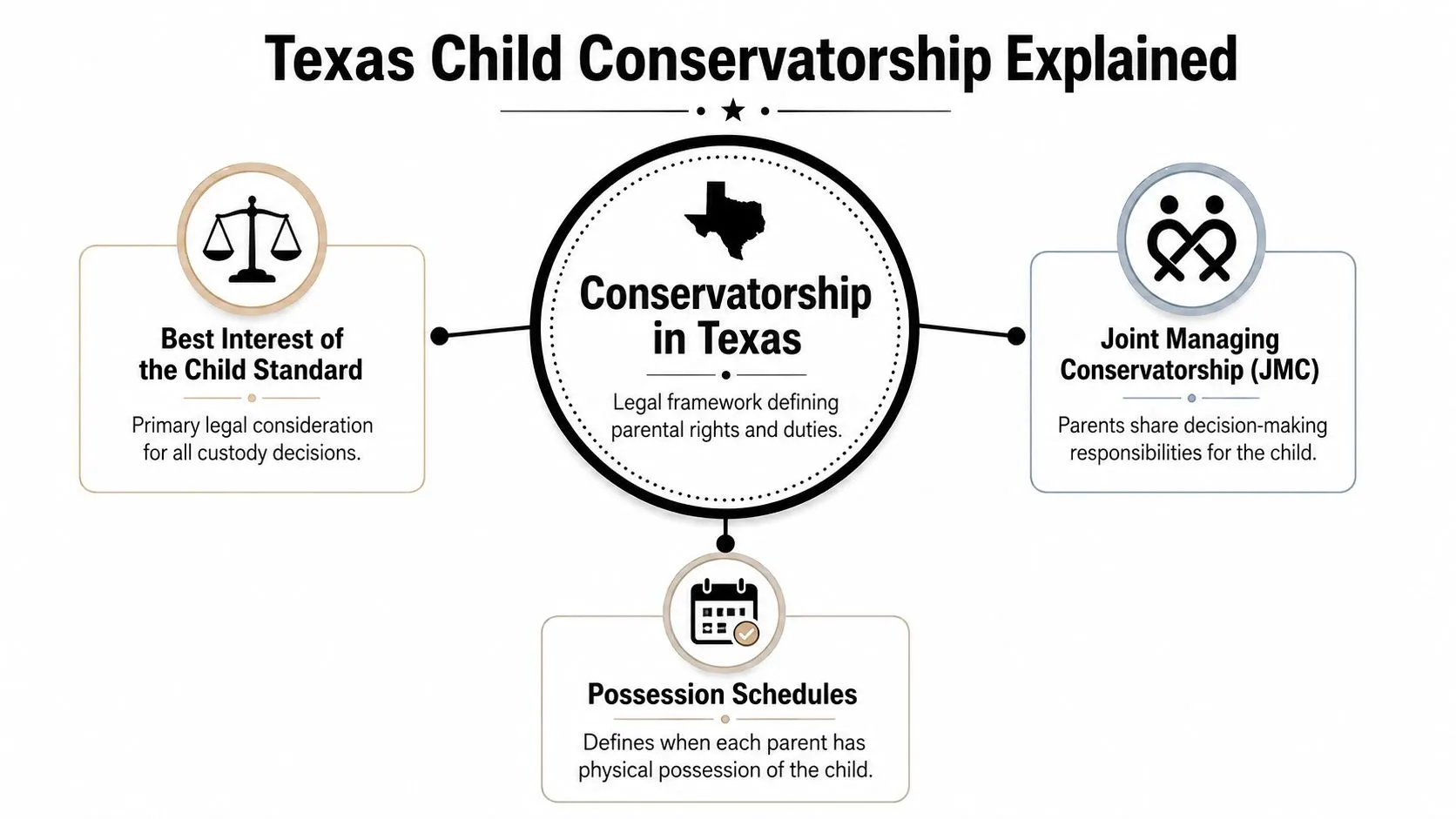
In Texas, people often use the word “custody,” but Texas law usually talks about conservatorship, possession, and access. Those words matter because each one answers a different question.
Conservatorship is about decision-making. Who can make important choices about school, medical care, and other major parts of a child's life?
Possession and access are about time. When does each parent have the child, and when can each parent visit or communicate?
A simple way to think about it is this. Conservatorship is the steering wheel. Possession is the calendar.
What best interest of the child means
Texas courts focus on the best interests of the child. In plain language, that means the judge looks at what arrangement is healthiest, safest, and most stable for the child, not what feels most convenient for either parent.
That standard affects everything from who decides medical issues to how overnights are scheduled. A court may favor frequent contact with both parents when that supports the child's well-being, but the court can also limit time or add safeguards if there are safety concerns.
Practical rule: The court's question isn't “What does each parent want?” It's “What arrangement helps this child most?”
What joint managing conservatorship means
Many parents hear joint managing conservatorship, often shortened to JMC, and assume it means equal time. It doesn't automatically mean that.
JMC usually means both parents share certain rights and duties. One parent may still have the exclusive right to decide the child's primary residence, while the other parent receives a possession schedule. That's why two parents can be joint managing conservators and still have different amounts of parenting time.
Texas families dealing with Chapter 153 issues sometimes look for focused guidance from a Texas Child Custody Lawyer, which covers representation in conservatorship, possession, and access matters under Chapter 153.
How possession schedules fit in
Think of parenting time like dividing a pie. The court first decides who shares responsibility for the child. Then it decides how the slices of time are divided across school weeks, holidays, and summers.
A possession schedule gives that division structure. It tells parents where the child will be on regular weekends, school nights, holidays, and summer breaks. When the order is clear, daily life gets easier. Parents can plan work, transportation, childcare, and family events with fewer surprises.
For both mothers and fathers, this matters. If you're the parent with less time, you need to know how to protect that time. If you're the parent with the primary residence, you need to understand the other parent's rights so you don't accidentally violate the order.
How Standard and Expanded Possession Orders Work
Texas parents often hear two similar phrases that mean very different things in day-to-day life. One is the Standard Possession Order, or SPO. The other is the Expanded Standard Possession Order, or ESPO.
The easiest way to understand the difference is to look at how much time each schedule gives and how exchanges happen during the school week and on weekends.
The traditional Standard Possession Order
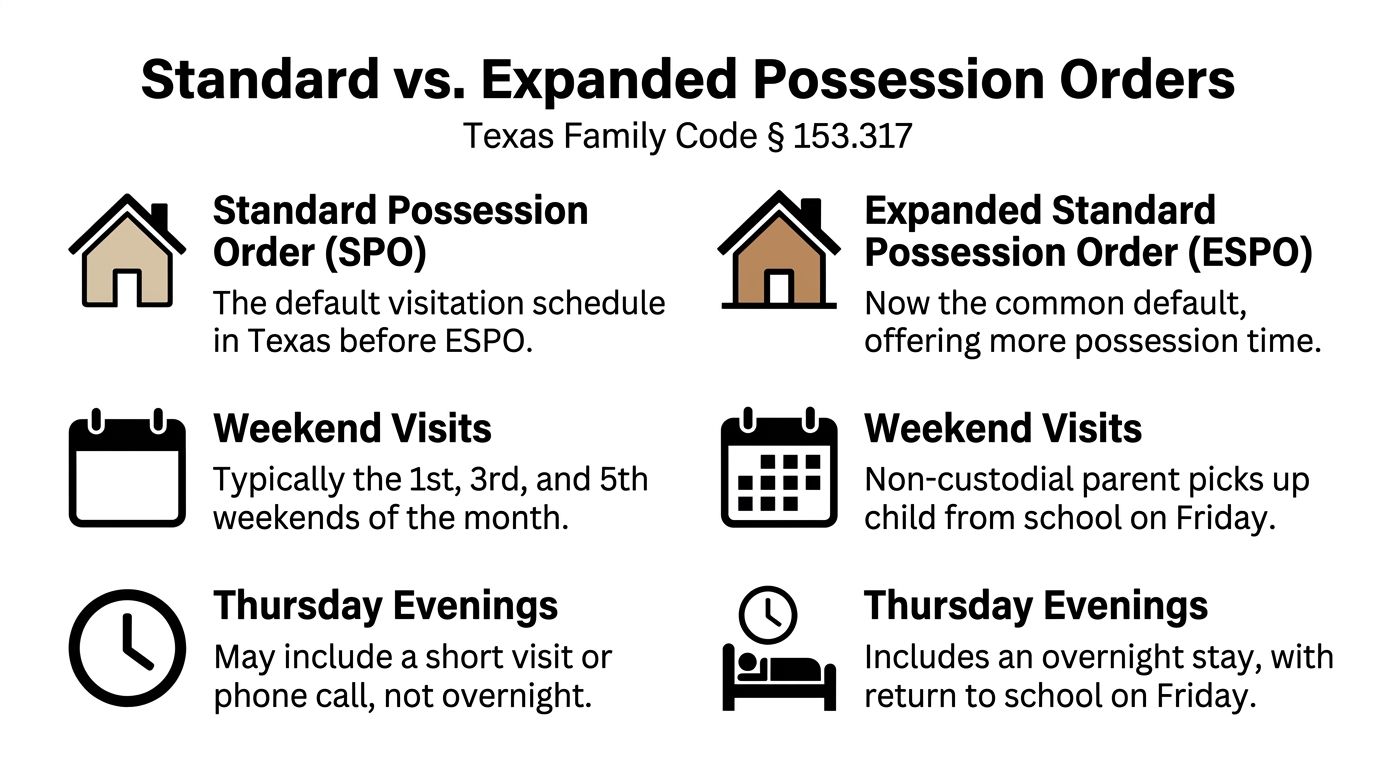
The traditional SPO has long been the basic model many Texas parents recognize. It usually follows a pattern built around the first, third, and fifth weekends of the month, plus a Thursday period during the school year and set holiday and summer rules.
Under that older baseline, the noncustodial parent had a noticeably smaller share of the year. As explained in this overview of the Texas Standard Possession Order, many parents start there when trying to understand what a court order may look like.
A short video can also help make the schedule easier to picture in real life.
The Expanded Standard Possession Order
The bigger change for many families is the ESPO. As of 2026, Texas courts have adopted the Expanded Standard Possession Order as the default custody schedule under Texas Family Code § 153.317, granting noncustodial parents approximately 46-48% of annual parenting time, nearly double the 20-24% provided under the traditional SPO according to this Texas custody guide.
That same source explains that the ESPO creates about 160-175 overnights per year for the noncustodial parent, compared with 80-90 overnights under the traditional SPO. It also notes that the ESPO applies automatically for parents who live within 50 miles of each other unless the court finds a reason to order something different.
What the difference feels like on a real calendar
The legal wording can sound abstract, so here's the practical version.
- Traditional SPO often means shorter school-week contact and less overnight time.
- ESPO often means the noncustodial parent picks the child up from school on Friday and returns the child to school on Monday.
- Thursday periods under ESPO can include an overnight, with return to school on Friday.
That changes more than math. It affects bedtime routines, homework habits, sports practices, and how connected a parent feels during the school year.
A possession order isn't just a legal document. It becomes your child's normal week.
When a different schedule may still make sense
Even with a default schedule, not every family fits neatly into one box. Parents may work overnight shifts, serve in the military, or live far enough apart that exchange routines become harder on the child. Courts can approve different schedules when those changes better serve the child's best interests.
That's one reason it's so important to read your actual order, not just rely on what friends or relatives say “Texas usually does.”
Scheduling Visitation by Age and Holidays
A court order may give you the framework, but families usually feel the most stress around two issues. First, what works for a child at a certain age? Second, how do holiday and summer blocks really work?
Age matters because an infant, an elementary-school child, and a teenager don't move through transitions the same way. Some families use a more gradual plan for very young children, especially if overnights or long drives are difficult. Older children may handle longer blocks more smoothly, but they also tend to have school events, jobs, sports, and social commitments that affect scheduling.
Holiday blocks and school breaks
Texas possession orders often spell out holidays separately from regular weekends. That matters because holiday periods can override the normal monthly pattern.
Common points of confusion include:
- Thanksgiving and winter holidays often follow a separate alternating structure.
- Spring break can be especially important when distance affects the order.
- Regular weekends may not apply the same way once a holiday period begins.
- School calendars control many exchange times, so the district's actual schedule matters.
If your order uses school dismissal and school return as exchange points, keep a copy of the child's school calendar in the same folder as your court order. That small habit can prevent a lot of arguments.
Summer possession by distance
Summer is where Texas gives very specific rules based on how far apart the parents live. For parents living within 100 miles, the noncustodial parent is entitled to 30 consecutive days of summer possession. If over 100 miles apart, the entitlement increases to 42 days, typically from June 15 to July 27 unless modified by April 1 according to Texas Access.
Here's that rule in a simple planning table:
| Summer Visitation Schedule by Distance | ||
|---|---|---|
| Distance Between Parents | Summer Days Entitled | Notice Deadline |
| Within 100 miles | 30 consecutive days | April 1 |
| Over 100 miles | 42 days | April 1 |
A child-centered way to apply the schedule
The legal rule tells you the minimum structure. Your child's needs tell you how to make it work well.
For younger children:
- Keep routines visible: share sleep, meal, and comfort-item details between homes.
- Use simple calendars: a color-coded paper calendar can help a child count down transitions.
- Plan gentle exchanges: avoid rushed pickups when the child is tired or hungry.
For teens:
- Protect core visitation time: don't treat the order as optional because a teen has plans.
- Coordinate activities early: sports, camps, and part-time jobs should be discussed before conflict starts.
- Stay flexible when possible: flexibility works best when both parents put it in writing.
If you're unsure which rule controls a holiday or summer dispute, look at whether that period overrides the regular weekend pattern. In many cases, it does.
Special Situations and Exchange Logistics
Some visitation problems aren't really about the calendar. They're about the handoff. A schedule may look fine on paper, but if exchanges are tense, unsafe, or constantly disputed, the child feels that pressure immediately.

When supervision or neutral exchanges may help
Courts may order supervised visitation when there are safety concerns, serious conflict, or questions about a child's well-being during visits. In other families, supervision isn't required, but neutral exchanges still help reduce confrontation.
Useful options can include:
- Community locations: library parking lots, community centers, or police-substation exchange areas when appropriate.
- Third-party support: a trusted adult approved by both parents for pickup and drop-off.
- Written handoff rules: exact times, places, and who may transport the child.
The goal isn't to make parenting feel formal. The goal is to lower conflict so the child isn't carrying adult stress between homes.
Flexible schedules are becoming more common
Not every family can live by the first, third, and fifth weekend pattern. Shift work, military service, and long commutes can make a rigid order hard to follow. A 2025 analysis shows that over 60% of custody modifications in major Texas cities now involve custom schedules designed for work shifts or school calendars according to this practitioner analysis.
That trend matters for both mothers and fathers. If your current schedule constantly clashes with nursing shifts, oilfield rotations, deployment demands, or a child's specialized school routine, a more custom plan may be worth discussing.
Calendar tools that reduce conflict
One of the easiest ways to prevent disputes is to use a shared calendar that lists exchanges, holidays, school closures, and notice deadlines in one place. If one parent uses Apple devices and the calendar won't sync correctly, a simple guide on troubleshooting iCloud calendar sharing can help keep both households on the same page.
A good exchange plan should answer four practical questions:
- Where will the exchange happen
- What time does it start
- Who handles transportation
- How will schedule changes be confirmed
When those details are clear, the child spends less time waiting, guessing, or hearing arguments in a parking lot.
Enforcing and Modifying Visitation Orders
When the other parent refuses court-ordered access, many noncustodial parents feel trapped. They don't want to escalate conflict, but they also don't want to lose time with their child. Texas law gives you a way to respond, but the process has to be handled carefully.

How enforcement works
If visitation is denied, Texas Family Code § 157.001 allows a parent to file an enforcement action. The SPO includes a notice mechanism: noncustodial parents must notify by April 1 to choose summer dates, defaulting to July 1 to 31, or elect a monthly weekend when over 100 miles apart. Missing these deadlines reverts to the default schedule and can lead to enforcement motions under Section 157.001 according to this Texas visitation schedule explanation.
That means enforcement often turns on details. If you claim a denial, the court will look closely at whether your order was specific and whether you followed it exactly.
A practical resource for parents trying to understand the court process is how to enforce a custody order in Texas step by step.
Steps parents usually need to take
- Keep records: save texts, emails, and notes showing where you were, when you arrived, and what happened.
- Bring the order with you: enforcement is strongest when the denied period is clearly stated in the written order.
- Follow notice rules: summer elections and long-distance weekend elections can fail if notice wasn't timely.
- Ask for legal review: wording problems in the original order can affect whether contempt is available.
Courts enforce written orders. They don't enforce side conversations, assumptions, or “that's what we usually do.”
When modification may be better than enforcement
Sometimes the problem isn't a single denial. It's that the current schedule no longer fits the family. A parent may have relocated, changed work hours, entered military service, or developed a pattern of missed time that hurts the child's routine.
In those situations, a modification may make more sense than repeated enforcement. Courts look at whether circumstances have materially changed and whether the new arrangement serves the child's best interests.
Texas parents also face a confusing issue when there's no separate child support order tied to the parenting arrangement. Some families discover that enforcing possession rights can become procedurally murky in that setting, which is one reason careful legal guidance matters before filing the wrong type of case.
Sample Calendar Templates and Next Steps
A court order tells you your rights. A working calendar turns those rights into something your family can live by. That's where many parents get stuck. They understand the broad rule, but they still need a practical way to map out summer dates, monthly exchanges, and holidays.
One helpful starting point is reviewing visitation schedule examples so you can compare legal language with real-world calendar layouts.
Fillable 30-day summer template
Use this if the parents live within 100 miles and the order gives a 30-day consecutive summer period.
30-Day Summer Possession Planner
- Child's name: ______________________
- Summer year: ______________________
- Selected start date: ______________________
- Selected end date: ______________________
- April 1 notice sent on: ______________________
- Exchange location: ______________________
- Exchange time: ______________________
Weekly notes
- Week 1 school or camp details: ______________________
- Week 2 medical or activity notes: ______________________
- Week 3 travel plans: ______________________
- Week 4 return preparation: ______________________
Important contacts
- Parent phone: ______________________
- Backup contact: ______________________
- Doctor or urgent care: ______________________
Fillable 42-day summer template
Use this if the parents live more than 100 miles apart and the order allows the longer summer block.
42-Day Summer Possession Planner
| Item | Fill in details |
|---|---|
| Child's name | ______________________ |
| Summer year | ______________________ |
| Default period or chosen dates | ______________________ |
| April 1 notice sent on | ______________________ |
| Transportation plan | ______________________ |
| Monthly weekend election if applicable | ______________________ |
| Packing checklist complete on | ______________________ |
This longer block works better when you break it into phases. Many parents split the planning into early summer, mid-summer, and final return week so camp dates, trips, and medical appointments don't create last-minute confusion.
Weekly and holiday planner ideas
A simple shared planner should include:
- Regular exchanges: weekends, school returns, and Thursday periods if your order includes them
- Holiday overrides: Thanksgiving, winter break, spring break, Mother's Day, Father's Day
- Notice deadlines: especially April 1 and any advance written notice for long-distance monthly weekends
- School events: performances, sports, and teacher conferences
If you're looking for a practical option among others, Law Office of Bryan Fagan, PLLC handles child custody, visitation, support, paternity, enforcement, and modification matters for Texas families.
Next steps that keep you organized
Start small and stay consistent.
- Pull out your current order and highlight every possession date rule.
- Add deadlines to one shared calendar.
- Save all communication in one folder.
- Write down missed exchanges with dates and details.
- Get advice before filing if the order is vague or the situation has changed.
The parents who feel most in control usually aren't the ones with perfect co-parenting. They're the ones who keep clear records and use a clear plan.
Key Takeaways and Call to Action
Texas custody law can feel overwhelming, but the core ideas are manageable once you break them down. Conservatorship covers decision-making. Possession and access cover time with the child. Best interests of the child remains the guiding standard under Chapter 153, and that standard shapes every schedule, exchange, and modification request.
If you're trying to understand the right visitation schedule for a non custodial parent in Texas, the biggest points are these. Your order matters more than assumptions. The Expanded Standard Possession Order has changed the baseline for many families. Distance between homes can change summer and weekend rules. Clear notice deadlines matter. And when a schedule stops working, you may have legal options to enforce it or modify it.
This area of law affects both mothers and fathers, and it can also affect grandparents and caregivers who are helping hold a child's routine together. You don't need to know every statute by memory to make good decisions. You do need a clear reading of your order, a practical calendar, and a plan for what to do if the other parent won't cooperate.
The good news is that confusion can be replaced with structure. A marked-up calendar, written notices, organized records, and timely legal advice can make co-parenting more predictable and protect your relationship with your child.
If you need help with a child custody or visitation case in Texas, our experienced attorneys can guide you every step of the way. Contact The Law Office of Bryan Fagan, PLLC today for a free consultation.


